(Continued from my previous posts.)
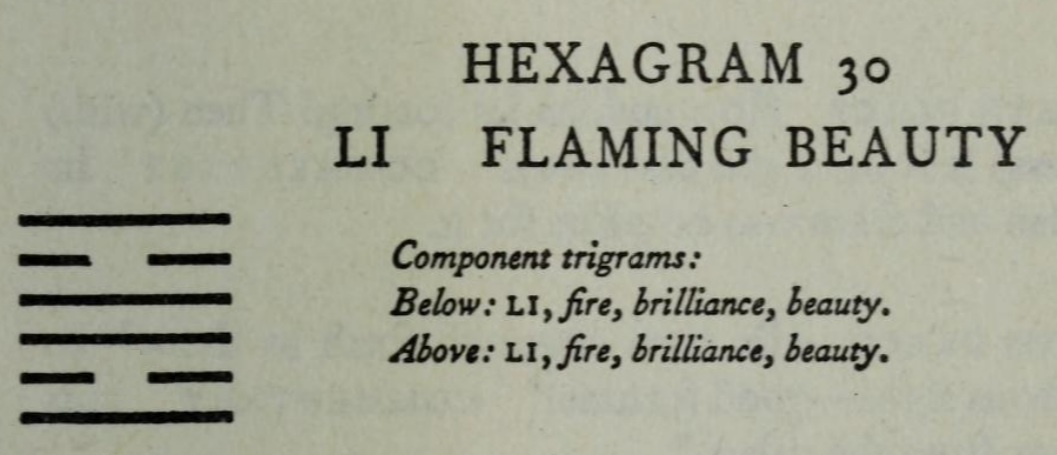
From John Blofeld’s I Ching (The Book of Changes).
This is my last post on PRISM for now; just like with Alkemstone, if something comes up worth posting about I may return.
Some things to get out of the way first: I have a set of screenshots downloadable here and a video here (I’ve also embedded it below). This is for anyone who wants to check the actual letters of the text or check frames of the color cycling as suggested in the comments. I haven’t had luck with either but I also haven’t pushed that hard.
There is sound but most of it is irritating. The one interesting part (in a treasure hunt sense) starts at 3:06 in the video where there is “music” which seems to be generated completely at random. That could of course signal some kind of coded information. (More on this later.)
I also had the question (brought up by Arthur O’Dwyer) what I thought the chances are the game is “broken”. I certainly don’t think it is intentionally so (this is a business software company that had four people make the game, they’d be risk-adverse about making a complete ruse) but it is still possible unfortunate typos slipped in which wreck something. For example, from the packaging that I quoted at the very start:
PRISM is an ISM Storydisk which tells the wonderous tale of the theft of the three ancient Keys of Color, and the adventures of the young boy who must seek them in the monstrous kingdom of Yolsva, Plane of Darkness. All is chaos, and the story contains many levels of hidden meaning through which the Keys may be found and reunited with the prism. When this occurs, and only then, can the mysterious and magical ending of PRISM unfold.
Yolsva is spelled Yolvsa in the game! This worries me both at a general level (if that’s a mistake, what else might be?) but also at the level of this specific name being odd enough it might be part of a clue. (Alkemstone had a typo in a clue where Jo was spelled Joe, so there’s precedent at least.)
I tried focusing my efforts on one page in particular, which feels quite central to the puzzle.
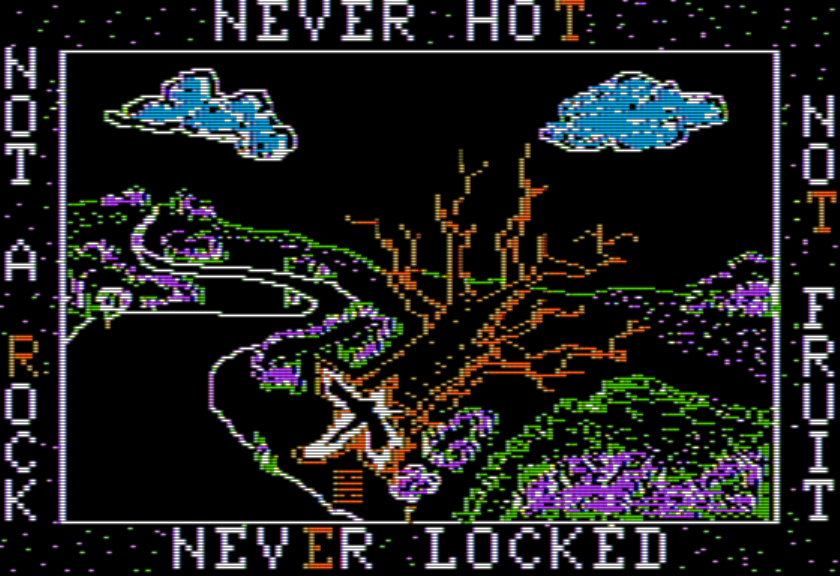
shamhat pointed out in the comments the part of the tree next to the double-fire symbol looks like a phoenix.
I spent a while researching the I Ching, or more specifically, the I Ching as understood by the authors in New York in 1982. There were a lot of “new age” style books from the 1970s so they could have been drawing from them.
From the 1970 book Secrets of the I Ching by Joseph Murphy, “one of the world’s best known authorities on helping people with mystic methods.”
The reason I say the particular slide I highlighted is central is that it has the double-fire symbol, also known (in the 1927 translation by Wilhelm) as The Clinging.
This hexagram is another double sign. The trigram Li means “to cling to something,” and also “brightness.” A dark line clings to two light lines, one above and one below— the image of an empty space between two strong lines, whereby the two strong lines are made bright. The trigram represents the middle daughter. The Creative has incorporated the central line of the Receptive, and thus Li develops. As an image, it is fire. Fire has no definite form but clings to the burning object and thus is bright. As water pours down from heaven, so fire flames up from the earth. While K’an means the soul shut within the body, Li stands for nature in its radiance.
Later Wilhelm writes:
What is dark clings to what is light and so enhances the brightness of the latter. A luminous thing giving out light must have within itself something that perseveres; otherwise it will in time burn itself out. Everything that gives light is dependent on something to which it clings, in order that it may continue to shine.
(There’s more to his text worth looking at; it’s the most likely translation our authors were using.)
A more scholarly breakdown from 1979 by Iulian K. Shchutskii (Researches on the I Ching, Princeton University Press) mentions a translation of “Supreme Success”. Many books vary — which is unfortunate for getting into the heads of our authors, who may have been referring to some lost hippie zine — but both “success” and “perseverance” seem fairly universal.
Another common interpretation I found (not universal, but common enough it’s a safe assumption the authors were thinking of it) is that I Ching symbols refer both to directions and to times of year.
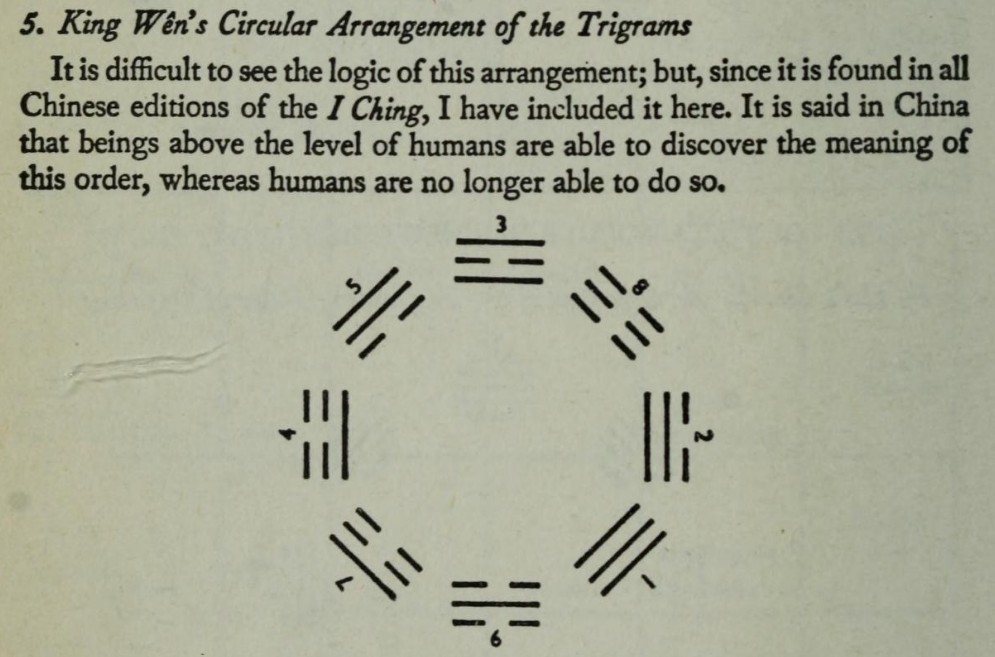
From Blofeld.
Unfortunately, interpretations again vary, but it generally seems to be earth is east and fire is south (earth I’ve seen northeast, also, or even at “center”); the important part also is that north/south/east/west are simultaneously associated with the various equinoxes. That means we can use the shadow method to find a digging spot. While I could see getting lucky with hiding one item by using some very distinct landscape clue (like a particular rock at a cave over a patch of dirt) with three items I find “dig where the shadow’s tip is at the _____ equinox” to be much more likely.
Going back to that fallen tree, my guess for NOT A ROCK / NEVER HOT / NOT FRUIT / NEVER LOCKED is that the answers are drawn from I Ching elements.
Heaven, the Creative
Lake, the Joyous
Fire, the Clinging
Thunder, the Arousing
Wind, the Gentle (Wood)
Water, the Abysmal
Mountain, Keeping Still
Earth, the Receptive
1 THRU 3 OF EIGHT could also be referring to these eight in particular (it may be the I Ching elements are associated in the game with a color as well).
I tried fitting the mysterious letters CGKFKEA as well. I had less luck (even looking at Chinese transliteration). It could refer to the composer Cage, who was very much into the I Ching, and the “random music” I referenced earlier could actually be a clue to him. His Book of Changes (1951) was formed via aleatory methods directly from the Chinese text.
Special thanks to everyone who contributed theories; and of course you are welcome to continue! I did manage to do multiple updates on Alkemstone after I “finished” so it quite easily can happen here as well. Additional thanks to Jeremy Salkeld for advice on I Ching translations.


 Renga in Blue
Is there any potential resolution to this short of finding the respective treasures? Are the author/adjudicators/whomever still alive and contactable?
I have one author contact but they did not respond to my query. (I just was going to ask about the history though, not spoilers.)
Mark Capella showed up in a CASA thread circa 2024 where some guy was going on about how he has the only known copy of The World of Odyssey for Apple II but didn’t seem willing to do what was necessary to help preserve it. Capella still seemed quite active online up through that time, but the email he was using bounces back as invalid now.
Mark Capella has a GitHub account and it looks like he has a new email address. Try the address found at github.com / markcapella / plasmasnow#acknowledgements.
this vague observation is likely rather unuseful, but anyone into both I Ching and programming at this time must have been aware that hexagrams act as an encoding of binary numbers, a place where one might theoretically hide eg. location coordinates
I didn’t find anything looking through a couple images vertically, as suggested in one of the comments last time. However, I note that this possible idea adds in some considerable complications. Because looking at the screenshots, there’s some unusual formatting going on with the spacing in some places. This means that if this doesn’t come into play at some point, this is some next level red herring.
Because to start with, we get the idea that anything pointing down could be a word. I didn’t see anything, and there’s a considerable amount of nonsense strings of letters that even anagraming it seems unlikely. However, despite this, there’s still something else which could be going on…cryptograms. Basically, everything on-screen, when shifted to a different letter, reveals a different message. Could be, two pages I looked at clearly had more than two single letter words, when there are only two in English. If this is how it works, then this is not going to be easy. If there’s a typo, it’s going to throw everything for a loop. (Which has happened, look up Sherlock Holmes – Consulting Detective, Case of the Cryptic Corpse for a much lower stake example)
Did anybody try the Atari version? Maybe there are some differences?
huh, searching “prism” at Atarimania didn’t reveal anything, I had to find it through google (maybe because it’s “misc” rather than a game?)
almost ALL the text is removed! it’s mainly just the pictures!
ok, actually just an emulator issue
but there are still differences, especially in how things are colored
complete download set of images here
https://www.dropbox.com/scl/fi/qzy9vc2d2rv8dpk8d5ltx/PRISM_atari_screens.zip?rlkey=fsu2fiiwl5ne2kvtuw772qotg&st=rut4kjsk&dl=0