Writing an adventure game is very similar to writing a novel. Everybody can write a few unrelated sentences, but the novelist’s skill comes from stringing sentences together in such a way as to create a tale combining imagination, flair and ingenuity.
— From Steve Lucas, 1985, Adventure Programming on the Amstrad
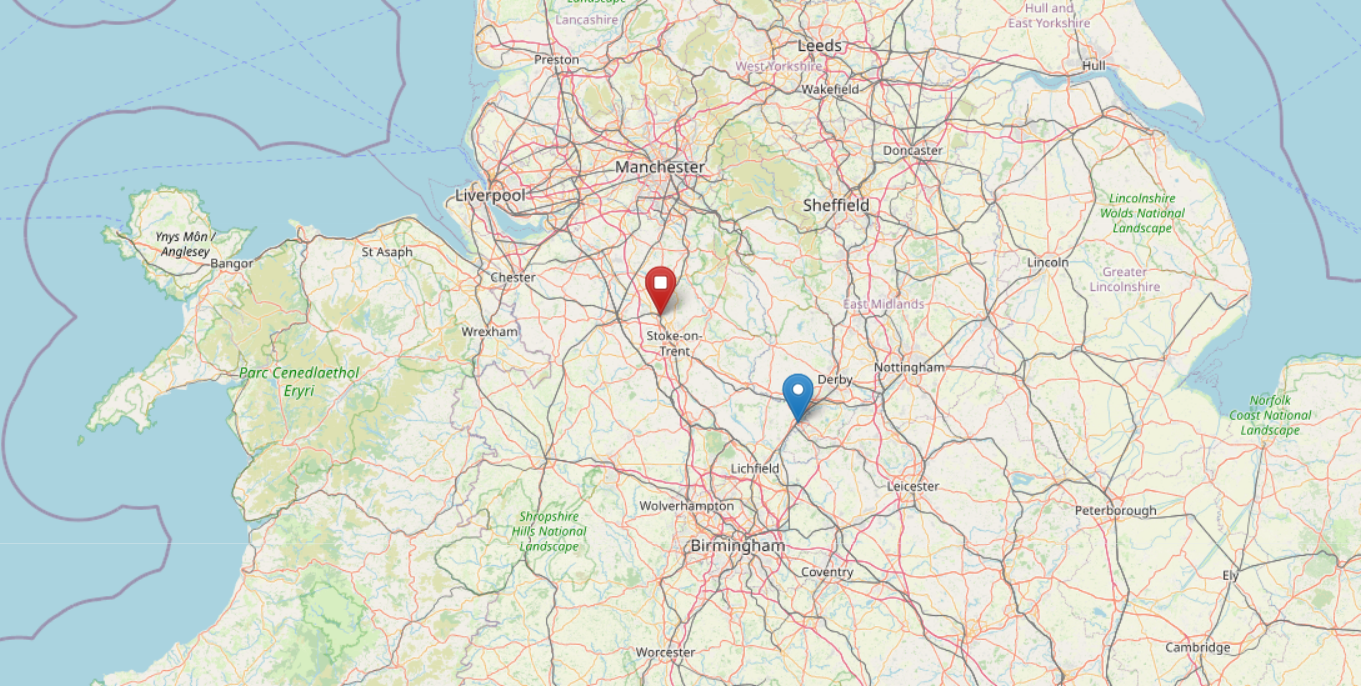
Two relevant places for today marked: Kidsgrove in red, Burton-Upon-Trent in blue to the southeast.
The British company ICL (International Computers, Limited) has come up here before; their game called Quest by Urquhart, Sheppard and McCarthy came from their computers as an after-hours project. They were curiously formed as sort of a forced integration of multiple companies from the 1960s. ICT (International Computers and Tabulators) was already a merger of elements from BTM (British Tabulating Machines), Powers-Sampas, and the computer divisions of GEC, EMI, and Ferranti; English Electric had merged in Leo, Marconi, and Eliot (changing names each time).
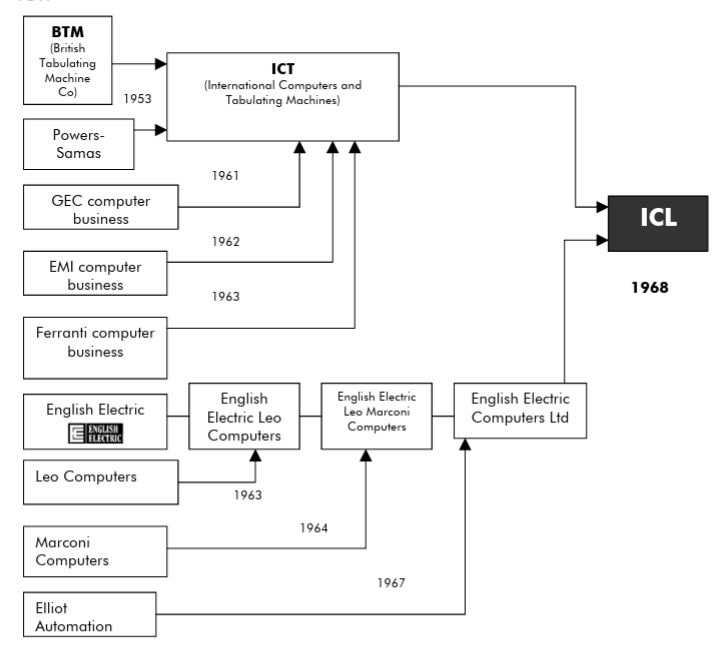
In certain contexts a government might be concerned about monopoly power, but the Wilson government of the late 60s decided the opposite; there was concern that the British computer market was simply going to collapse under outside pressure (especially from IBM). So, the government invoked the Industrial Expansion Act which pushed together the two companies into one in 1968, keeping the name ICL.
The resulting mammoth had a disparate variety of incompatible products; ICL decided to “start fresh” (with government money assistance, 40 million pounds) and develop the 2900 series. (Their own 1900 series was ailing and outdated, using only 6 bit characters.) At Kidsgrove in particular (site originally built by English Electric in the 60s) they made printed circuit boards but also were one of the sites developing software for the new device, in particular the (now well-regarded, unstable at the start) VME/B operating system.
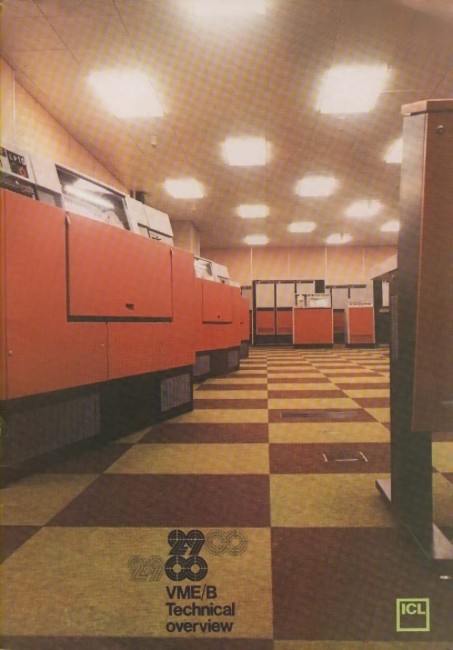
From a 1976 booklet, via the Centre for Computing History.
Early releases of VME/B were characterised by one word – late. At one stage VME/B was being produced in Kidsgrove, but top management and validation remained in Bracknell. As days turned into weeks, management became increasingly impatient. “We haven’t finished it yet” was the reason for a conspicuous delay in handover to system test. “Then just put what you have finished on a tape and send it down here so that we can make a start on validation”.
A couple of days later a tape arrived. It was put up on a tape deck and the machine was booted up. Nothing happened. Consternation ensued. Much diagnostic effort was expended in trying to get the new version of VME to load. Eventually it transpired that the tape contained only an end of file mark.
“That tape you sent us – its completely empty.”
“But that’s what you asked for.” came the reply. Somehow a week’s delay was bought.
— Andrew Mason from Another ICL Anthology
One of the people hired around this time was Andrew Espeland. I’m unfortunately just guessing he was at Kidsgrove but I have decent evidence, as he worked at ICL starting around 1973, had an address at Burton-on-Trent in 1983 and went to Burton Grammar School in the 60s, meaning there’s a fair chance he stayed locally in between. The nearest ICL location from Burton-on-Trent was at Kidsgrove. In the later part of his time there it is possible he did some telework, as we know Kidsgrove specifically was set up for that. You can see a demo below of a worker with Airbus connecting to an ICL terminal, circa 1982:
While ICL expanded all through the 70s (helped along by the government policy of buying homegrown computers) they were starting to be in trouble in the 1980s. They were intending to expand to a factory in Winsford (about an hour northwest of Kidsgrove) and the local government “bent over backwards” to aid in this, with 1,500 new houses built and “sterilising a major factory site” but ICL started to backtrack; from the floor of Parliament:
The matter is urgent because the loss of 1,500 jobs is in an area where unemployment is already at 11 per cent. The only other large employer, Metal Box, is due to close at Christmas with the loss of 500 jobs, many of them directly affecting my constituents, [it] would push unemployment up to 15 per cent by the spring.
This is a death blow to Winsford. I have just learnt that the men’s bitterness is such that they have today occupied the factory, and I submit that the House has a special responsibility to air their grievances as urgently as possible.
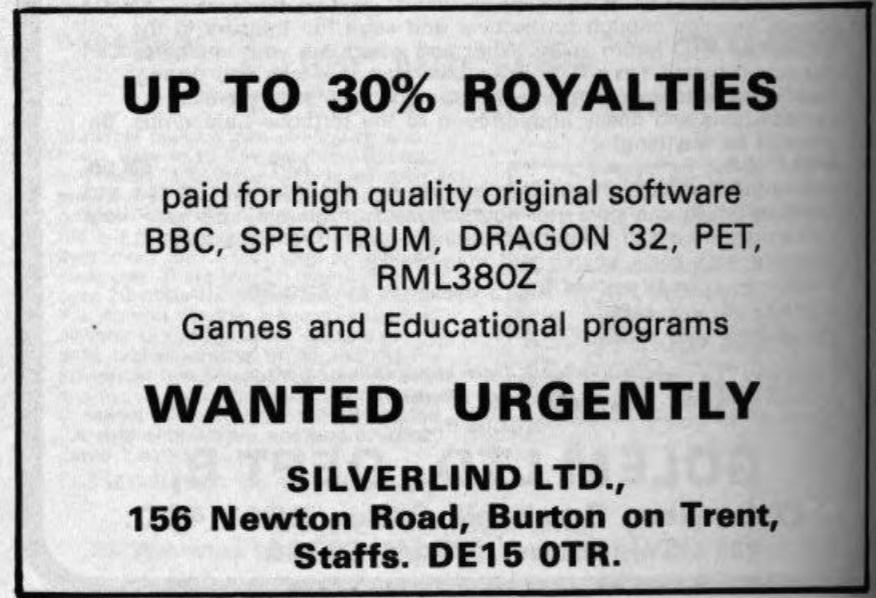
While the situation at Kidsgrove wasn’t quite as bad, they still went from 33,000 to 20,000 employees from 1981 to 1984. So it is possible Andrew Espeland was one of the redundancies; whatever happened, he decided to strike it out on his own as a software publisher in mid-1983 and founded Silverlind. He posted solicitations for authors during this time.
Esperland gave an interview to his local newspaper (Burton Mail) on November 23, 1983, featuring the Silverlind Master Diet Planner (written by Professor C. V. Brown and Dr. E. J. Levin of the University of Stirling)…
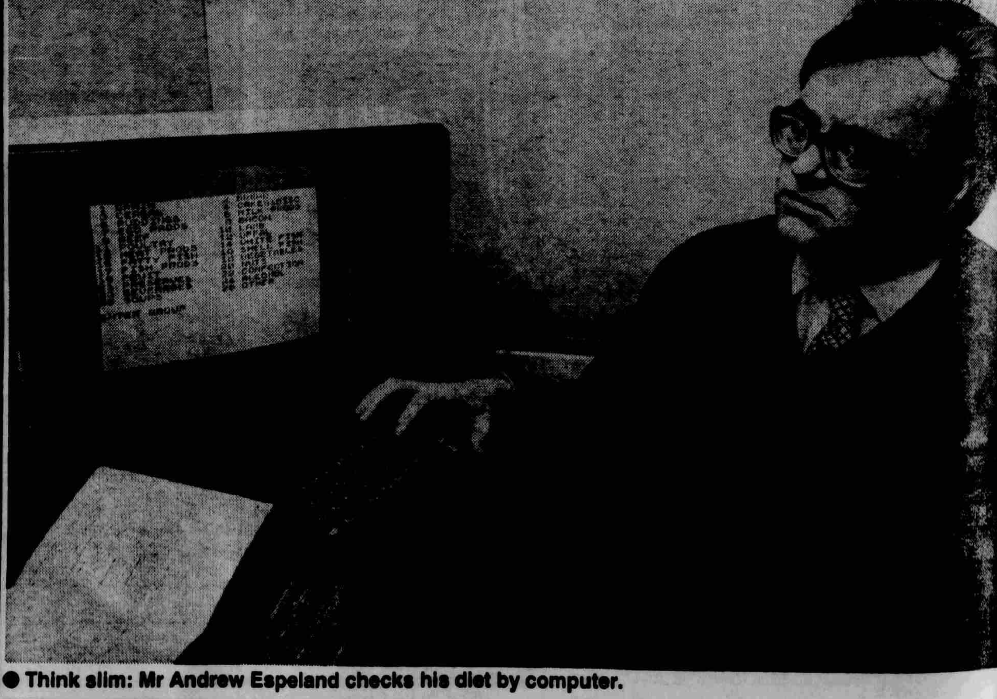
…although it was the sort of interview where he was starting from scratch with teaching how computers work, including explaining to the reporter “that software and hardware were not related to pornography.”
Silverlind is like a book publishing company, only we sell tapes instead of books. We offer the amateur a chance to turn professional. Everyone who has a computer thinks he’s great at coming up with programs, but not many people have the resources to market them if they’re good. That’s where we come in.
Please note that he went straight from ICL to personal computer tape distribution; this is different from the situation at Sumlock I wrote about recently where there was a branch computer store in the late 1970s that led to software publishing. Put another way, Sumlock’s ads and packaging come across as being sold by someone with product and consumer experience, while Silverland’s come across as being made by someone who came straight from writing operating systems to running a company. Silverlind did not last long, with ads starting by the end of the year and petering out by early 1985 with no increase in catalog size. The late 1983 ads include three adventure games.
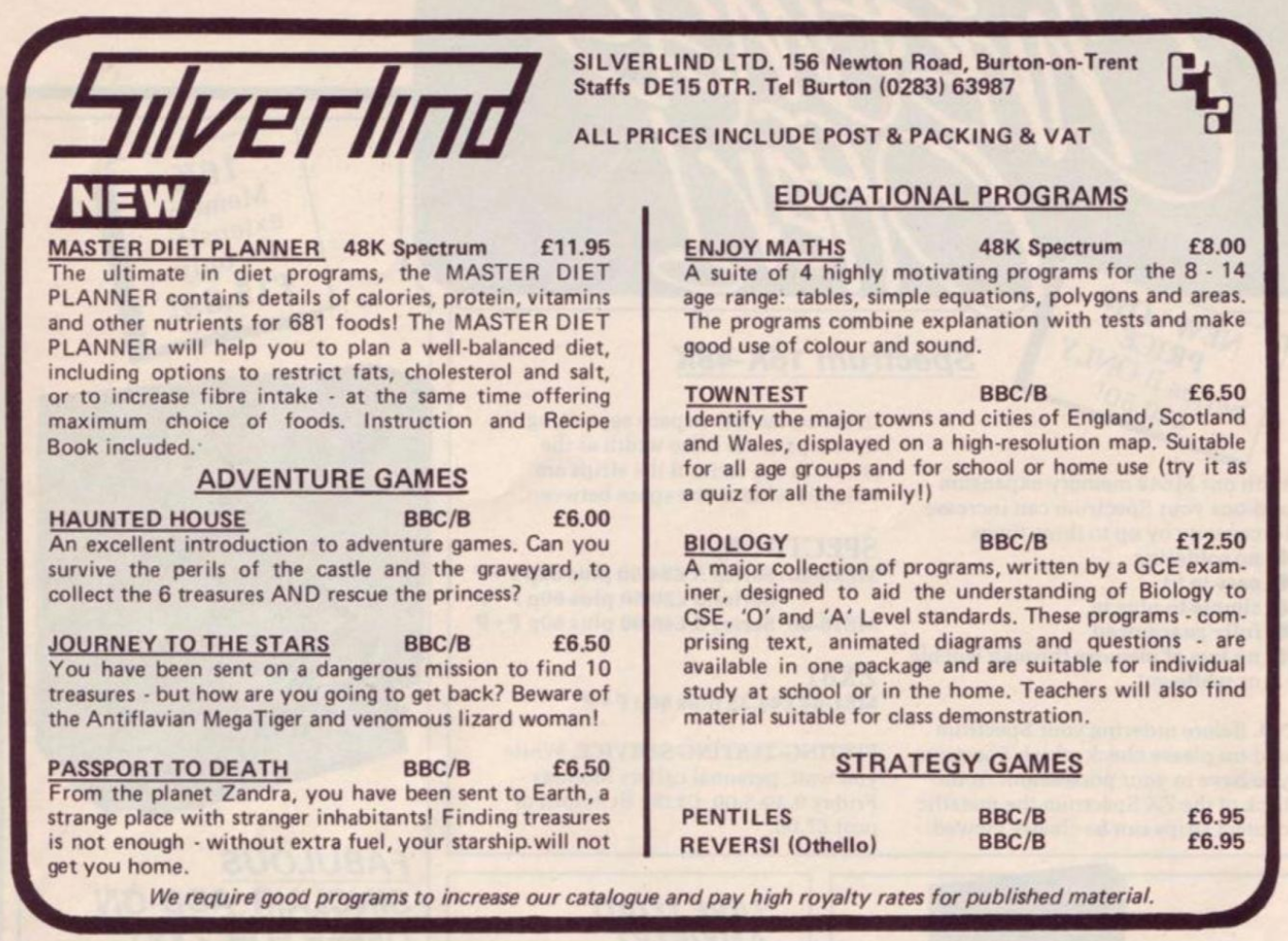
All three are (probably) all by the same author, one we’ve encountered before: Steve W. Lucas. He is, as I explained earlier, sort of the British version of Peter Kirsch, writing a staggering number of type-ins starting in 1983, although many are repurposed ones he had already written.
The reason for the “(probably)” is we only have copies of two of the Silverlind adventures: Haunted House and Passport to Death. Gateway to the Stars (AKA Journey to the Stars) is lost, but assuming it is by Lucas we might see it again under a different name anyway. (I’m suspicious of “A Journey Through Space” which is in his Adventure Programming on the Amstrad book; there’s no tiger or lizard woman but Lucas often renamed things. The book game is allegedly “buggy and impossible to finish” which is another thing common amongst Lucas games.)
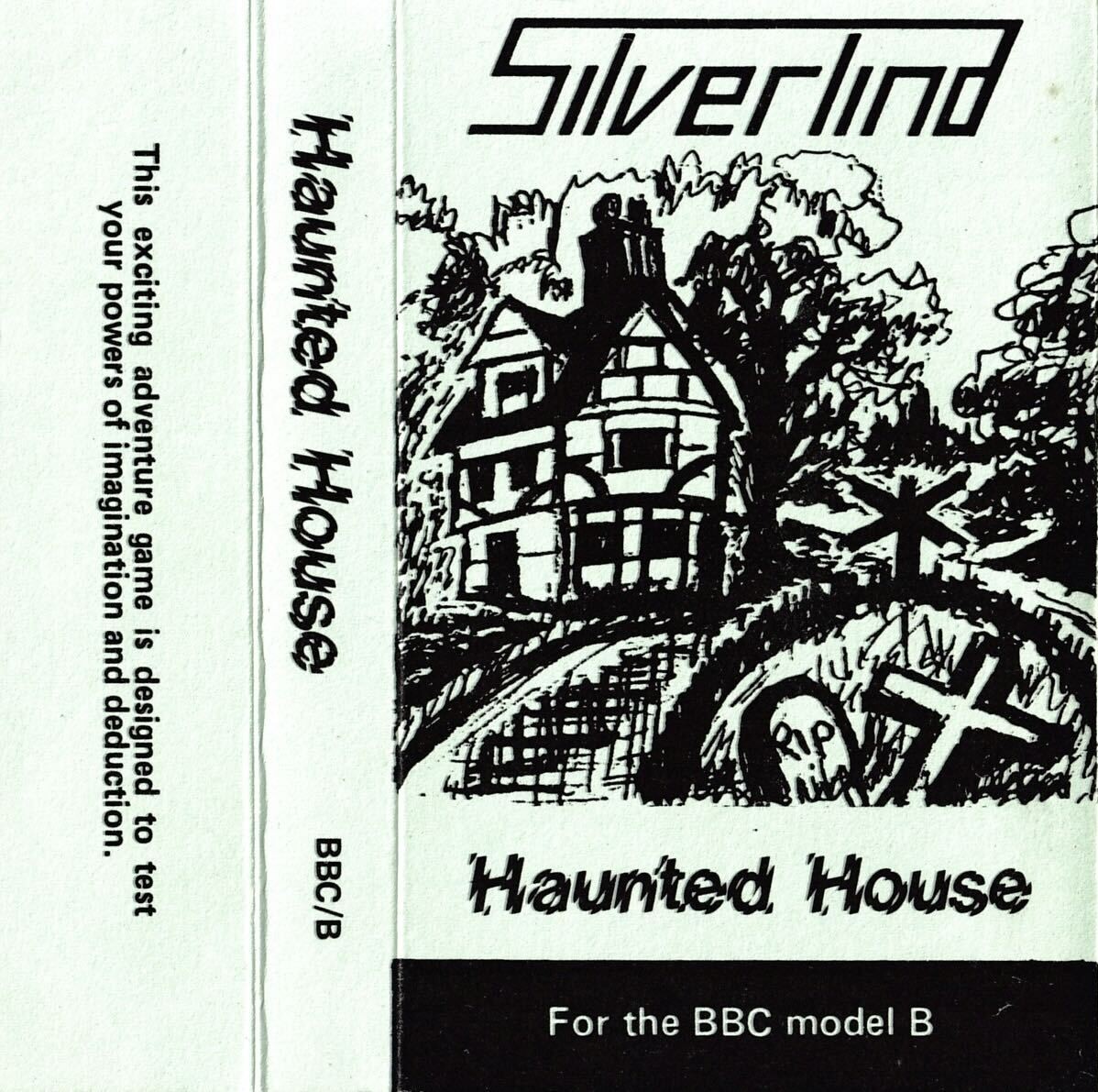
Via Everygamegoing.
While the previous Lucas game we played had versions for Amstrad and Oric, this one is for BBC Micro! Just like the other Lucas games this does have a clone-situation but I’m going to focus on the original for now and visit the duplicate situation at the end.
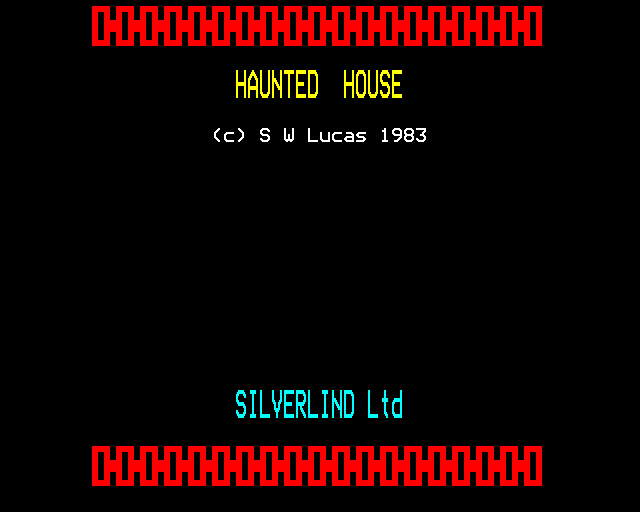
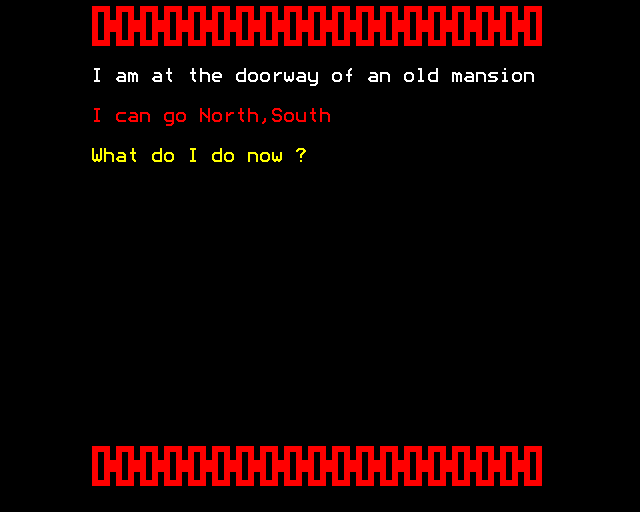
I have the full instructions from the inside of the tape, but they don’t give any context other than “you are standing in the doorway of an old mansion” and “you must recover the six treasures”.
You have a lamp which won’t work, a note and a gun when you start. As you visit the other locations you will find a variety of objects which may be of use – or are they red herrings?
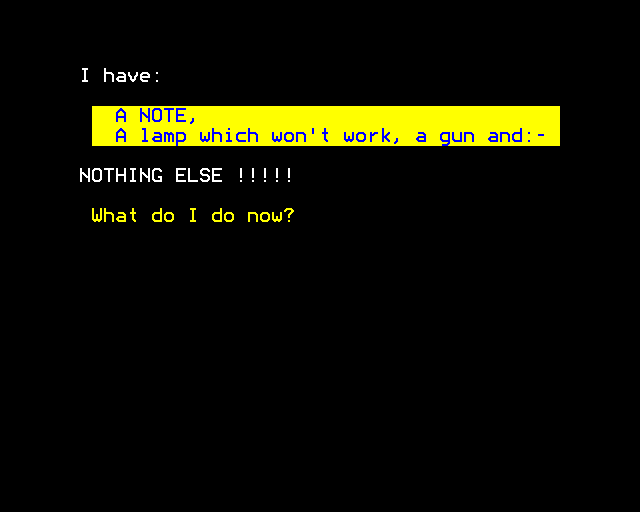
Regarding the note:
The note is from my great grandfather ARNOLD J HARBUTHNOT. It reads:
As my sole living heir, I have sent you on this dangerous mission to find 6 treasures and rescue the princess. you must deposit these items on the doorstep.
Apparently there’s a princess too? In a haunted house? Wouldn’t be the first time that’s happened. (I will find the princess this session, but not rescue her yet.)
The overall structure of the complex has a house to the north, a path in the middle, and a castle to the south. Despite the Haunted House name the castle is more extensive than the house, but let’s start with the house first.
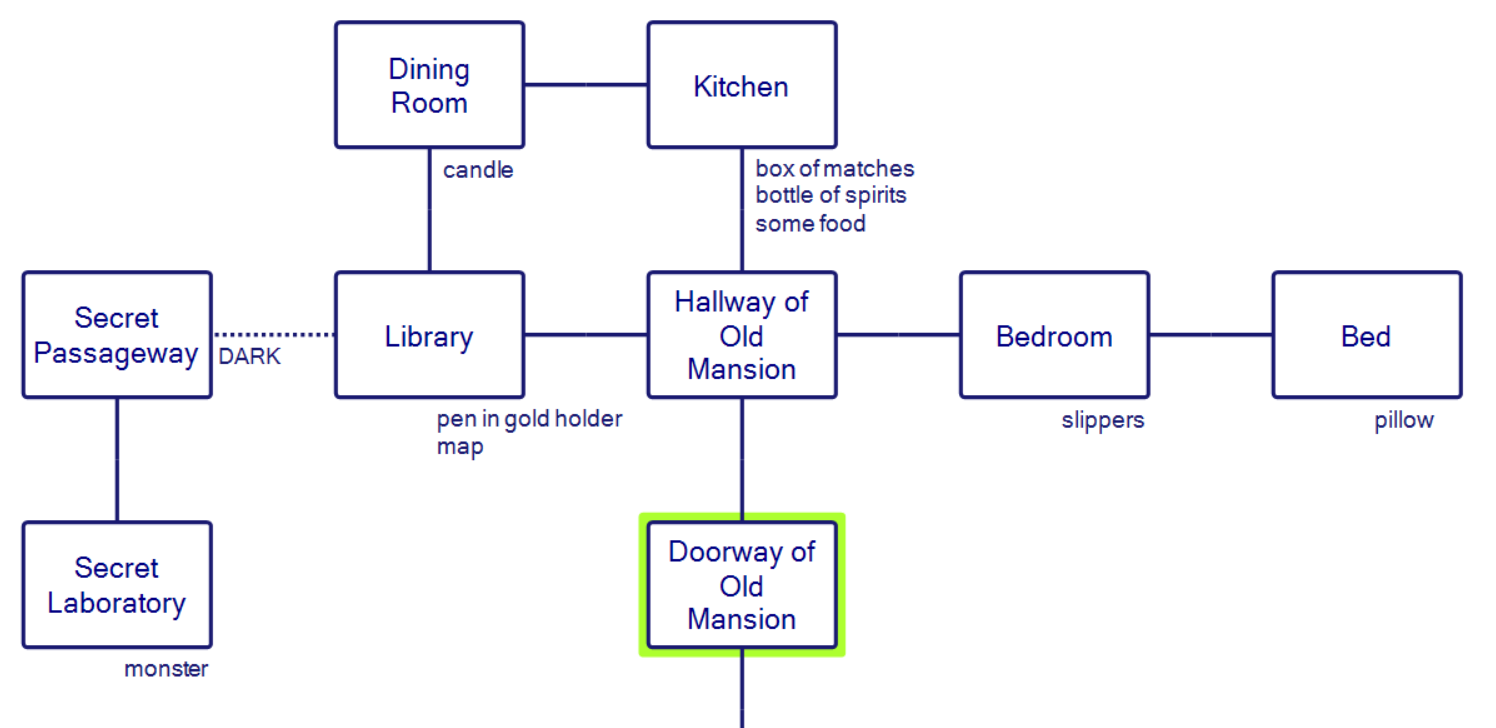
There’s no descriptions of rooms beyond their names, so you need to use your imagination.
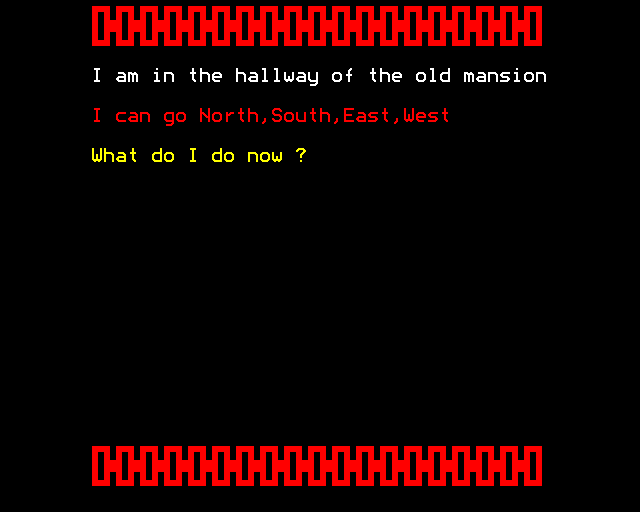
Doing a grand tour, east of the hallway is a bedroom with a pair of slippers, and “an old four poster bed” with a pillow. North leads to a kitchen with a box of matches, a bottle of spirits, and some food, and going west after leads to a “large dining room full of cobwebs” that contains a candle.
West of the hallways is a library with a map and a “pen in a golden holder”. The map curiously says “not at the moment” when you try to read it; this is a game where items often only can be used in very specific cases, even if there is no logical reason to restrict them (like books). Trying to GET PEN reveals a secret passage…
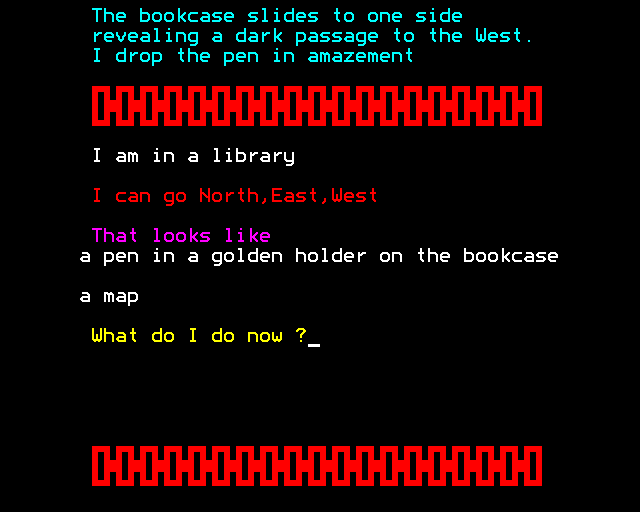
…and going in is death.
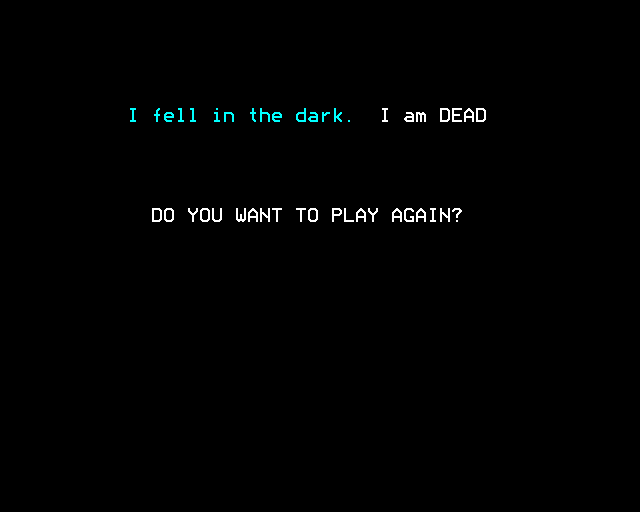
Well, to be fair, the game did start by announcing we had a dead lamp. With the matches and the candle you can LIGHT CANDLE (…normally, one time it caused my game to crash…) and go into the secret passage safely. Not far in, you get stopped by a monster.
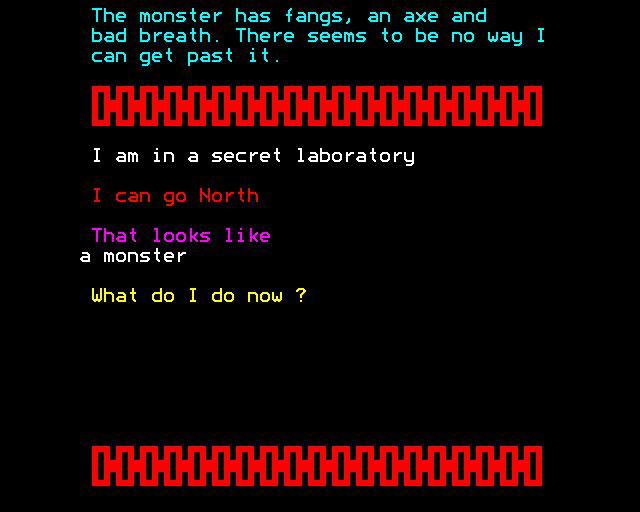
There’s a “sharp knife” you can find later but if you try to KILL MONSTER the game says “you’re a coward”, which is rude but fair for a standard adventurer who will likely rely on trickery or some gizmo instead to get by. Let’s turn to the middle path area…
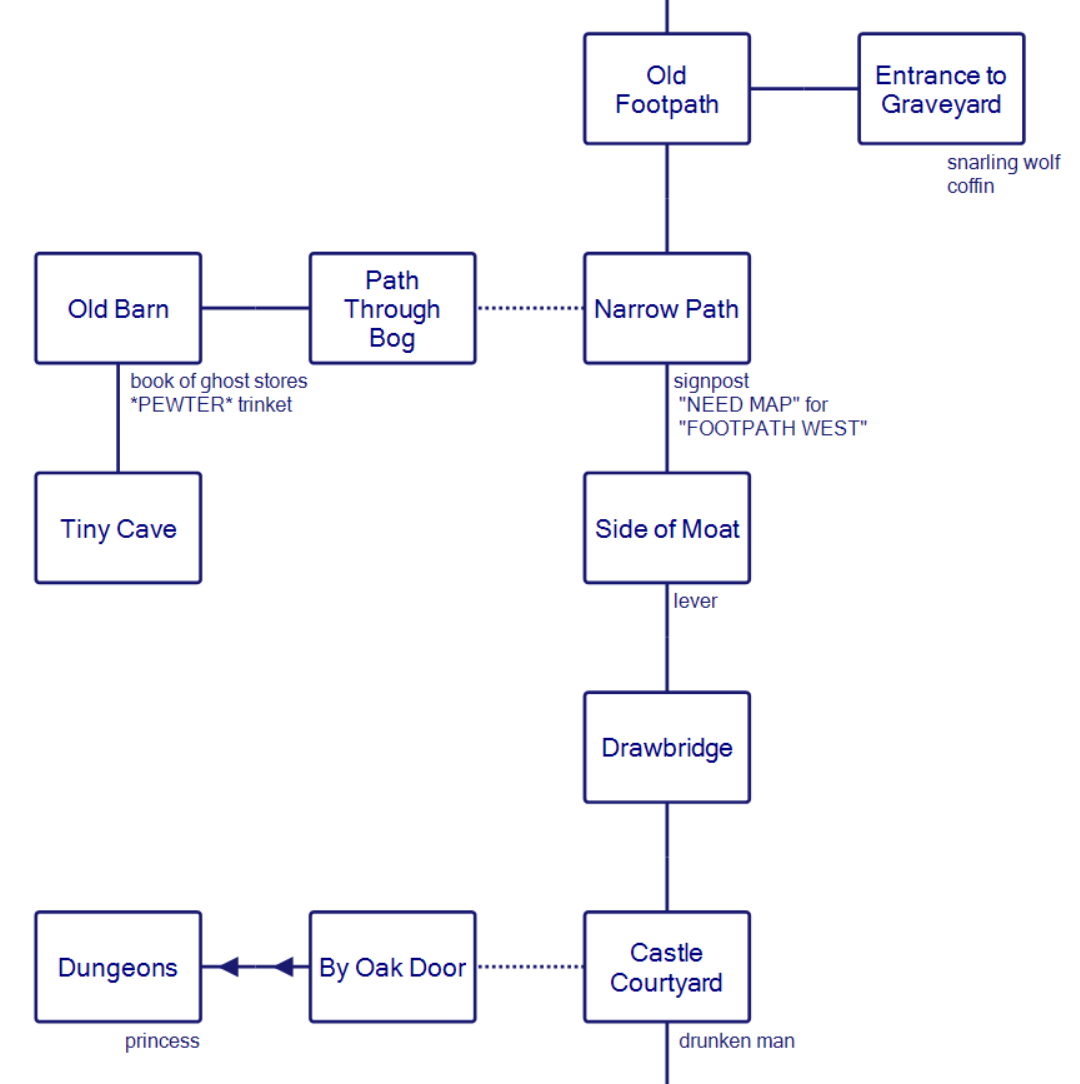
…where off an “old footpath” to start there is a “snarling wolf” at a “coffin”.
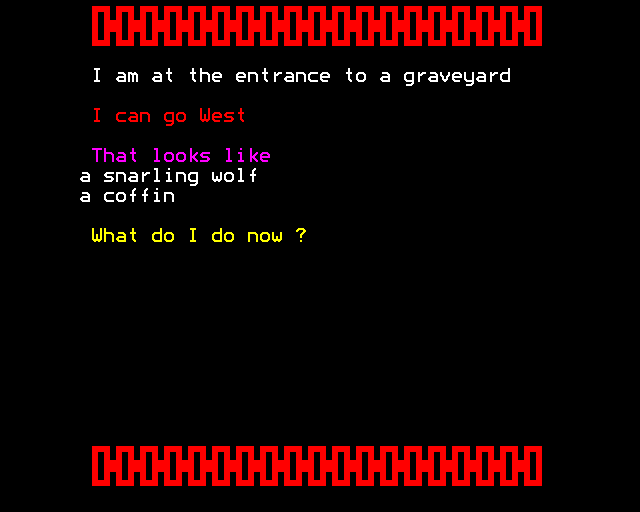
Trying to OPEN COFFIN gets a blank response from the game (another thing that’s pretty common; 98% sure this game was written before Journey of a Space Traveller because it has more jank). I can get a reaction from the wolf by trying to GET WOLF…
That makes it mad. It attacks me. I am DEAD
…but that isn’t helpful so let’s move on! Further south is another split in the path where a signpost informs us that “FOOTPATH WEST IS DANGEROUS. YOU NEED A MAP” and this is the one and only spot the map can be READ successfully.
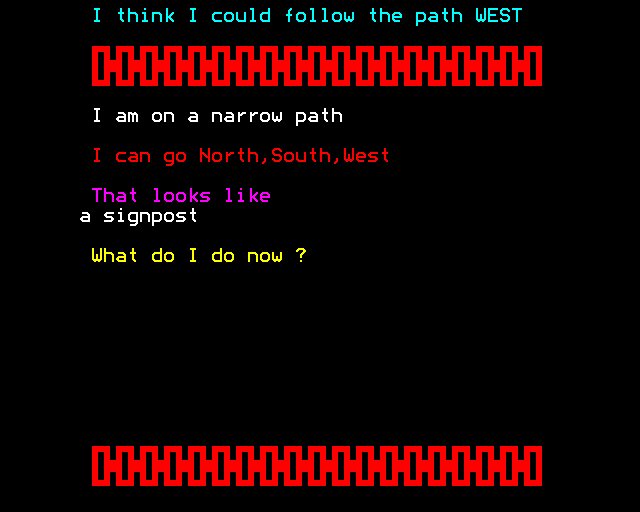
(I originally died while holding the map thinking it would be used passively. Not only can the map only be read in the right room, but you have to do the READ command before moving otherwise you’ll die.)
This leads to an Old Barn with a *PEWTER* trinket and a book of ghost stories, and just past is a tiny cave which appears to be empty. I tried to do SWEEP even though I had no appropriate item and the game told me I couldn’t swim. This is a two-letter parser. (On the BBC Micro, why!)
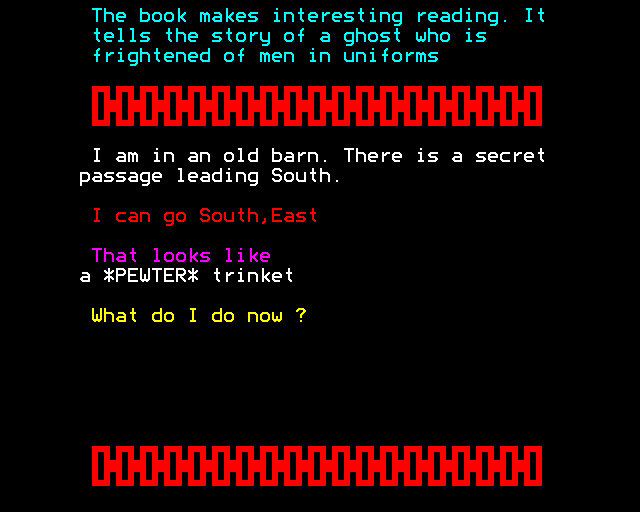
Reading the book only works in this room.
Moving on you can find a drawbridge (no puzzle, just PULL LEVER) followed by a “drunken man” in a Castle Courtyard that is blocking your way west (you can pass south unfettered). If you take the spirits from the kitchen and drop them he will helpfully pass out.
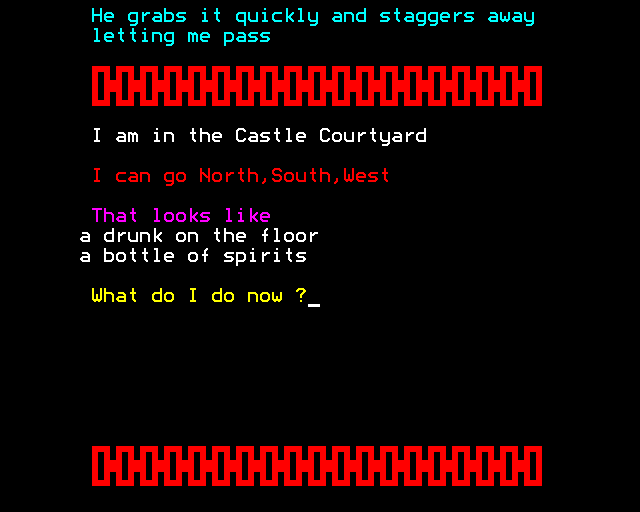
Go farther west and you’ll find the princess! Except now you are locked in, and typing HELP as the game suggests indicates that if you don’t have a key you should reset your game.
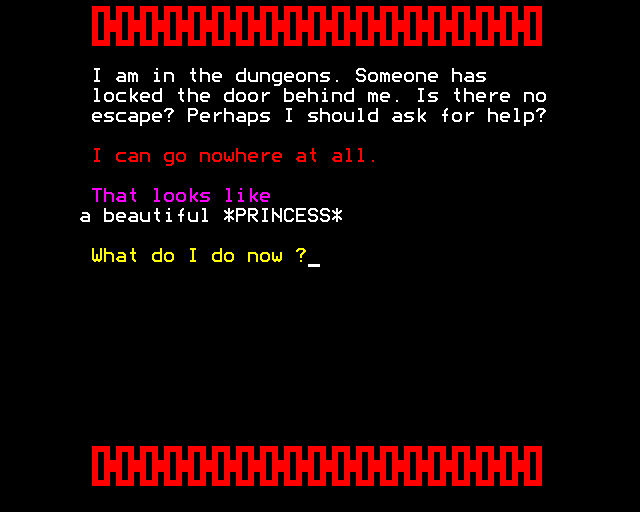
Ignoring the drunk man for the moment and going south into the castle…
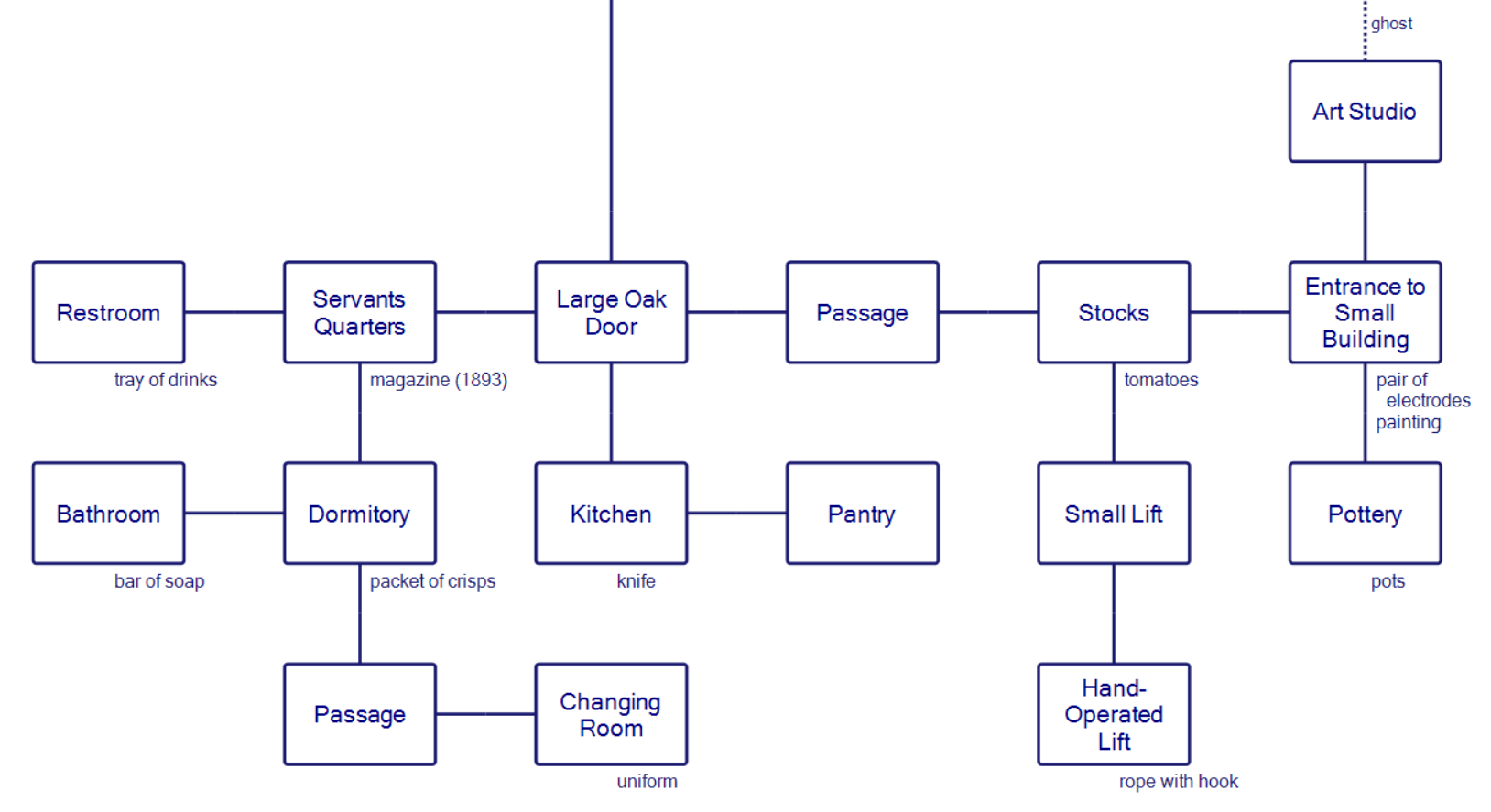
…you can do a sweep down various rooms to the south and west and find a sharp knife in a kitchen, a tray of drinks in a restroom, a bar of soap in a bathroom, a packet of crisps in a dormitory, and a uniform in a changing room. (You might think to WEAR UNIFORM while in that room, but there is no response to this.) There is cryptically also a “magazine dated 1893” where READ MAGAZINE gets the message “I can’t make it out.”
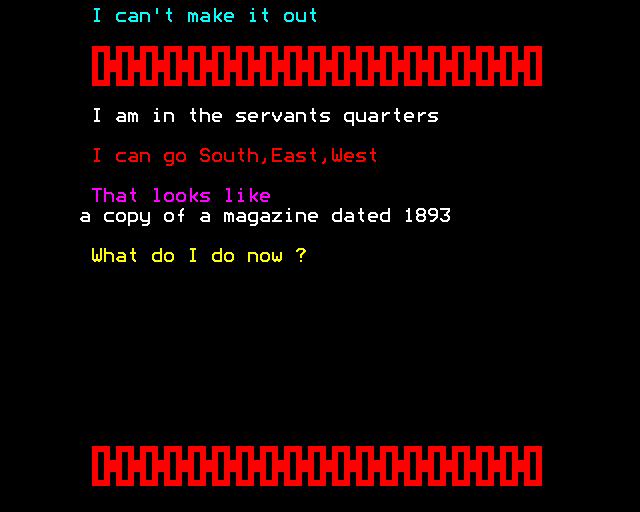
35% chance this is a red herring, 30% chance I need an item, 30% chance I need to bring the magazine somewhere else, 5% chance this is a bug.
Heading east instead leads to a most curious room for a game called Haunted House.
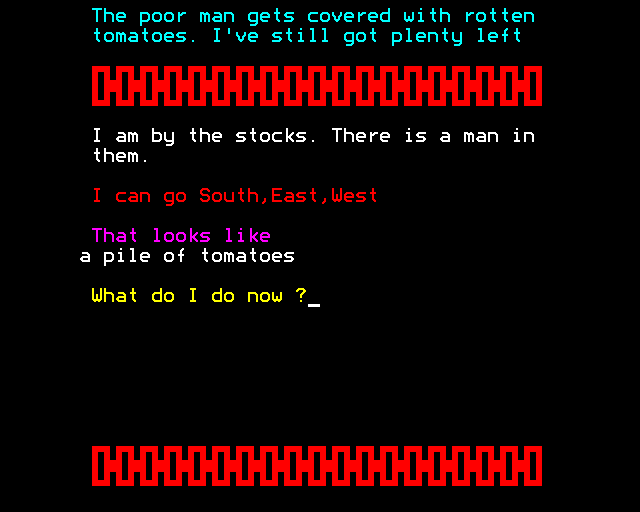
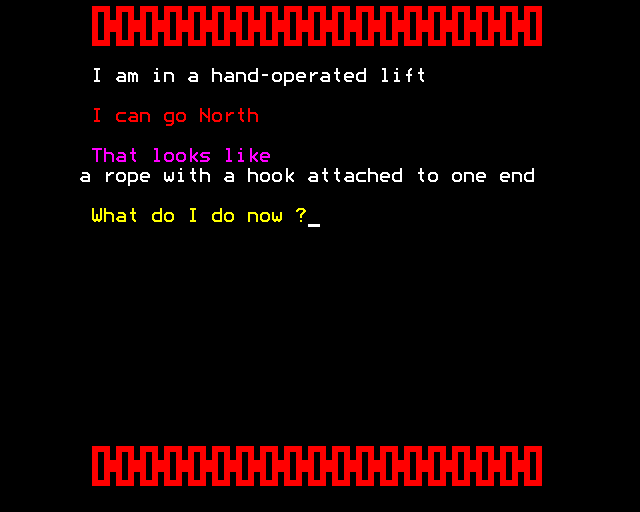
You can THROW TOMATOES (as the screen shows me doing) but FREE MAN and RELEASE MAN are right out. Maybe this scene is here to be funny? Just south of here is a “hand-operated lift” with a “rope with a hook” inside but no apparent way to operate the lift.
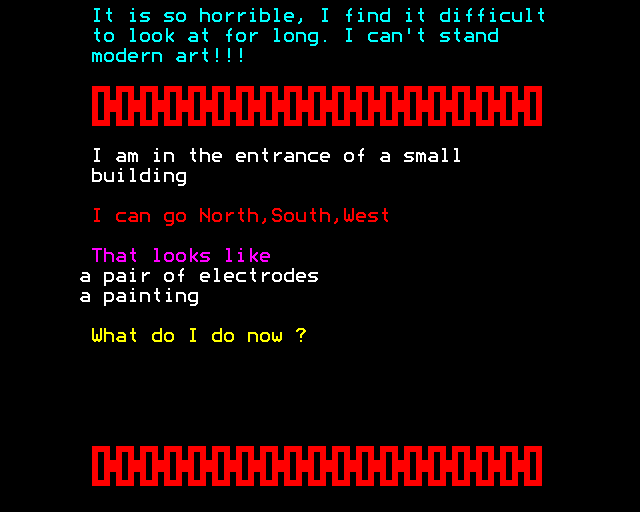
To the far east you can find a “pair of electrodes” intended for ??? and a painting which the main character is actively offended by.
South is a pottery room with some pots (spooky?) and to the north is a ghost (spooky!)
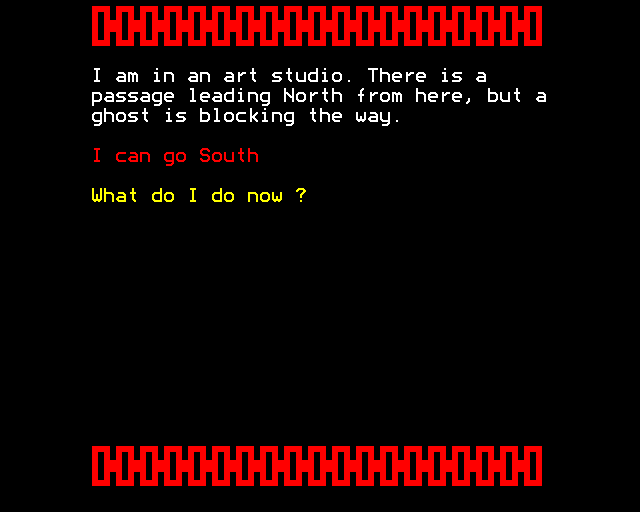
You might think, ah, the book says the uniform will scare ghosts, but I have not been able to wear the uniform, nor does it get used “passively”. I tried SCARE GHOST and since the game has a two-letter parser it read the command as SCORE instead, telling me I had 1 out of 7 points possible.
There is a solution on CASA and my pain tolerance will not be high, but I admit there are things I haven’t tried like giving the crisps to the wolf, or stabbing the princess with a knife, or entertaining the man in stocks with a puppet show using slippers on my hands. I will also take suggestions in the comments for next time.


 Renga in Blue
Genuinely wondering how much the “you can only read it in the right place” thing emerges from a game with a two-letter parser containing both a MAP and a MAGAZINE to read….
yeah, I guess they were forced that implementation? You try to READ MAGAZINE in the room you find it and the game says “I can’t make it out” and if you go east and try it again the game says “I can’t see anything to read” even though you’re holding the magazine both times. You can just say READ without the noun, even.
Ah, yes. I think we’ve linked this one to Steve’s ‘The House on Misty Hill’ & also his ‘Monster’s Final Hour’… which, iirc, all borrow elements from the John R. Olsen classic Frankenstein Adventure, previously covered on this blog.
Ah – jinx! You beat me to it
We’ve spent so long looking at the crossover between all Steve’s different games.
Always nice to be reminded of Frankenstein Adventure, though. It was/is a great game. I spent some time recoding John’s Quilled version in the PAW… which ended up being more difficult than I expected, simply because John had used clever tricks and limitations of the Quill system to actually implement a lot of the game’s responses.
I had read the CASA entry already so knew this was coming. I wanted to wait until I could see how extensively the connection goes before I wrote about it (it’s pretty free-form so far, kind of like the Hitch Hiker game borrowing elements of the Supersoft Hitchhiker) but since there’s electrodes I’m guessing we awaken a monster. But that isn’t the goal of the game this time!
All four games re-use the bookcase/pen/candle/monster section of John’s original game. At least Haunted House/Misty Hill (which seem to be largely identical to each other) add some new elements in there, such as the princess and a basic treasure hunt. Monster’s Final Hour is just a direct copy of Frankenstein Adventure.
I guess Steve was just ahead of his time when he came to recycling. ;)
Whatever the quality of his games, I do respect his work ethic… he produced a lot of different versions of titles for a whole range of microcomputers, and I’m sure his work did inspire many other people to give adventure writing a go.
*I guess to be fair, even Monster’s Final Hour does throw some extra elements in there.
Exploring the history of this game on CASA. Seems as though Steve Lucas was fond of cannibalising his own work as well as that of others. Bits of this game apparently come directly from Frankenstein Adventure by John R. Olsen, which you’ve covered.
Another entry in what could be called the genre of “Games named Haunted House”. There’s at least 21 of them.
I’m just waiting for my first nameclash where the games have the same name AND the same author name but they’re totally different authors and games
Same year, both self-published, of course.
There was a table somewhere with one axis labelled with “Haunted” and “Mystery” and the other with “House” and “Mansion” although I don’t remember if there were games in all four cells.
There are multiple games for all those mansion/house combinations. The one with the least is Haunted Mansion (I think we have just two games for that).
There is an opening for a game called Haunted Mystery!
spooky domicile chart is here
Pingback: Haunted House: Pray Harder | Renga in Blue
Pingback: ZENO (1983) | Renga in Blue