I’m sorry, I’m going to have to pitch this for now. If there’s a future version with save games (or at least where the frequency of knife attacks is greatly reduced!) and perhaps less bugs I can take another swing. (ICL’s Quest which I also bailed on has had recent progress, so it isn’t impossible even given the circumstances of being on an unusual platform written in NORD-FORTRAN where we don’t have the source!)
Full setup for playing SVHA Adventure on real hardware, via Ronny Hansen.
Regarding bugs, I ran across some erratic text messages, including one that made me unsure if I was even doing the right thing or not. The snake that got chased off by the bird makes a reappearance in SVHA Adventure, and by scooping the bird back up again I was able to get past where the snake was lurking:
You’re at bottom of long flight of steps.
(This is right after getting out of Witt’s End by going southwest and reaching a new area.)
S
You pass fissures and cracks in the wall along the stairs. There’s a large one on the east, but it’s too small for you to worm through. You are on top of long flight of steps going down and north. There is a strong oak door leading south, with no handle or key hole on this side of the door.
S
You can’t go through that oak door.
You’re at top of long flight of steps.
OPEN SESAME
S
You can’t go through that oak door.
Note that OPEN SESAME (prompted by the hints about Aladdin, as suggested by bananathoroughly in the comments) gives an absolutely blank prompt, as opposed to any kind of feedback if you’ve done something right or wrong. Other words don’t have the same sort of response…
ABACADARA
I don’t understand that!
SHAZAM
Good try, but that is an old worn-out magic word.
…which makes me quite worried a bug is interfering with the act working. And if not, well, I have absolutely no idea how to get through, and getting back to the particular location is a slog; you have to keep randomly going directions in Witt’s End many times, enough times that the game prompts multiple times if you want a hint at getting out!
Incidentally, trying to leave after arriving at the door is death:
N
You pass fissures and cracks in the wall along the stairs. There’s a large one on the east, but it’s too small for you to worm through. The snake suddenly strikes from the fissure!! You’re bitten and pummeled and strangeled thoroughly. That must have been an irrated snake!
It might be that the only way the enter is via the other side, and the only reason I know that is yet another bug:
There is a dangerous orc in the room with you!
You’re in hall of mists.
Rough stone steps lead up the dome.
GET AXE
key hole on the other side. There is, however, a key hole on this side.
There is a dangerous orc in the room with you!
The “key hole on the other side” line seems to be randomly printing from somewhere else in the text. I’m extremely patient with jank and frustration in games, but when it might be combined with a bug it becomes too much. It potentially turns getting unstuck not just “figure out what the author intended” but also “make sure to avoid memory corruption”.
And as mentioned before, there’s the extra condition of “avoid getting killed by a knife”. Original Adventure always had a dwarf appear first and throw an axe that missed; you can get unlucky and meet an orc first, meaning you will have no weapon at all. Or you can get super unlucky and die immediately upon sight of an orc, although it doesn’t matter; either way you are essentially dead.
There is a dangerous orc in the room with you!
One sharp nasty knife is thrown at you!
It gets you!
Oh dear, you seem to have gotten yourself killed. I might be able to help you out, but I’ve never really done this before. Do you want me to try to reincarnate you?
One other bit of business, though: I accidentally missed an exit.
This is back where you find the ring; you can turn west to enter a Crypt, with a “vault” to the west. I wasn’t able to get any farther, though.
You are in something that seems like a chapel or something. We’ll call this the sacred chamber. There are something like an altar on the south wall, and various things on the walls that suggest a religious place. To the north is an opening from the chamber, usually barred by a gate.
The gate is up.
There’s a ring of a curious shape on the altar. It looks magical.
GET RING
OK
N
You are in small room with dirt floor.
The gate is up.
W
You are in a crypt. A coffin is standing in the middle of the room.
There seems to be a vault to the west. A passage leads east.
The vault door is closed.
The coffin is closed.
OPEN COFFIN
You don’t have the necessary piece of metal for doing that.
This area turns out to be the section taken from a Greg Hassett article in Creative Computing, July 1980 on how to write an adventure. If you’re not familiar with Greg Hassett (who at this time was 14), you can try my writeup of World’s Edge; in the article he mentions his games before that are (in order), The House of Seven Gables, King Tut’s Tomb, Sorcerer’s Castle, Voyage to Atlantis, Enchanted Island, and a machine-language version of the same game called Enchanted Island Plus.
This is not from any of Hassett’s games, but rather an imaginary game written purely for the article. The Studio-54 group turned it into a real game! Except there is some variation because holding the ring does not allow for opening the coffin (as suggested in the article) and while there’s a limited number of items to test I’ve spent a week struggling so I’m done.
I did at least get to test throwing the ring in the volcano (just in case of a Tolkien reference) but alas, nothing happens.
I’m afraid I’ve left things too incomplete to make any large conclusions, but I do want to emphasize the code is currently held together with duct tape and being run on an emulator. It is easily possible that some of the difficulties I mention are due to bugs or emulator issues and so aren’t “authentic”; this is especially possible with random number generators which are enormously finicky across platforms. (A concrete example: for a long time the Pokémon Red/Blue speedrun community banned all emulators except for a very specific one called gambatte-speedrun; every single one had different RNG than a real Gameboy, despite many being completely authentic otherwise and even allowed with other games. Now, there’s exactly two emulators allowed, and all others are banned.) Given the endgame isn’t even reachable with the current game’s state I don’t feel that bad about setting it aside.
COMING UP: A type-in, followed by the glorious return of Infocom.
The thing I’ve found most fascinating studying the various incarnations of Adventure is the almost philosophical difference in approaches to where the expansions go.
With Woods’s own variation (Adventure 430) he essentially treated it as a “master quest” version of the game, adding secrets to the underground which otherwise could be seemingly unchanged at first glance (with the only major addition being changing the starting forest into a large maze). With Adventure 448 (mostly from Brown) the new sections felt “segregated” off so that the authors had a region they could call their own. Adventure 501 (and the follow-up Adventure 751) felt like it expanded outward more than inward.
SVHA Adventure (or Adventure 360, based on the maximum score) instead seems to add interconnectivity: taking various dead ends, digging through farther, and connecting up some of the tunnels that come out as a result. There is very little interference with the “main game” (although a few rooms have tweaks) but rather there’s a new extension, as if the fictional universe the same cave system lasted for another 100 years (with dwarves, orcs and elves claiming more spaces) before the player arrived.
The upshot is this is hard to represent as a single map. I can give my original Adventure map as currently annotated. Please keep in mind I do not have all the rooms yet.
Let me explain the new isolated aspects first (although they might not stay that way) and then get into the interconnected section (where four distinct places in the cave all now link together).
The Hall of the Mountain King, as I mentioned in my last post, has the first difference someone is likely to see (“There is a barrel with a tap standing here.”) I still haven’t used the barrel anywhere yet. Going southwest, the rooms have some slight changes, with the path which normally leads directly to the dragon now with a “moist room”…
You’re in a corridor leading southwest/northeast, and rising slowly in the southwesterly direction. The walls are very moist, the reason being that mist from the northeast are condensing on the walls here.
…and while the secret canyon is there, it has the word “SINBAD” which is new.
You are in a secret canyon which here runs E/W. It crosses over a very tight canyon 15 feet below. If you go down you may not be able to get back up. The word “SINBAD” is hewn into the wall.
This place is also near the big interconnected zone, but let’s save that for now. In addition to SINBAD there is a related writing in the Oriental room now.
This is the oriental room. Ancient oriental cave drawings cover the walls. A gently sloping passage leads upward to the north, another passage leads SE, and a hands and knees crawl leads west. Among the drawings is scribbled “ALIBABA”.
There is a delicate, precious, Ming vase here!
Close to there — heading west to the Large Low Room, then north — is another new section.
This is an entirely self-contained puzzle, at first there is a room with a gate that can’t be lifted…
You are in a small room with a dirt floor. A gate is set on the way
south, and a way lead west. There is a low crawl going north.
The gate is down.
open gate
I’m not strong enough to do that, you know.
…but the text implies you just need to be stronger. A few steps away is a pantry…
n
You’re in narrow crawl space.
w
You are in a dusty pantry. There are shelves and cupboards. Nothing of
what you would expect in a pantry is to be seen. A crawl getting tighter
lead to the east.
An envelope stands on one of the dusty shelves.
…and the envelope contains a “small pill” that makes you feel stronger if you eat it. Heading back to the gate, you can then open it and go inside.
open gate
That pill surely made me strong!
s
You are in something that seems like a chapel or something. We’ll call this the sacred chamber. There are something like an altar on the south wall, and various things on the walls that suggest a religious place. To the north is an opening from the chamber, usually barred by a gate.
The gate is up.
There’s a ring of a curious shape on the altar. It looks magical.
I am unsure if the ring has any particular effect.
Finishing off the isolated areas, I’ve already mentioned the “leather satchel” found by going up from the clam area; as far as extra items go there’s a “parchment” in the volcano area that crumbles when I try to pick it up.
You are in a small chamber filled with large boulders. The walls are very warm, causing the air in the room to be almost stifling. The only exit is a crawl heading west, through which is coming a low rumbling.
Near the entrance lies an old withered parchment.
There are rare spices here!
get parchment
At your touch the parchment withers into dust. Something was written on it.
There’s also a new zone that I found off Witt’s End, the “maze” that just loops you around (and where the original way to escape is to not go east).
You’re at Witt’s end.
There are a few recent issues of “Spelunker Today” magazine here.
sw
You are at bottom of a long flight of steps leading south and up. A corridor leads north, but obviously curves a lot further on. There is a waist-high column in the middle of the floor. On the pillar is placed a crystal(?) stone about two feet in diameter. There are tiny flickers of light in the ball, it looks like pictures of rooms. This is obviously the great palantir of Osgiliath, which was lost in the kin-strife in Gondor in Third Age 1635 !!!!!!!!!
s
You pass fissures and cracks in the wall along the stairs. There’s a large one on the east, but it’s too small for you to worm through. The snake suddenly strikes from the fissure!! You’re bitten and pummeled and strangeled thoroughly. That must have been an irrated snake!
Oh dear, you seem to have gotten yourself killed. I might be able to help you out, but I’ve never really done this before. Do you want me to try to reincarnate you?
…but let me mention three points on the snake first:
1.) Is that the same snake as the one that got driven off by the bird? Do I need to take the bird with me, perhaps?
2.) The problem with the bird again being helpful is that this is an instant death — there isn’t an obstacle that you then react to. Original Crowther/Woods was quite good about avoiding instant death; it would have a beat along the lines of a dwarf appearing or it being dark before you hit inevitable doom. The instant death is much less fair (especially given that this game has no save game facility).
2b.) In order to cope with the lack of save games I have been saying “yes” to the resurrection question. In nearly every other Adventure variant I would say no and just restore my save game, but the combination of no-saved-games plus instant death makes it the only practical way to handle things.
3.) Perhaps it is possible to reach this spot before facing the snake, and it will be clear? That would represent the kind of softlock I associate more with the Cambridge games like Hezarin.
Now, on to the palantir. It gave me some trouble operating it; I eventually realized it was fishing for “look direction”.
LOOK EAST
The stone starts searching in that sector.
A room underneath a grate. The stone shows
plain nothing.
A cobble crawl. The stone shows
plain nothing.
The stone found nothing in that sector.
The odd sequence here indicates it is doing some sort of “step by step” search where it somehow has the map subdivided into “zones”. This will be important later.
LOOK NORTH
The stone starts searching in that sector.
A ledge in a rock wall. The stone shows
A brass vessel stands in a corner.
In a pit with ice walls. The stone shows
A ruby sparkles in the middle of the room.
LOOK SOUTH
The stone starts searching in that sector.
The stone found nothing in that sector.
West gets the most information
LOOK WEST
The stone starts searching in that sector.
In a throne room. The stone shows
plain nothing.
A corridor with fairyland carvings. The stone shows
plain nothing.
A brightly lit dancing hall. The stone shows
plain nothing.
A corridor with grotesque statuary. The stone shows
plain nothing.
The stone found nothing in that sector.
I wasn’t able to get any other results. Note the similarity with Adventure 366 (which also has a palantir) but also the difference (this one can’t be used to teleport … I think).
Time for the big interconnected section:
I have a hard time capturing this as they are drawn on my map in very different places, but it interconnects with
a.) the “wide canyon” south of the Bedquilt area which previously was a dead end
b.) the “crossover” near the two mazes which normally led north to a dead end, but now passes through
c.) the vending machine in the “all different” maze
d.) the Giant Room with the eggs
Let’s start with the “wide place” canyon, which has a hole that goes down:
You are in a narrow corridor going southeast-northwest. There is an awful smell. There is a hole in the ceiling, but you cannot reach it.
SE is a room with an even more awful smell, and NW is a dungeon.
You are in someone’s dungeon. There are cells on both sides of the corridor. Most of the doors are rusted, but small windows give you the opportunity to check out there is nothing of interest inside. There is one door that may be unlocked, however, and inside this cell you can see a form huddled on the ground. The corridor goes southeast-northwest.
The celldoor is locked.
I have yet to bring keys over to this room, but it is an obvious next step in my gameplay (I kept getting hit by dwarves, and also orcs which work more or less like the dwarves).
Another entrance to the same complex is the vending machine. That’s been a popular place to muck around, since the vending machine gives entirely optional batteries for lamp extension (in other words, in a walkthrough there’s no reason to go in the all different maze!) This version of the game adds a hole where the player finds out after (by seeing it in in a mirror) they are very dirty:
As you look behind the machine, you see a small hole in the floor. It is just big enough for you to get through. From what you can see, there is no chance of coming up this way if you go down.
D
You are at the bottom of a narrow shaft. You cannot climb up the shaft. A corridor leads to the north.
N
In a niche in the corridor there is bolted a highly polished steel mirror on the wall. The corridor goes north/south here. As you pass the mirror, you see a black and ominious figure there. After checking behind you, you find you have seen yourself. That shaft must have been a chimney!
(I have yet to get here with water — again, no save games, plus getting hit by axes. It does appear “clean” is a verb but just going nearby to a waterfall doesn’t work, you have to be carrying the bottle.)
N
You are in a well lit room. The walls are hung with fantastic draperies, (to heavy to carry), and there are rich carpets on the floor, (also to heavy to carry). At the opposite end of the room there is what appears to be a decorated throne. Beside the throne is a table covered with velvet. On your side of the room is also a table covered in velvet. There is an opening to the south, the throne is to the north.
A five-armed chandelier made of gold, furnished with strips of other precious metals, is standing on the table.
On the throne sits a lovely elven princess, clad in some green garments. She eyes you warily.
If you approach, she leaves through a curtain to the east, but trying to follow lands you outside.
You are at the throne in the throne room. The throne is of such magnificent splendour that it is hard to take your eyes away from it. Added to this you have the table beside it, covered in a kind of velvet that gives out its own soft light. To the south is an opening in the wall. The draperies to the east and west might also cover doors or openings. A scepter, wrought from mithril, inlaid with gold, and encrusted with diamonds almost as clear as silmarils, lays on the table.
E
There must have been magic at work. As you walk through the draperies and the opening behind it, you find yourself in free air. Behind you is a blank mountain wall, in the middle distance you can see the building from which you started. The building is to the northeast.
Heading west rather than east leads to a “rune room” with Viking runes, and more branches. You can meet back up with the dungeon by going east and the southeast; going northeast instead leads to a torture chamber.
You are at the branching of the corridor. One path leads southeast, one leads west and steeply up, and one northeast.
A graphnel with a suspicious rope coiled at the end lies in a corner.
NE
You are in what has obviously been a torture chamber. Chains hang on the wall, different “implements of the trade” are spread across the floor and shelves. A reek of blood still lingers in the air, and there is an oppressive gloom in the room. An exit leads south, another east. Hovering slightly above the floor, a whitish apparition emerges before you. A low, rasping moan is heard, the sound sends a chill all through your bones. You can, somewhat undistinctly, hear words. It sounds like: “Give back, give back, oh give back my body to me. Nobody will pass whom won’t do so, nobody will pass on this way …”
(I haven’t gotten any farther past this section.)
Turning back to the rune room and going west instead leads to a ballroom and another instant death. You can reach the same ballroom approaching from the south (which enters via the “crossover” route) so I’ll show that version off:
You are at a crossover of a high N/S passage and a low E/W one.
N
This seems to be the start of a finely hewn corridor, leading northwest. A narrow corridor goes to the south.
NW
You are in a corridor with finely chiseled steps. The corridor goes up and north, and down and south.
N
You are at the southern end of a brightly lit hall. Steps lead down to the floor, which is bare and obviously designed for dancing. To your right a balcony goes round the east side of the hall. The balcony entrance is northeast, the steps go north. To the south is an opening to a corridor. On the other side of the hall another staircase goes up. On the floor a merry band of elves are dancing, forming intricate patterns. They see you and beckon for you to come and join them. An orchestra with gleaming instruments is at the balcony, playing a lively tune.
NE
You stand at the balcony behind the orchestra. There is some unrest among the musicians. Suddenly, it turns out that both the dancing elves and the musicians are orcs. Those in the orchestra are small and delicate, they throw away their instruments and scurry out of the room. The others stand at the floor and throw knives at you. Their aiming turns out to be exceedingly accurate.
I think the solution here may be (as we’ve seen in other Adventure versions) to get two types of enemy together. If the dwarves are chasing us, and we walk into the ballroom (or balcony) with the dwarves in tow, I suspect they will fight each other and we can get away. Or maybe the death will just be more colorful.
c.) locked door at the dungeon (which I just haven’t brought the keys to yet, but I’m sure the thing inside will kill me)
d.) what to do at the torture room
e.) reading the parchment without it “withering away”
f.) applying SINBAD and ALI BABA (no, rubbing the lamp doesn’t work)
g.) the elf in the throne room and the magic exit
Some of these I have strong leads for, just I need to grit my teeth and boot up another game from the beginning in order to do a test. I think the dwarves are rather deadlier than in the original (they hit more often) and the previous game didn’t have orcs; while orcs work much the same as dwarves, it means there’s even more enemies to cope with and potentially be killed by.
There is a dangerous orc in the room with you!
One sharp nasty knife is thrown at you!
It misses!
You’re in slab room.
This means even though it seems like a simple thing to bring object X to place Y I have had multiple attempts in a row foiled by a stray thrown knife.
This post assumes some familiarity with the original Adventure; if you haven’t yet seen, my series on the Software Toolworks version (the only one that paid the authors Crowther and Woods) is a good place to start. Otherwise, onward–
Via Ronny Hansen, a setup for playing SVHA Adventure on ND-10 hardware.
Recently, two articles dropped on spillhistorie.no, both by Robert Robichaud (the same Rob that frequents the comments here). One was on the game Ringen, the Tolkien game in Norwegian that I’ve written about before. However, I had very little information to work with and was only able to play by going through a particular section preserved on VikingMUD, then making guesses about the game. The real Ringen (actually 1983, not 1979) has now been preserved and I am excited to play it. However, doing so requires playing in Norwegian so it will need some preparation time before I get there.
The other post was on a game written in English (later translated to Norwegian, but the translation is lost), so I can get to it right away. I’m going to summarize from the article and add some details, but you’re better off reading Rob’s article first and coming back here.
As a computer, the TX-0 was somewhat odd as it was built for a special purpose. It was, however, a truly programmable computer; it had a good directly driven CRT display, and – most important – its circuits were all transistorized. Moreover, it was available! I could sign up for time and then use it solely for my own purposes.
Yngvar Lundh, fresh from studies at MIT, went back to his home country of Norway to establish a computer presence there while working for the Norwegian Defence Research Establishment. He led the team on Norway’s first full-fledged computer, Lydia, a classified project used to analyze the sound of Russian submarines; this was followed with SAM (Simulation for Automatic Machinery) also intended for naval applications.
A group photo uploaded by Yngvar Lundh himself to Wikimedia, with members of the SAM team in 1962. Yngvar is on the far right. Note the similarities with the TX-0.
Per Bjørge (fifth from the left in the photo) went over for a year of study at MIT and returned in August 1966; after he returned, work on SAM-2 started, with Per Bjørge on the day team and Svein Strøm on the night team.
The computer was taken on “tour” to visit the institutes of Norway, and while on tour, Per Bjørge (another engineer who had spent a year at MIT), Rolf Skår (yet another) and Lars Monrad Krohn (who did a collaborative project with MIT) talked with a former-student-turned-entrepreneur who convinced them to form their own company. Hence: the start of Norsk Data, which not long after came out with the Nord-1, essentially a direct commercial conversion of the SAM technology.
They had early financial troubles, although development of their own time-sharing system helped and their Nord-10 minicomputer had good sales to universities. (Also helpful: they landed a contract at CERN. While the leaders of CERN first were more interested in getting a computer from the MIT-affiliated DEC, Norsk Data had DEC’s price sheets so were able to undercut them by 10%.)
From Wikimedia.
The important point in the story above is the cross-pollination from MIT. When ground zero for adventures happened there, it makes sense adventure would make their way over to Norway. Compare this with Italy where their first-known adventure came from an author who saw a variation of Crowther/Woods at a trade show rather than on some local mainframe.
With all that established, our story now turns to the Norwegian Institute of Technology. A group there calling themselves Studio-54 had a hobbyist/hacker culture and access to a ND-10 (via strong connections with Norsk Data; some members did work for them). One member of the group, Svein Hansen, discovered Crowther/Woods Adventure on a PDP minicomputer. While the minicomputer was intended for “serious” work at the school, he had access via Studio-54 to a ND-10, leading Svein to convert the source code in 1979. Once the port was made, there became the irresistible urge to add things to it, hence other members of the group (Nils-Morten Nilssen, Ragnar Z. Holm, Steinar Haug) piling in with new rooms, puzzles, and treasures. From the game’s own introduction:
This ADVENTURE is based on the ADVENTURE originally written by Don Woods and Willie Crowther, later expanded by Bob Supnik and Kent Blackett, and still later expanded by Nils-Morten Nilssen and Svein Hansen. In the present version some of the added features are taken from an article by Greg Hasset in Creative Computing, which added hitherto unknown parts of the cave. Many thanks to Greg!! This version is reprogrammed by Svein Hansen, and maintenance and extensions is presently handled by him. The program is written specially for NORD computers in NORD-FORTRAN 77. As Svein Hansen is responsible for this version, any inconsistencies and non-answers that might surface are best reported to him, either directly or through RSH, Norsk Data A/S, P.O. Box 25 Bogerud, OSLO 6, Norway. Personal message from Svein Hansen: Although I am responsible for this version, some of the added features are not my own. They are the lunatic and weird outcroppings from the minds of the Studio 54 Hobbies Group at the ND.10-54 community at NIT, Trondheim, Norway. Any nervous breakdowns, downbitten fingernails and suicides etc. resulting from these ideas ARE NOT MY RESPONSIBILITY !! Blame it on that sneaking, no good group that are ever trying to write more vile computer games.
This version of Adventure eventually made its way back to Norsk Data and was sold in a “games pack” compilation as SVHA Adventure.
Now, while the game has essentially been restored (after much suffering) with 70 new rooms and 20 new items/treasures, there’s a bug that means it is “impossible to escape” with two of the treasures (I don’t know yet what that means yet other than two can’t be deposited at the starting building). I’m just hoping the endgame is traditional and not something mind-blowing that we’re missing!
You are standing at the end of a road before a small brick building. Around you is a forest. A small stream flows out of the building and down a gully.
Time to first change? A single turn. But not a major one this time.
You are inside a building, a well house for a large spring.
There is a set of keys here.
There is a shiny brass lamp nearby.
There is food here.
No bottle! That’s just outside, though. I don’t know why.
You’re at end of road again.
s
You are in a valley in the forest beside a stream tumbling along a rocky
bed.
s
At your feet all the water of the stream splashes into a 2-inch slit in the rock. Downstream the streambed is bare rock.
There is a bottle of water here.
I’m almost wondering if it was a hacker-experimenter type change rather than one meant to affect gameplay; that is, if you’re mucking about changing the code of Adventure for the first time, one of the easiest things to do is to take an object and try to move its starting room and see if it works. So there might not be a “reason” for the change in a traditional sense.
Going on in, the first change otherwise I’ve found happens at the Hall of the Mountain King, where there is a barrel with a tap.
You are in the hall of the Mountain King, with passages of in all directions.
There is a barrel with a tap standing here.
A huge green fierce snake bars the way!
In the area with the clam I found a path leading up to a knapsack, but that was otherwise just a dead end. The most significant change I found was starting at the “crossover” near the mazes (all alike, all different) where heading north is normally a dead end.
HOO-HAW!!
You are at a crossover of a high N/S passage and a low E/W one.
…ok, HOO-HAW? I don’t know.
n
This seems to be the start of a finely hewn corridor, leading northwest. A narrow corridor goes to the south.
The finely hewn corridor is new, as is everything after.
nw
You are in a corridor with finely chiseled steps. The corridor goes up
and north, and down and south.
n
You are at the southern end of a brightly lit hall. Steps lead down to the floor, which is bare and obviously designed for dancing. To your right a balcony goes round the east side of the hall. The balcony entrance is northeast, the steps go north. To the south is an opening to a corridor. On the other side of the hall another staircase goes up. On the floor a merry band of elves are dancing, forming intricate patterns. They see you and beckon for you to come and join them. An orchestra with gleaming instruments is at the balcony, playing a lively tune.
n
You go down to the dance hall floor. The elves turn suddenly out to be orcs, all of them shouting and reveling at the way they fooled you. They grab their knives and hurl them at you. You stand a fair chance of landing a job as a pin cushion.
Grisly! Unfortunately, the game lacks a save game function, so it’s been slow going checking where changes might be. I can cut-and-paste walkthrough sections, but that technique only works if the RNG is consistent (otherwise I end up getting walloped by a dwarf axe somewhere in the process). It took Rob a month to get through everything, so this might turn out more difficult than your typical Adventure expansion.
I’m especially looking forward to finding the Greg Hassett section mentioned in the instructions (apparently they just lifted the “theoretical” game from an article and turned into a real one) — hopefully next time!
I had missed a couple things in the open, and then missed one (1) mostly absurd puzzle, then had to struggle a bit more with the parser to get to the end.
Back when I had found the letter and the rubbish bins, I had missed (because it was only implied in the text, and you had to LOOK again to see it) that a “cheque card” dropped along with it. (I still needed to interpolate what that meant; that term does not get used in the United States.) I had also missed the fact you could go “west” at the bank despite not being able to go in it.
I then hit a potentially serious headache by trying TYPE 1001, as told to me by the phone call.
ASIDE: Dialing 1001, as I tried to do after, is equivalent to dialing a random number, which is the reason for the other message, which apparently was meant to be the local time “at the third stroke it will be 3.23 and 30 seconds”. Repeating dialing 1001 alternates between another message (“4.31 and 30 seconds”) before returning back to the first one, so I think the implication is the system is broken and it isn’t giving a real time at all. In other words, that part was a “red herring” meant for “atmosphere”.
Returning back to the bank machine, the parser here did something monstrous: “TYPE 1001” gets the response that you’ve typed the wrong number!
I baffled for a few beats and it was only my experience with similar issues elsewhere that held out here: I tried the process of entering the card in and typing 1001 on a line by itself, no verb, and it worked. I guarantee some gnashing of teeth was felt in the 80s on this part.
After that, while scrounging about the map, I found I missed another room exit, going east at the rain section. This leads to an isolated room where there’s a small key that will be used later.
With the fiver and key in hand, I was still stuck on the rusty door at the house. In the meantime, Strident had made some comment about a milk commercial from the 80s…
…and I was truly baffled, as while I had tested drinking the milk, it simply said “you drink the milk” and the item went away. There’s no indication of any kind of effect. (In general, I’m always quite cautious with consumables on old school games; if there’s no immediate effect usually it either gets given to a character or applied, like the cheese, or is a complete red herring, like the food in this game.) However, I went through the map and tested nudging everything again to see if there was something new, and found magically I could now open the rusty door. (I assume you Hulk Out and manage to rip it off its hinges due to the raw power of milk, but it just says you open the door in the text so it is left to the player’s imagination.)
Definitely the worst puzzle in the game, although not nearly at the same level as the skull puzzle in Invincible Island. I imagine some players never even realized the puzzle existed (going to drink the milk first before even trying to get into the building).
In the basement of the building were some rats; fortunately I already had the rat trap with the cheese prepared.
Past the rats is a “cardboard box” where it isn’t clear it is a sealed box with something inside (rather than an empty open box) but I experimented enough to realize I could OPEN BOX WITH SCISSORS, yielding a pair of boots.
With the boots now worn (remember this switches outfits, so our player is no longer wearing a lab coat or dungarees, but just boots) I was able to get past the building site. At the far west were some pipes where EXAMINE PIPES yielded a flight suit.
After this comes the final part of the map: the airport.
While walking in the airport is straightforward, there is an officer inside the airport that tries to stop you if you go in any farther.
I was left (by this point) with the official papers, the fiver, the small key, the flight suit, the book, the old hat, and the food as unused items. The last two are red herrings; the other four get used here to win.
You can give the official papers to the officer and he’ll then say there’s a “pass fee”.
Is this a bribe? This feels like a bribe.
Handing the fiver over, you get waved in to find an airplane.
The panel indicates it needs a key for the ignition; this is where the small key gets used. You also need the flight suit worn and need to have read the book (which teaches flying) to do the final command, which isn’t FLY or many other variants I tried. I even started to check if there was an “invisible” item like a joystick or if the plane also needed gas. I eventually gave up and had to look at a walkthrough: TAKE OFF.
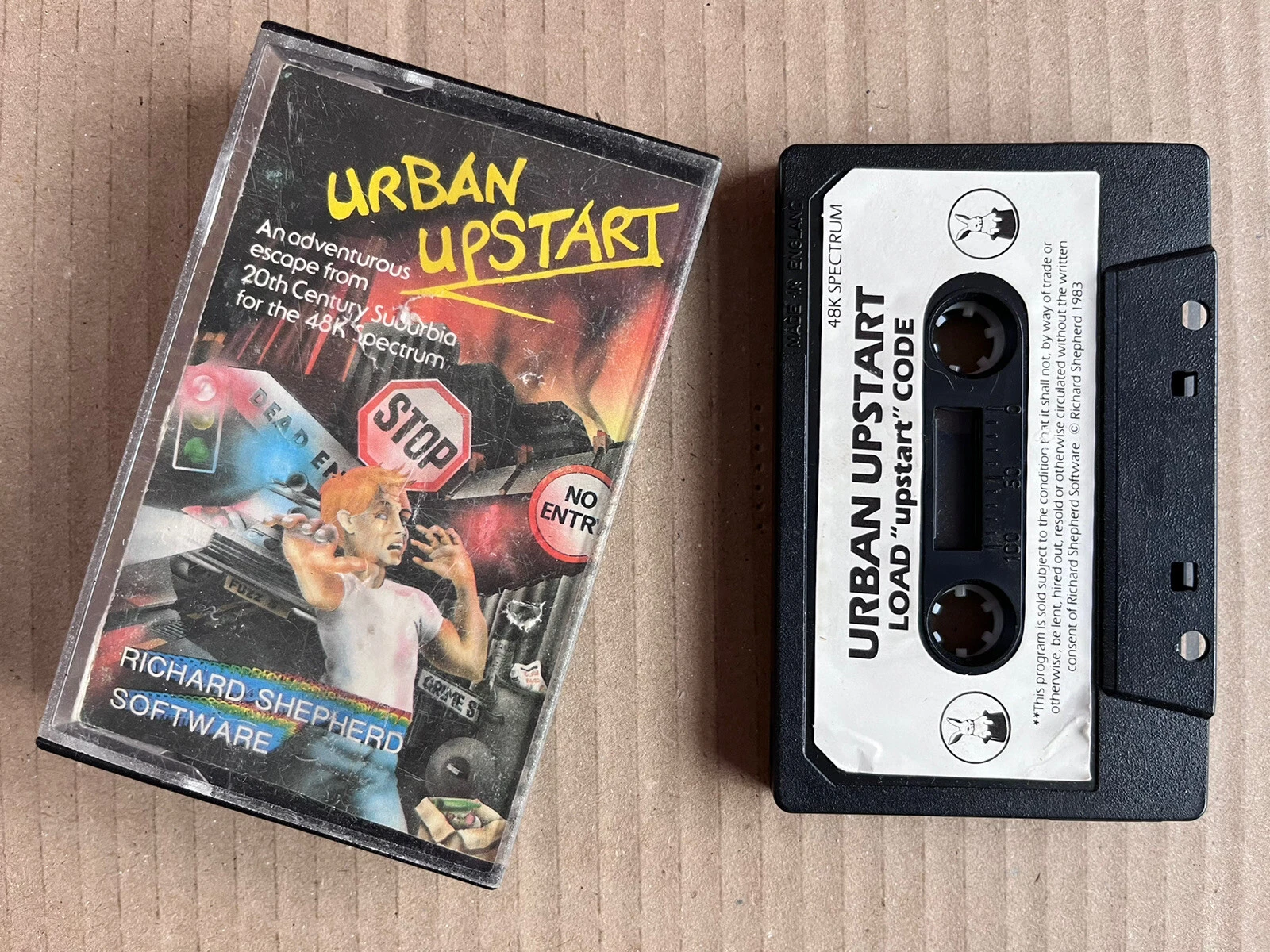
I agree with several people who said that Urban Upstart was by far their favourite adventure, and great fun to play. Its success on the Spectrum has now led to a Commodore 64 version just being released.
Urban Upstart was quite well regarded, and Pete Cooke has indicated it was by far his best selling game. While I’d mark it as “above average” it does fall short of “all time classic” given the janky parser and occasional awkward clueing. (I didn’t even discuss how the game is extremely slow to run; I had to crank the emulator to 900% before it became fluid.) I could just chalk that up to being an “old” game where people simply have greater standards now, but it does seem like there’s more going on than just that.
Another Scunthorpe picture from 1983.
Being in the “cultural mood” helps; I will return to a more detailed examination of politics and industry under Thatcherism in a later game (as Thatcher herself even makes an appearance). I think this is also a case where the medium is deeply appropriate for the message. That is, it just feels right to have a satirical, slightly-punk game on the ZX Spectrum in the first place. With a rich fantasy world, the limits to the art and parser can be jarring; here they seem appropriately on theme.
One comparable situation is with the modern lo-fi horror games. Many “indie” horror games now take an aesthetic last seen on the Playstation 1; having giant polygons and uncanny textures can add to the mood rather than feel like unrealism. Unnatural, low-resolution monsters that look broken because the hardware surpassed its polygon limit? Perfect!
Itch even has a compilation of new games called Haunted PS1 Demo Disc.
Similarly, when Urban Upstart does something frustrating, it feels quite akin to dealing with the frustrations of 1983 Britain that were being vented. Sure, you might get sent down a wrong alley for hours because you typed GIVE LAGER and got pounded for not typing GIVE LAGER TO FAN, not realizing you were doing the right thing but with the wrong words, but it just adds to the experience.
Coming up: a new variant of Adventure from 1979 that only made it on the Internet as of today.
…and the only two of note are LISTEN and CROSS, neither which would be obvious things to try in a limited parser. (Keep in mind that there is always the possibility of a rare verb that I don’t have listed, so this isn’t guaranteed to be everything.)
Regarding the football fan from last time: they are indeed, as I theorized while typing my last post, a fan of lager. GIVE LAGER TO FAN works. (GIVE LAGER results in you getting completely pounded, with no indication the parser simply didn’t know what you meant, but I had already been trained by Invincible Island to watch for this issue.) Handing the lager over gives enough time to pick up the rat trap nearby.
The game accepts PUT CHEESE IN TRAP but I have not managed to get any farther than that (I could try dropping the trap in every single room hoping for a hit, but I haven’t gotten that desperate yet).
In more ordinary Me Missing Things, I missed that the fish and chips shop is enterable (with plain ENTER, the game doesn’t understand SHOP). There’s nothing in there although there’s some sounds from the back, where the magic LISTEN verb works. RADIO isn’t an understood noun so I don’t know if this is supposed to be meaningful.
The shop also has a “red herring” which causes a herd of cats to appear following the player. I suspect this is a red herring in both the literal and figurative sense, because authors find this joke irresistible, but maybe this will finally be the game that bucks the trend.
The chip shop is helpfully centrally located (and remember the police are zealous and will nab you if you drop things on the road) so I’ve been using it as my base of operations.
New rooms are in yelllow.
Heading a bit southwest is the red scarf I mentioned quite briefly last time. What I neglected to get into is that there is the sound of heavy boots when you pick the scarf up, and after a certain amount of time you get stomped by someone who doesn’t appreciate the scarf. I assume this is a football hooligan reference. There’s enough time between picking up the scarf and getting sent to the hospital that I assume there’s a puzzle that involves unloading the scarf somehow.
Northwest from the shop is the building site (where I still end up sinking, even after dropping all items) and the small area of rain that requires the umbrella.
Just past the rain is a canal with a bridge; here CROSS is needed (and is the only way I can find to use the bridge, yay for the verb list). This leads to a building with a rusty door I have been unable to break into.
Just south is a car park with “some milk”, one of my only two new items. The other new item comes from back at the dustbins that couldn’t be OPENed because the game wants EXAMINE. Grr. (EXAMINE works on almost nothing in the game. Of takeable objects, the only one that it has worked on is the papers from the Town Hall, described as being written in Greek.)
Here is where things get cryptic and where I am happy to field explanations. I went over to the phone box and dialed the number and got as second number (1001) and when I dialed that number I got yet more numbers:
I’m not sure how to interpret this information or what it gets used on. Other than sinking at the building site and the rusty door I’m out of obstacles to whack at. Optionally it may be possible to deal with the police sergeant somehow upon being arrested but that may also simply be a dead end.
(You can try giving him items, but he just says no bribes.)
There’s always the possibility of “hidden puzzles”; a number of locations didn’t seem to have anything active going on (like the church and graveyard), or a random yellow wall in the middle of town but may reveal something with the right action. I still am not sure which way my character should even be aiming to escape; I’m imagining the big road block is not the route we are going to use, and nothing else suggests a pathway out.
We’ve now seen three games (Pythonesque, Mad Martha, On the Way to the Interview) that have a sort of “satirical urban magical realism” aspect to them, and they’ve all been British.
While we’ve had comparable satire from the United States, it hasn’t been couched in quite the same terms (battling old ladies in the streets, getting run over by a bus literally anywhere including inside houses, husbands being chased down by their wives with an axe). Some of the same flavor can be found in Asylum II but the setting is very much not urban. The closest comparison I can think of is the various “naughty games” like City Adventure and the first two Misadventure games, but they still don’t strike me as inherently focused on urban sleaze, just sleaze in general.
The other term I’ve used for the genre is “British degenerate” game and it fits here too.
I’m not keen on “cultural zeitgeist” theories why certain trends happen; they tend to lead to of-the-cuff speculation:– when Tolkien became popular with the counterculture of the United States there was the rumor Tolkien wrote the books while on drugs, and an article in the Ladies Home Journal claimed
No youngster is going to believe in a beautiful knight on a white charger whose strength is as the strength of 10 because his heart is pure. He knows too much history and/or sociology, alas, to find knighthood enchanting in its feudal backgrounds and to dream of Greek heroes and of gods who walked the earth. But give him hobbits and he can escape to a never-never world that satisfies his 20th century mind.
which seems comedically off the mark; Tolkien’s sources were also quite old.
Still, there was something particular to culture in the UK both in their humour and in their politics that led to these sorts of “urban satire” games; certainly, given the literal title of one of the games, Monty Python (and by extension, The Goon Show) deserves some credit; Not the Nine O’ Clock also could be an influence. I have a theory regarding the ZX Spectrum in particular but I’ll save that for when I’m done with the game.
Urban Upstart is explicitly an “escape from 20th century suburbia”.
We are literally trapped in the city and need to escape. Choice of time: 3 o’clock in the morning.
Incidentally, if you don’t put the dungarees on, after you get out of the starting house you get arrested for indecent exposure.
The opening house has some scissors and a lager in the fridge, as well as a large key for unlocking the front door (which is locked from both ways?) After some fiddling about with the parser trying to leave the house (just the word LEAVE alone or LEAVE HOUSE works, don’t try to ENTER DOOR, GO DOOR, etc.) we’re out on the town.
The bookstore is enterable (!) and has only one book, on How to Fly, suggesting our final exit may be via aeronautical vehicle.
There are “dustbins” in the back of the house but neither OPEN nor EMPTY work and I’m not sure if they’re there for anything else other than flavor (there’s a lot of dead ends and “urban debris” type rooms, so it might just be atmosphere). What you can find is an umbrella lying about a bus stop, and food and cheese in a park. Park cheese, delicious.
The park is adjacent to a church with a graveyard. The tombstone says John Smith.
Just past the bookshop is an alley near a Football Ground, and a grumpy football fan past that (hanging near a rat trap, for some reason).
I haven’t tried giving him the lager yet.
The fan pounds you if you try to pass (or don’t, even) and you end up landing in a hospital in a different part of the map. There are multiple ways to get sent to the hospital but let’s follow the path there next.
You land in an unsupervised hospital bed in a straightforward maze, but if you try to walk out of the hospital, a doctor escorts you back to the bed.
The maze includes a white coat, so the way to get out is to simply wear the white coat over your dungarees and sneak out the entrance.
To the west is a hill with some red tape on the top — that’ll be useful in a moment — and going back east passes by a sign (“Keep Britain Tidy”), a car abandoned in the road (can’t enter or drive), and a red scarf.
Incidentally, the police are quite serious about keeping Britain tidy, and if you drop an item while juggling inventory onto the street, you will immediately get arrested.
Looking at the north part of town…
…there’s more civic grime (on “Civic Street”), a phone box (with a working phone, I don’t know who to call), a very serious roadblock at the far north…
This is the kind of parser which insults the player. It does fit the theming.
…and a “wasteland” nearby which has an “old hat”.
At the end of Civic Street is a Town Hall which you normally can’t enter, but I thought to bring over the “red tape” and I got in. I get the perception this game may not be 100% looking for realism in puzzle solutions. In the Town Hall you can find “official documents” which I haven’t used yet.
The last obstacles are around a turn at “muck alley”. One involves an area that mysteriously rains; I’m sure nabbing the umbrella will help, but I haven’t gotten around to it yet (or rather, when I went to get the umbrella and needed to trade inventory, that’s when I discovered the town policy on litter so haven’t bothered to go back around yet). As a side path off of that is a “wet and muddy” building site which describes you sinking, and if you are there too long you get trapped in the mud and sent to the hospital.
Continuing the theme of not wanting to fiddle with inventory yet, I think getting through here may involve simply dumping my inventory elsewhere (the author’s last game, Invincible Island, had something similar). To summarize, I’ve found scissors, a lager, a key, dungarees, an umbrella, some food, some cheese, a red scarf, a white coat, some red tape, and some official papers. In terms of active obstacles I still need to take the umbrella through the rain, get through the building site, and get past the football fan; optionally there might be a way to get out of the police station. (If you just walk in the station you get trapped in, just like if you were arrested. LEAVE doesn’t work. This might even be a parser issue!) However, it is quite possible I’m simply missing some spots due to the parser being finicky.
Dutch paperback editions of Lord of the Rings, via Reddit.
The most comparable game I can think of on the last puzzle — and the other reference-puzzles — is the game Avon. That game was chock full of Shakespearean references and in some cases it helped to know the reference to solve a puzzle (like the Cassandra with her gift of prophecy; it is originally unclear she is trying to do prophecy if you don’t know who she is). However, there never was a case where it was absolutely required, and I speculated about a game leaning into references and not being shy about requiring book- or play- knowledge.
The fact we’re being subjected to a blizzard of Shakespeare references is given up front, and I had genuine fun learning about characters I didn’t know and scenes I didn’t remember. I think the idea of a game being intentionally past its bounds is not intrinsically terrible as long as the “educational” part is telegraphed.
Ring Quest absolutely requires book knowledge to win. It has an issue straight out the gate with failing the “is telegraphed” condition I mention above — despite the early Tom Bombadil puzzle, it was only about halfway did I realize the extent of outside knowledge the game was asking the player to use. There’s more issues, but let me explain that last puzzle first…
Orc with mithril, from the movie version of Return of the King.
…which was directly after passing through Shelob’s lair, at the tower of Cirith Ungol. The orcs fought over the mithril coat (the one obtained from Smaug) and killed each other in “the fight that follows”. However, we were unable to leave:
You’re stopped by what seems to be an invisible wall.
You’re in the tower of Cirith Ungol.
Orc corpses lie everywhere.
NE
You’re stopped by what seems to be an invisible wall.
Three-headed, vulture-faced statues seem to be staring at you.
SE
You’re stopped by what seems to be an invisible wall.
A new regiment of Orcs arrives and takes you prisoner.
You’re doomed to the torment of the Tower!
The “vulture-faced” description means we are dealing with the Watchers from the book. Here’s Tolkien’s description:
They were like great figures seated upon thrones. Each had three joined bodies, and three heads facing outward, and inward, and across the gateway. The heads had vulture-faces, and on their great knees were laid clawlike hands. They seemed to be carved out of huge blocks of stone, immovable, and yet they were aware: some dreadful spirit of evil vigilance abode in them. They knew an enemy. Visible or invisible none could pass unheeded. They would forbid his entry, or his escape.
Sam (as I was half-remembering last time) comes into play with the phial, which he brings out, and the Watchers are warded off: “slowly he felt their will waver and crumble into fear.” What I most definitely was not remembering is that the Watchers get dealt with a second time, as Sam and Frodo leave the tower. Quoting Tolkien again:
‘Gilthoniel, A Elbereth!’ Sam cried. For, why he did not know, his thought sprang back suddenly to the Elves in the Shire, and the song that drove away the Black Rider in the trees.
‘Aiya elenion ancalima!’ cried Frodo once again behind him.
The will of the Watchers was broken with a suddenness like the snapping of a cord, and Frodo and Sam stumbled forward.
This is an invocation of first Elbereth (invoking an angelic figure), and then Eärendil (heroic). These statements are in two invented languages (Quenya, Sindarin) and Bots did not have a wiki to refer to. The game wants you to INVOKE ELBERETH.
INVOKE ELBERETH
The will of the Watchers is broken with a suddenness
like the snapping of a cord.
You’ve now passed the Silent Watchers of Cirith Ungol.
A winged Nazgul dives down on you!
KILL
With a ghastly cry the ringwraith falls.
Among the now shapeless garments you discover a golden ring.
You then have a straight shot to the cracks of doom, with one more ringwraith along the way (I ended up with eight of the nine Man-rings). Before that, just for fun, if you diverge the wrong way:
Suddenly your gaze is held: wall upon wall, battlement upon battlement,
black, immeasurably strong, mountain of iron, gate of steel,
tower of adamant, you see it: Barad-dur, Fortress of Sauron.
There is an eye in the Dark Tower that does not sleep.
It has become aware of you!
There’s no real puzzle here; you don’t need to resist the urge to wear the One Ring or anything like that.
Frodo at the moment he decides not to destroy the ring, from the Rankin/Bass animated version of Return of the King.
(I’ve wondered how you might render the urge in game form. Possibly as a longer term “sanity management” system like Sunless Sea or Darkest Dungeon; maybe if you keep the Sense of Will under a certain number it allows resisting this moment?)
You’re standing on top of the Orodruin.
In front of you are the cracks of Doom.
INVENTORY
At present you’re carrying the following:
a bow and 14 arrows
3 Elven-rings
1 Dwarf-ring
8 Men-rings
the One Ring of Power
a long rope
the phial of Galadriel
a tiny key
the sword from the Barrow-downs
some dead wood
THROW RINGS
As the Rings of Power plummet into the Cracks of Doom,
your quest has come to an end.
The realm of Sauron is destroyed!
So far, this game has lasted 25 minutes and 50 seconds.
Out of a possible 1000 points, you scored 819.
You’ll notice I was lacking some rings, but the game is fine as long as you toss in the One Ring; you don’t need to destroy all the rings to win, just the One; the rest are for points. (Which, ok, fair.)
Focusing on the final puzzle: in Tolkien, Sam does not know Quenya; he was remembering something he heard prior in his journey, and the word Elbereth gets used as a “password” in the tower to identify it is Sam talking (with the logic no Orc would say that word). For the player of the game, from the content of the game they not only don’t have that to refer to, but they need to parse what was going on in the text into a valid statement in the parser. It honestly still took me a while and the reason I knew I was on the right track is that ELBERETH was an understood noun. (SUMMON TEXTGARBAGE gets a message about needing to be more specific, whereas SUMMON ELBERETH gets “You can’t do that.” which means the noun was understood.)
Eén Ring om allen te regeren, Eén Ring om hen te vinden,
Eén Ring die hen brengen zal en in duisternis binden,
In Mordor, waar de schimmen zijn.
Pieter Bots first read Tolkien when he was twelve. It seems likely he read it in Dutch; it was readily available translated, as the very first translation of Lord of the Rings from English was into Dutch, using the somewhat odd title “In de Ban van de Ring”; it literally translates to “Under the Spell of the Ring”. Tolkien himself approved the translation of placenames (The Letters of JRR Tolkien. Letter 190). I have prodded at various key moments but don’t see anything that would suggest some kind of different perception the author might have had due to the change in language, and of course even if he originally read the books in Dutch, by the time he wrote Ring Quest he could have read the books in English.
The most truly erratic thing, besides the book-knowledge and the giant number of sparse rooms (likely related to the 1975 HOBBIT heritage) is how the player is all the characters at once: Frodo the ring-bearer, Sam with the phial, Gandalf with moments like the staff, Bilbo with the dragon and Bard with the dragon simultaneously, even Pippin and Merry at Treebeard. (I never was able to invoke Treebeard, which I’m guessing would net me the last Man-ring, but I’m guessing it’s a reference like Elbereth rather than a “normal” adventuring action; same for obtaining the Dwarf-rings from — presumably — Moria.) The logic more or less worked; at the very least I don’t think the author “didn’t know the novel” or got confused. The biggest stretch was Galadriel and Elrond giving their rings when asked (they never gave them to any character), although I can see where the temptation to include every ring came from.
Overall this was fascinating in an “outsider art” sense in the same manner as Tiny Adventure; with Crowther/Woods being merged with a game that probably traces back to mainframe Star Trek, an unusual deviation in media history was bound to happen. Not like it was the greatest fun to play: I’ve stuck to the highlights, but the experience of trudging through had a great deal of
You’re following a north-south trail.
S
You’re following a north-south trail.
S
You’re following a north-south trail.
S
You’re following a north-south trail.
S
You’re following a north-south trail.
S
You’re following a north-south trail.
S
You’re following a north-south trail.
which gets across why the gigantic grid method wasn’t duplicated as much elsewhere.
I’m gone through essentially the whole map now, with two major chunks and two minor chunks remaining I can’t reach.
The red highlights are areas I explored, although I decided not to go through the tedium of filling in every single square to the southwest, as they’re all “wandering aimlessly” rooms. The rooms to the right are roughly the same (although they do connect with the Mirkwood maze). The two columns to the southeast are actually “wraparound” rooms; you’re going east and the game switches from saying you’re wandering to the southeast to saying you’re wandering to the southwest.
You’re wandering aimlessly through south-eastern Middle-Earth.
E
You’re wandering aimlessly through south-western Middle-Earth.
The missing parts are circled. For the missing minor chunks, one of them is a portion near the map of Mirkwood that the maze doesn’t quite get to, and might simply be all mountains. The second, more suspicious one, is a section at Moria which has no rooms:
The empty spaces are all adjacent to Thrain’s tomb, and since only one dwarf-ring has been located (out of seven) this suggests the rings might be in the area somehow
You’re standing in a dimly lit chamber.
In the center you see a stone tomb.
On top of it lies an old, dusty book.
READ BOOK
Among many sad tales is the story of Thrain, once Lord of Moria.
After hiding the seven Dwarf-rings, he departed to seek vengeance
upon the Dark Lord.
Nothing was heard of him ever since.
OPEN LID
You’ll have to be more specific.
OPEN TOMB
In it you discover the skeleton of a noble Dwarf.
Of the major gaps, one is past Saruman’s army. I have not been able to summon Treebeard’s army by any means to assist, as was promised.
The last major gap is at Mount Doom itself; I have gotten past Shelob (as I’ll show off shortly) but I am only one step in further; I haven’t gotten around to experimenting yet.
My major progress (based on a hint from Rob) was based on going absolutely gonzo with using book references to try to solve puzzles. The instructions say the “Elven-rings are kept by the elven-lords” and since they know of your question you can ask for them. That doesn’t mean they’ll visibly display in a location or anything, you just have to assume they’re there (based on it being logical based on the books).
You’re standing at the foot of a slender tower.
W
You’re in the Grey Havens.
ASK CIRDAN FOR RING
Cirdan knows of your quest and gives you Narya, the Ring of Fire.
Now we’re getting deep into the trivia. (And also the wildly specific phrasing; nothing else works except you can put LORD CIRDAN if you like.) Over at Rivendell, ASK ELROND FOR RING works equally well…
Elrond knows of your quest and gives you Vilya, the Ring of Air.
…and just north of where Galadriel’s Mirror gave a vision, Galadriel herself awaits (again you have to make the leap to assume that she’s there!)
ASK LADY GALADRIEL FOR RING
Galadriel knows of your quest and gives you Nenya, the Ring of Water.
That’s not all! Now that we’ve unlocked Go-Wild-With-Book-References mode, there was something else also that Galadriel gave over:
ASK LADY GALADRIEL FOR PHIAL
She might be so kind if you gave her something first.
GIVE JEWEL TO LADY GALADRIEL
Galadriel thanks you kindly .
In return she gives you a small crystal phial that radiates a bright light.
Oho! So that resolves the purpose of the jewel sitting on the road; as El Explorador de RPG points out in the comments, that means the jewel is likely the Elfstone, also known as the Stone of Eärendil, being used in a slightly different context here.
From “The Gift of Galadriel” (1991) by Greg Hildebrandt
I took the Phial all the way through Moria with no effect, but it certainly does work on Shelob.
You’ve reached the haunted city of Minas Morgul.
E
You’re groping through a dark tunnel.
Suddenly you hear a rustling sound behind you!
LIGHT PHIAL
The Lady’s glass sends forth a bright light.
KILL
The dazzling light makes the monstrous creature helpless.
Your blade inflicts a mortal wound.
Notice how this is so reliant on book-references it does not even bother to describe who Shelob is!
Shelob on a cover. From the UK HarperCollins version, 2020.
Immediately after, the mail stolen from Smaug comes into play:
SE
You’ve reached the tower of Cirith Ungol.
You are surprised by a patroling band of Orcs and taken prisoner.
However, when they discover your mithril coat, they start to quarrel over it.
In the fight that follows all Orcs get killed!
Trying to leave, the game says “You’re stopped by what seems to be an invisible wall.” Then the game says “Three-headed, vulture-faced statues seem to be staring at you” followed by the player being overtaken by orcs a turn later. I’m not remembering exactly what happens here in the book (I remember Sam was involved; we are all the characters simultaneously) but I’m guessing it’s still another match to the text somehow?
Just to recap, we are missing:
a.) some method of getting the Ent army to help with Saruman; the fact getting captured isn’t an immediate game over is suspicious, but I have not gotten anything to happen
b.) all the Dwarf-rings except one, which may or may not be connected to the empty space on the map attached to Moria
c.) and some method of getting by the orcs I just mentioned.
Any and all speculation are welcome, keeping in mind the game is reliant enough on book-knowledge to require you remember who Lord Cirdan is.


 Renga in Blue