Archive for April 2025
I’ve finished the game, and it turned out to be much more elaborate than I expected for a tiny-space computer. I also have more history to report; this continues directly from my last post.
First off, a little more history. Remember that Micro Video took over from Interact once they went under, right at the end of 1979. In Micro Video’s own newsletter, I found an article from Cori Walker from 1981 supposedly giving more of an inside story on the rise and fall of the original company Interact Electronics. I say “allegedly” because right away there’s some description of Lochner that seems a bit off (I would call him more a developer on the Dartmouth time-sharing system rather than one on BASIC, even though interfacing with BASIC was involved), and it also doesn’t match with the story as told by Barnich, the engineer at the company who developed the system. Walker specifically claims development started in 1976 only to finish in 1978. Barninch gives the development date starting at 1978. Both have “receipts”, Barnich in form of the actual master board design (with dated photograph) and Walker in the form of a prototype that landed with Micro Video.
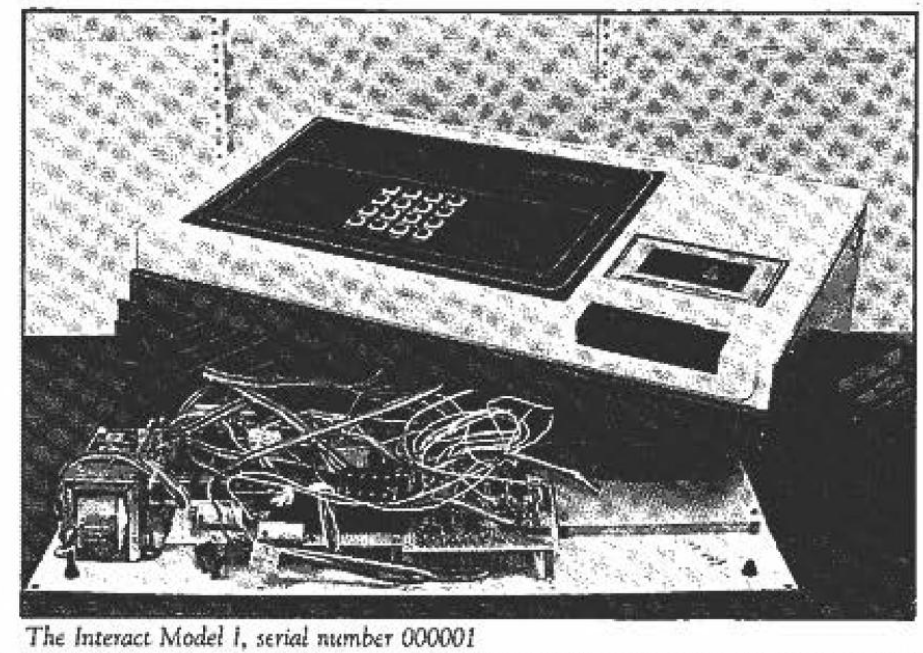
You’ll notice no keyboard! According to Walker the system originally had 4K of ram and was meant to be a “console/computer” more along the lines of the Bally Astrocade.
Post-launch, Walker blames “marketing” and “quality control” as issues leading to the company’s downfall. They provided “virtually no support for the machines once sold”; essentially, they were a hardware company with very little experience with manufacturing or marketing (speaking of the CEO, this matches with Lochner’s past experience focused on services for corporate machines).
New products were, announced when they were in little more than the “idea” stage, months before they realistically could be delivered. A user newsletter was talked about, but never produced. Customer letters, inquiries, and phone calls went unanswered, promises were made that were not kept, and Interact came to be viewed as completely unresponsive to the users needs.
(Note she’s not blaming anything about inadequacy of the hardware — trying for too much capability at too low a cost, as I mentioned last time — but she’s also with the company still trying to sell it.)
I think the two stories (development as early as ’76, or only starting in ’78) can be reconciled, given Walker’s reference to new products talked up while in the “idea” phase. My guess is Interact was in some kind of development phase during at least ’77, but spinning their wheels with “idea” meetings trying to land a perfect cost-effective product, resulting in “prototype box” shown earlier. By ’78 they were needing to get something just out the door so landed an experienced engineer (Barnich) to get what was now a “computer” done fast, keeping the same external design.
Micro Video was originally founded in June 1979 looking for ways to use the Interact for promotional displays and businesses. Interact’s slow fall led to their essentially taking over mid-stream; Walker even mentions completing “the software Interact had left unfinished”.

Dave Ross, president of Micro Video (shown above), discusses the software process in the same newsletter as the history capsule.
Some programs, like EZEDIT, were started at Interact before it went out of business, and Micro Video finished them. Some, like Earth Outpost, are patterned after popular arcade games. In this case, it’s a space war type game. Some, like STAR TRACK or our new Troll Hole Adventure, were inspired by games popular on other, larger computer systems. The best source, however, is user requests. The MONITOR, for example, was developed because many people asked to have machine language access.
Regarding Troll Hole specifically: he later mentions programs “submitted by outside programmers must meet certain criteria” so not everything was internal, but his particular phrasing from the long quote above implies Troll Hole was made internally, and there’s something from the content of the game itself (which I’ll get to later) which implies the same. So I think “Long Playing Software” was an attempt at a “company sub-name” for a particular branch of game, leveraging the common ads for adventure games that tout how many hours they take to play. If so, they only used the name once, and when published Mysterious Mansion in 1982 (made by what seems to be the same programmer) it just is given as being by Micro Video.
Heading back to the content, I really did not have many rooms left to find, but I still found the game tough to crack, as the density of object use (and re-use, and the ability to use something the wrong way) was high. I also didn’t have a conception of just how much physical modeling the game was using.

Marked rooms are new.
This is only missing the maze, which I’ll show later but turns out to be a simple grid (and manages to bump up the room count for the ads).
I’ll describe puzzles in more or less the order I solved them, although this involves jumping around the map quite a bit. To start, I had some VITAMINS that were TOO DRY to eat, and while the jug of milk was described as TOO SOUR I still thought it had to apply somehow. I realized the game lets you simply empty the milk and re-fill it back at the pond with water, making the vitamins edible.
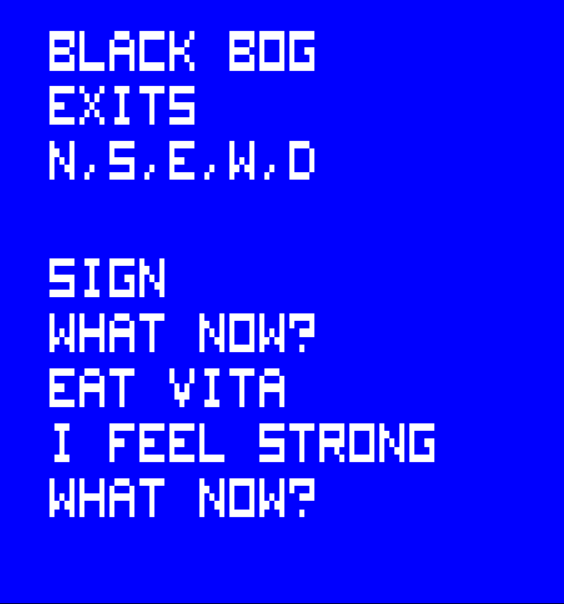
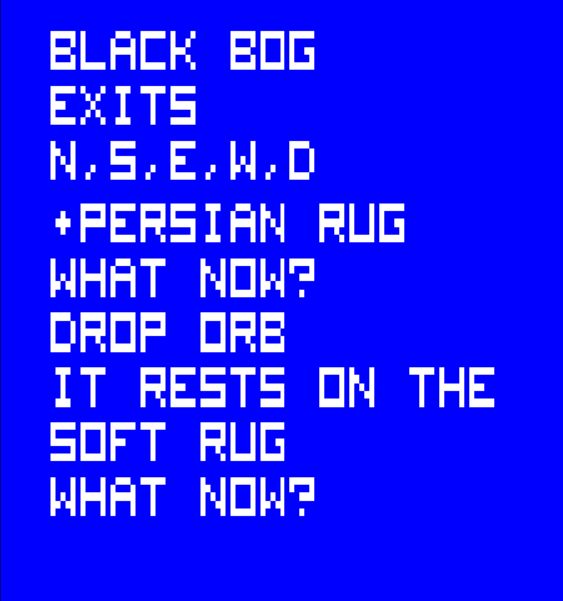
With the increased strength I was able to pick up the “stone chair” from the living room, freeing up the Persian rug to get moved over to the treasures. Also, as I suspected, it allowed for dropping the “fragile” treasure (the orb) without it breaking.
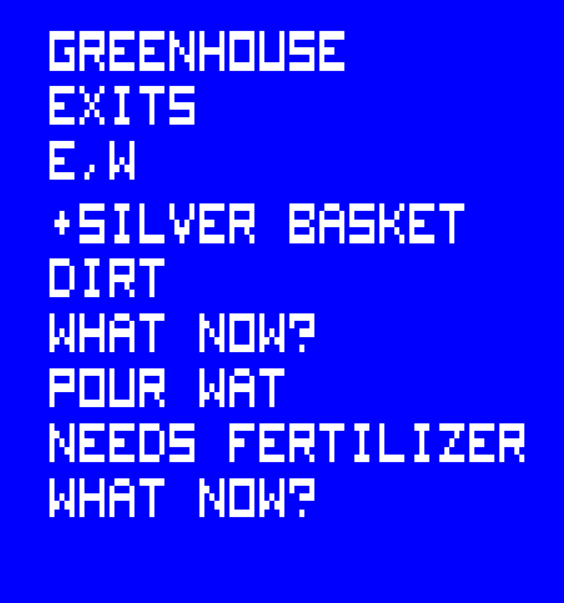
I also incidentally realized that the jug of water used for the vitamins had a second use and could be poured at the greenhouse, but I was told that it needed nutrients. I figured (at the time) I needed to wait for an object later.
I also managed to work out the both the ELF and the “singing sword” which was giving electric shocks. The ELF, for mysterious reasons, will be happy if (while holding the cereal, the TROLL CRUNCHIES) if you FEED ELF and drop an animal call. The WELCOME MAT that was hiding the key will COVER THE FLOOR if you drop it…

…and you are safely able to pull out the sword, turning it from a SINGING SWORD into a SILENT SWORD (but still at treasure).
The mat is not described as rubber, so this requires a leap of abductive reasoning both in terms of the composition of the mat and the mechanics behind the sword (not just “magic”).
Poking at the various obstacles left, I was stuck for a while. I managed to realize I could LOOK (CEREAL) BOX again in order to find some PIECES OF GLASS (trying to eat straight out of the box is the only way in the game I’ve found to die, so at least it gets hinted) and they are described as lenses.
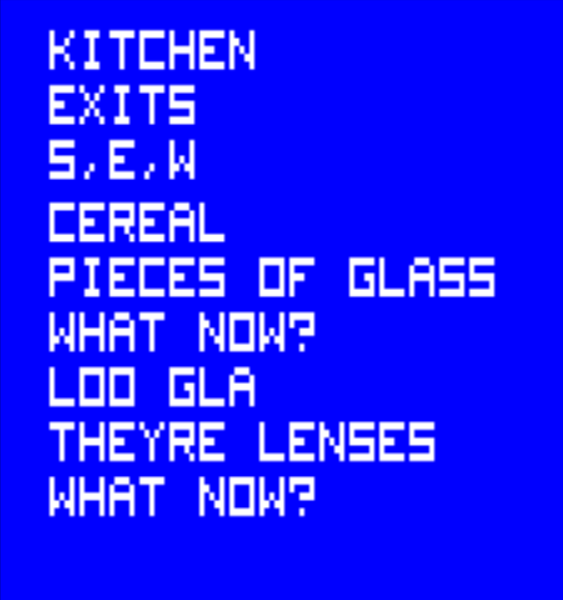
I had a paper tube and had been itching to find somewhere to use my BUILD command, so I tried BUILD TELESCOPE and it somehow worked.
Unfortunately, that still didn’t get anywhere on the parts I was stuck: the cobra, the nutrients, the screwed-in cover, the orc, the gold nugget that doesn’t fit through the door. I had vague suspicion perhaps I was softlocked, and in fact I was: every single puzzle I listed was now unsolvable.
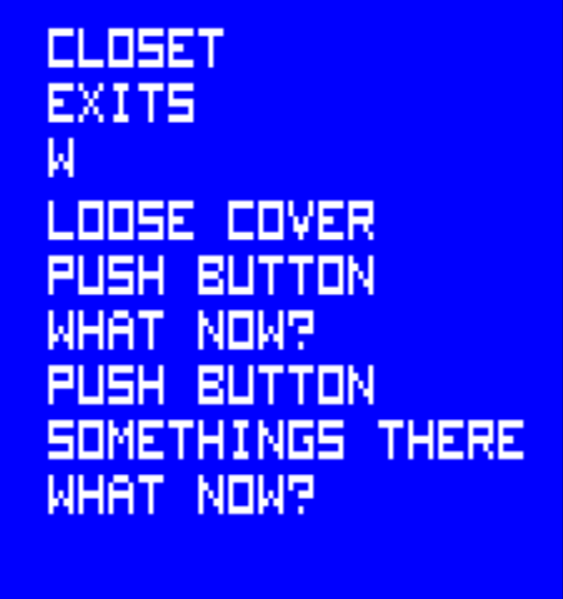
Thinking in these terms (what items did I have in the past where maybe I burned something I shouldn’t have?) I realized the screw might be the kind where a dime would work just as well as a screwdriver. The dime I had spent on the pay toilet (in order to get the paper tube) but what if I used it to UNSCREW first?
Indeed this works, and it reveals a button leading to a new room, a DEN.
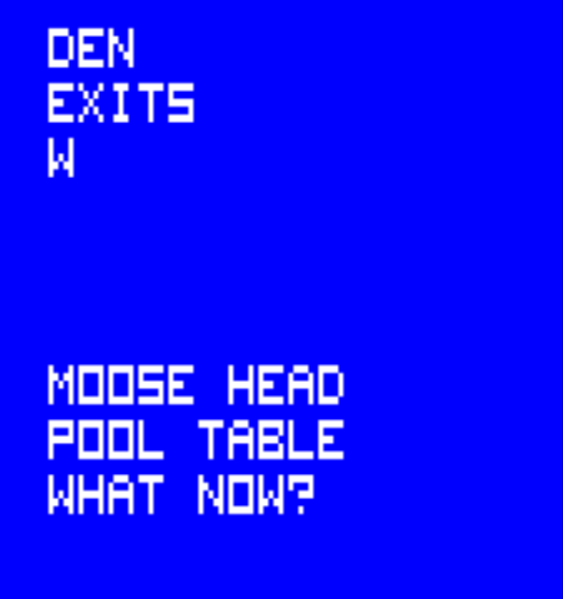
Now it is safe to spend the dime.
The ANIMAL CALL I had from the ELF I had tried in every single room (BLOW CALL) with no luck, but since this was a new room I tried it here.
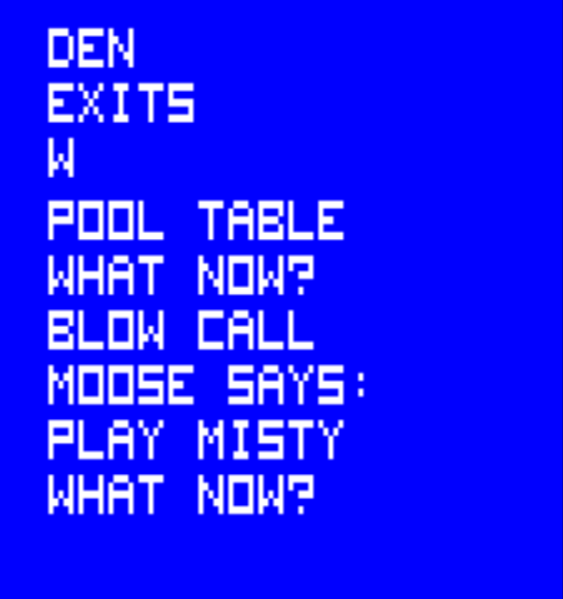
Taking this hint back over to the piano that I couldn’t open, I tried not PLAY PIANO but PLAY MISTY. It unlocked the piano, revealing a GOLDEN FLUTE.
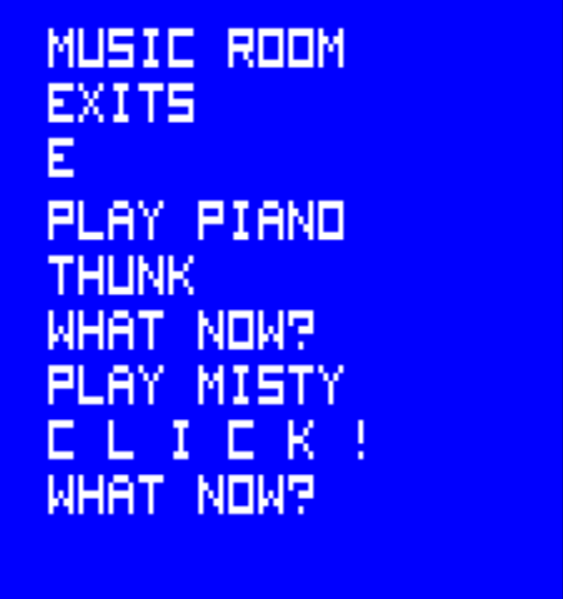
Already suspecting I needed a flute for the cobra, I went and played the flute and found that the COBRA DANCES.
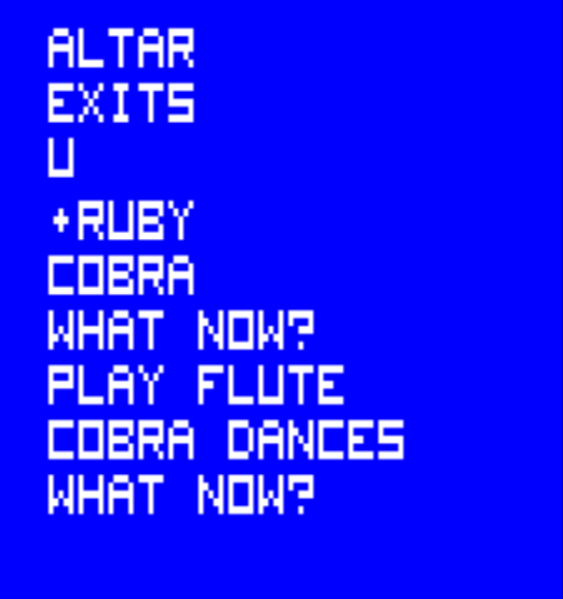
That isn’t helpful by itself, but the game is tricky with its item use again: if you take the SILVER BASKET from back at the greenhouse and drop it before playing, the cobra will crawl inside, snake-charmer style.
The cobra can then be toted over to the ORC and released, where it will chase the orc away, sort of a sideways variant of bird-vs-snake from Crowther/Woods.
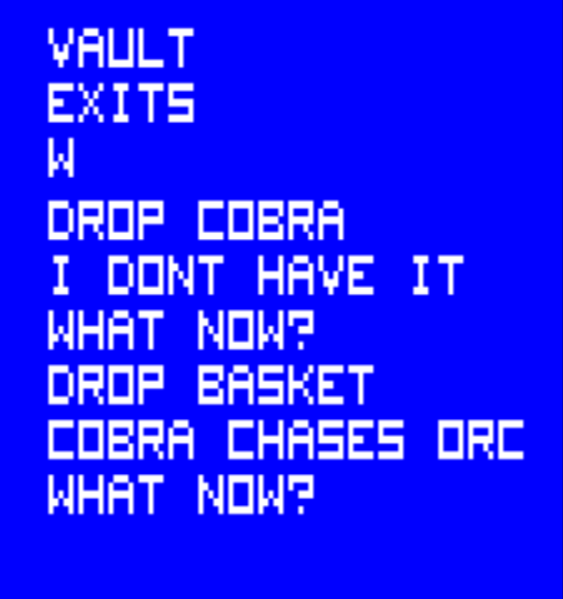
This allows grabbing the crown for another treasure ticked off, plus access to the cave. The cave only leads to one place, though, a canyon view with a BILLBOARD. I had the telescope already (trying to use it everywhere to no effect) but I instantly knew here is where it applied.
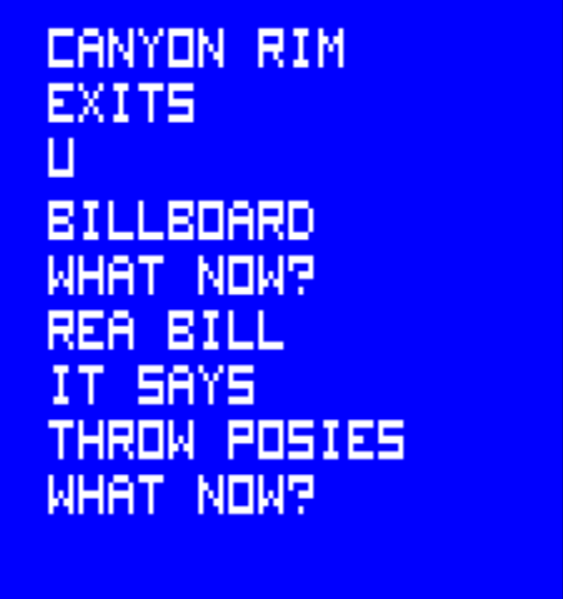
Remember the fertilizer? Now is when that part stops our progress. Using the same logic as with the dime, I realized I had dumped the milk somewhere random, but maybe sour milk could potentially be helpful in gardening? (Can anyone confirm or deny this one? Sounds suspicious.)
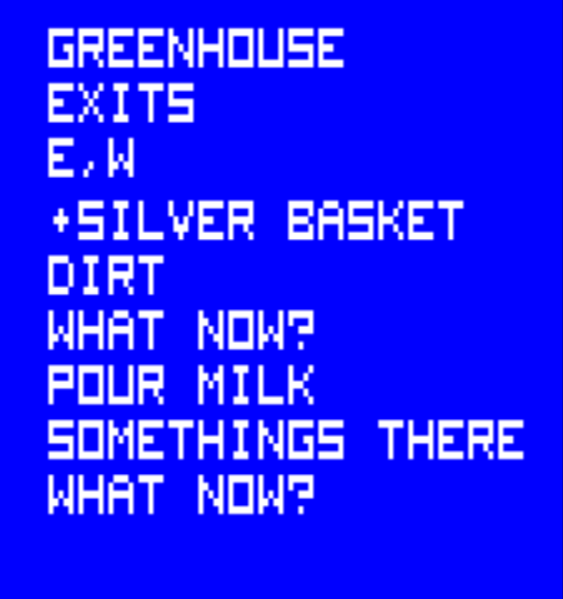
This causes flowers to pop up that can be thrown at the canyon rim. (By the way, if you’re keeping track, yes, this involves a fair number of game-restarts. Fortunately the whole area is small.)
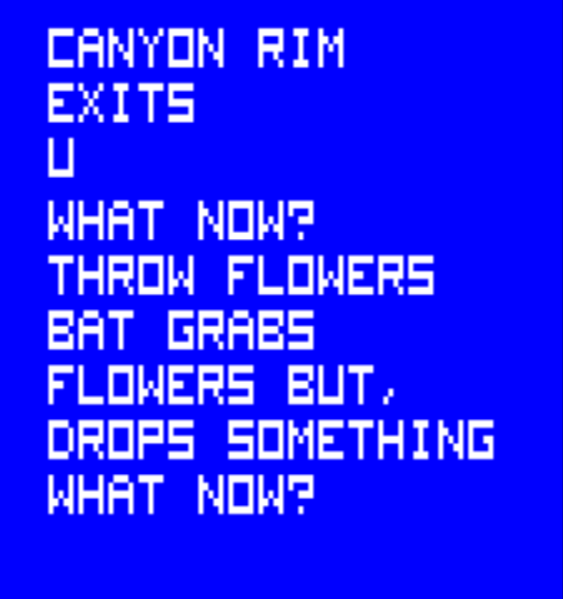
The bat that takes the flowers straightforwardly drops a PEARL, one of the treasures.
That’s still not everything yet! Back by the den there was a rope with a balloon, where I found by popping the balloon I could get the rope. Having gotten this far with no use for a rope (including at the canyon) I was starting to get suspicious, and keeping my eye on my verb list, tested out UNTIE ROPE (fortunately this one didn’t need a game restart because I was already in a restart after a restart and I hadn’t bothered to deal with the balloon yet).
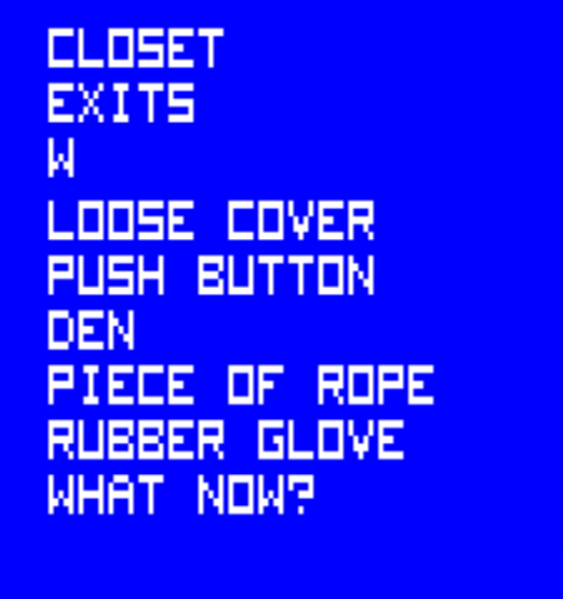
The rubber glove let me pick up the frog, which I had noted long back was described as being too slippery, but I had no use for it. I ended up needing to refer to a hint left by Gus Brasil in the comments (thanks!) about how there’s a secret passage from the living room. That had to refer to the picture, but the picture was highly resistant to my efforts to MOVE PICTURE and PUSH PICTURE and so forth. The description is 2 EVIL EYES STARE BACK AT YOU and that message the mirror revealed from long back said PICK 2. I guess they’re supposed to go together, because you can PUSH or POKE the eyes specifically.
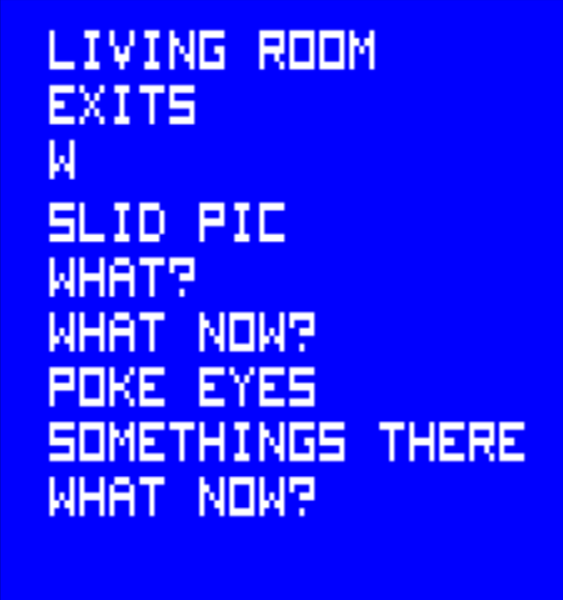
This is a second-level noun. I’ve referred to this concept before (see Inca Curse), but just to recap, this is a noun that’s mentioned inside the description of another noun. When game prepares ahead for this, it makes for richer interaction (or in the case of Earthquake San Francisco 1906, a shaggy dog joke). With Troll Hole this is the only place the trick occurs, but I’ll give it a little forgiveness in that
a.) nearly every item is important, so it’s curious for the picture not to be, meaning I had an eye on it still
b.) it has the PICK 2 hint
The SOMETHING that is THERE is a new passage leading to a new room: a spider with a golden web.
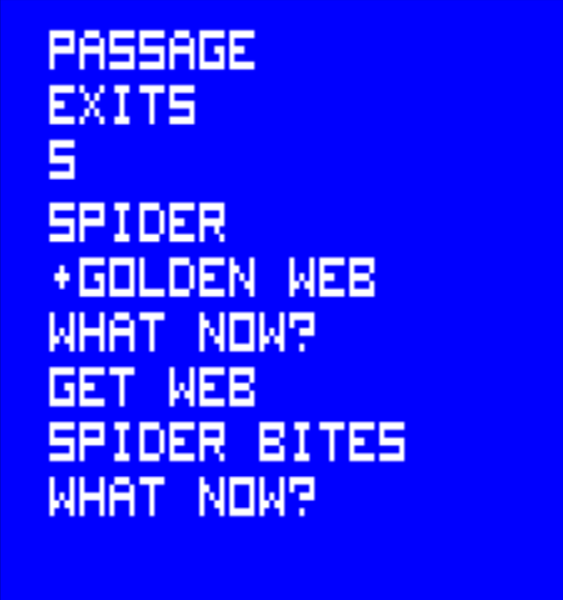
Being low on resources — just the frog really — it wasn’t hard to put the two together.
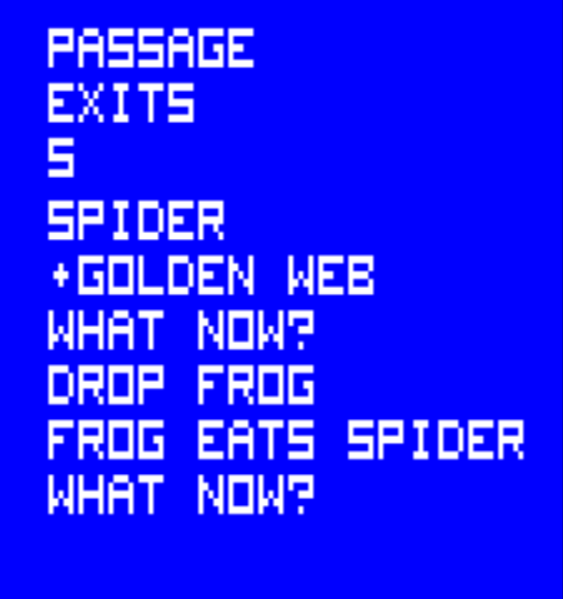
While the GOLDEN WEB counts as a treasure, taking it also opens another passage to a maze. Every room in the maze allows you to go N/S/E/W/U/D and there are 16 of them, but realizing the gimmick makes things go faster:
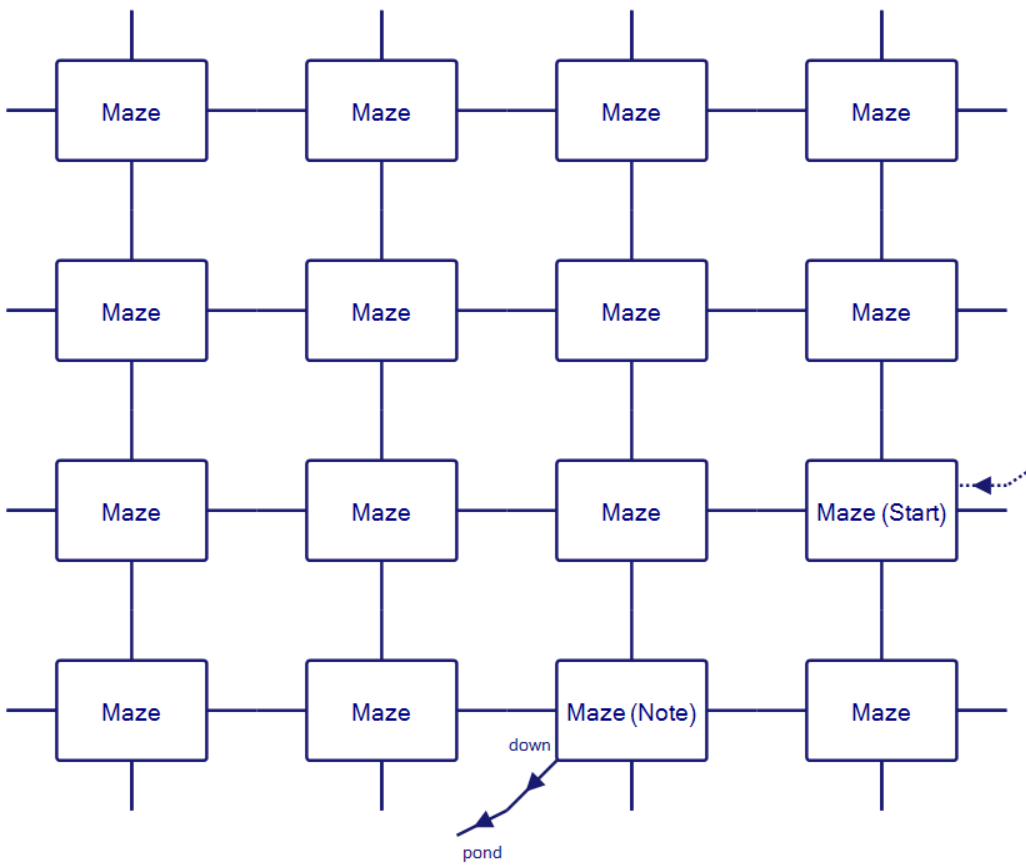
The edges of the grid wrap around; I have not marked up/down exits as they are more irregular, but the only one that is important is the one that escapes, going down to the POND. It is in a room with a NOTE.
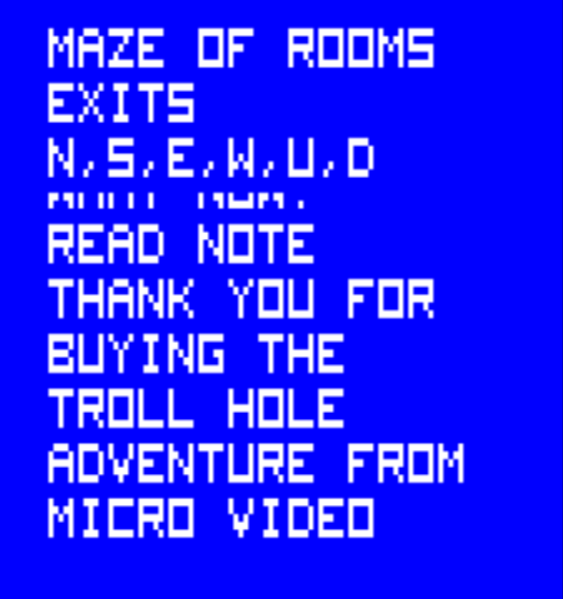
The note also says YOU PROBABLY THOUGHT THIS WAS A MAP BUT IT ISN’T! It’s just a “thank you for playing” type note, but it solely gives credit to MICRO VIDEO. This suggests to me it was written for Micro Video and the LONG PLAYING SOFTWARE name that shows at the start was added as an afterthought meant for marketing.
The maze route is what’s needed to get out the gold nugget (otherwise there are no treasures / useful items). And that’s all ten!
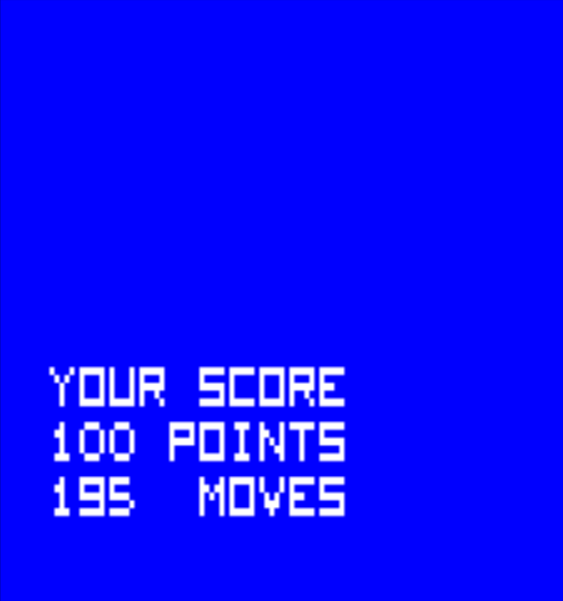
This turned out to be far more satisfying than I expected. I wasn’t originally playing with “rich object properties” in mind due to the 8K memory space, but everything is modeled properly as opposed to being faked (unlike, ahem, certain recent games we’ve seen on more capable systems). The softlocks are irritating but they are also part of what makes the difficulty of the game work; having a DIME immediately where it gets used makes it quite likely a player will use it up quickly and not even think about it for the other obstacle (unscrewing a cover). In other words, the old-school design finesse at least has a rationale, and creates a puzzle that is hard to duplicate otherwise.
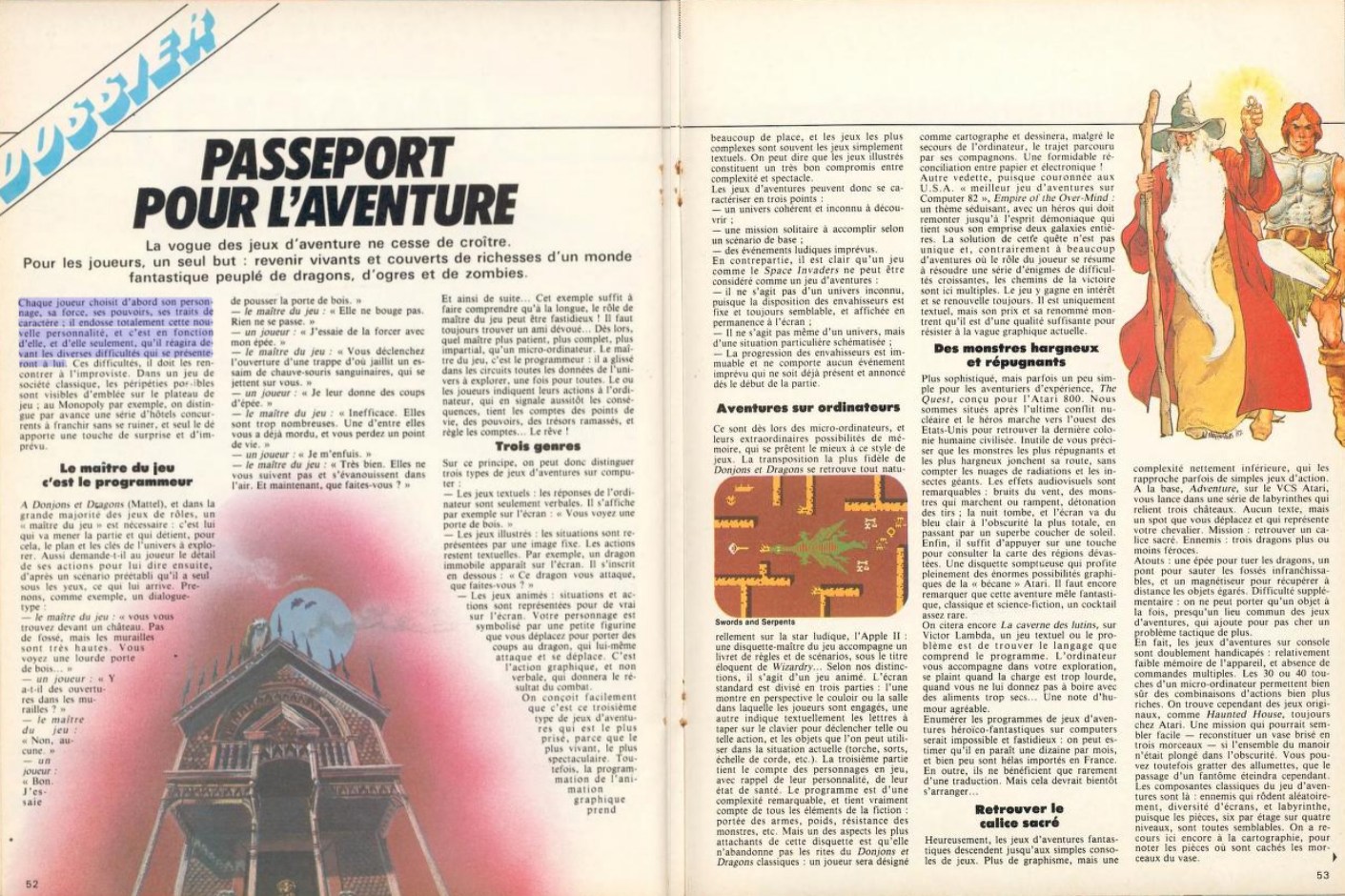
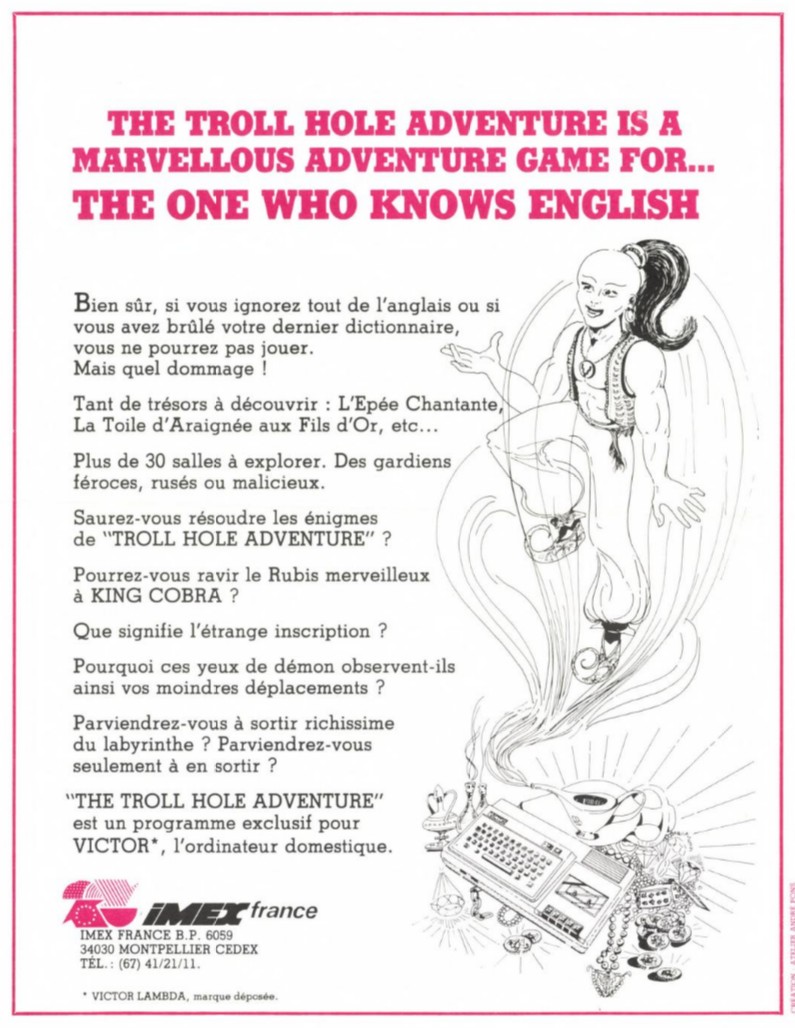
The ad in a French magazine at the top of this post starting selling the game in English before it was even translated; it did get a translation in 1982, which was notable just for the sheer scarcity of adventure games translated into French available. Tilt from January 1983 calls out the shortage and mentions La caverne des lutins in a multi-page spread about the format, but because it doesn’t have enough text adventures, it talks about things like Atari 2600 Adventure and the Intellivision game Swords and Serpents.
So this game ended up being wildly obscure in the United States (rare computer, even rarer cassette, only dumped quite recently and found thanks to Gus Brasil) but still ended up being seminal elsewhere due to the happenstance of Mr. Coll’s purchase of Interact’s design. (At the Computer Adventure Solution Archive, while La caverne des lutins has had an entry since 2011, as of this writing The Troll Hole Adventure isn’t mentioned at all.)
Unfortunately, this didn’t happen with Micro Video’s 1982 game (Mysterious Mansion). I don’t know the circumstances of why, but I think it may be even more obscure than Troll Hole; I will investigate when I return to the Interact soon.
When Kenneth Lochner was hired by Dartmouth away from Montana State College as a programmer in 1964, he had been working in computers for four years. Lochner in particular had been teaching FORTRAN and had been having a miserable time, not due to FORTRAN itself, but due to student experiences in using punch cards:
Returning to the motivation for this system, let it be noted that anyone who has taught a symbolic system to beginning programmers is aware that syntax and logical errors abound in the programs they produce. One can visualize the standard scene in a [IBM] 1620 installation: a group of students loading the assembler, loading and unloading the punch hopper, entering the object deck, watching the typewriter anxiously, and then staring in increasing bewilderment at a machine which has halted, cleared or is in an infinite loop.
Lochner was integral to helping develop Dartmouth’s legendary time-sharing system, where a large computer could have its time divided into slices, and multiple users could then access the same machine simultaneously using terminals (as opposed to slow batch punch cards and their resulting infinite loops). Notably he developed “communication files” which were essentially an early version of UNIX pipes, gluing together the output of one operation/command to become the input of another.
As Lochner wrote in an article describing Dartmouth’s progress, “The main purpose for developing the System was to provide for teaching computing to almost all Dartmouth students, including those concentrating in the Social Sciences and Humanities. A second purpose was to tap the hitherto unrealized wealth of small computer problems related to the everyday research activities of a college faculty, small problems that would never be initiated if the turn-around time were as long as a single day.”
The explosion of computing at Dartmouth that followed led to a fair number of important early programs that later showed up in David Ahl’s books like ANIMAL, but for our story today we need to keep following Ken Lochner, as he became restless at Dartmouth, first helping Ford develop their own time-sharing system using a Philco 212…

Picture of internals of a Philco 212. Source.
…and then in 1969 he went over to the newly founded Cyphernetics in Ann Arbor, Michigan, a company focused on commercial time-sharing services. They were successful enough to be bought by Automatic Data Processing in 1975, and two years later Lochner left to found Interact Electronics to work on an entirely new project: the design of a personal computer.

Master Artwork, Interact Model One Home Computer, April 10, 1978. Source.
The Interact Model One aka Interact Home Computer aka Interact Family Computer was designed during 1978 in Lochner’s now-home turf of Michigan. Lochner hired Rick Barnich as the lead engineer (the picture above is his) and was keen on keeping the price tag low, or as Barnich later bluntly stated, “Cost targets dictated the design.” The price managed to stay under $500, making it cheaper than any of the Trinity (PET, TRS-80, Apple II) and even capable of color.
I haven’t seen any interview with Lochner specifically about the restrictions given, but it seems like the goals for the base model were:
a.) cheaper than the three major competitors
b.) color graphics
c.) enough memory to handle a reasonable-sized program (8K RAM, 2K ROM, not dropping to, say, 1K like the initial ZX80)
maybe with the same populist goals in mind as the Dartmouth Time Sharing system had, making something capable enough for both programmers and artists. The sacrifice led to a “chiclet” keyboard, low-res graphics, and a very chunky text mode.
Unfortunately, putting the three main goals together without compromise flew too close to the sun. Interact tried to be generous with their software line (they gave thirteen tapes away on new units; tapes of course were super-cheap) and at the time, Lochner was quoted as saying:
Software is the pivotal point in the mass marketing of a personal computer.
Apparently, it wasn’t, as the machine more or less flopped in a year, selling only a few thousand units (compare to the Commodore PET breaking 200,000). The only reason it became notable is because of Michel Henric Coll, who picked up the technology and re-tooled it for the French market (switching, for example, to an AZERTY keyboard). Letting him take over the story:
I discovered the Interact Model 1 during a trip to the United States in July 1979. It was as simple as can be. I had read a description of it in an American technical magazine. Upon arriving in Ann Arbor, I called Interact and explained that I wanted to sell their product in France. James Scotton, Interact’s general manager, sent a white Cadillac to pick me up at my hotel and devoted the entire day to me. The deal was quickly concluded.
He signed an agreement in September (not long before Interact collapsed and the stock was liquidated), and then:
Having obtained the right to sell Interact under my own brand, I immediately renamed it Victor Lambda. It was during a group brainstorming session organized during a business development internship I attended at the Toulouse business school from January to July 1979 that I discovered the name. We had already decided on the first name, Victor, thanks to the computer’s help. We were looking for the name. Tired, someone blurted out: is it really important to spend so much time on this research to sell a standard computer to a standard customer? [“Standard” or “typical” being “lambda” in French.] It clicked. We had found it.
The Victor Lambda was renamed in a later iteration the Hector. Rather unusually for a program on an obscure system, today’s game has a French translation, and the reason why is the success of the Hector (which took a lot of its software line from the already-existing US line).

Coll showing off disk drives for the Victor II in 1983, a peripheral not available with the Interact base model.
When Interact Electronics folded a year after their hardware launch, they had their stock bought and product continued via Micro Video (a company technically started when Interact was still alive, but only by a few months) and NCE/CHC (a mail order house). While the number of units sold never passed “thousands”, they kept the flame alive for die-hard fans all the way through the 80s.
With die-hard fans come fan groups, one of them being based on out Detroit; from 1980 and 1982 they distributed their Interaction newsletter. The December 1980 issue mentions two adventure games.
This first is a port of Chaffee’s Quest done by Dave Schwab; not trivial due to the font size, and the fact the Interact uses one-dimensional arrays and the original Quest used a two-dimensional array. It is notable mostly in that Schwab got permission from Chaffee for distribution; most of the authors we’ve seen do ports didn’t bother to ask.
The second is a brand-new game specifically for the Interact. It is by “Long Playing Software” with no author given.

The “at last” suggests this is another manifestation of the strong desire for authors to put some form of Adventure on absolutely every system. Despite the enlarged text size, this manages to feel like a “normal” adventure game, just with highly clipped text. Since the memory capacity is higher than the VIC-20, there’s a bit more depth in description than, say, Hospital adventure.
The ad copy inquires
Can you get the priceless ruby from the King Cobra? What does that strange inscription say? Why do evil eyes watch your every move? Can you solve these and the many other mysteries of THE TROLL HOLE ADVENTURE??? Will you come out rich? Will you come out at all?
and as it implies, this is another Treasure Hunt where we gather all the treasures in the world and put them in a central location. (The line about being “rich” implies we are absconding away with the treasures this time. The troll probably is smelly and deserves it.)

The sign is here just to inform us this is where the treasures go.
To the east there is a pond with a frog (ITS SLIPPERY)…

…and otherwise that’s all of the above-ground. Heading down into the titular Hole leads to an ENTRY WAY.

The front door is locked, but the ENTRY MAT hides a key so that is a quickly-resolved problem. The issue for me starting was the lamp, which refused to light. Mucking about with the shovel I found that DIG back in the starting location revealed a BIC LIGHTER, but even with the lighter in hand I was unable to get the game to understand any permutation of LIGHT LAMP I could think of.

This game does let you plunge ahead and interact with things in the dark — there’s no grues — but you need the light first to know what the items are.
I resorted to making my verb list; fortunately, the game was fairly polite, giving one response (H U H ! ! !) for when it understood a verb but was otherwise confused…

…and a different response (WHAT?) for when the verb is missing from the game’s vocabulary altogether. This let me use my usual list, which was a relief given the number of games lately I’ve been playing with broken bespoke parsers.

However, this still wasn’t enough! Not every verb available is on the list, and I finally found FLICK LIGHTER is what the game wanted (this will be the first time I’ve used FLICK in an adventure game). Just for completeness, I have also found UNS(CREW) but have not been able to apply it yet.

I’ve only found 15 rooms and there’s allegedly 30, so there’s still a fair amount of game to go. At the start there’s a LIVING ROOM with a STONE CHAIR (too heavy to move), a PICTURE, and a PERSIAN RUG (a treasure). The rug has the stone chair on it, so I have been unable so far to retrieve that particular treasure.

Further west is a CEREAL BOX with some CEREAL (TROLL TOASTIES), and a jug of milk that is described as SOUR if you try to chug it.

Turning south, there’s an ARMS ROOM that has an ELF and a SINGING SWORD. I have been unable to interact with the elf; the sword gives a shock when trying to take it, and is described as being stuck in a stone.

Nearby is a BATHROOM with a PAY TOILET and a MIRROR. You can take the MIRROR revealing VITAMINS and a DIME, then INSERT DIME to get into the toilet and find a PAPER TUBE. I have not found a use for the tube. Upon trying to eat the vitamins the game says they are TOO DRY. If you try to BREAK MIRROR you die from it shattering.

Further on to the east is a Vault with a ORC GUARD, CROWN (treasure), and CAVE. The orc prevents taking the treasure or entering the cave. I assume the sword gets used here.
Returning back to the sword and turning south, there’s a TEA ROOM with a CRYSTAL ORB (glowing softly) and an INSCRIPTION. The inscription seems to be written “backwards” and you can read it if you are holding the mirror from the bathroom. (IT SAYS PICK 2, and I have no idea what this is referring to yet.)

No idea if breaking the mirror here is bad, but there’s an inventory limit so I need to keep juggling.
Adjacent is a closet with a BALLOON ON ROPE and a COVER; the balloon has “GOT BUMPS” and the cover is “SCREWED IN”. You can break the balloon leaving a rope but I haven’t found a use for the rope, and it is possible the balloon needs to be used first.
Back where the TEA ROOM was there’s one last branch leading down to an ALTAR with a cobra and a ruby. I have not managed to defeat the cobra but the game does recognize FLUTE as a noun. (I should also note from the verb list that MAKE and BUILD are both verbs, so we may just need to gather supplies and make our own, that is, MAKE FLUTE. The paper tube was suggestive but just holding that wasn’t enough to cause it to work.)
Rewinding back to the kitchen with the sour milk, heading west leads to a room that is too bright to see if you’re holding the lamp. If you’re not holding the lamp, the room is totally dark. The solution is to drop the lamp off before entering and bring in the orb instead, which will give a light enough glow to be visible.
There’s a gold nugget in the room but it is too big to bring up the troll hole. There must be another route to the start.

The are rooms past this, so after noting the HALLWAY on the object list, the right procedure is to grab the lamp, step back into the room with it being too bright, but GO HALLWAY anyway since you’ll keep moving forward.


Not much of note in either room yet. You can pick up a HANDFUL OF DIRT in the greenhouse.
This turned out to be surprisingly complicated and dense. None of the treasures are giveaways; even the crystal orb I haven’t scored yet (dropping it smashes the orb, just like the mirror). To recap the obstacles…
- there’s an orc guarding a cave and a crown
- a cobra guards a ruby
- a gold nugget can’t be brought up the hole to where the treasures go
- the rug can’t be removed from under the stone chair yet
- the crystal orb can’t be dropped (probably getting the rug will fix this)
- the singing sword can’t be pulled
- the cover can’t be unscrewed
…on top of objects like the sour milk currently remaining unused. I’ve been finding myself thinking more in terms of a standard adventure rather than a minimalist 8K effort. I’m tempted to try the French version (La caverne des lutins, released 1982) to see if the changed text gives any different textual hints that might help me out. I will take any suggestions people have, and I’ll even take spoilers if someone has beaten the game (in ROT13 format only, though, please).
(The second part of this post is here.)
I’ve finished the game entirely without hints. It was decidedly easier than Masquerade. My previous post is needed for context.
I don’t think my success had anything to do with getting better at figuring out Dale Johnson’s logic; even with some intentional softlock (aka “walking dead”) points, everything is genuinely clued better here than his other games.

Via the Gallery of Undiscovered Entities.
Last time I was puzzled by a boulder I couldn’t move and a cave blasting wind. I had neglected to LOOK BOULDER, having “CARVINGS” on the side:

After some contemplation, I decided “total” strength was referring to not having your strength be split by holding items in inventory, as the “single” man is alone. Dropping everything and pushing the boulder worked.

With the wind stopped, while it meant the cave couldn’t be entered from this direction, over by the cliff it mentions you might be able to “jump” down and there no longer is any wind interfering.

Giving a full map from here:

The slope you land on goes a long way down, with a lifejacket, an ax, and a crank findable along the way. At the very bottom is a boulder (the same boulder you pushed earlier) and when trying to push it from the other side the game indicates you need some leverage. It also has some extra writing.

Going back up, I didn’t have much to noodle with other than the catapult, so I tried INSERT CRANK on catapult and found that it fit. I was then able to TURN CRANK before pushing the button again, leading to landing in a different (safer) spot.


I had already tried using the ax in various places with no luck, but at the bottom of the tree it clearly is intended to be used except the game says it isn’t sharp enough. Oho, so that was what the grinder is for! One restored save game later and re-creating the catapult jump:


The hole lets you jump back in the long sloping passage, but obnoxiously, the pole can’t come up as it is too big. However, it gets used specifically for going down and getting leverage on the boulder. This results in what would normally be a fatal plunge into water except we’ve got the lifejacket now:

SWIM a few times and a trading ship will appear.

I tried walking away and got thrown off the ship, with a message that indicated I could have traded something (on the trading ship, d’oh). You lose everything but the lifejacket when plunging into the water, so that’s the only thing you have to trade. It fortunately works:

The thread left over from sewing up the green uniform works to STRING LUTE (…pretty sure that wouldn’t work in real life, but I’ll accept the cartoon logic in a toon-game). I then took the lute over to the stage with the merry men, and found singing a song put them to sleep.

I was stuck a bit until I remembered that doing DANCE earlier changed their description to ROWDY (also, LOOK ME indicates we are covered with tomatoes). Doing the rowdy-dance first and then playing lute was the right sequence to keep the crowd from falling asleep prematurely:

Marion had indicated we weren’t charming enough, so the charm was clearly the right item to get to her next. (Except she doesn’t like the tomatoes; you need to go back to the POOL and CLEAN ME first.)


From here I was very stuck trying to work out she went; everything including the wedding chapel was empty. Of course Tuck had left prematurely when I gave the penny, so I re-did the sequence while holding on to the penny and found both Marion and Tuck at the chapel once I finished. (For a beginner player, this still seems like the thing mostly like to stump them, because it’s a softlock that can happen from an action long before the final result.)


Marion disappears, and the only obstacle left seems to be the Sherriff of Nottingham. The telescope clearly was pointing the way through, though, and the description mentions a mounting bracket. The only thing complicated enough to hold a mounting bracket was the catapult.

With the telescope mounted, you can TURN CRANK again to get the catapult to zero in on a different target. (This feels vaguely off since you could have technically turned the crank a second time before, but I think the implication is you are implicitly using the telescope to help aim, and otherwise it would be too exact a shot.)

I did PUSH BUTTON expecting some kind of dramatic showdown, but that turned out to be the very last action of the game.

Honestly, it worked for me? I liked the idea of taking a classic story but telling a story about the story, rather than what everyone would normally be expecting. The fact regular characters could be used allows for the “fan fiction shortcut” (like we saw with Trek Adventure) where a complex character can be painted with broad strokes, meaning Friar Tuck walking off with money isn’t surprising, nor the Merry Men being a bit temperamental about what constitutes a good performance. The textual hints were quite good at nudging actions the right direction and if it weren’t for the softlocks I’d be perfectly chipper handing this game off to an absolute beginner; as things stand, I’d probably start them with something like Transylvania but this would land early on the list.
At least the graphics were good while they lasted Dav Halle had developed his own system called Zoom Grafix which partly explains why they somehow lept ahead of Sierra to be alongside Polarware in terms of quality. I’ve been having trouble articulating what artistic direction I’d give to Sierra (assuming I could be alongside their past-artists). Consider an average shot from Time Zone.

The face is bizarre in a way that never gets glanced upon in Sherwood. Depth is particularly flat (notice the bricks). I do wonder if this was partly a technical restriction; if you go back to the finale screen of Sherwood, you’ll notice both characters are made up almost entirely of curves, while the vector-line aspect of the Time Zone thief above is hard to avoid.
In the end it was likely just about professionalization and technical issues. Both Sherwood Forest and Masquerade dealt with real artists, while Time Zone had most of its art cranked at speed by a fresh teenager. Sierra did what they could with their resources, and both Polarware and Phoenix represented the next level of advancement in the software. The combination was enough to cause a vast gulf in the look between the games (not even bringing up how Mask of the Sun had a dedicated team of artists at work).
Phoenix incidentally didn’t last much longer after Masquerade. Quoting the founder Ron Unrath:
By 1984, the software world has changed significantly. Very large companies such as Disney and Hasbro were starting to get involved in publishing, and advertising rates were going up. It was difficult for a small company like Phoenix to compete.
They did make it a little longer under the name American Eagle, even publishing another Dale Johnson game, FrakTured FaebLes, with art by fan favorite Rick Incrocci. Unless some new information is unearthed we’ll need to wait until 1985 to get there.
My prediction is still even looking ahead to just 1983 the art will be on the higher-quality side, but we need to make it there first. So coming up: a computer that failed completely in the United States, only to be given a second life in France.
Sherwood Forest is from Phoenix Software. We last saw them with The Queen of Phobos and Masquerade; the latter was written by today’s author (Dale Johnson) before Sherwood Forest but wasn’t published with final art until much later (1984). Today’s game has a different artist, Dav Holle (he is in the “thanks to” credits of Queen of Phobos).
This is the last time we’ll see Phoenix for this blog.
Unlike the Robin Hood game we’ve looked at already (or Sierra On-Line’s take) we’re not re-creating all of Robin Hood’s adventures in his battle with the Sheriff of Nottingham, but rather just trying to get married.
Welcome to Sherwood Forest. Robin needs your help. He doesn’t seem to remember who he is or that he was supposed to marry the beautiful Maid Marion today. It must have been that nasty bump on the head he took while fighting the Sheriff of Nottingham the other day.
From what I have gathered so far, the famous elements of Robin Hood are in but they are getting used in a much sillier way (Little John guards a log bridge, but rather than wanting a quarterstaff fight, he is looking for Robin Hood, since somehow he doesn’t recognize you, and you need to make a green uniform first … look, we’ll get there).
The game is in machine code; quoting Dav Holle about the process:
I did the drawings, and the image compression and decompression, the disk bootloader, and animation and data input code. Dale would get the text strings from my data input, and would parse the text and come up with the text response. His code would also tell me what location should be drawn and what objects or characters should be drawn in the scene, and my code would draw that stuff as needed. All of Sherwood Forest was written in assembler.
The difficulty of Masquerade was listed as Class 5; this is Class 3 so is allegedly easier. I say allegedly because Johnson games always tilted fairly hard; at least the opening was reasonable to do.

Regarding the graphics, notice how the title screen refers to animation. The screen above animates the eyes. The first room has an owl which also has animated eyes.

There’s nothing as extensive here as Sands of Egypt with screen scrolling or Temple of the Sun of a complete motion; it’s all small spots like a banner moving, but it complements the overall cartoon style.

You start out in a quite open area where you’re free to wander. To the immediate west is a pond that has a “grindstone”. To the east there’s a haystack where the text suggest it can be burned to find something inside.


Giving out the full starting map…

…let’s start our tour by going west to the Castle. There’s a taxman on the way, where Robin Hood can do his thing and ROB him.


Robbing the taxman yields a bag of gold dust we’ll be using shortly.

The Sheriff of Nottingham at the castle is pointing at the poster as shown above. It’s supposed to be “you’re going to land in jail” but it’s curious in how it could simultaneously refer to the (future) couple being royalty somehow.
Turning north, down a “well traveled road”, up next comes a Faire.

The gold dust goes to the beggar at the entrance (probably, Johnson isn’t above using “wrong” routes for items).
HE SAYS, “THANKS! HERE’S SOMETHING YOU MIGHT NEED.” HE TAKES THE GOLD, DROPS A SMALL FLINT, AND DISAPPEARS.
The west there’s a dock with no boats (I assume this is for a story event later)…

…and to the north is Maid Marion at a kissing booth.

If you go for KISS MARION, though, she says “SORRY HONEY, BUT YOU JUST AREN’T CHARMING ENOUGH.” (It’s like an amnesia plot, except everyone except the main character has forgotten who he is.) I’m not sure how to deal with her yet, but I’m guessing I won’t have the item(s) needed until the end of the game.
One of the main mechanics to try in every room is LOOK, because it seems to be fairly well behaved about telling you what is genuinely interactable; it may not always be obvious from the initial room description and picture. Here, LOOK reveals and awning — the green awning above the booth — that you should take.

One last place at the Faire I haven’t figured out yet is a stage, with some “Merry Men” watching. You can hop on to the stage and DANCE or SING and get some tomatoes thrown in your direction but I don’t know yet the use of this, other than the MERRY MEN change to ROWDY MERRY MEN.


Circling around the map some more, there’s a tailor and a blacksmith in the center of town. The blacksmith has a broken grinder but while holding the grindstone you can FIX GRINDER. I don’t know the use of this yet. Rather more helpfully it has some STEEL you can pick up.

Before doing the tailor, let’s do a quick stop back at the haystack, because flint + steel means we can now MAKE FIRE.

(The smoke is animated.) In addition to finding the needle in the haystack, if you LOOK ASHES twice you can find some THREAD followed by a penny. Take the thread, needle, and green awning back over to the tailor.

The tailor is out but there’s a note indicating you can drop things off if you want. Dropping off the green awning, thread, and needle, and then leaving and coming back:

This happens immediately, there’s no realistic time passing. I had left the penny for payment but it turned out not to be needed. I guess we have an account.
Circling around our tour further, there’s a wedding chapel with Friar Tuck who talks about “quickie service”.

I gave the penny over and he said he would “put it in the offering plate next Sunday” then left. I assume there’s some important ramification to all this later (either that or I did something wrong).

Little John next! (Again, sort of a “reverse amnesia” plot.) The green uniform is enough to convince him to leave opening the way through…

…although I should point out if you just try to attack him, it results in a death (my first of the game; I thought maybe we needed to wrestle rather than use quarterstaffs).

On to the cave he mentioned! Here I am mostly stuck. First off comes a catapult:

There’s a button on the catapult. If you push it the game automatically assumes you are climbing on before pushing, and it launches you to death. I don’t know if there’s some syntax for launching an item, but I’m guessing the game is fishing for the player providing a method of safe landing.

Further on, there’s one branch over to a “cliff” with heavy winds, where jumping also leads to death.

Finally, there’s the warned-about cave with heavy winds, in addition to a boulder too heavy to be moved.

Trying to GO CAVE results in “A TREMENDOUS WIND” catching you and blowing you to a “ROCKY GRAVE”.
To summarize, I have as open problems the Sheriff, the boat dock, kissing Maid Marion, the merry men at the stage, the catapult, the cliff, and the cave. I don’t have any unused items other than the grinding wheel (which can’t be moved). Unlike Time Adventure, Johnson is the sort of author willing to re-use items, but I get the intuition I’m missing something simple here with what I have. No hints though, please, this has been enjoyable to play so far!


 Renga in Blue