I’ve finished the game, and you’ll need to have read my previous post to make sense of this one.
Before I get back into the game proper, I’d like to do a side trip into history, as this game (and the Softside adventures in general) relate to something interesting about the history of “public domain” distribution companies and preservation as a whole. With that in mind let’s visit the retailer Currys (“Britain’s Electrical Specialists”) before they were bought by Dixons in 1983–
(Ad allegedly from 1980 according to the channel. Does anyone know what is up with UK stores and their lack of apostrophes?)
In 1982, Les Ellingham was a special project manager at Currys, and had the task to launch selling Atari 8-bit computers. Ellingham proposed starting a user’s group in order to more easily show off the Ataris, and got space in a pub in an upstairs room. This was the genesis of BUG (the Birmingham Users’ Group).
The first night — advertised on posters — ended up having a “massive turnout”, and based on the success of the group, they started also producing a newsletter (edited by Ellingham).

The founder himself, writing in Input/Output:
The main objective is to encourage Atari owners in this country to begin writing their own programs, but for those of you who are not as yet ready there are plenty of reviews and hints, and tips for beginners. The magazine started in conjunction with the Birmingham User Group, but is now produced independently although several BUG members contribute material. It has grown quite quickly and many people see it as the UK equivalent to ANALOG magazine.
Page 6 had a strong focus on adventures, trying to keep up a list of every Atari adventure game ever made, and issue 10 (July/August 1984) was a “special issue” devoted solely to the game genre.

Like many Users’ Groups from the 80s, they had a library of public domain software, and unlike many Users’ Groups from the 80s, the entire library is online. Disk #82 (Super Adventures 6) includes both Robin Hood and The Mouse That Ate Chicago (for Atari, of course). The games aren’t technically public domain in the legal sense, being copyrighted by Softside, but if a game showed up in a magazine disk, it seemed to be fair game for any distributors. For those of us delving into gaming history, that’s not necessarily a bad thing: I get the impression that the BUG specifically might be the reason we have a complete Atari collection for the Softside Adventure of the Month games (whereas for TRS-80, for instance, we only have a small selection); one of the early games in the series (I think Alien Adventure?) I only found on a Page 6 disk.
One practical upshot is that when Dale Dobson ran through the complete series, he played the Atari versions which were the only ones readily available. The other upshot is that while Robin Hood had a bug for Atari not present in the Apple, the reverse seems to be true here.
The mice were supposed to be wandering about more than they were (Sam in particular can be lethal), but for some reason their routine was broken. I switched over to Atari and was able to finish the game.
First, a detail I missed that is purely for story. The mountain that was too steep to climb has a cave, and you can enter it to see what happened to Hans and the Professor.
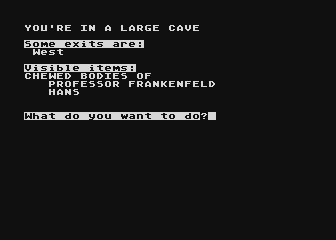
Second, something I had attempted in the Apple version which worked, except (I think) I had the emulator speed too high. If you go to the river where the fight happened and try to GO RIVER, there’s a message…
GASP…PANT…CHOKE
…which made me think I just couldn’t swim. There had briefly flashed on the screen another room, wherein our intrepid mouse-slayer had gone to the bottom of the river.

You need to HOLD BREATH in order to do this. Fortunately, this maneuver is repeated in other games so I puzzled it out quickly. The same command shows up in The Institute, Secret Kingdom, Savage Island (both parts) and Nuclear Sub.
It immediately occurred to me — especially given the CAT BURGALAR reference when trying to enter a house — that I needed some milk. The grocery store was still open and obliged, and I was able to drop the saucer and use POUR BOTTLE to get a saucer with milk. I tried taking it to the front of the (still-closed) pet store but no cats were being attracted.
Back when I was playing the Apple II version I wandered for many, many turns waiting for the stores to be open. Knowing Kirsch’s prior game had “drama timing” I figured that was the case here (that is, certain events aren’t based on X turns passing, but rather when the player reaches goal Y). As another example, even in the Atari version the mice don’t start wandering until you enter the powerline area.

I was unsure the first time around, but I think the way to read this scene is that Maja is the super-huge mouse, and the other three are simply regular-huge. That is, Maja is Godzilla, King of the Monsters, and can only be taken down by a similarly impressive monster.
Sam is the one that was hanging on Hancock Building (and is the only one of the four that killed me by hanging around). The other two are Puji and Fiji, neither who get descriptions.
To take down Puji, you shoot the powerlines while the critter is nearby. Trying to shoot powerlines at any other time simply has the shot miss, and yes, this doesn’t make any sense.

(Game design reflection moment: this game is supposed to be about discovering the weaknesses of the mice. It is perfectly fair to have only this one succumb to an electrical trap — maybe Sam and Fiji are are too alert and dodge, and Maja is so big he just ignores it. What isn’t fair is having the shot itself fail when the wrong mouse is in the room. In a way, this is trying to make the gameplay easier by preventing a softlock — probably the powerline-shooting would only work once. In a Lucasarts style game, this would be unacceptable. However, I honestly would rather have had the mouse-evasion-plus-softlock scene; I would have known to reload, and it would have given a strong clue I was on the wrong track, just with the wrong victim. A simple UNDO feature, not yet invented, would have evaded this being a real gameplay problem, or the game could even auto-UNDO, similar to failing at one of the grail traps in Indiana Jones and the Last Crusade. The general design lesson is that preventing failure doesn’t always make life easier on the player.)
I was on the right track with cheese on the bridge (which never worked, likely because the cheese-hungry Fiji never goes that way); if you DROP CHEESE at the quicksand your player will automatically put it in as a trap.
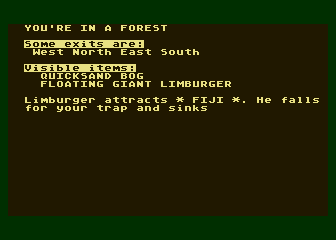
This is the moment where the music store but not the pet store opens. The music store, just like the grocery store, is happy to give you something for free if they have it in stock.
(Game design reflection moment #2: drama time is often seen as the superior alternative to constant time advance, but drama time can be so cryptic to decipher that it only works in particular circumstances. Certainly Outer Wilds did fine with not only constant time advance but real time. So while it is a more “modern” approach — maybe not the best term since it shows up in 1981 — it isn’t automatically better.)
The music store was more cryptic than the grocery store to figure out but fortunately there aren’t that many instruments that are associated with mice. We need a flute.

With flute in hand you can attract Sam’s attention; as long as you’re in the room adjacent, PLAY FLUTE will cause him to come towards you. Given the bridge hadn’t been used yet, it was quickly clear what route I needed to take.
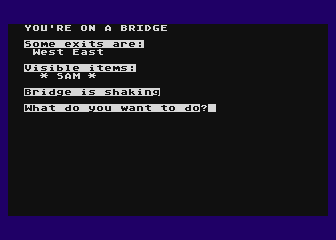

There’s still the giant, Maja, to contend with, but fortunately the pet store has decided to open. (I get what the author was after using drama time. Due to the plot beat which you’ll see shortly Maja’s defeat has to come last. If I was designing this I would have made the method of defeating the smaller mice available right away and had some specific connection to the pet store owner — maybe they’re too afraid to come until they’ve seen you’ve defeated 3 out of 4, and then they’re willing to let you in.)
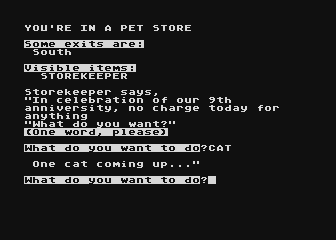
I already had the milk-in-a-saucer so I already had a plan: take the cat to the enlarging machine, drop the saucer off to keep him from wandering, activate the machine, and … profit?
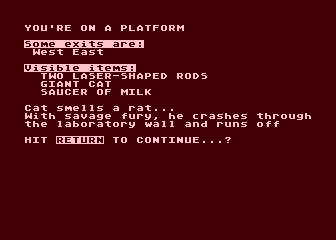

This could have been Kirsch’s best game so far. Everything is one connected puzzle. Nearly all the action the player takes is participatory comedy, which is rare even in modern games. The writing could be better but generally hits the right tone all the way through.
However, details matter enough in game design it was still a miss. The promise of being able to figure out the mouse vulnerabilities via observation was an illusion. The movement was random and a bit broken (and even in the Atari version, I had a dead mouse randomly appear somewhere it wasn’t supposed to be). The powerlines puzzle was broken in an effort to keep the wrong mouse from being fried.
At least the ending was comedic and satisfying at the same time.

Yes, I’m sure that won’t be a problem at all.
Coming up: the return of the warm, soothing glow of Apple II graphics.


 Renga in Blue
“This is the moment where the music store but not the music store opens.”
Is this Zen or just a typo?
where you can buy tea and no tea at the same time
fixed, thanks!
I just remembered that the power lines trick is so iconic that it’s how the giant robot defeats the squid creature in the Beastie Boys’ Intergalactic.