There are authors from prior centuries that used to be world famous that are now obscure, or at least known more to niche enthusiasts rather than the wider public. The most popular and most prolific author of the mid-19th century was G. M. W. Reynolds, even beating out Dickens.
“Again these awful words!” ejaculated the old man, casting trembling glances around him.
“Yes—again those words,” echoed the mysterious guest, looking with his fierce burning eyes into the glazed orbs of the aged shepherd. “And now learn their import!” he continued, in a solemn tone. “Knowest thou not that there is a belief in many parts of our native land that at particular seasons certain doomed men throw off the human shape and take that of ravenous wolves?”
— From Wagner, the Wehr-Wolf, one of the earliest werewolf novels
The best selling poet in all of American history was Rod McKuen, who sold 60 million books and performed to a rapt audience at Carnegie Hall. I won’t expose you to the horror, but I can link a sample at the blog post entitled Slightly Creepy Seventies Bad Poetry.
Carlos Castaneda used to be a household name, with his first three books (The Teachings of Don Juan: A Yaqui Way of Knowledge, A Separate Reality, and Journey to Ixtlan) making him a superstar anthropologist; the third book earned him a doctorate from UCLA. They describes his dealings with an indigenous Yaqui sorcerer who used peyote for drug trips and had mystical powers like levitation and teleportation. Castaneda was taught to see the inner workings of the universe, while dispensing 1960s New Age wisdom to us, the readers.
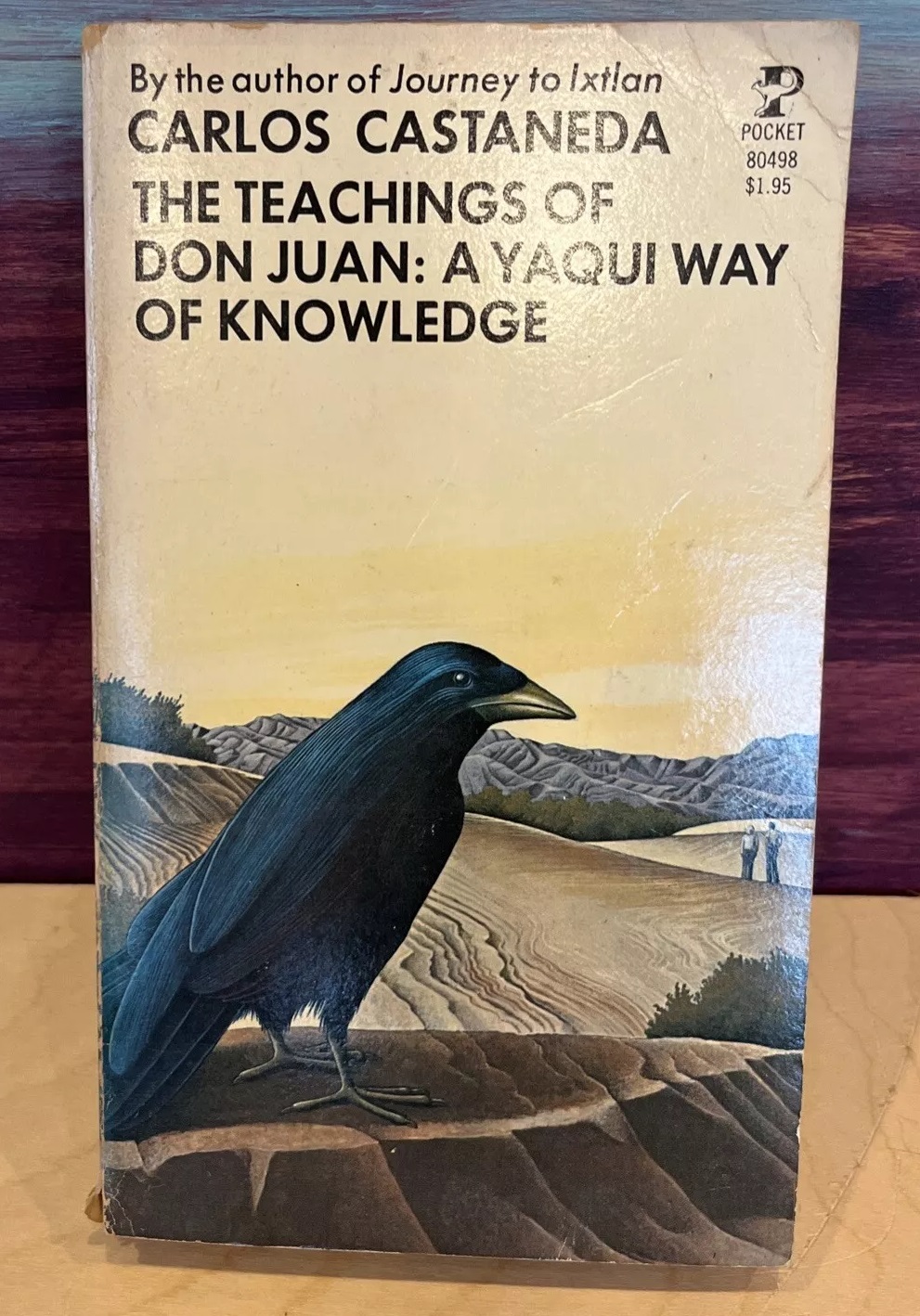
Via eBay. $2.70 or best offer. They printed a lot of these.
While the first book held to strong reviews, critics eventually started to question the veracity of the events — not as in doubting the magic, but doubting Castaneda ever even had dealings with the Yaqui. The Yaqui did not experiment with peyote (to the disappointment of drug enthusiasts who took pilgrimages based on the books) and before Castaneda died in 1998 it was pretty well established he was a fraud.
Ken Kalish, the author of today’s game, El Diablero, does not seem to have been a true believer. He used the novels instead as a sort of fictional background universe.
Carlos Castenada purported to be an anthropologist who found himself apprenticed to a Yaqui Indian ‘sorcerer’ from Northern Mexico, called Don Juan Matus. Although there were unfortunately some things which involved peyote, the basic idea dealt with an underlying reality beneath common perception (which even Aristotle referred to).
This interview was admittedly given long after 1982, but I don’t think the peyote comment would be compatible with him being a superfan at the time. (The word “purported” and quote marks around “sorcerer” also are suggestive.)
After graduating college, Kalish worked in construction for two years. He used some of the money he made to get into stock speculation (he listened to a radio station for market reports). He ended up making a “nice profit” which he used to obtain a computer:
So now, I was walking out of the Radio Shack with a Color Computer, chock full with a whopping 4k of RAM and also with Color Basic from a fairly new company called Microsoft. Before too long, I’d piggybacked two sets of 16k chips with a soldering iron, had bought the Microworks editor/assembler cartridge and was thinking, “hmm, I think I’ll write a game or two myself on this thing. The first step will be to figure out how to clear the screen…”
He became (relatively) famous for his Tandy CoCo work, mainly for his arcade-style games like Starship Chameleon.
El Diablero is his only text adventure.
You awake, dazed and confused, in the middle of a desert. You had been learning the techniques of sorcery from an old man. The old man told you that an evil Sorcerer, a “diablero”, had become his enemy. Now, your teacher is missing and you are alone. Worse still, you cannot remember those spells you had already learnt.
I admit I like the vibes from the setup, even if the actual gameplay effect is to drop us in a large desert.

I played the Tandy CoCo version. There’s also a port of this for the Dragon.

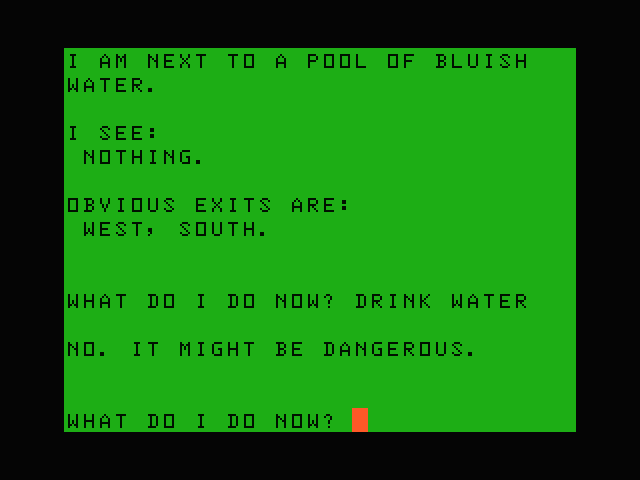
You can’t drink from the yellow pool; you are told it is too dangerous. The same is true for a “bluish” pool at the northeast corner of the map.
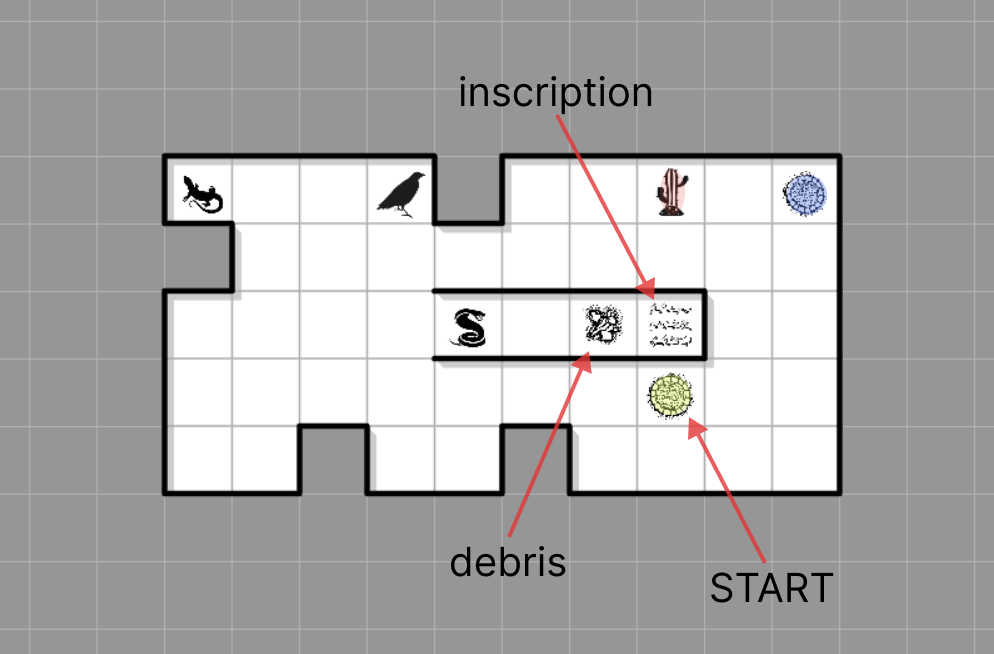
The room descriptions are mostly the same (“I am in a desert, cactus all around.”) with only slight variations (“I am in a desert. There is a large slab of rock nearby.”) and the map is rectilinear, so rather than my usual node-based method I drew things out like they were a tabletop RPG map:
Before taking the tour, I should mention one unusual property of the game: while you can type GO NORTH, GO EAST, etc. to travel around, the usual abbreviations of N, E, W, and S don’t work. The game instead uses the keyboard’s arrow keys, and you don’t have to hit ENTER after pressing, say, right arrow. However, because the author wanted to reserve “left arrow” for deleting text, the symbol @ gets used for autotyping GO WEST. This sort of makes sense if you look at a real keyboard:

Via the TRS-80 CoCo Wiki.
The emulator I was using (XRoar) maps the “[” key to “@”, so to keep my sanity I wrote an AutoHotKey script to make the left arrow work normally.
#Requires AutoHotkey v2.0
#Singleinstance#HotIf WinActive(“XRoar”)
Left::[
(Just in case anyone wants to follow in my footsteps. The game itself is here.)
So back to the map! There’s three animals (lizard, crow, snake). You’re allowed to take the crow…

…the lizard “scampers away” from you…

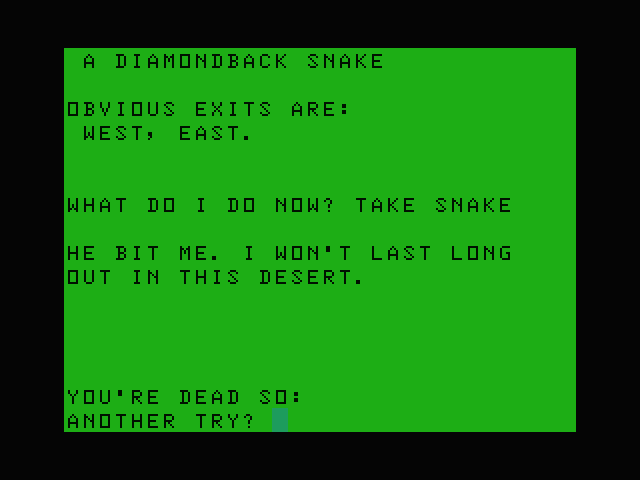
…and trying to take the snake kills you. Fair enough.
The snake marks the entrance to a small canyon section. Here’s a repeat of the map so you don’t have to scroll back:
There’s some “debris” in the canyon you can just take, and a “strange inscription” that is “not understandable” if you try to read it.

Other than the two pools I already mentioned, the only place left of note is a blighted cactus.

I haven’t gotten anything productive to happen, nor have I had any indications of somehow having the ability to cast magic. El Diablero, the nemesis, is out there somewhere; it is unclear if we are meant to defeat him or run away.
This game is allegedly quite hard, as mentioned by both by the interviewer of Ken Kalish and Alastair, who wrote the CASA Solution Archive entry. There’s even a GameFAQs entry (very unusual for an obscure text adventure) which claims the playtime is about 12 hours. I’ve got my week clear just for this game, and I’m even willing to do one of those “well, I haven’t made progress but here’s what I’m pondering” type posts. (It’s been a while, eh? I’m still quite interested in the thought process of solving puzzles, not just plowing through history.) Please hold off both spoilers and speculation for now, I’ll let y’all know when it is time to start piling on.


 Renga in Blue

I thought it was Castaneda when you mentioned a con-artist anthropologist in your last post, but thought it was unlikely!
On IF-related matters: started playing the Phoenix game Xeno (no spoilers please, I feel I’ve spoilered myself enough just by glancing at the source…even if that didn’t spoil very much). Not got very far in it at all, but there were two small aha moments.
Xeno is pretty legendary, but I haven’t played it so I’m not able to give spoilers!
I don’t know yet how close the integration is with the Castaneda books, but the otherworld-mood definitely matches.
Carlos Castaneda text adventures? Rod McKuen poetry excerpts? The content of this site seems to be getting weirder and weirder, and frankly I’m all for it!
Also, maybe it’s just me, but the hideous Coco/Dragon green background suits the atmosphere of this game perfectly…
I think my best color scheme was with Williamsburg Adventure but I didn’t twiddle any knobs for this one, it felt like the default was appropriate.
I was going to say that I thought McKuen was still well known because of “MacArthur Park.” But it turns out that “MacArthur Park,” written by Jimmy Webb, and McKuen covered it as “The Middle of MacArthur Park,” on his album Alone… which I don’t understand. If you are a big-time poet aren’t you supposed to write the words to your own album? Also McKuen recorded a <i>lot</i> of albums. He did at least write/translate “seasons in the sun” which is from a Jacques Brel song, and I think still remembered a bit (I’m not going to slag him off for it much because translating songs is <i>hard</i>). Anyway Rupi Kaur is like the most famous poet now.
I’m glad you disclaimed spoilers and speculation because I got nothing.
Rupi Kaur last I checked was around 12 million books. Could get there.
Getting to the next part uses a Castaneda reference, kind of, although I worked it out without knowing the book counterpart. It helps to have the verb list
CUT, SWIM, READ, BREAK, OPEN, DRINK, THROW, SMASH, PUSH, PULL, TURN,
SAY, SHOOT, WEAR, LIFT, GAZE
Next post today or tomorrow, not sure yet
Pingback: El Diablero: The Mirror World | Renga in Blue