I’ve finished the game, and be sure you’ve read my other posts before this one.
(Also, in my second post, by accident I picked a screenshot of a room that held a secret. Can you find it before I talk about the room?)
A little more on the nonsense-monster name thing to kick things off —
Rather more famous than The Gostak is the Lewis Carroll poem Jabberwocky.
‘Twas brillig, and the slithy toves
Did gyre and gimble in the wabe:
All mimsy were the borogoves,
And the mome raths outgrabe.“Beware the Jabberwock, my son!
The jaws that bite, the claws that catch!
Beware the Jubjub bird, and shun
The frumious Bandersnatch!”
The poem is an exercise in imaginary words, although curiously enough, if you look up pictures of the Jabberwock they most look the same. That’s because it was illustrated by John Tenniel in Through the Looking-Glass, the novel where the poem appears.

More interesting visually is the Bandersnatch; if you look up depictions, there’s a wider variety of approaches.

A collage made up from random pictures on an image search. I needed to add a date restriction to avoid clashing with the Netflix show.
There’s still some curious consistency having a creature that walks on legs, but the creature is still in a real sense an infinite beast encompassed by every visualization at once.
That’s not how I thought of Qedejiv the weird and Baryon the bad and Zezotim the blue and (most importantly) the Elmralat. I didn’t have (nor do I have) any visualization at all. I am not one someone with aphantasia: I visualize things all the time. But with no reference, I had them stored more conceptually. If you were to insist on a visualization, Rob’s comparison to “weird fantasy” like Dark Crystal seems appropriate, and that may even be what the author was thinking of. But I only had that feeling as a mood, not something concrete I could draw.

Last time I had found a horn which seemed to have three “Brothers”, including the green treasure I had already found, with some link to the Elmralat: “Held afore from him / Who bears the Elm / And in a secret / place was hid it.” I supposed I needed to bring the red book to Remesis the red and the blue book to Zezotim the blue, getting the last two treasures, and then something special would happen with the horn and it would then need to go to the Elmralat. Then I would defeat and/or make friends with the Elmralat, Mortal Kombat style.

I was correct on all accounts.

The one major catch is that I was running into a game-crashing bug.

I tried many different combinations of horn and treasure and I just couldn’t get them to combine; either they would stay separate or I’d get the crashing bug. I finally broke down and went for a walkthrough.

Spellcheck, you don’t know what a Sesajat is? This is from the legendary Dorothy Millard (or Irene), author of many C64 adventure games. These include Yellow Peril, where you are trapped in a world where everything is yellow.
Fortunately, I didn’t spoil much other than one puzzle later which would have been very difficult to get. As far as why my game was bugged, I don’t know, but the intent seems to be you pick up the horn first, then pick up the treasures, and they automatically go in the horn if you do so. (This wasn’t happening in my game, but I think you need to have found the horn before any treasures for things to work correctly.)

Back on track! I took the horn over to the Elmralat and hit one of the nasty parts of the game, which Dorothy observes: the travel agent sends you somewhere random. I got lucky the first time I played and got sent to the correct place (the forest) but on this playthrough I got sent all the way back to the ice river and had to walk back and try the travel agent again, hoping for a more favorable outcome.

The incorrect first destination.

The right way to land.
Toting the horn to over to our infinite beast, the first obvious thing to try is to GIVE it just like you do with the books, and that turns out to be correct:

This gives you a “frosted glass sphere”. Dropping the glass sphere breaks it but reveals an “iron key”.
A key. Hum. No idea.
OK, here is where the secret comes up. I think the only plausible way you could work this out is wondering about the verb “pull” off the list, which hasn’t been useful anywhere at all. It is only useful here:

You can pull the floorboards.


This leads to yet another map section, although a mercifully small one.

On the way there’s a healing balm that’s the only useful potion of the game…
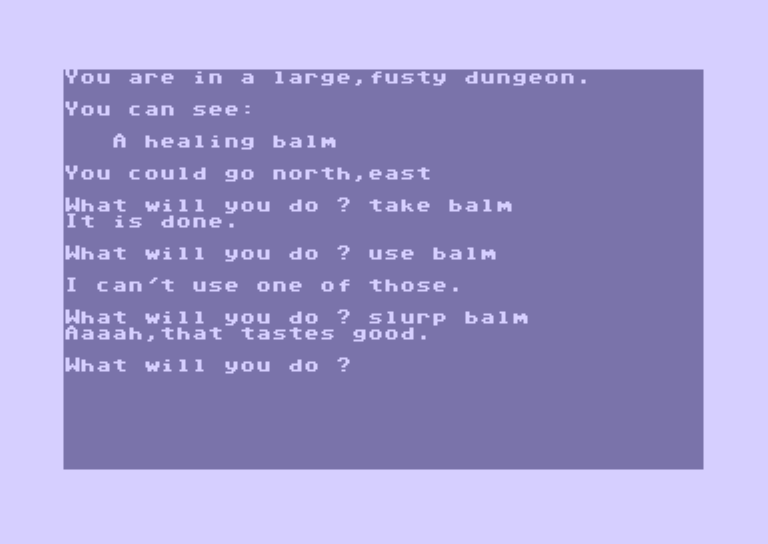
…the kind of room which doesn’t describe the room but rather gives your mental state…

…and some creative writing.

I guess that explains what the letters on the talisman are. This is meant to be a hint that the talisman is about to be relevant.
North of here is a locked cell with a padlock, where you can use the key. Inside is an old man.

Who is he? An old hero? A king? A random chosen one? Admittedly this makes about as much sense as The Dark Crystal did if you don’t read the companion books.

There: that’s our quest. Now we need to take the TREASURE OF CESIS all the way back to the start, and we’ve won.

Sorry for spoiling your secret, C. Steadman.
I more or less ignored all the treasures; as I already theorized, there’s no “storage place” so the point total is based on what you’re holding, so it’s pretty limited anyway. You could scoop up the gold pieces (I didn’t bother) for a few points, but given they’re placed at random and I’m already past the 14,000 point mark, I think I’m fine stopping there.
I can’t say I appreciated the bugs, the dodgy parser, or the floorboards puzzle (where out of the 150+ rooms you have to guess that one room description might hold a secret) but the atmosphere was utterly unique, and probably wouldn’t have worked in any other context than a cryptic C64 game.
Coming up: Dragon’s Keep, for the Apple II.


 Renga in Blue
It’s interesting to note that the for loop in line 1885 goes up to 46 without ensuring there are so many characters. The question is why it doesn’t always crash…
Continuing onwards with irrelevant musical references, as is my wont: Frumious Bandersnatch were one of the better San Francisco 60s psych bands, and “All mimsy were the borogoves” was the title of 90s Norwegian prog/psych folk revivalists The Smell of Incense’s first album. Lewis Carroll and psychedelia – Two great tastes that taste great together!
The provenance of this game is indeed mysterious. If Steadman was Australian, it would seem like Dorothy Millard herself, or maybe Helen Stuckey, would be the most likely to know first hand. Maybe they’ll chime in one day. Otherwise, the only (unlikely) lead I came up with is a review of Annals of Rome in the March, 1987 issue of the Amstrad PCW 8000 Plus magazine, written by a (presumably British) Chris Steadman.