We, have, so far, had three adventure games from Japan, all in 1982:
Omotesando Adventure (ASCII, from April)
Mystery House (Micro Cabin, from June)
Mystery House II (Micro Cabin, from September)
Micro Cabin hadn’t technically yet formally incorporated as a software publishing house for their first adventures (they were still just a store) but in November 1982 they took the plunge, and they also published two more adventure games: Takara B. D. Adventure (written by A. Tako) and today’s game, Diamond Adventure (ダイヤモンドアドベンチャー), as written by N. Minami.
In addition to The Spy (seen above) N. Minami also later worked on Ghost Town (from August 1984), and Worry (aka Mystery House: Worry, from December 1984). All three games are more elaborate than Diamond Adventure, which is short in an Eno / Space Gorn sort of way: it has only a handful of rooms. Mind you, they’re illustrated, and the game still took me a while to get through (for reasons I’ll explain shortly).

The entire map of the game, from Retro AVG Strategy Guide, which calls it the easiest of the adventures played for the blog.
The original version was PC-6001, as shown in the catalog, and there were later versions for X-1 Sharp and MSX. The PC-6001 version is undumped, so I started with the X-1 Sharp version. I was able to load the game using what’s generally “standard” Sharp BASIC (HuBASIC) but I was getting syntax errors.
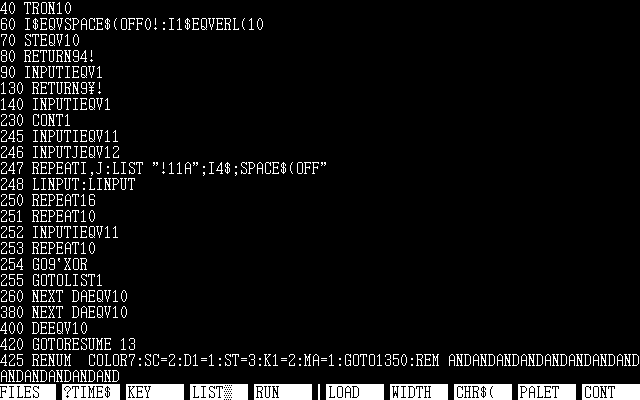
Part of the source code when viewing in HuBASIC.
After this I tried out the MSX version. The NEC and Sharp versions both — like Mystery House — give images with text in Japanese, but require typing commands in English. First enter a verb, hit ENTER, then enter a noun, then hit ENTER again.
The complete list of words is FORWARD, BACK, LEFT, RIGHT, UP, DOWN, ON, OFF, SEARCH, TAKE, LOOK, UNLOCK, USE, OPEN, MOVE, LIGHT, DOOR, MAT, SHELF, TELEVISION, TABLE, VASE, CHAIR, BOOK, PICTURE, SAFE, CANDLE, MATCH. It makes sense, given the players are Japanese, that the complete list of words would need to be given in-game; the game otherwise is expecting you to recognize things from their pictures, but a player might not even know the English word for “safe”.
The MSX version has one other very important difference from the original: the commands are now typed in Katakana, in Japanese.

This was a pain for me not just because of my inadequate Japanese skills, but my inadequate skills at handling MSX emulators. First off, I could only find the file in “TSX” format and the usual emulators don’t like it, so I had to convert it to WAV format (like a raw audio file) then convert again to CAS (which all emulators are fine with). Then since I’m not on an MSX keyboard, I was essentially typing characters “blind” (pressing right ALT activates the character mode). No emulator I found simply let me translate normal modern Unicode into what it’d look like on the MSX. I ended up making “fake” text. For example, early on you can search a postbox. Postbox is ポスト; with the diacritic symbol º separated as the game needs it you get ホºスト. If you are pasting into an emulator the text to paste is ノミソツ. That is, for example, cutting and pasting “ミ” into the emulator creates a “º”. I had to refer back and forth from tables and essentially make a cut-and-paste dictionary to make real progress.
The thing that makes gameplay slightly easier is that it comes with some built-in verbs. The full list is
F1 = Up
F2 = Left
F3 = Forward
F4 = Right
F5 = Open
Shift-F1 = Back
Shift-F2 = Down
Shift-F3 = Get
Shift-F4 = Search
Shift-F5 = Help
but note this leaves out words like USE which has to be typed on its own.
I managed to get a little ways, but the text issue was painful enough I grinded more on the Sharp problem before finally resolving it. What brought realization was finding a different Micro Cabin catalog just for Sharp products.

On the right page, under the line that translates to “Diamond Adventure”, it indicates a very specific BASIC interpreter called dB-BASIC is required.
With dB-BASIC loaded the syntax is LOAD”DIA-ADV” with the right tape inserted (despite other BASICs wanting a “CAS:” in front to indicate you’re using a tape, dB-BASIC only can load BASIC games from tape; if you put in the CAS it gets confused and will skip the file you’ve named). To save a lot of suffering to anyone who wants to play I have everything packaged together here, and you can either load save state 0 (right after typing RUN, just hit ENTER) or save state 1 (as the game loads). The reason to use the former is that there’s some random elements to the game which won’t appear with the other save state.
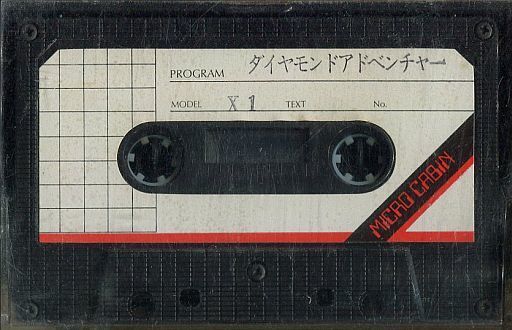
Tape of the Sharp version, via Giant Bomb.
With all that setup, let’s get back to the actual game!
We are quite simply tasked with going to a three-story building — which has a diamond worth 10 million yen — and stealing it. This is essentially a combination of Omotesando Adventure (visit a building with alarms, be sneaky) and Mystery House (nab a diamond). While Crowther/Woods Adventure did make it to Japan it wasn’t the urtext so it makes sense people would be making copies of Omotesando instead. (The other November game from Micro Cabin is even closer to Omotesando, but we’ll save that one for the future.) The practical ramifications for early Japanese adventures are: less treasure hunts with multiple items, less mazes.
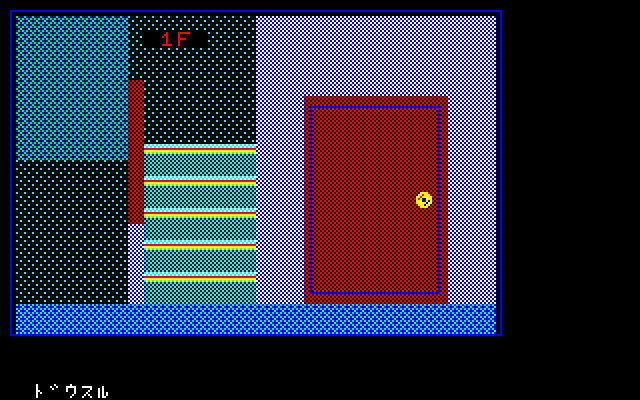
After moving Forward from the starting location towards the building.
You can (in the MSX version), open the first floor door, walk in, and immediately die.


It took about three hours to reach this point.

The first-floor door is impossible to open in the Sharp X-1 version. In either version you’re supposed to go UP when you approach to arrive at the third floor.

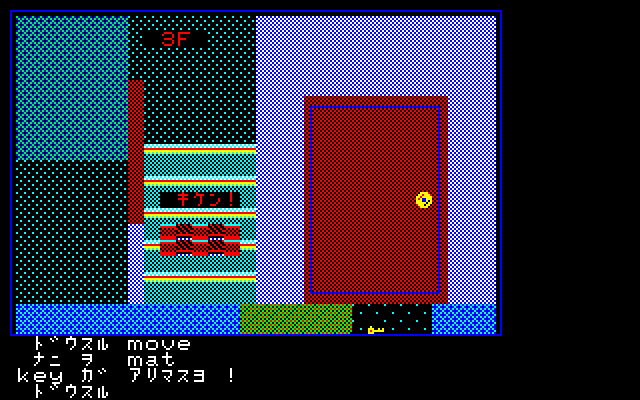
With the key from moving the mat (see above) you can just walk in.

One thing I neglected to mention when writing about Mystery House (I wasn’t aware at the time) is that many of the early objects are randomly placed. So there’s a set number of places you can search, and a fewer number of items, and those items are scattered; this makes it so each playthrough is slightly different. This game does the same trick, except it is such a small game it takes roughly 4 minutes to find all the objects that can be searched. Here, you can just the vase, table, and “shelf” (even the Japanese player on the MSX walkthrough I watched got confused about that and had to check the help).
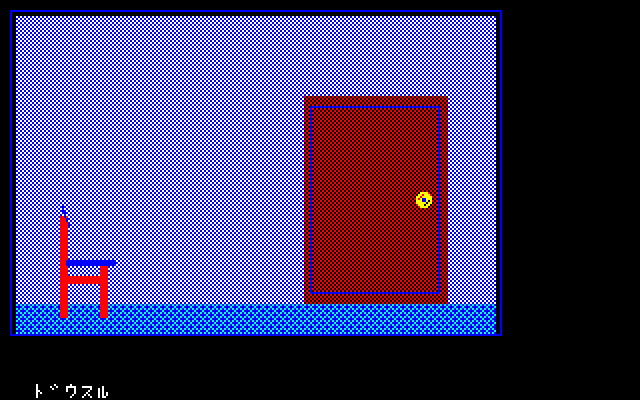
Just to the “right” you can find a chair to search:
And through the door you can find another table and a television:

The items you get (assuming you’ve been thorough) are a candle, a match, and a key. You can move the “picture” here to find a safe, which unlocks with a key. Within the safe is another key.

Moving on, you can find a bookcase. You can TAKE BOOK, specify a row (either 2 or 3) and then specify a book (1 through 5).

I think you might also be able to find either the candle or match on the chair.
Randomly, two books are useful. One of them will give you the code which will be used shortly.
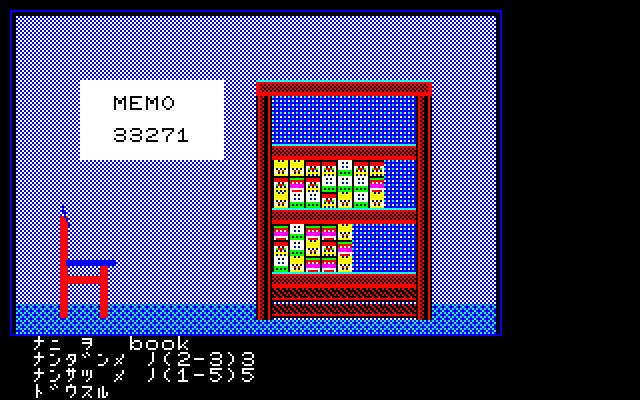
This code is randomly generated.
The other will cause the bookcase to swing open revealing a secret room. You can go in to find another “shelf” which unlocks with the key from the safe.


The shelf reveals a stairway inside (very similar to a moment in Mystery House). You can then find a safe which requires the code from downstairs.


“Good job! You did it!”
This wasn’t notable in a gameplay sense — the double-book secret is honestly the only part of the game that counts as a “puzzle”. The emulator was the real boss. This is notable in a history-of-games sense, as an amalgam of Omotesando and Mystery House in the short window where copying was happening. In 1983 things start to get very different (including with the third game from Tsukasa Moritani after the two Mystery Houses); Crowther/Woods Adventure cast a long enough shadow that it still was affecting Western games 5 years later.
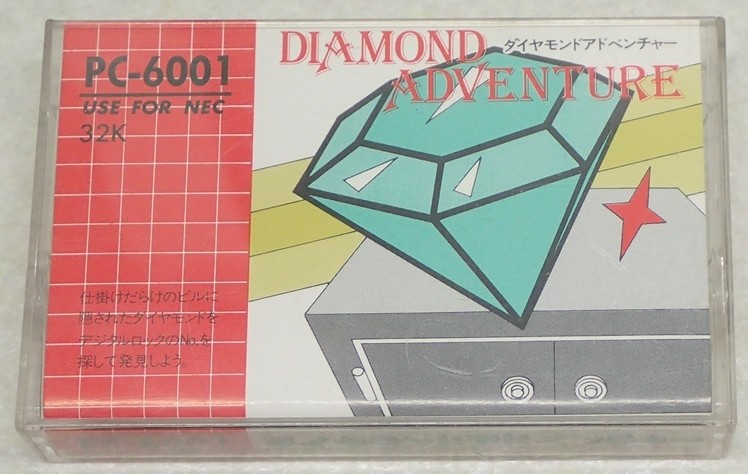
From Yahoo! Auctions.
We’re back to Softside here (previously: Arrow One) with another Peter Kirsch game.

Something that might not be obvious at this point is that essentially, by this time, Peter Kirsch was one of the most experienced adventure creators in the world, similar in quantity to Scott Adams. He (probably) wrote at least 9 of the games we’ve looked at so far, and he’s edited the other Softside games from outside contributors. The need to output adventures monthly kept the momentum going, even though it also meant the games sometime seem a bit rushed.
While this condition wouldn’t cause every creator to branch out this way, for Kirsch this gave him opportunity to experiment. Magical Journey from early 1980 was his only “gather the treasures” game; by Kidnapped later in the year he had an escape divided into a series of a “mini-adventures” based on the floor you were at. In his Adventures of the Month he’s tried sequences of movie-like scenes (Around the World in 80 Days), turning “saving passengers” into a collectathon (Titanic), collecting ingredients for a potion book (Witches’ Brew) and exploring an alien planet with a language-translation mechanic (Arrow One).
Structurally, Robin Hood shares similarities with an RPG. There are a series of heroic tasks you can accomplish (not always in a specific order), and you can meanwhile rob the rich and build up your “gold” supply. Once you have four tasks done a person will appear allowing you to get task #5 and win the game.

There are, as usual, Atari, Apple II and TRS-80 versions. Due to a bug mentioned by Dave Dobson in the Atari version I steered to Apple. (See here; you need Adventure Pack #2.) The TRS-80 version isn’t up for download; Ira Goldklang has a copy, and has it marked as Peter Kirsch, so I assume his credits show up there just like with Witches’ Brew.

You start fairly lost in Sherwood — despite the map not being much of a maze, I had trouble for while because I couldn’t do any object-dropping. You start with a bow, sword, and 3 arrows, but the game doesn’t let you drop any of those for the purposes of mapping (“LITTER THOU NOT / KEEP THY WEAPONS”).

The “hoofsteps” from that starting room are a random mechanic that runs the entire game. While in Sherwood Forest (the area in the map above, plus a western portion) merchants will constantly pass through the forest. You can climb up a tree, then go down to surprise them.

It took me a long time to get the right parser syntax. I tried, for instance, ROB MERCHANT to no effect.
Specifying what you are robbing turns out to be important; you can steal a horse (only once, although it is unclear why later attempts fail) and you can — and this is very hard to find, and I only found it from the walkthrough long into my game — STEAL CLOTHES. This will give you merchant clothes, and you can swap back and forth between your classic green and your DISGUISE. (Note you need to be wearing the green to steal from merchants, otherwise they just laugh at you.)

This sets up one of the early tasks you want to do, but you need to gather all your merry men first.
Here’s the western side of Sherwood.

It has one of the side-tasks you can do, in order to be classic Robin Hood.

Through the forest you can find Will Scarlet who will just straight up join you (and you can pick up the pole next to him). Everyone else takes a little more work. Little John is waiting on a log for your to do a quarterstaff duel with the aforementioned pole (he wins)…

…Allan Dale needs a harp (which you can find under a “boulder” in the forest, although pushing it requires having found some merry men to help push)…

…and Friar Tuck wants food. This was the hardest one for me to figure out. There is the occasional random sound of GEESE; you’re supposed to SHOOT GEESE with your bow (this uses up an arrow) and you don’t have to cook it.

Once you have all the Merry Men, they start complaining about not having a horse. One can be stolen, as mentioned earlier, but no other merchant falls for the same trick. Fortunately, the remainder of the horses just happen to suddenly appear in Sherwood so you need to wander until you find them.
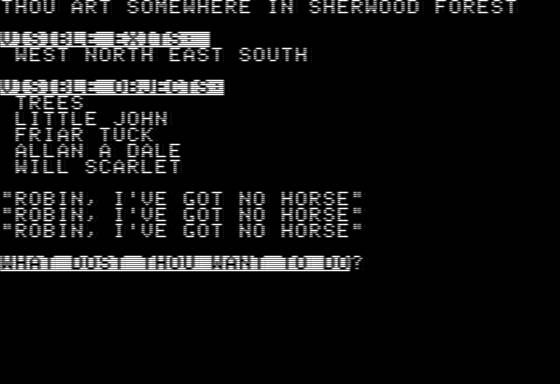
With everyone on a horse (including you) you can take off for Nottingham (be sure to have on the disguise!)
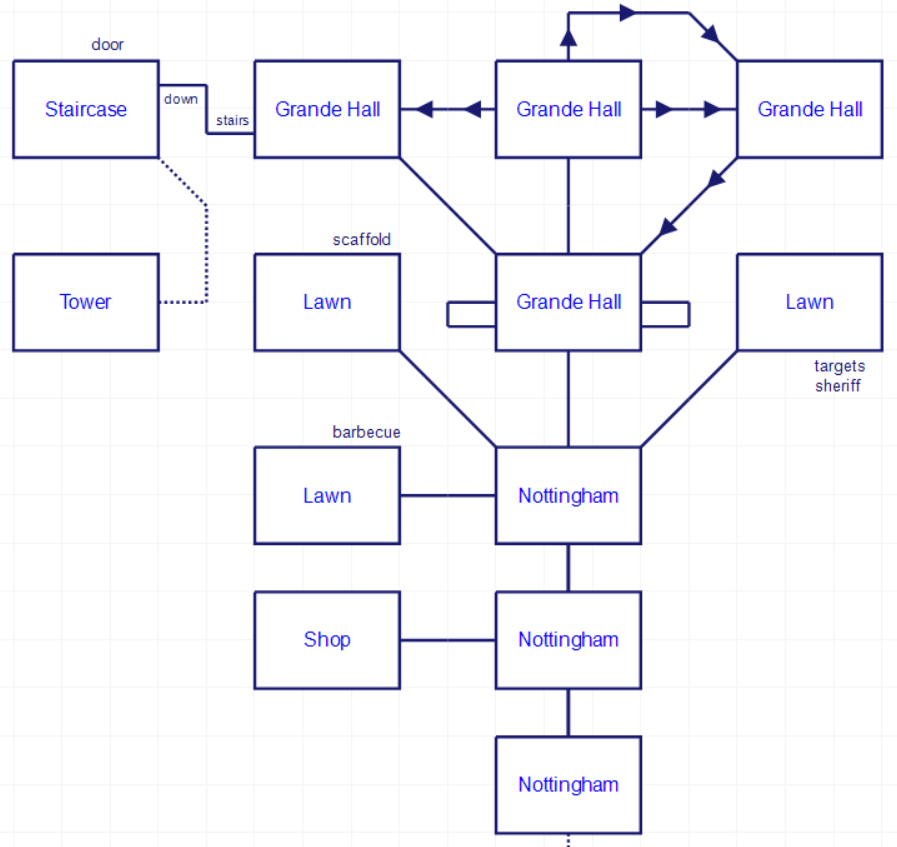
Along the way there is a store that sells new swords (25 gold) new bows (5 gold) and new arrows (1 gold). You’re going to need 3 arrows for the contest (something you will find out only partway through, oops) and you’ll also need 10 gold to enter the contest so I hope you robbed at least one of the merchants!
(Spoiler: later in the game you’re going to need another arrow or two and another sword. So you need at the very least 27 gold total from the merchants. Each merchant has between 0 and 3 gold, and it took me over an hour of grinding to get to what I needed. It didn’t help partway through I had the disguise on instead of the green suit and I couldn’t figure out why my robbing attempts were failing.)
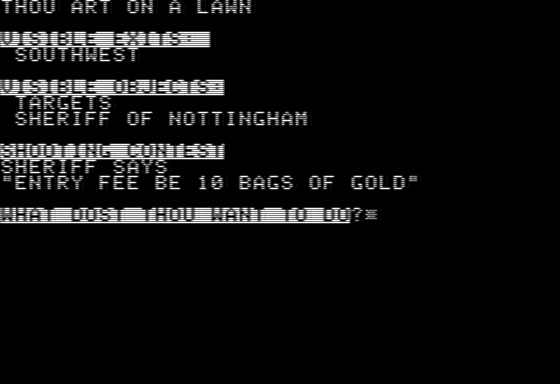
The game will ask what name you want to enter under. I tried ROBOT and apparently that was too close to ROBIN and I got immediately arrested, which was hilarious.

What isn’t hilarious is that the contest is purely based on random luck, and you have to get through to win the game.
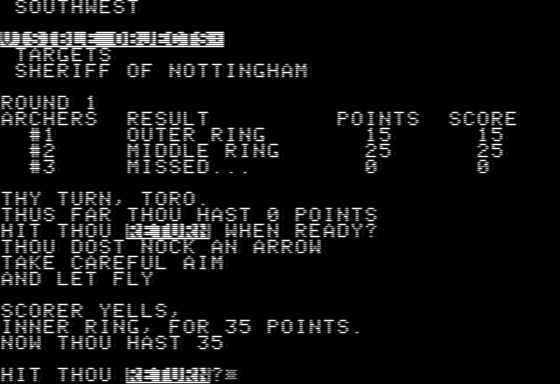
On the fifth time I made it through. I’m not sure what the probability is, but that was long enough to wonder if I was supposed to solve a puzzle to “bend the odds” before starting. (You are not. It really is just random.)
After winning, you get a golden arrow, but you also get caught.

The Merry Men will fortunately do a last moment rescue.

Back in the forest (where you’re probably going to need to grind merchants for the next part, make sure to dedicate some time) there’s supposedly some sort of note about rescuing Maid Marian (that Dave Dobson mentions) but I never found one. I instead, being stuck, wandered back into Nottingham to seem if anything changed, and in the castle I found a guard at the foot of a stair which previously wasn’t there.

Trying to attack with a bow causes the bow to break. Trying to attack with a sword also causes the sword to break, but fortunately you get a last moment assist.


However, you’ll need to get both sword and bow back. Fortunately, I used the magic of “save states” to rewind and avoid the bow breaking, but I still had a new sword to buy (25 gold). The sword is needed to kill a second guard at the top of the stairs.

I just want to emphasize how the structure means this is not like one of Kirsch’s cinematic structures. In all likelihood, you likely need to break after defeating the guard to go grind some gold before defeating the second one. So it isn’t like this is a continuous dramatic action. (In practice this is less strong than the cinematic scenes; in theory I see how this is a nice way of making the action feel not-so railroaded.)

Before nabbing Marian, after killing the first guard, the Sheriff of Nottingham will sometimes appear. This is truly the oddest (and frankly, immersion-breaking) aspect of the game, because there’s no confrontation or chase message; the game is waiting for you to do away with the Sheriff. The sword doesn’t work, you need to use the bow.


With the not-well-described victory, your next step is simply to wander around until for some reason the Rightful King of England shows up.

We robbed every merchant in the country, and spent most of our money on a new sword for us and only a little bit on the poor.
I definitely recommend Dobson’s take on the game as he hit the Atari bug I alluded to without first realizing it was a bug, and he narrates the action “straight” like it was meant to happen.
… there aren’t many clues as to what we’re supposed to do — we just have to find things to try and hope some of them count toward victory.
A more complex game might have been able to let you run things as a “Robin Hood simulator” without any concern at all about a specific narrative sequence, and in fact kind of happened already with the classic game Defender of the Crown. Could it also be done while maintaining the adventure-game-ness? The closest I can think of is the Sierra On-Line game Conquests of the Longbow which has, at least, a very versatile score system.
Kirsch found here a way to combine the “cinematic” and “freeform” style play; the unfortunate side effect was having severe grinding and a weirdly undramatic rescue and battle against the Sheriff. I still felt like the game “worked” in an immersive sense but only because it was strictly speaking fan fiction.



 Renga in Blue