It’s pretty clear, reaching the end of the game, that Jyym Pearson was just goofing around. All of the remaining puzzles were absurd in some way. I almost feel like he was trying to channel William Denman (of Med Systems who published this, and made the Asylum games) but Asylum did it better somehow. Also, Denman makes a actual cameo.
From 80 Micro, 1983 Special Edition. “Winston Churchill, Abe Lincoln, and Groucho Marx guide you to ways to remedy your mistakes and save Paradise.”
Continuing directly from last time, I had killed a demon who had left behind a hand.
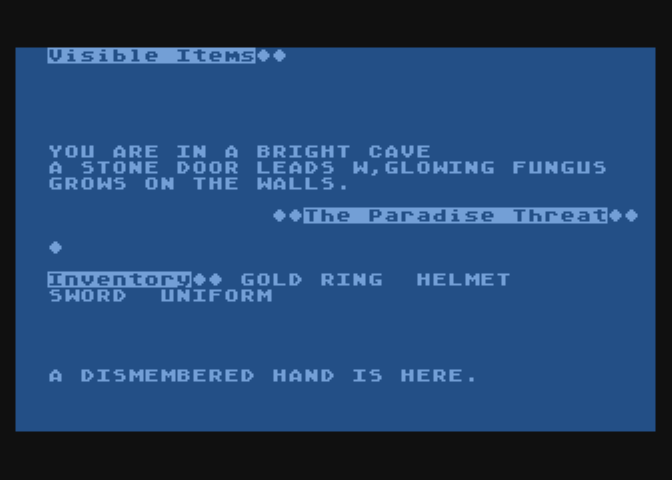
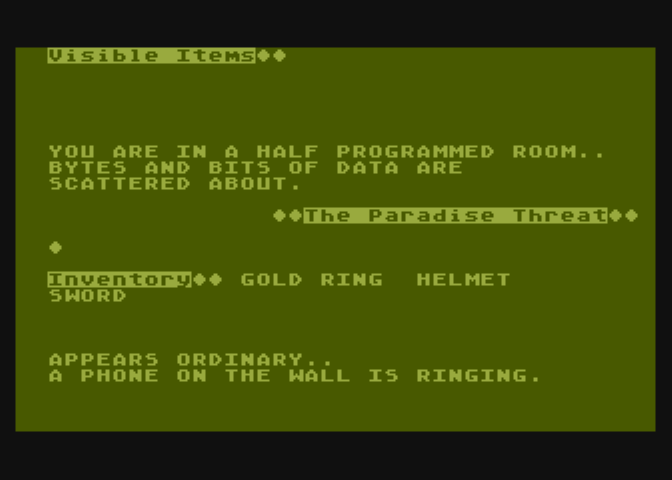
If this was a “closed room” puzzle it wouldn’t be too terrible; the problem is I wasn’t sure if I was missing an item from previous rooms (I was, but it doesn’t affect this puzzle). With a hand and the objects being held the only one that goes together with it is the gold ring. PUT GOLD RING ON HAND:
Arbitrary un-clued magic for the win! Buckle in everyone, it’s only going to get weirder from here.
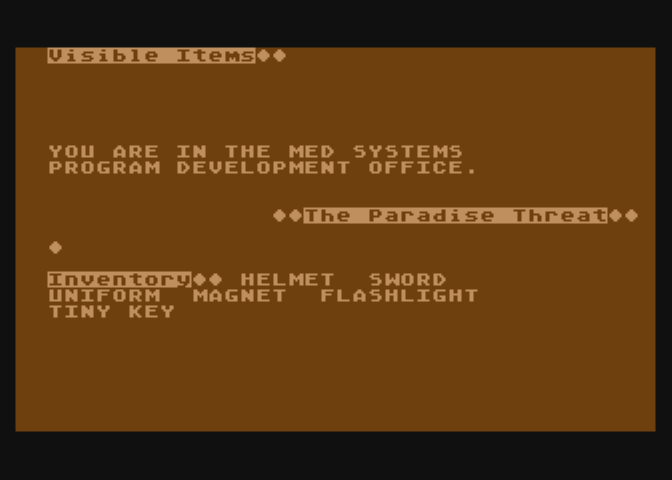
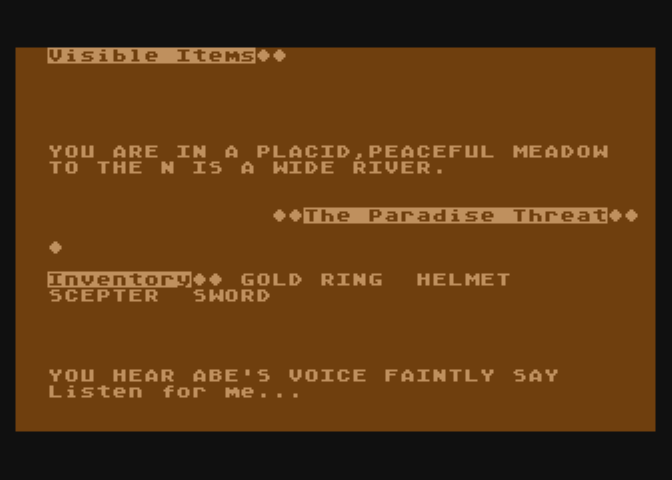
This screenshot shows all my items shuffled over.
I didn’t have much to work with other than a door with a plate. Nothing seemed to help from my item stock, so I went on another trip trying to look / listen / smell all the rooms to see if something new came up. I don’t think this was a new thing; rather I missed it because the placement is so utterly absurd:
This is just a random hallway room right before the Nazi hall with the timber. This captures the spirit of bombing every single direction in every single room in Zelda 1 just in case you missed something.
I get what’s going on, here: the author is trying to squeeze nearly every single room into having something of interest, and out of the “opening area” this is the only one that was “just a hall”. This still is, in a narrative sense, absolutely silly — we’re supposed to be getting help to save Heaven, yet this particular help can only be received by listening in a very particular room. This is decidedly crossword winning over narrative (except the crossword isn’t really a crossword but rather a puzzle requiring random-search).
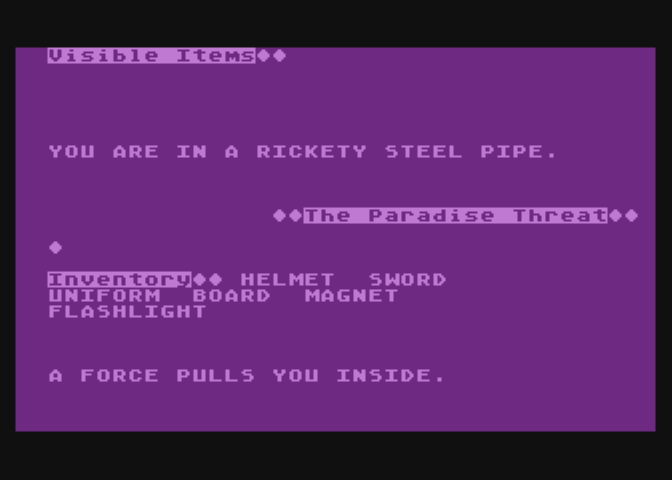
PUT MAGNET ON PLATE:
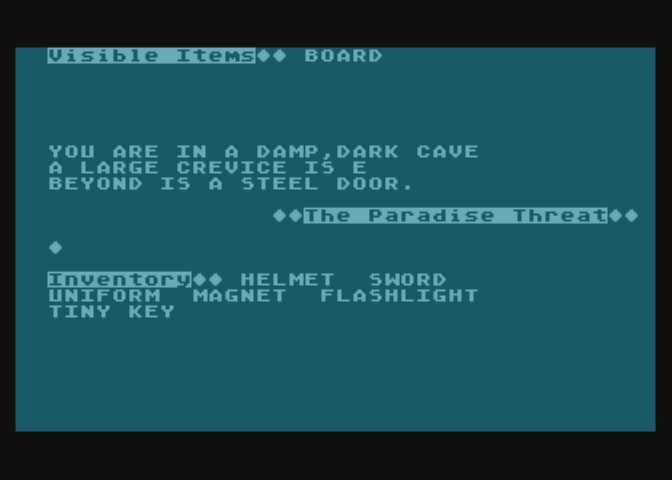
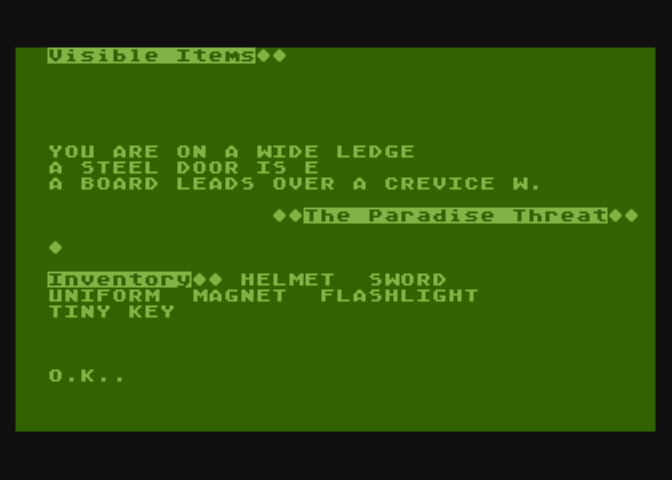
A few more steps leads to a crevice where you can use the board again, and a steel door the requires the tiny key that previously worked on the desk. (Again, any manner of narrative is just being pitched, since the tiny key previously worked on the door Eichmann was sitting at.)
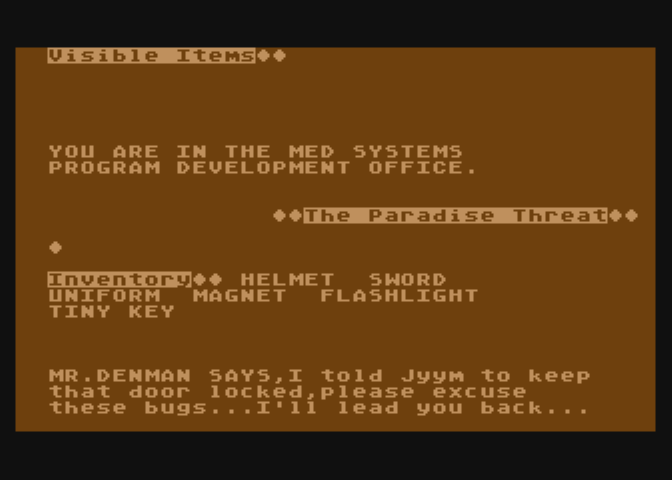
Inside the development room are a bunch of programmers chained to computers and William Denman, who leads you back out.
The steel door then can no longer be opened, and this is the end of the line.
I was quite stumped but I went for the structural solving juke: there had to be a reason for this section. Doing yet another pass through all the previous rooms yielded no new things, so there was still a secret to be found. Back at the crevice, which I hadn’t bothered doing a LOOK at (given it is a repeat) there’s the message that SOMETHING’S HERE. You need to CLIMB CREVICE (not the board).
Doing this action kills you on the other crevices. This is a “repeated element” fakeout puzzle where an author looks like they repeat an element but there is a subtle difference.
This puzzle wasn’t terrible, even in the confines of the parser, but it gets followed by something absolutely as off-the-wall as humanly possible.
ABE’S VOICE CRIES,Did you listen
to Marx, he knows the clue.
I spent some time hanging out a the opening (where Groucho Marx is one of the crowd of people in the conference room) thinking I had missed some interaction or clue. No, the game railroads you into typing LISTEN to get any effect.
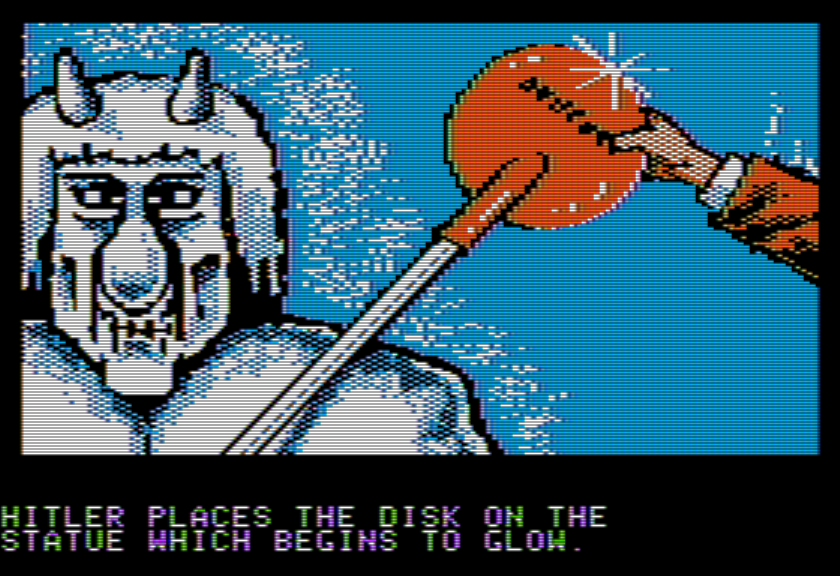
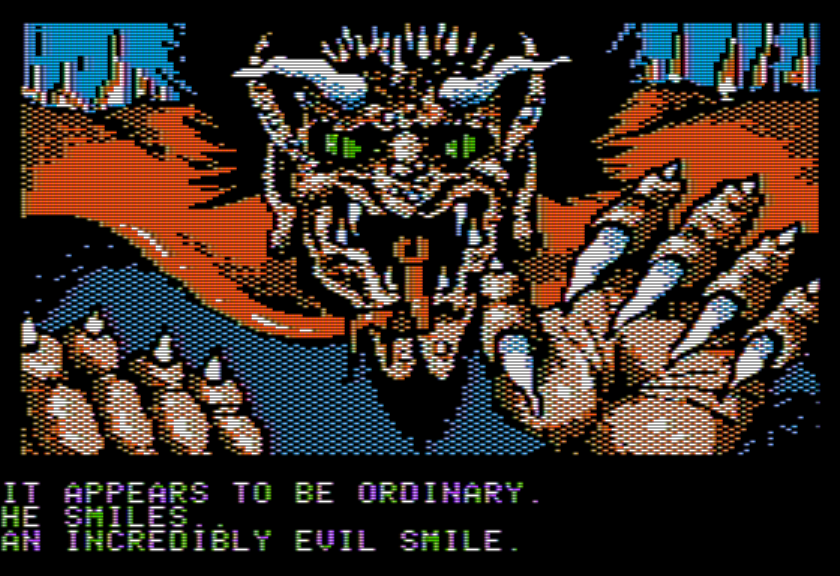
What the statue looks like, from Lucifer’s Realm.
I guess the mindset to be here is like original Adventure (where I genuinely liked the PLOVER puzzle); in that game, though it set you up with magic words to begin with making it possible to have a lateral connection. Here, this is the only magic word in the game. Just type on its own, without applying the verb SAY to it: GROUCHO.
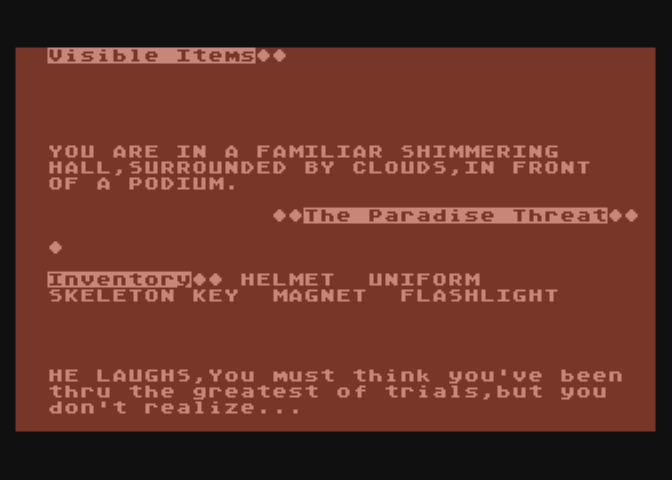
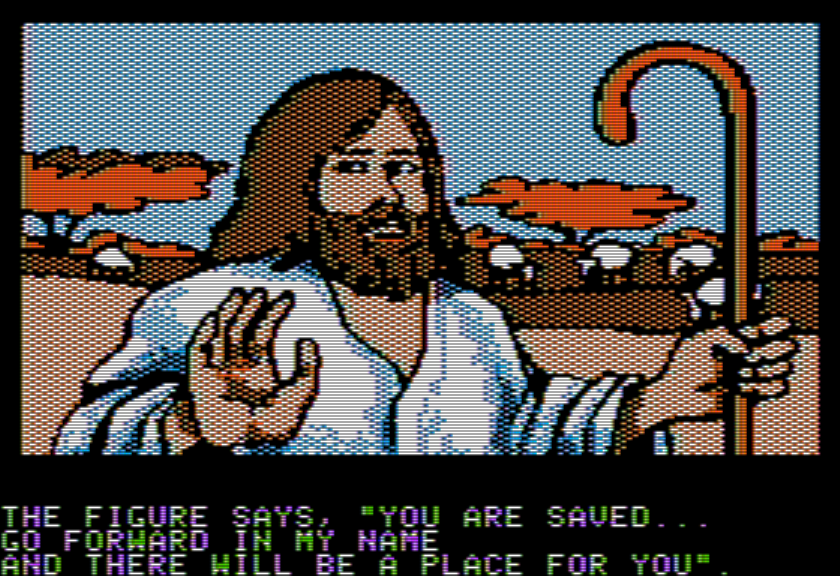
Yes, that’s genuinely the ending. You then get sent back to the bearded man at the podium.
Things gets rather meta.
“God” continues:
Nothing that has happened to you since your death has been real… It’s been a test !
There are no heavens or hells here
Every man makes his own,in his own mind….
You’ve passed your own test…
Congratulations…
HE TAKES YOUR ARM, LEADS YOU TO A DOOR AND SAYS,
I’ve many marvelous things to show you,come.
Congrats! Now buy our other games!
Now, I admit The Prisoner had a similar ending and I wasn’t grouchy about that one, but this is a game with a universe that started with a promising and unique atmosphere (Lucifer’s Realm) and even Paradise Threat had some promising moments going in, but it started to get more and more arbitrary before falling in a pile of bits and bytes. Asylum had a consistent tone going for it where “you’ve escaped the game” or “you just met the programmer in the Asylum” both seemed to fit; The Institute had a similar angle going but again themed everything appropriately. So I don’t think a meta commentary on “you’re just playing a game, ha ha” is inherently a bad thing it came off here more as an anticlimax than anything real.
Pearson has one more game to go (The Farvar Legacy) where we battle the undead. Maybe this time he’ll stick the landing.
NEXT: A short game supposedly set in a real location, followed by Sirius Software.
I had left off being baffled by a board (obtained from a pile of lumber) and some quicksand. My issue was half with the parser and half with visualization.
From the Museum of Computer Adventure Games.
To be specific, from the room marked YOU ARE AT THE EAST END OF THE VALLEY typing LOOK gets the message that
TO THE E A PILLAR SITS
IN A MUDDY FIELD,THE VALLEY BENDS S.
My assumption was that I go east to the quicksand, use the board to stabilize the way, then proceed further east on to the pillar. That assumption was wrong.
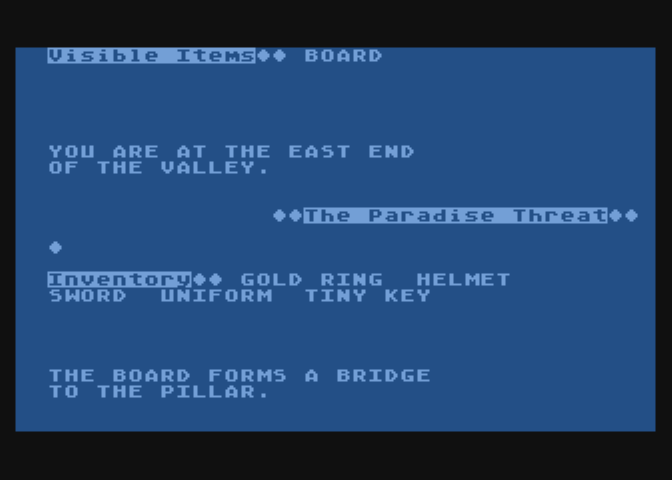
You need to DROP BOARD to the west; if you then LOOK the game says
THE BOARD FORMS A BRIDGE
TO THE PILLAR.
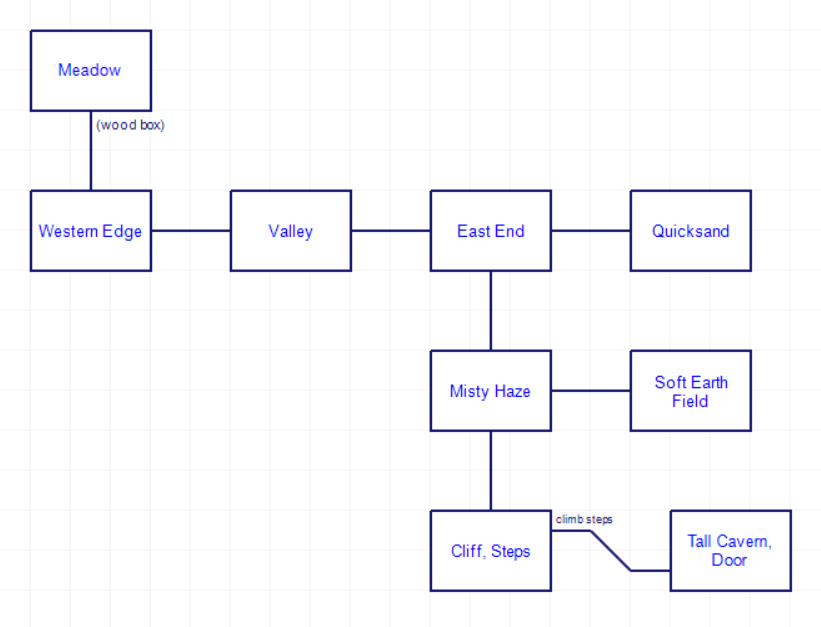
For this to make any sense to me physically — remember, we’ve been toting this bridge around — I suddenly visualized the “pillar” much different than I originally did; something fairly low. Let me invoke the power of Microsoft Paint to show what I mean:
This jives enough with the text descriptions to work for me, but I still couldn’t get across the board. A “normal” game would just land you on the pillar if you try to go east, but nope, you just go in the quicksand.
Fortunately, I had the power within me to “test every verb I have encountered in the game”, so I was able to stumble upon … CLIMB BOARD? Really?
I guess my visualization should have been such that the pillar would be much taller, so the board is more at an angle, but how would that make any sense anymore given this would indicate a board taller than a person? Incidentally, CLIMB BOARD is also the way to get back; there really is no consistency in this game in how to travel (CLIMB STEPS but just going WEST to go back, in another instance).
I had the suspicious powder and only one real obstacle, getting the key from Eichmann.
What he looked like in Lucifer’s Realm.
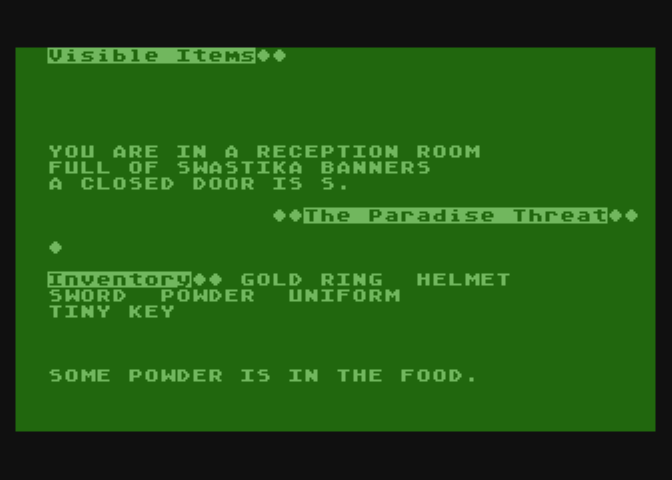
I took it back to the room with the secretary and the secretary was gone, but there was still a tray full of food there. Time for some poisoning!
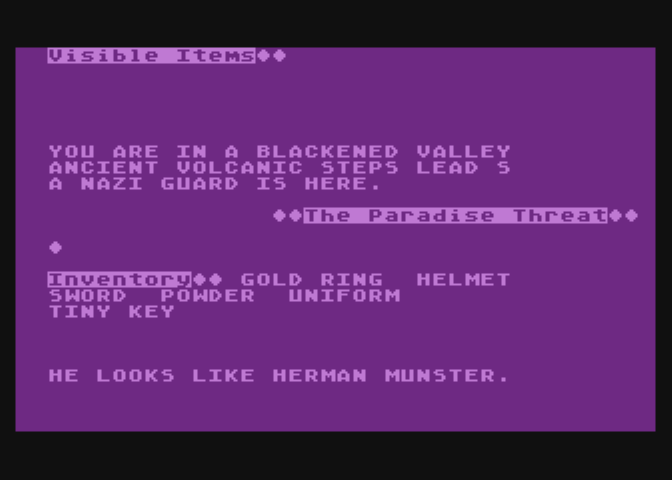
Some more wandering — and finding the Nazi guard I had knocked out by scent had been replaced —
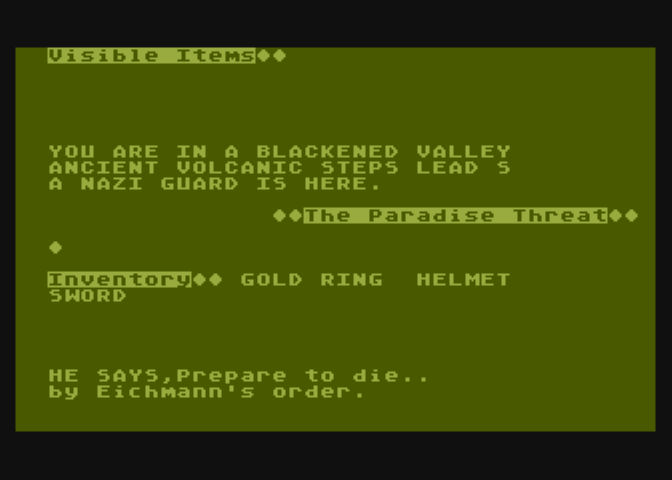
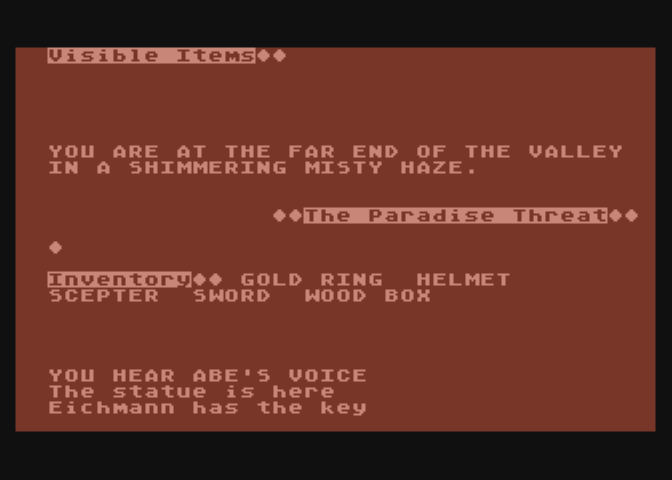
— and I rather delightfully found an unconscious Eichmann. I rummaged through his desk (applying the TINY KEY given to us by Jyym Pearson on the phone) and found a SKELETON KEY; we’d already been warned ahead of time by Abe Lincoln this would go back at the door in the haze.
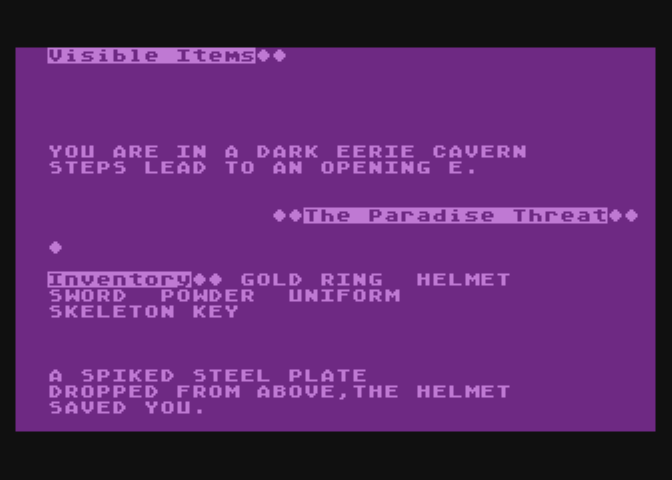
Taking the key back leads to a trap, but the kind of trap that is easy to avoid as long as you haven’t been discarding your starting inventory items.
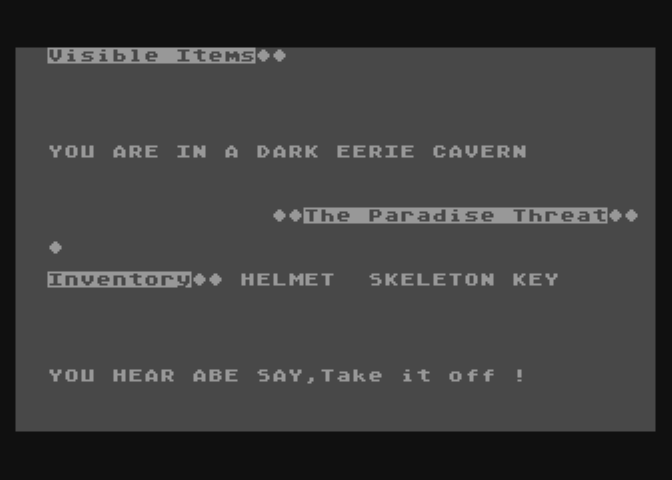
I was then in darkness in what appeared to be a maze and dutifully started dropping items and mapping out exits. However, I soon realized the items I dropped were simply disappearing, so this had to be a gimmick rather a maze. Applying all my senses, I tried LISTEN.
This had to be referring either to the gold ring or helmet. With the helmet off, typing LOOK gave the description of a breeze from above, so I tried UP to no avail, and also CLIMB UP (“YOU’LL FALL”), FOLLOW BREEZE (“I DON’T UNDERSTAND”), CLIMB (with no target: “YOU’LL FALL” again), GO TO BREEZE (“I DON’T UNDERSTAND”), JUMP (“IT’S TOO DANGEROUS”), ENTER PASSAGE (“I DON’T UNDERSTAND”), CLIMB PASSAGE (“IT’S TOO DANGEROUS”), JUMP PASSAGE (“IT’S TOO DANGEROUS”) and then UP again for good measure.
After a reset just in case I made a typo on something, I finally found you’ll move farther if you:
LISTEN
DROP HELMET
LOOK
LOOK UP (not just look!)
JUMP (only immediately after doing LOOK UP)
As far as I can tell, if you miss your opportunity to jump, even though you still feel the breeze, you’ve softlocked the game. It’s great to have all this combined with a tricky parser, right? I knew LOOK UP was used previously by Pearson but it still isn’t an absolute standard of mine to test (maybe has only gotten used in 5 games so far from 1972 to 1982)?
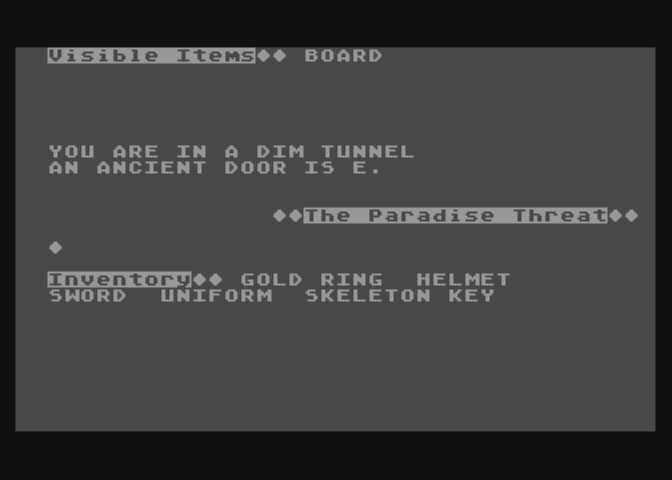
The dark figure will run south to a brick wall with a window; there’s guards there that will kill you if you don’t still have on the UNIFORM. (I should incidentally point out I’m maxed out on inventory at this point; you have to take another loop to get here, so I brought the BOARD, PACKET of seeds, and TINY KEY over on an extra trip after intentionally dying in order to teleport to the start. So dying isn’t technically a completely negative thing in this game.)
From here there’s a crevice to the east, and you can use the board to get over (I suspect many players left it behind at the pillar so would need to return for it).
Then comes an ancient door (neither skeleton key nor tiny key work)…
…so you can veer south to find a dragon. The dragon is sleeping and no threat as long as you don’t try to hurt it or CLIMB it. (Why would you try to climb it? You’ll see in a second.) Heading south from the dragon mysterious leads to a “DARK MOIST PLACE” which I believe is just supposed to be literally inside the dragon. I tried dropping the sleeping powder there to make the dragon extra-sleepy but no dice.
Trying to drop the powder here into the mouth doesn’t work either.
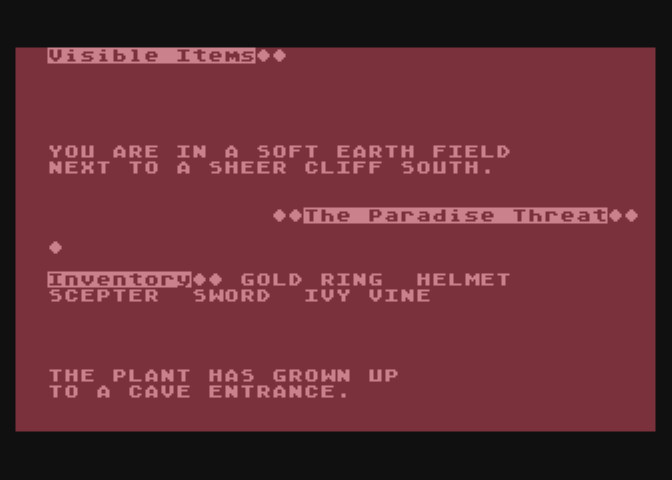
Testing out various actions, I noticed DIG mysteriously told me “O.K” rather than denied my action. The last place this happened was somewhere soft enough to plant seeds, so I tried it again (“THE PLANT GROWS UP AND OUT OF SIGHT”) and then typed CLIMB. Oops.
The command defaults to the dragon. I was genuinely confused here for a bit because I thought the dragon was eating me because I made noise climbing up the plant. I finally found the eating to happen again when I tried CLIMB DRAGON and connected the dots.
The plant needs you not have much in the way of inventory, so you have to do the “drop everything, grab one item” shuffle, but it fortunately doesn’t take too long.
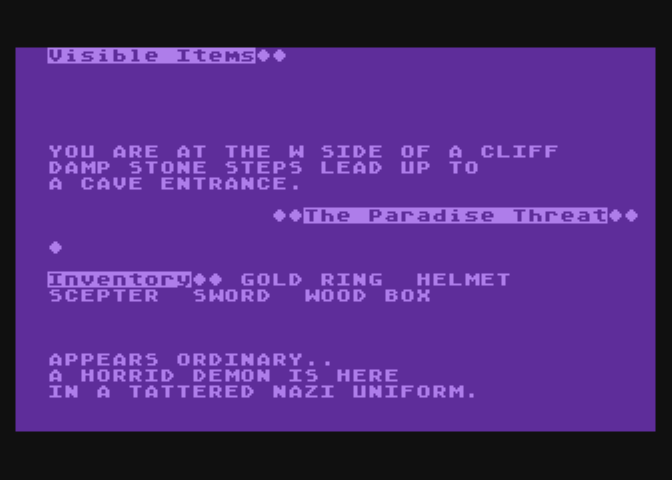
Along the passage I found a dead Nazi that did not react to any of my commands other than UNDRESS NAZI (I was told there was a quota of only one naked Nazi in this game). I highly suspect something useful is there but my verb-fu is failing yet again. Just a bit south is a Nazi demon, who is easily dispatched by your sword:
The demon may be ambidextrous, but one more slice kills the demon outright, leaving behind a severed hand. Unfortunately I am unable to pick up with the hand or interact with it in any way, and I’m stuck to the left by another locked door (again non-responsive to my current keystack).
I think the next step here is likely to comb over all the rooms again in case a new latrine has popped up or Jesus has made another call somewhere.
My biggest issue is I’m worried I might have a solution (like the powder does go with the dragon) but I’m fighting with the parser enough that I pass by thinking I’m wrong and waste time. Not my favorite scenario to be in but I’ll plug through. I’ve incidentally finally caught up to Will Moczarski, who (other than the demon) managed to get to this place in a single post.
This is, without question, one of the worst parsers I have dealt with in a long time, and that includes all the other Pearson games. I had numerous points where I knew what I wanted but couldn’t communicate, or where I wasn’t sure if I was doing the right thing.
First off, a little theory. I’m going to explain how the “rulebook sequence” in the parser for Inform 7 works (which is as modern as it gets) just to give a sense about the problem of message priority. From the Inform 7 handbook:
First it makes sure it knows what the input words are, and that the command makes grammatical sense … If there’s a typo in the input — or even if the parser knows all of the individual words but doesn’t understand how they’re strung together — the parser will reject the input before anything happens. Assuming the parser can figure out what the words are, and that they’re in a grammatical form that the parser knows, Inform starts processing the action.
The game then checks Scope to see if your item being referred to can be seen (or if it is a case where it makes sense to refer to something even if you can’
>open gate
You can’t see any such thing.
(You also get the same message if you try a noun that isn’t in the vocabulary — the game is trying to prevent “noun hacking” here to find objects that you haven’t seen yet.)
Once past that phase, things get more complicated:
There’s a Before section, which is checked before anything else. This triggers before any checking of the world environment, so this is for responses that override even checking if an action is plausible; it just checks if a verb is trying to be used. Suppose the player tries EAT CHEESE. A player controlling an alien with no mouth might just immediately be told they have improper anatomy; even if the cheese is in a locked container, it is much more logical to just say the action will never work.
The game then passes through an Accessibility check; even if the target of an action is “in the room” with the player it might be impossible to reach. So here is when EAT CHEESE might inform the player that the cheese is locked away and you don’t have any way of getting at it.
This is followed by an Implicit action check. This accounts for circumstances where the player expects item-juggling to be handled automatically, like unlocking a door with a key that is held in one’s pocket; the game can automatically take the key out of the pocket rather than force the extra steps, and will be explicit about this happening with a message like “(first taking the key out of your pocket)”. In the cheese-eating instance, if the cheese is close enough to reach, the game might have the player first pick it up before eating it.
Then comes the rulebooks Instead, Check, and Carry out. This is the “central” part of the parser and includes more specific checks like the cheese you’re eating is really a rock (which you find out by trying to eat it). Finally there’s an After section (there might be a chain reaction of other things after successfully eating the cheese, for instance).
This structure has been designed after a lot of experience with parsers having strange messages because of priority issues. Not every condition has been obvious. If you try to EAT PRIME MINISTER and there isn’t a single government official in sight (perhaps the Prime Minister walked to a different room and the player didn’t notice), the best response is to say you don’t see the Prime Minister, not “don’t be a cannibal”. The cannibal message feels appropriate but implies the Prime Minister is visible; the player then may try to GIVE LETTER TO PRIME MINISTER and be confused.
The Paradise Threat has (in addition to other parser sins I’ll get into) some priority issues. Suppose, having seen some timber described you try to GET TIMBER and you’re holding six items. The game will go
ONLY SIX ITEMS PLEASE.
This implies “you’d be fine getting it, but only if you reduce your inventory”. So you do some item juggling and try to get the timber now, getting
IT’S NOT A VISIBLE ITEM.
Clearly, the fact that the timber is not considered “visible” is the more salient fact than the player’s inventory capacity. The game is essentially checking conditions in the wrong order.
I’ll hit other issues in context, let’s get back to the action–
Last time I had dropped off a wood box to get consumed by termites but couldn’t get at the result. I waited around a very long time and nothing happened. I had neglected one of the other Pearson tendencies: to have time pass based on entering certain locations. That is, in most games, if you have a timed event, you might think to type WAIT sufficient times and the game will move on; in the case of The Paradise Threat, sometimes you can hang out for many turns and find nothing will ever happen. The game is waiting for you to move to some other specific part of the map, and passing throw room X will cause the time-passing condition to happen in the earlier room Y.
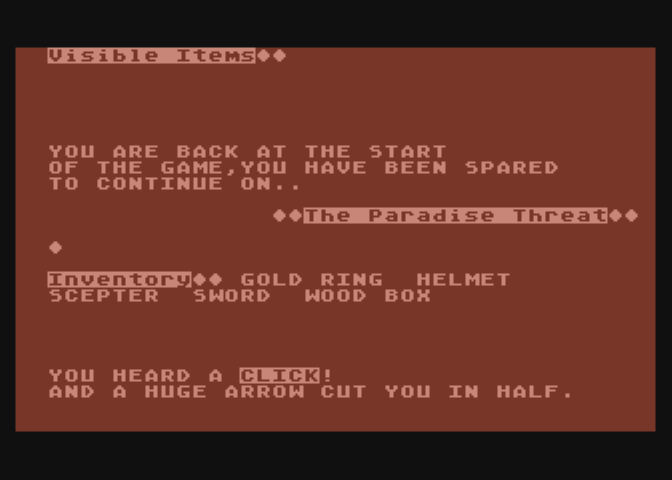
I went over to the arrow-killing room, stepped back out (as long as you immediately go west you don’t die) and then found the termites were finally done with their snack.
The packet had seeds, so I took them to the soft area I was able to dig. After PLANT SEEDS I had to walk around a bit more; the “arrow-killing time pass” seemed to do the trick again.
There’s a cliff described as also being at 30 feet, so you have to wait around for the plant to get that high.
Before showing the result, I should mention I elided something important on the parser: PLANT SEEDS. PLANT is not understood as a standard verb elsewhere. Hence it turns out that this is a game with a “standard dictionary” of verbs and response to when they don’t work, but also a bespoke set of verbs-with-nouns that will work only in the particular cases they are intended. In that parser diagram, you have to imagine a brand-new list of phrases which all get interpreted on their own outside of the main structure.
PULL, which I originally thought didn’t work, works specifically here: you can PULL ROPE to get the crossbow to launch early.
TWAANNG…..THUMP !
This disarms the trap that had been stumping me. Looping back around to the trap and the next room:
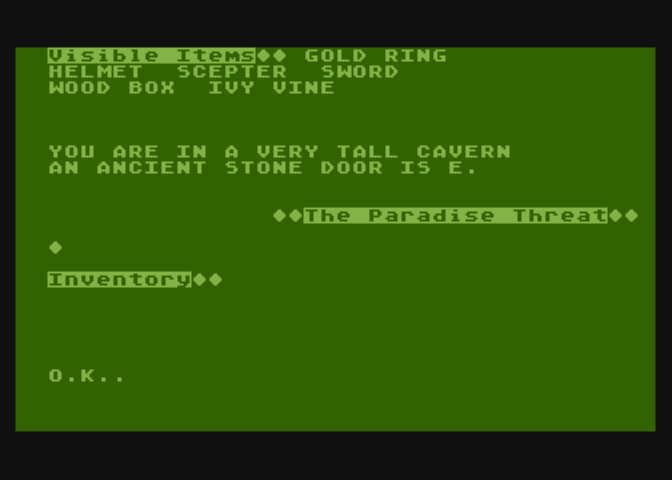
If you just drop the scepter it disappears. The logical step to me seemed to be to attach the ivy to the scepter, but I went through
TIE IVY VINE
ATTACH IVY VINE
WRAP IVY VINE
ATTACH SCEPTER
PUT IVY VINE
and many other permutations before arriving at the exact phrase TIE IVY VINE TO SCEPTER. This is the only way to do the operation. TIE IVY VINE along just gets “I DON’T UNDERSTAND”; trying to TIE IVY VINE TO SCEPTER while anywhere other than this specific room also gets “I DON’T UNDERSTAND.” This is about as mind-bogglingly misleading as a parser message can be, especially because it isn’t playing guess-the-verb, it’s playing guess the phrase.
Essentially, the “bespoke phrase” part of the parser skips any of the kinds of checks a good parser might have and only looks for: are you in the right room with the items, and have you typed the exact phrasing? If so, go on, otherwise, go to the generic non-understanding message.
You have to incidentally JUMP to get back (both JUMP VINE and JUMP IVY VINE work; the game inconsistently will sometimes need the two-word version of the noun and sometimes not). This reflects one of the other issues with the game, that map traversal requires very specific phrasing and reversing directions isn’t consistent. Normally, when outside a cave with steps, even our lower-tier parser games would accept at least a subset of GO CAVE, U, E, ENTER CAVE, GO STEPS; you have to CLIMB STEPS exactly. Trying to CLIMB STEPS to go back has the game say
YOU’LL FALL.
being of course the exact same steps we just climbed up. No, you have to go WEST to go backwards. I have to essentially glance at my map every time I pass back and forth to make sure I’m typing in the right word. Door to the east? OPEN DOOR, not EAST. Going back, OPEN DOOR fails — “you can’t” — and you go WEST instead.
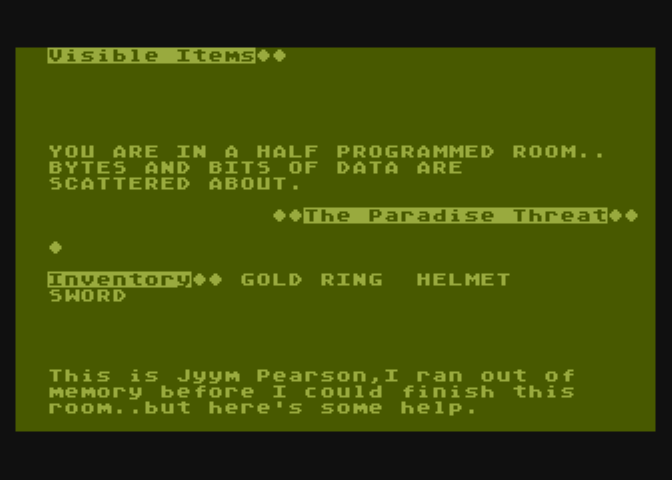
Once in the hall, the game takes a moment to go meta.
ANSWER PHONE:
However, trying to make the conversation go further I was stumped; LISTEN gave me I HEAR NOTHING COMPREHENSIBLE; trying to ANSWER the phone again did as well. I assumed I was in another part of the game which required exact phrasing, so I ran through about 30 phrases before looking at the phone, which (after what looks like a cut-off conversation) has a tiny key.
Moving along…
From Lucifer’s Realm.
…I came across a Nazi guard at a door. Trying to KILL GUARD (we have a sword, after all) gets
YOU’RE TOO KIND.
which is the default “kill but not understood” response. If you TALK GUARD…
…only then do you have the opportunity to KILL GUARD and finally be understood. However, the guard just blasts you with his gun.
Being stuck I let the death happen, since that just warps you to the start, and explored around a little, keeping in mind Pearson was going full steam now on the “timed events” that were really dependent on you reaching some farther location.
As typical, it took an infuriatingly long time to figure out how to get into the hole (CLIMB HOLE) and then you just find out it is a latrine. The smell is enough to kill the guard if you go for a round 2.
We’re about to see a bunch of Nazis and none of them have this reaction.
Heading past, you get into a “huge hall” and a “reception room”. Taking the reception room first, we are encouraged to come back later, which sounds like another “timed” event to me.
There’s food on a tray we can access, so I assume he hasn’t actually started lunch yet.
Back in the huge hall, I did a LOOK HALL and found some lumber. LOOK LUMBER reveals a board.
Yet again I had enormous parser struggles, finally landing on PULL.
The board seems like it’d help with the quicksand, but no dice. I tried about 30 different parser commands, gave up, and went to check if Will had already gotten that far in his first writeup.
That’s not the case but moving on I find that I can indeed drop the board and thus access the quicksand room without sinking. I can thus reach the pillar and pick up some powder.
DROP BOARD, then go EAST? Nope. Drop board before arriving in the quicksand room, then going east? Nope. Not
CROSS BOARD
STAND ON BOARD
STEP ON BOARD
WALK ACROSS BOARD
USE BOARD
GO TO PILLAR
etc. etc. etc. etc. etc. etc. Still no idea what to type even though I’m following Will’s exact directions.
We’re mostly past this nonsense in 1982; the only parser from that year of comparable badness I remember is Grandell Island. What’s so baffling here is I certainly don’t remember this much trouble from the prior Pearson games. I think the author is trying hard to make a “compact” game where every step is interesting but the end result is that every step I can only manage on the fourth or fifth parser attempt.
In a stark reminder of how different two experiences of an adventure game can be, Will Moczarski reports he finished this game in a handful of hours. I have put significant effort in with no real progress. This may be a matter of the Atari version of the game being more obscure, or me missing one single verb or object in the right place causing a cascade, or just bad luck.
I have found things in the rooms I’ve already mentioned but none of them have allowed me to pass my two main obstacles, the quicksand…
…and the arrow.
To be absolutely thorough, I made sure to LOOK in every room using every plausible noun as well as LISTEN and SMELL. The first useful LOOK was in the very first room of the dying land, where I did LOOK PLANT on the supposed plant-life and found an IVY VINE I could take.
Although the game is finicky and requires you type IVY VINE in full, not IVY or VINE, otherwise you get the weird sensation of typing TAKE VINE and having the game tell you it isn’t visible despite it being listed as visible.
The vine is described as “long and slender” and I assume will be a rope at some point. The next room over I found — again in the plant-life — a fallen-over tree with termites. However, I could not get anything else to happen with either TREE or TERMITES, and that’s after forming my standard verb-list and testing everything.
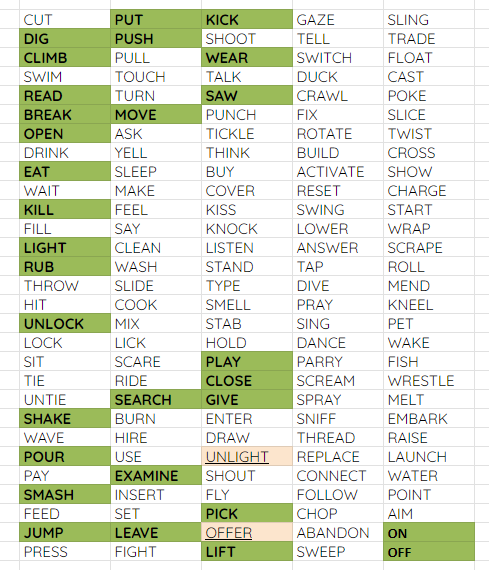
A quick aside on the testing-list: while it certainly is useful to instantly have at hand the game lets you TURN, PUSH, and MOVE things, forming this kind of list also helps get a sense of what the parser responses will be like beforehand, which can prevent chasing phantoms. For example, just typing PUSH by itself gives
OK..OOMPH..SO WHAT?
which is detailed enough it might be a cue in some games that the action is right, just you need some assistance, like the truss in Pythonesque. Since this is clearly a generic not-even-type-an-object message, its appearance should not be marked as remarkable at all. Similarly, THROW with no verb says
IT BOUNCES BACK AND OUCH!
which means you aren’t supposed to be improving your aim: you’re just barking up the wrong tree.
Returning to the game, the tree gave me no joy, and moving on to the very next room yielded a pillar.
I think from the description the pillar is supposed to be adjacent to the entrance to the quicksand to the east, or at the quicksand itself somewhere? Either way I cannot refer to it (again I ran down my verb list).
In the quicksand itself you get one extra message about how “you’re either shrinking or sinking” before you die. This indicates there should be an opportunity for extrication, but the way the parser works is odd: it intercepts basically everything I’ve tried to type except for dropping items. This includes some logical self-rescue attempts like THROW IVY VINE.
Moving south, to a misty haze, I technically found two things. One, by using LISTEN, was the voice of Abe Lincoln.
The other, just by typing LOOK, was finding an ancient door in the ground. The door is unfortunately locked.
To the east is a truly odd location: a field of soft earth where DIG (which normally fails to work) will “succeed” but with no result in the room as a consequence.
I tried DIG ten times just in case it was one of those cumulative dig puzzles (although so far games have gone that route have had an item you can find on turn 1, but a second item you can find on turn 2). My guess is I will be told in the future somehow I should dig here and that’s when digging will become useful.
Climbing up to where Demon Trivia was, I found nothing useful, so I started trying at the arrow room some more. Again, the weird “dropping takes no time” element of the parser game up…
…but otherwise, any other parser action at all resulted in death. (Including making a typo and putting in DRP HELMET trying to get the screenshot above.)
I feel like I’m missing something simple and fundamental like an exit. The diagonal directions do work but none of them have revealed a “new” direction, they’ve just duplicated the cardinal directions, so I have declined to map them.
Please no hints for now, unless you don’t know the answer and just want to speculate. I’ve seen this game described as “outtakes from Lucifer’s Realm” so it genuinely might be short, but that’s only true if you’re making forward progress!
BONUS ADDENDUM: While reviewing this post for typos, I thought to drop the wood box with no seams at the tree with the termites. The termites swarmed the wood box, but then I was unable to open or take it; LOOK WOOD BOX gets YOU CAN’T SEE IT WELL. So I’m doing something right here but I need to tweak my implementation somewhat.
However, someone else was being a worse person: Hitler.
Hitler wanted to raise an army against Satan, so Satan gave notice that stopping Hitler would be worthy of a a ticket up to the pearly gates.
While you needed to give over a powerful “Deecula” statue in the process (see gloating above), you managed to stop Hitler and gain the favor of both Jesus and Satan.
The end result is that Hitler’s army gets kicked out of Hell, so he decides to turn his fury towards Heaven instead. To save Heaven you have to a final showdown with the Führer of Evil himself.
From the Museum of Computer Adventure Games.
The Paradise Threat by Jyym Pearson picks up directly where the game Lucifer’s Realm leaves off, and marks the next step in Will Moczarski’s marathon of Med System games over at The Adventure Gamer. Just like with Lucifer’s Realm we are going to both be blogging it at the same time (his first post is here). He will be playing the TRS-80 version and I will be playing the … Apple Atari version.
Sorry, Apple II superfans: this one didn’t get illustrated like the last game. Text-only, making graphics with the power of your imagination!
Before really getting rolling, let’s briefly review the prior Jyym Pearson works, and most particularly the quirks and tendencies that need to be kept in mind while playing one of his games.
Authors can of course add things to their style, remove things, and do one-off experiments, but they do tend to have certain “signatures” that are visible if you consider an oeuvre in aggregate. In Pearson’s case (with his sometimes collaborator, Robyn) he always has very intense use of the LOOK command. Getting through sections will often involve intensely applying LOOK to each and every noun mentioned, and then to nouns mentioned by using LOOK. Earthquake San Francisco went into shaggy-dog-joke territory, having a CREVICE with a QUARTZ with an INDENTATION with a FLAT SPOT with an OBJECT with a DIAMOND, requiring you to apply LOOK at every step in the chain.
LOOK UNDER is rare but did show up in The Institute.
Pearson also appeals to more than just visual senses; LISTEN was required to localize a child in Earthquake, LISTEN was used to find a dripping sound in The Institute. Lucifer’s Realm had multiple uses of SMELL.
While Escape from Traam was essentially linear, Pearson gradually started to add non-linearity by requiring re-visits to old locations; for example, Lucifer’s Realm had an early encounter with Beelzebub giving general quest information. Late in the game, upon encountering Jesus, he says you should speak to the “evil one” again, requiring a re-visit all the way back to Beelzebub.
With all this preparation I’m still probably going to get crushed somewhere, but that’s how adventure games go. Noteworthy is that this is the first time I’m playing the non-graphical version; I could tell from comparing the TRS-80 and Apple II versions of Lucifer’s Realm that puzzles sometimes went under revision. Here we’ll just have to deal with version 1.
The game starts almost like it ought to be the epilogue to the prior game where you get your long-deserved rest; you rise up to a tunnel and get led by Winston Churchill into heaven who ominously says “only you can help us”.
Abraham Lincoln shows up shortly after to explain that Hitler’s army still has the power of the Deecula statue and is now veering towards heaven. Because we were the one that restored the statue in the first place we are (by some mystical rules) the only ones who are able to destroy it.
The game thus rather generously starts you with a GOLD RING, HELMET, SCEPTER, and SWORD, essentially the Armor of God. At the very first room where you can really start acting (the peaceful meadow) if you LOOK you’ll see something floating in the river, and you can find a wood box that way.
Proceeding further leads to dead lands.
I don’t have much of a map done yet.
Early on you can land in trouble in some quicksand; I haven’t been able to get out and I suspect I might need an item I don’t have yet. Veering away from the quicksand to the south leads to a demon who asks you trivia.
Yes, really, trivia.
He says,Welcome to the new quiz show LET’S MAKE HIM SQUEAL.
Thus you need to know (or be willing to look up) what the capital of Ecuador is and how many yards are in a mile. This is not a moment Pearson has had before but it makes me wonder if the pattern will be demons trying to trick us and play games rather than having to do that much in the way of physical combat.
Past the demon is an ancient stone door.
I was unable to get through, so I stopped to LOOK (as is the Pearson Way) and immediately died.
We are apparently immortal and I could see this getting exploited in a puzzle somewhere. This seems like a good place to leave off for now. I need to do my verb-testing run and of course LOOK and re-LOOK in every location for clues.
I’ve finished the game, and this continues directly from my last post.
British schoolchildren (Andy Stoneman, Luke Youll, John Shaw, David Graham, Steven Iveson) using a Video Genie, from the Mirror, 1981.
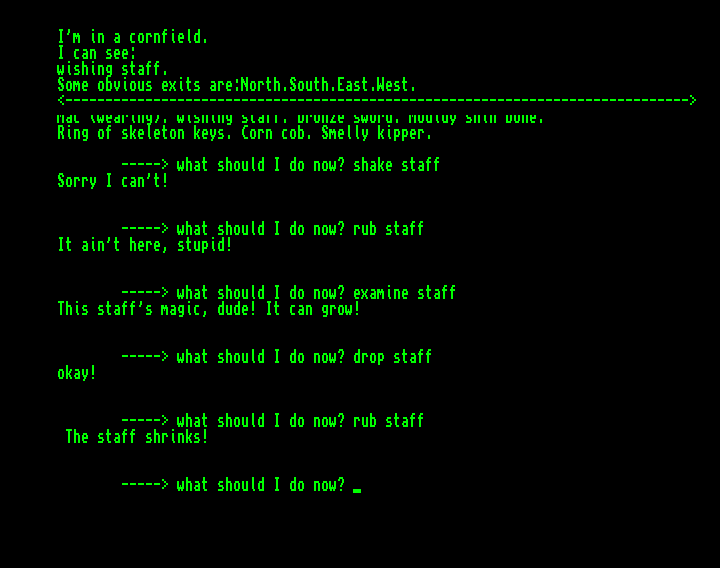
I left off on the edge of a cliff where the game hinted I needed to use a “wishing staff” but I was unable to do so. The game needs, admittedly logically, the verb WISH. I am still unclear what action is really being taken by the player. I can concretely visualize “wave” or “shake” or even — to cause the wishing staff to shrink back to a normal staff — the verb “rub”. Does wish involve saying some magic phrase, or is it reflective of an internal state of mind? This is not purely theoretical: I know from experience I have a harder time summoning up such verbs when they occur.
The game is also finicky about how the item is held. You must be holding the staff to use wish (and then the game will have you drop it); you must have the item dropped to be able to use “rub” and undo the wish.
Crossing over reveals a “dynamite shack”. Despite visible threats to the contrary it will not tip over no matter how hard you try to whack at it.
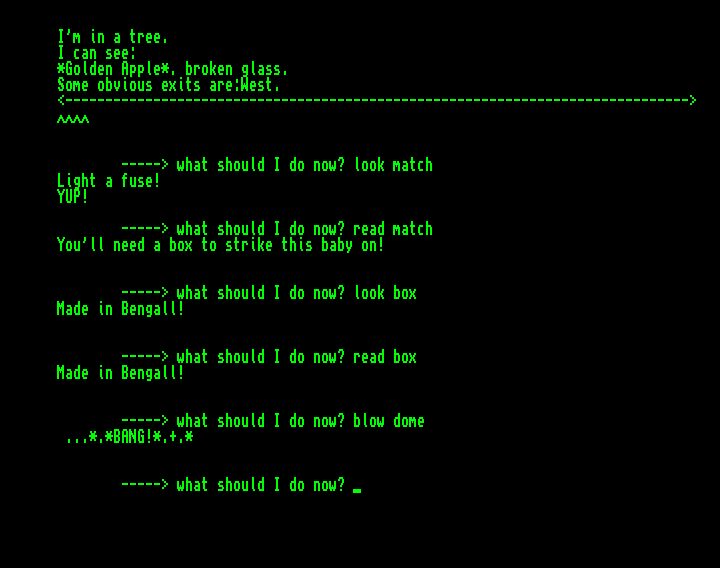
The dynamite turns out to be what we need to break into the glass dome, but we need to be able to light the fuse on it first with a match (hence needing both a match, and a thing to strike the match on to light it). The switch either causes some pipes to make sounds (if you type OFF) or water to start running (with ON). I tried each and then running all around the map until I could find a result. With the water ON:
Just in case you want to see the result without the jacket on:
“scoulded most heinus” is a terrific one for the collection.
I was stuck a long time here and ended up finally prowling through source code. I didn’t hit much enlightenment other than finding there were multiple “cave” rooms. My prior attempts at poking in the dark cave led me to breaking my neck. Here is when I needed to take a leap of insight/faith.
We have seen many, many different methods now of coping with darkness. Darkness will randomly kill you if you are in it long enough (Crowther/Woods Adventure); darkness will kill you upon one step (Zork); darkness will kill you if you go “down” while it is dark (Ferret); darkness is safe as long as you don’t run into a wall (Scott Adams). Given this was designated as an Adams tribute, I should have figured it would be the last case, but I was originally treating the darkness more like Zork.
The other thing is: “exploring” in the dark in the Scott Adams games was always a sort of hack. In Savage Island, Part 1, you could technically skip solving a puzzle via tediously mapping through the dark, but it was obviously not an “intended” solution, so here, I was treating the darkness in a similar way. This was a mistake.
You have to feel through the darkness in this game.
This means, essentially, you have to map your way through with random fatal falls. There is the unspoken rule in some games that this level of randomness means you have reached “brute force” and need to lean off, but it doesn’t take long here if you start mapping to find some “strange oozy mud” which glows in the dark.
Here’s the map I made, including the “stubs” I added when I fell in the dark:
To the south you can pick up a match (as long as you’ve swapped the geyser from below-ground to above-ground) although you still need a way of lighting it. To get that you need to first get by a “large rock” in the cave. You are explicitly given the hint to try to “prise” it but I was having no luck. I realized the fact I could undo the wishing operation meant the staff was a likely candidate tool, and indeed:
The next step uses an object I only mentioned incidentally: a bone that’s sitting at the scary altar from last time. Past the rock is a valley of bones, so I tried (based on the game’s text) to return the bone back home.
The empty match box has the standard-issue friction surface on the side, which is sufficient to light the match. So we can take match, box, and dynamite back to the glass dome to win the game. (Mind you, this still took me a while, I tried commands like STRIKE MATCH and the like which were not understood; the game wants you to skip all the implicit action and go straight to BLOW DOME.)
Go bowling forever, I guess.
I’ve been wondering, from the author’s note in my last post about trying to publish the game, who he tried to publish with. The TRS-80 was not prolific in the UK; if you saw one, it was often the cheaper clone system Video Genie (seen at the top of this post) instead of the proper Radio Shack system. Even given the clone presence, there wasn’t a giant stack of publishers to choose from like with the ZX-80/81/Spectrum; really the most likely possibility is Molimerx, which published the early Howarth work and also Temple of Bast. I wouldn’t say they were overwhelmed with adventures, though. My guess is if Paul Standen accurately reported that they wanted “arcade games” because of having too many adventures, it was rather that Golden Apple was not quite at the same standard as the other games. Or maybe the swearing and tone weren’t respectable-commercial enough. When in the dark you are told you “can’t see shit”; this is not the sort of message that would appear in any “respectable” adventures until, maybe, the late 90s? (I’m thinking Little Blue Men by Michael Gentry of Anchorhead fame, and Chicks Dig Jerks by Robb Sherwin who went on to make games like Cryptozookeeper.)
This game isn’t interesting as a grand moment in game design (although the philosophical handling of darkness was accidentally of note); it does give another good data point of what a schoolchild’s real game-writing was like, with the attitude of the “Adventure narrator” cranked higher in intensity and lower in maturity.
Just a joke bit.
Coming up next: A sequel, where we must battle against Hitler one last time.
Paul Standen describes his game Golden Apple (or Glod) as written when was a “schoolboy”; he sent it to a software company (not specifying which) back in 1982:
We do loads of adventures, we want arcade games is not what they said, but implied. I packed away my computer and joined a band.
He then brought it out again in 1990, and with the aid of David Hunter, converted it to a system called AMOS for Amiga, releasing it to the public domain. AMOS was meant to be a language for implementing games on the Amiga (that allowed for compilation) and is probably most comparable to something like Gamemaker today.
He originally wrote it in “Scott Adams” style, although the game can be played more like an Infocom/Magnetic Scrolls game. I went with the author-preferred look.
The object is simply to find and claim the golden apple, and the secret of immortality with it. The “claim” part is important because while I have found the apple I have not been able to get inside the container it is within and win the game.
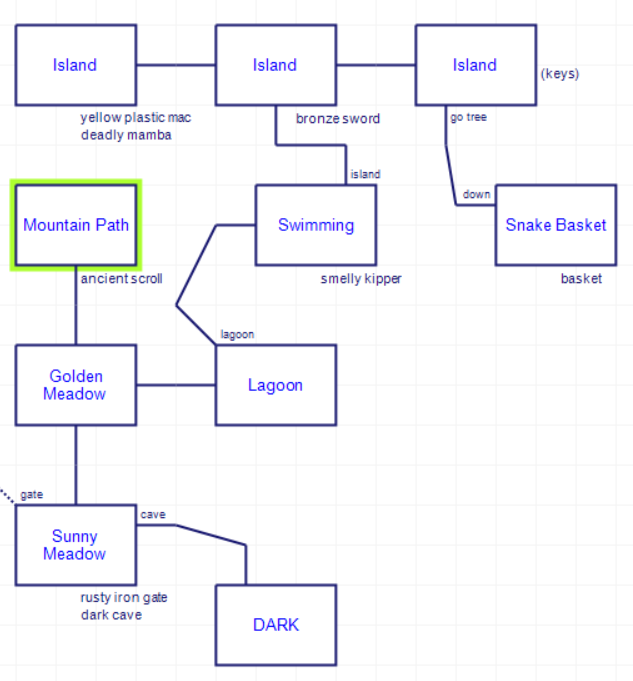
Early on you find a “lagoon” where you can swim in and find a kipper. Examining the kipper indicates that snakes hate kippers.
This makes the next part seem like it ought to be easy, but I had to reckon with the parser a little.
The Scott Adams games quite universally had good noun discipline: if you saw a noun mentioned, you could at the very least refer to it. (It occasionally had a “secret noun” — that is, a noun you could refer to implied by the room description but not separated as a noun — but that doesn’t seem to apply to this game.) Because you do not need to refer to the mamba, the game here simply doesn’t even think that it exists in the corresponding parser command. This is a sign that the author isn’t using some kind of rigorous object-based system for their adventure but rather having parser commands accepted on the fly, making it harder to communicate with confidence.
This is a pattern of the game generally, where things are only half-implemented. It is a little like someone who writes a game based on a pre-written walkthrough but only does cursory checks for deviation. Mind you, you can at least die:
Swearing by the game was very unusual for this era. If anything the game chastised you for using such language. Also, the bronze sword is in the room adjacent to the snake and I haven’t found a use for it yet.
You don’t need to refer to the mamba because you can just drop the fish instead.
Past that is a tree, where if you climb it you find a basket full of snakes. I was baffled by the basket for a while.
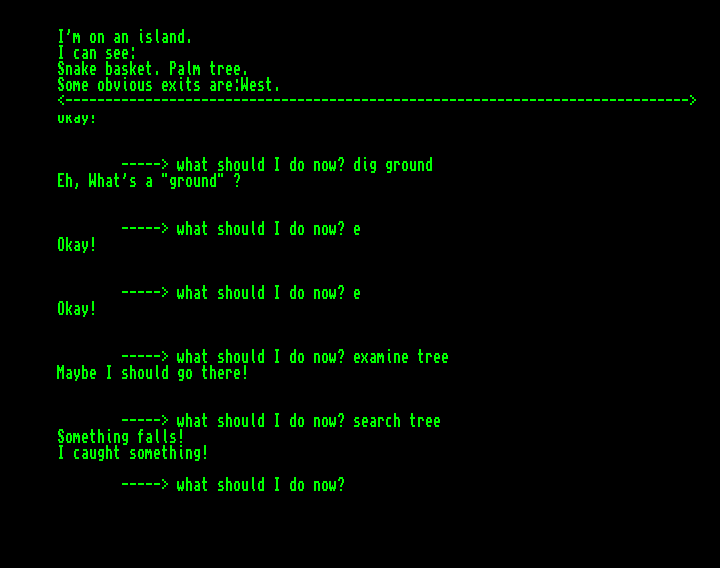
At least you can refer to the basket with an examine command but the game fails to allow any interaction otherwise, including dying. Just in the spirit of experimentation I went back down to the tree (without climbing) and tested my various possible verbs on the tree itself.
I hit paydirt with SEARCH (which is distinct from EXAMINE in an unclear way), as the basket fell down from the tree along with some skeleton keys.
Moving on, there’s a dark cave and a locked gate.
The dark cave remains cryptic to me for now; you fall and die without a light source. The newly-found skeleton keys go to the gate, though, opening a new area.
The room descriptions look vivid but there’s not many objects to fill the imagination. There’s a spooky graveyard with a spooky house but I can’t even get nouns to be recognized in either.
The most glamorous location is a blood stained altar, where you can obtain a “shin bone”; just past that is a “vault” where you can find a “wishing staff”.
The wishing staff is quite odd and I suspect I’m missing something parser-wise. You can rub it to get the staff to shrink but only if you aren’t holding it.
EXAMINE STAFF gets the message “use it at the cliff” but I have tried to do so with no good result.
Not even JUMP at the cliff does anything. What self-respecting Scott Adams clone doesn’t let you jump to your doom, at least?
Mopping up the last locations, there’s a pond with some goldfish (can’t pick them up or refer to them in any way I can find) a field with a corn cob (which you can get, and is “corny”) and a door in a stump which leads to, perhaps anticlimactically, the golden apple.
In a narrative sense, having the golden apple be shown off so early is a strange move; in a gameplay sense, it is an interesting curveball. I’m guessing all we’re really questing for now is one good cutting item (some games use a diamond, so let’s say that).
I’m not ready to plunge into the source code yet (this is uncompiled, so I can read everything) but it is comforting to know it is there, because the somewhat hacky parser may turn out to be my nemesis.
(Thanks to benkid77 at the CASA forum who helped me find the game in the first place; you need to download the AMOS system separate from the Golden Apple source code which can be found on a public domain disk.)
First off, I’d like to apologize, as it looks like my spam filter for comments is more hypertense than normal, and I just had a whole slew that I had to approve. I don’t have any control over how it works so I don’t know why it suddenly got spikier but maybe WordPress had some major troll invasions lately so they tweaked accordingly. In any case, if you ever make a comment and it doesn’t show, please feel free to drop me an email (it is on my About page) if that happens.
Secondly, I’ve sort-of made a special cameo over at Wargaming Scribe as he hit a game that was sort-of an adventure game. (My fictional counterpart, mind you — I didn’t play. I did participate in the multi-player Time Lords and completely couldn’t find anything no matter where I journeyed in time. Let’s just say Julian Gollop was ambitious but his better designs came later.)
Third, if anyone is familiar with the Heathkit computer, could I get some assistance? I’m trying to get a Heathkit only game to work and I am failing miserably even after trying every emulator available. My finest moment was getting H89 to work in MAME (already a troublesome feat, almost nobody has an up-to-date BIOS set) and getting an error that read “no error”. I am now also carrying TEA and NO TEA at the same time.
There’s no rush (it is a 1981 game, so on my loop-back list anyway) but I’d like to get this one at least ready for when it’s time.
There’s a video of disks working, but I think what happened is it was added to MAME support and taken out in a later version?
While I’m at it let me mention some games that are recent and not-quite-so recent that will be of interest to the readers of this blog who like the old-school text adventures.
First off: from very late in 2023, Never Gives Up Her Dead, by Mathbrush. The author has written some extremely good small games in the past, and this is his shot at a massively large difficult puzzle-fest of the old school.
Time is running out after a meteor strikes your interstellar starship. While the crew is under full alert, only you seem to notice the strange red portals opening up throughout the ship.
Explore ten different worlds, learn the truth of your destiny, and confront the mysterious figure who has been haunting you from the start in this epic sci-fi adventure.
Much more recently — as in two weeks ago — saw the release of Moondrop Isle. This is yet another giant game, but with many authors, specifically:
Ryan Veeder, Nils Fagerburg, Joey Jones, Zach Hodgens, Jason Love, Mark Marino, Carl Muckenhoupt, Sarah Willson, Caleb Wilson
It is playable online here and there seem to be some gimmicks that make it an online-specific game — I have yet to get that far but what I’ve seen is very good.
Finally, in old-but-recently-recovered news: on the Stardot forum, longtime poster leenew brought up that the game Satan’s Challenge was broken and seemed to be a bad dump. This led to a giant effort by another longtime poster (duikkie) and many pages of hand-written notes before a reconstructed version was made here. So the game Satan’s Challenge (Microdeal, 1984, BBC Micro) is finally playable for what is likely the first time for decades.
While I mentioned it last time, let me delineate out carefully the four versions of the game:
1.) Pythonesque, the original 1982 version, released for PET and Commodore 64 (I played this version, on C64). The top of the screen at the start actually reads
PYTHONESQUE or The Cricklewood Incident
but the catalog just calls it by Pythonesque. Either title is appropriate, I suppose.
2.) Streets of London, a 1983 version just for C64. The intro screens are different and at least one of the rooms has a different name, so there is some tweaking going on despite the games allegedly being identical.
This is important because the walkthrough I used — and yes I absolutely, completely needed a walkthrough for this game — was for Streets of London (1983), not Pythonesque (1982), and it is possible, likely even, that I played a worse version of the game. This is a type of game where even a small (and non-obvious) change of variable might drastically change the gameplay experience.
This is called “Strip a go-go” in Pythonesque.
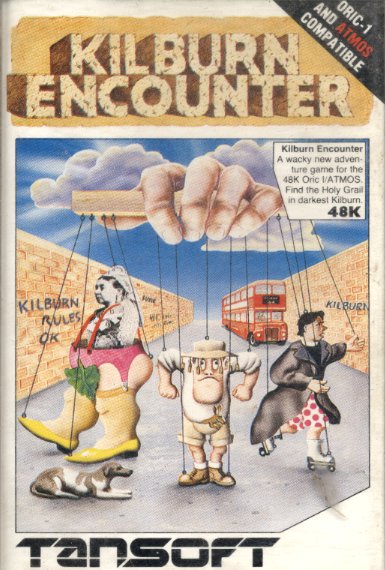
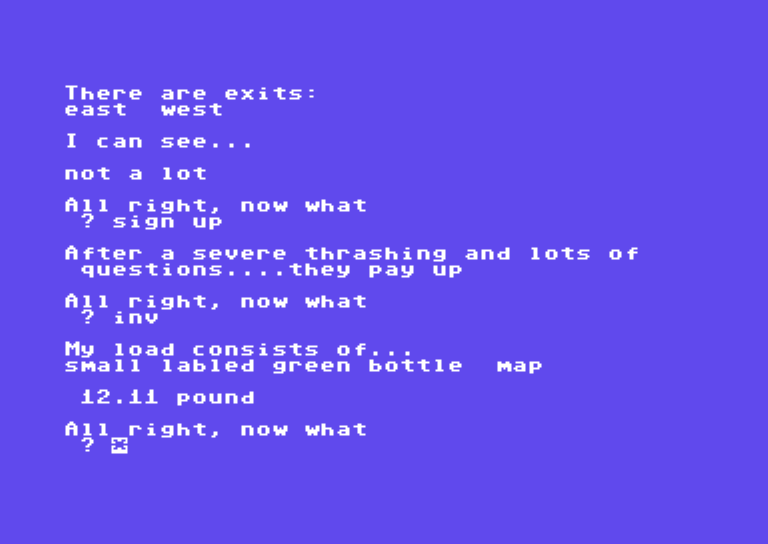
3.) The Kilburn Encounter for Oric. This seems to try to match the original.
4.) The Cricklewood Incident (alone, without the “Pythonesque”) for Electron, Dragon, and Spectrum, with at the very least textual changes.
From the Centre for Computing History. This feels closer to an actual graphic Monty Python would make than Streets of London did.
I have no plans to investigate items 2 through 4 thoroughly because, at least in the incarnation I played, the game was extraordinarily bad. Mind-rendingly bad. I think if I’d been able to follow the walkthrough as written, it might have been okay but still painful; I had to deviate and come up with my own route. It was rewarding in a “I finished something hard” sense but not in a “fun” sense.
To pick up from last time, I was in a scenario where I was occasionally getting money but I didn’t understand why, but I otherwise was either applying a magic word (OH YANGTZE) to move around or waiting to get teleported at random.
I first discovered that the source of my money was the magic — every time I used it, I would get 50p. However, the word is only usable a maximum of 3 times. The word lets you go almost anywhere in the game, including the second-to-last place you’re supposed to go. Behold:
I also discovered if I had money, and I hung out at the tree-lined lane at the start, I would start to get mugged continuously by the Hell’s Grannies. The amount they take is dependent on the difficulty level at the start of the game (remember I went with easy, which was a wise choice).
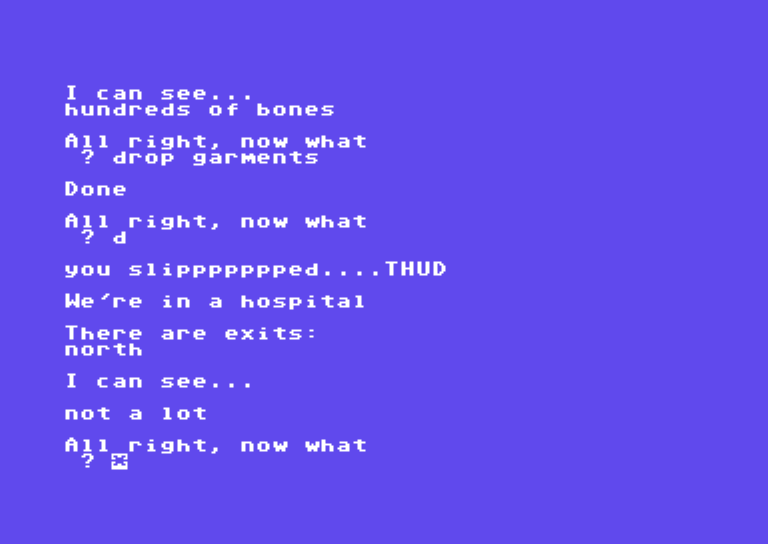
More rarely, this message happens. The flask of meths incidentally is useful once (only once) for a teleport just like the magic word, and subsequent uses send you to the hospital.
One major thing I was missing is that MUG is a word; that is, you can mug the grannies back. Sometimes you’ll just get some money (something like 10 to 110 pence), sometimes she’ll put up a fight.
I just jammed the keys as fast as possible. Your health resets on a hospital visit, which happens if you hit 0 health, but going to the hospital also drops your money by half.
I think an optimal strategy might be to jam the 9 key quickly (run away) and only get money from the “guaranteed” muggings.
There’s one other method of getting a large chunk of cash (more than 10 pound at once) but it requires an almost absurd leap: at a “squalid DHSS office” you can SIGN ON. (Which I guess means … pick up your pension check, maybe? … they don’t even exist anymore, so I have no idea.)
I also worked out the navigation in general, and this is where the nightmare truly begins. First and most simply, if you “die” for whatever reason, you land in a hospital (which takes half your money) and then you can travel back to the start.
The starting area has a bus stop. You can wait at the bus stop and spend money to ride a bus. This bus will drop you somewhere random off a list of 6 places. If you hang out near the bus stop and just wait for an “incident” to happen you might either land at a bus stop but you might also land at the hospital or just another spot on the tree-lined road.
A random teleport. It happens once every 60 turns or so but it truly is random, so if you are depending on it you might having to wait for 100+ turns.
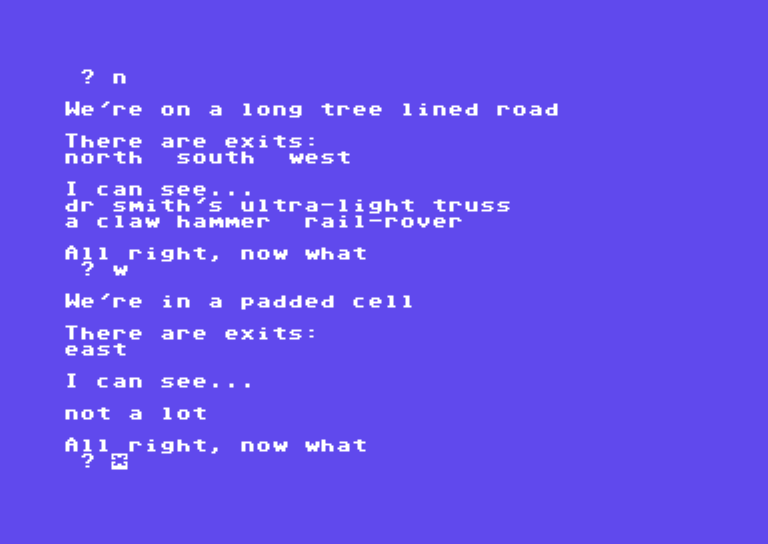
Then, at one of the bus stop stations, there is also a train station. If you buy a “rail-rover” for 5 pounds (something I never was able to gather until the SIGN ON bit) you can also start riding the rails, and it means you can wait for trains. These trains will also take you to random places off a different list of 7 places.
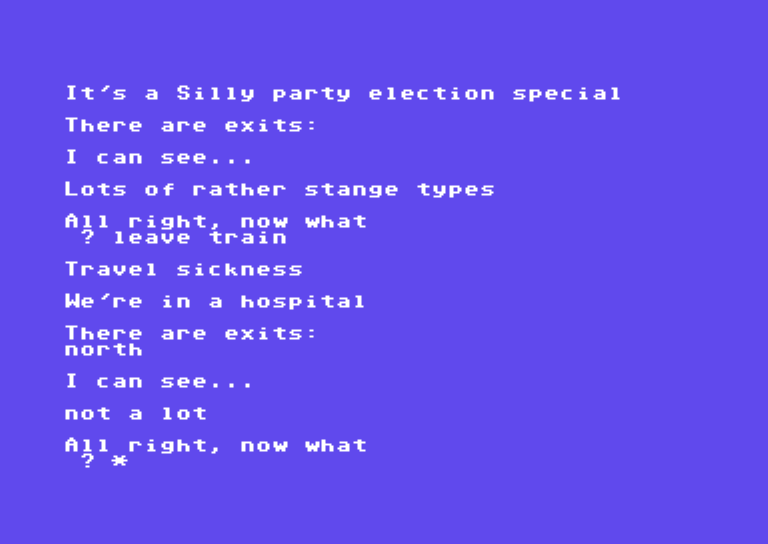
The trains are likely to kill you (at least in Pythonesque). You sometimes are on the train with “skinheads”; if you have the machine gun you can kill them first, although you still are liable to end up with “travel sickness” unless you also have travel pills handy (which can be bought from a shop). I found if I left behind either the gun or the pills I almost always failed to ride the train before landing in the hospital.
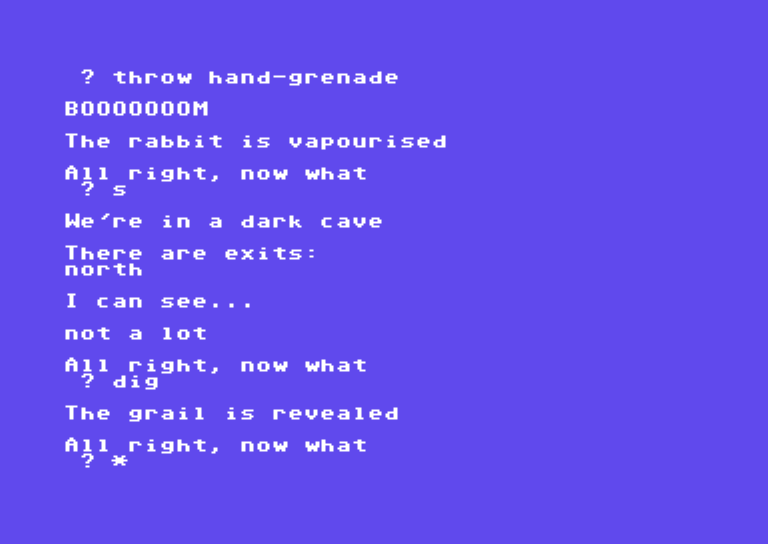
One of the trains takes you to the “dark forest” area which is the final portion of the game (and eventually leads to that rabbit cave I showed off earlier).
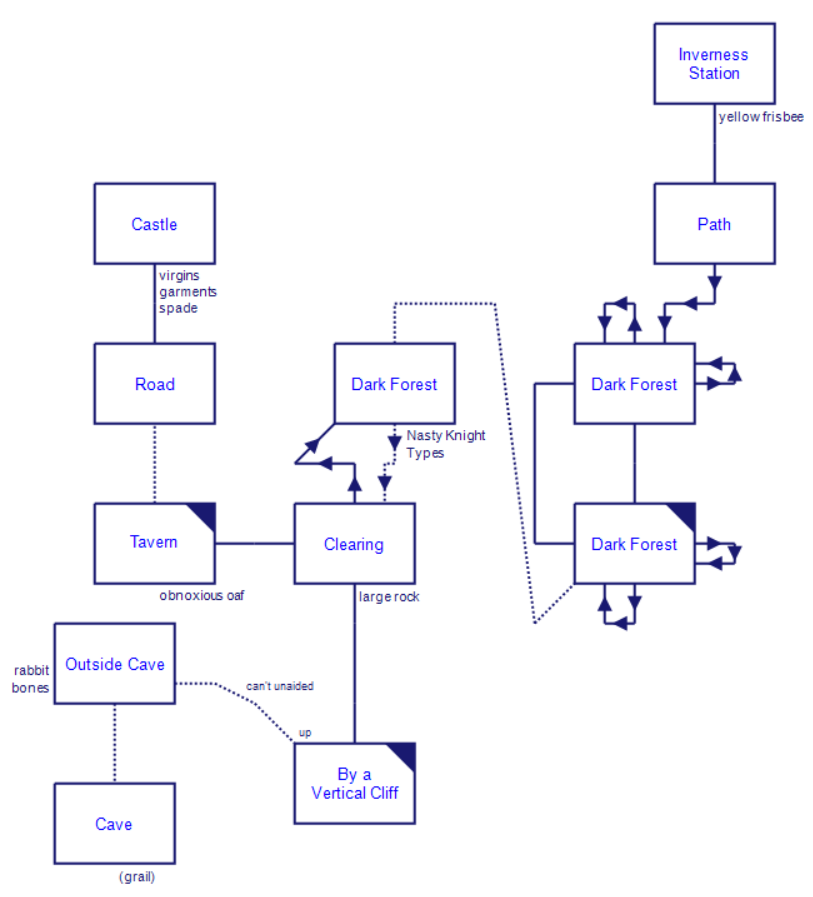
In a meta sense, it looks like this:
Keep also in mind this game has an inventory limit, and if you’re playing without knowing the solutions first, you don’t know what you’re supposed to be toting around in what order.
Traveling with this structure is the most painful I’ve ever experienced in an adventure game. (This includes sluggish late era 90s CD-ROM stuff that made molasses look fast.) I knew (or prior to me deciding to lean on the walkthrough 100%, thought I knew) the place I wanted to go, but it often took 10 iterations to get there, and in the meantime it wasn’t hard to randomly end up in the hospital or just run out of cash by using the bus too many times. If you end up in the hospital from the train, to get back you have to first luck out and get to the right bus station, and then get back on the train from there. (Also keep in mind I also only discovered the “solution” for skinheads relatively late in my gameplay.)
The magic word, remember, can let you go anywhere, and it is what ended up letting me struggle to the end of the game.
So, here’s how things are supposed to go, and I’m going to give the “no magic word” version:
First, mug enough of the Hell’s Grannies to get money for bus rides and some purchases. That maximum I could get to was roughly 2.50, but I didn’t try doing the run-away strategy when the Grannies fought back.
Second, get the money from the DHSS office; in the meantime nab the machine gun (in the open), a truss from a chemist and some travel pills (the walkthrough ignores the pills, don’t do that), a shrub (maybe, I’ll get back to that). You’ll also find the cheese shop scene…
…but rather than shooting the owner, you need to shoot the person making music instead. The owner will be happy and give you a map. (The map, again, might be optional just like the shrub, I’ll get to that.)
Near where the train platform is you should buy a rail-rover ticket when you can. You should also get a green bottle with some “big boy macho tablets” from that weird coffee table scene I mentioned last time (Voltgloss pointed out it was from a Python sketch involving “Doug and Dinsdale Piranha”).
Note that amidst all this you’re skipping a bunch of items that seem like they might be useful (like a claw hammer and a ferret). Did I say already how mean this game is? I’m also ignoring the fact you don’t have enough inventory slots to carry all that above all at once so you have to ferry things in multiple trips.
You need to then hit the trains. You need to be holding the rail-rover to get on, but also machine gun and travel pills at all times on the trains. Make sure you kill skinheads if you see them, and take the travel pills otherwise.
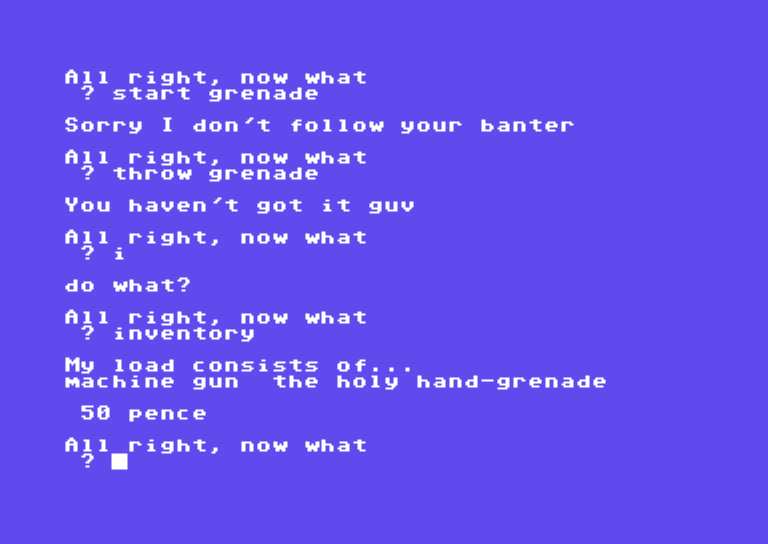
You need to go to a sex shop to pick a doll (which costs money, hope you haven’t run out from the muggings, the Grannies will mug you on the train platforms too), a holy hand-grenade from a cistern, and a torch just laying out in the open. You will not be able to carry all these at once so multiple trips are required (probably involving trekking all the way from the start to the trains again and doing some more muggings and hoping you don’t land in the hospital).
The most important station is Inverness (I showed a version of this in my last post before it was connected to a station):
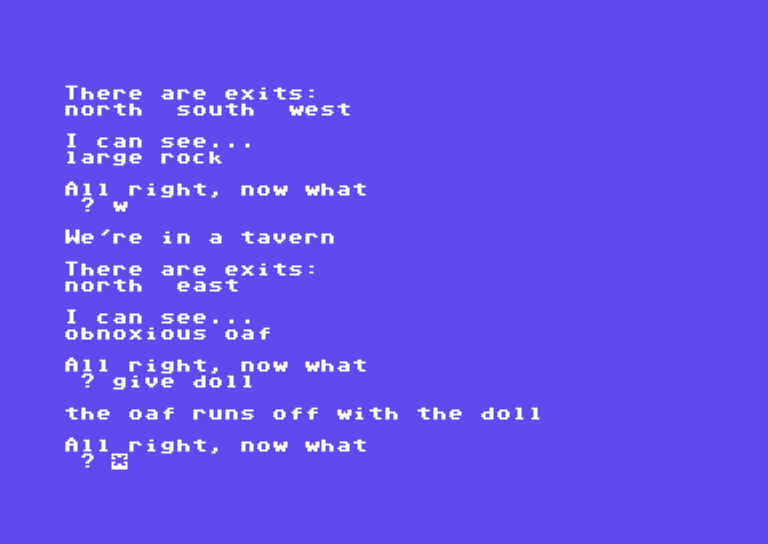
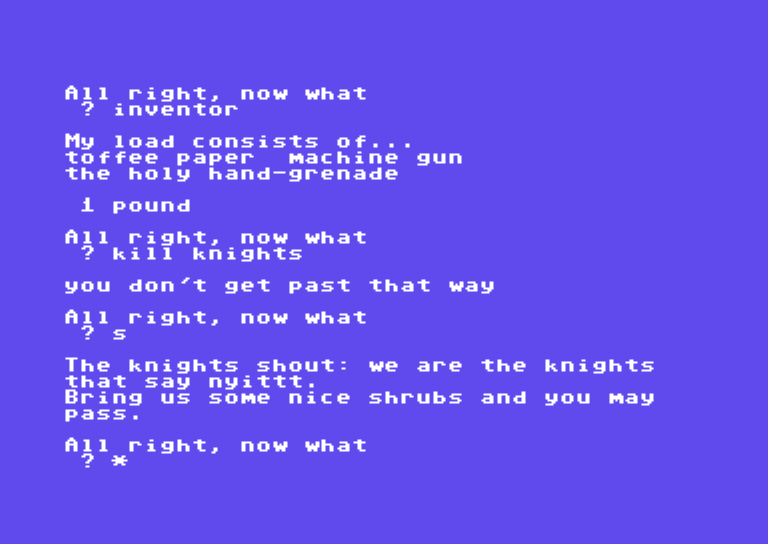
To get past the Dark Forest you need the map (to get by the “maze”) and the shrubs (to get by the Knights). You can then use the doll from the sex shop to distract an “oaf” and open a new path.
North of the oaf is the castle with the virgins, and there’s some garments and a spade there you need. You’ll end up at the hospital with the virgins unless you are holding the green bottle with the Big Boy tablets (but you don’t need to have eaten them … in fact, if you’ve eaten them, there’s some ravenous ladies that will tear you up on the train, so it’s a bad idea).
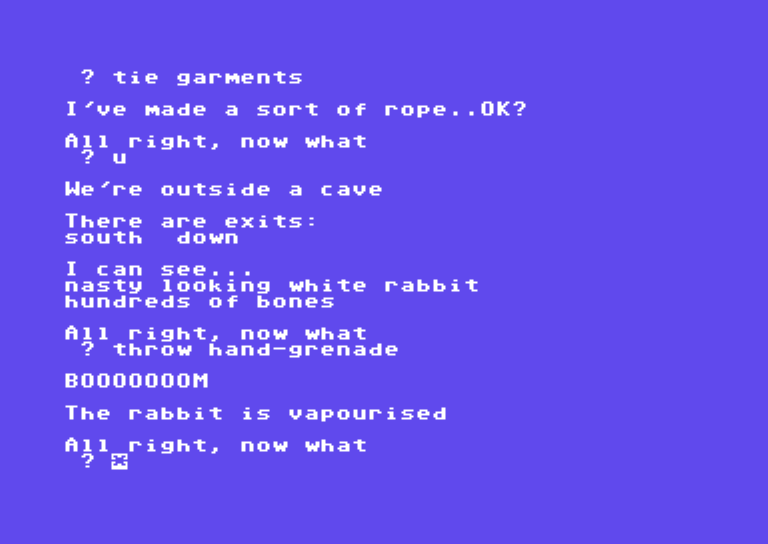
Then you can take the garments and TIE GARMENTS to make a rope for the nearby cliff.
Then you can finally get to the long-awaited killer rabbit, the “non-magic-word” way.
However, THROW GRENADE here is still a dud. You need the Book of Armaments. That’s back at the library, in the bus stop section. Additionally, to get that book, you need a library ticket. To get the library ticket you need to unlock a locker. To unlock the locker you need a key, which you obtain by moving a big rock near the cliff, and to move the big rock you have to be holding the truss.
It’s the hernia-patient thing that goes around your waist.
So you have to get all the way to the cliff area — with the many back and forth trips given you have basically one inventory slot free, and of course perfectly knowing exactly each items you need — and then take the key back to the bus station area, then get back to the train area once you have the book.
I didn’t have a torch the first time through here and wasn’t able to see in the cave.
As the above images imply, I was finally able to pull things off, but only with a little magic help in the middle. There’s enough locations in the cliff area that a random teleport gets there without too many attempts; so what I did after getting the truss was to OH YANGTZE my way to the rock and grab the key early. That allowed me to avoid some of the steps. Then when I had the green bottle, book, hand-grenade, doll, and torch (max inventory, notice no room for even the train ticket) I teleported back to the cliff area again trying to figure out how to wrangle the train ride and was able to finish the game. (All this implies the map and shrubs are technically unneeded, since this strategy skips past their use — of course you have to know all about this beforehand!)
Getting back is easy, since you can drop your rope (garments) and fall down the cliff to the hospital, then take two more steps back to home from there.
You know, I would be disappointed by the ending, but … sure. Fine. I was expecting that. After all, the original movie had an anti-climax and then filled the blank part of film after with organ music.
I still feel like I made everything appear smoother than it was. The narrative above assumes the straightforward path of how to do things, but I had so many instances of random jumping around, not having enough money, just having the train go to the wrong place over and over, and even having the train in one instance never stopping (a bug I guess, I was trapped forever) that Pythonesque was a prime example of me suffering so you don’t have to.
I did imply that a slight change of variables would make things better. I think the best single change would be to simply drop inventory limits — let the player carry everything and it would reduce the number of ferrying trips by 5 times. If the game also was more generous with magic word use — despite the fact it could be used to bypass some puzzles — and tweaked some other aspects (like maybe always get 100+ pence from a mugging) Pythonesque would be plausibly playable. It may be that some of the later versions have done those things. The walkthrough, as I’ve already implied, says absolutely nothing about needing a machine gun or travel pills on the train, despite the fact I only safely made a train trip one (1) time without them. This suggests the authors lightened up a little.
Regarding the humor, I don’t have much more to add from what I’ve said: it’s essentially references without punchlines.
Having the killer rabbit, Book of Armaments, and hand-grenade all used together might make someone recall the famous scene and enjoy it for its own sake, but it isn’t telling a joke. You just have to remember the “five is right out” line and “who being naughty in my sight, shall snuffeth” and chuckle internally, I suppose.
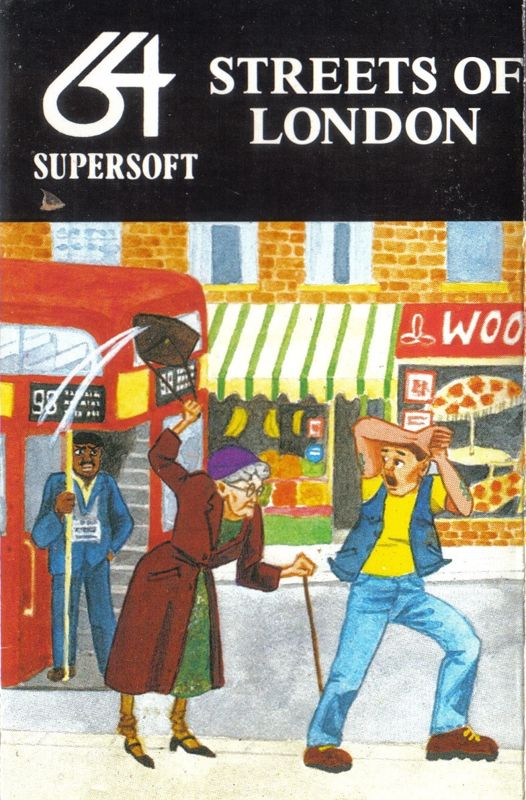
Can you escape the padded cell? Will the old lady hit you with her knitting? How much longer will you have to wait for a 96B bus? These and many other questions will be answered in PYTHONESQUE.
Supersoft we’ve seen twice now before: Brian Cotton’s game Catacombs (for a while lost media, first of a series, we’ll get to the rest sometime) and more relevantly for today, their own version of The Hitch Hiker’s Guide to the Galaxy.
The company received permission from Pan Books to publish Hitch Hiker’s but got in a legal tangle trying to re-publish the game (so re-named it); here, we have a game that started life as Pythonesque — as in the Monty Python comedy troupe — and later again surfaced for the C64 as Streets of London. There was no legal tangle to speak of but perhaps the company was a little nervous.
From Mobygames.
The authors (Allen Webb and Grant Privett) also have credits on The Cricklewood Incident and The Kilburn Encounter which allegedly just rework the elements of Pythonesque on different platforms. They look different enough I’ll keep them separate for now (meaning they’ll wait for a later year).
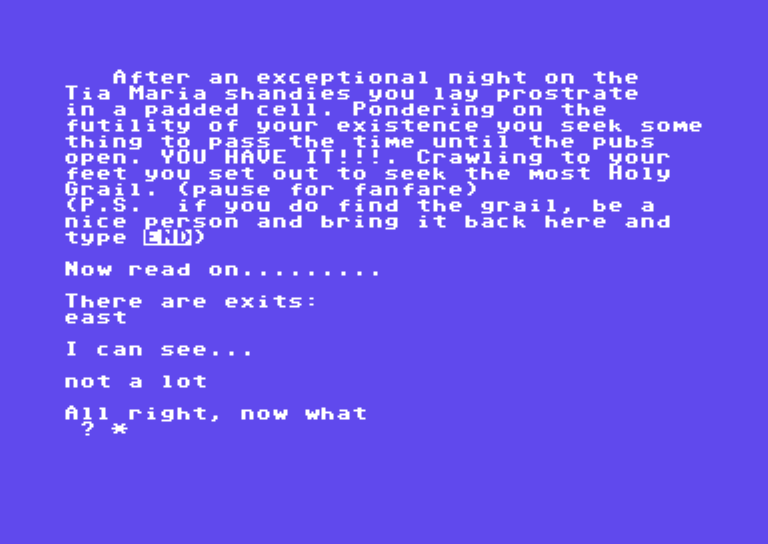
The game starts, oddly enough, with you choosing a difficulty level (1 to 5, I went with easy, usually a wise choice on old adventures where the interest is more in puzzle-solving). You then wake up in a padded cell and decide you need to go locate the Holy Grail.
This one absolutely spins the wheel on random, and draws items from famous Monty Python movies and sketches, like the Holy Hand Grenade. The structure is heavily surreal in a way we have yet to see in this blog.
Namely, the game is spread out amongst many small micro-chunks. You teleport (either via random chance, or using a magic word I’ll show off in a moment) and might be in a one-or-two-room area, and one of the directions will drop you right back in front of the padded cell again.
The magic word comes from a piece of toffee paper just outside the entrance: “OH YANGTZE”. It teleports you to completely at random to one of the micro-chunks I’ve been mentioning.
If you don’t recognize the words (I admit I’ve only seen a couple episodes in whole and the “greatest hits”) they’re from the skit asking the deep question “Why is it that so many of Britain’s top goalies feel moved to write about the Yangtze?”
I’m not sure everything is meant to be a reference, although in the same area where you find the toffee paper is one of the most famous ones, one of Hell’s Grannies.
In game form, she isn’t as threatening, or at least I have yet to have her try to hit me as illustrated at the front cover at the top of this post. As implied, there’s also a bus stop there, but the problem is not getting beaten at the bus stop, but rather lacking in money.
I’ve gone through various runs where my character’s finances go up, but I have no idea why or how they do. Money is important not just for the bus but for the fact some places require you to buy things rather than just letting you take them.
The hand grenade just lands with a thud if you try to throw it and doesn’t explode (you can’t PULL PIN). The machine gun I’ve managed to use on the old lady but that just nets you a dead old lady and no game progress.
If you do have money to ride the bus it works like the magic word — you get on, get off, and find yourself at some new random location. Also, sometimes you randomly just get swiped up for no apparent reason and sent to a new place.
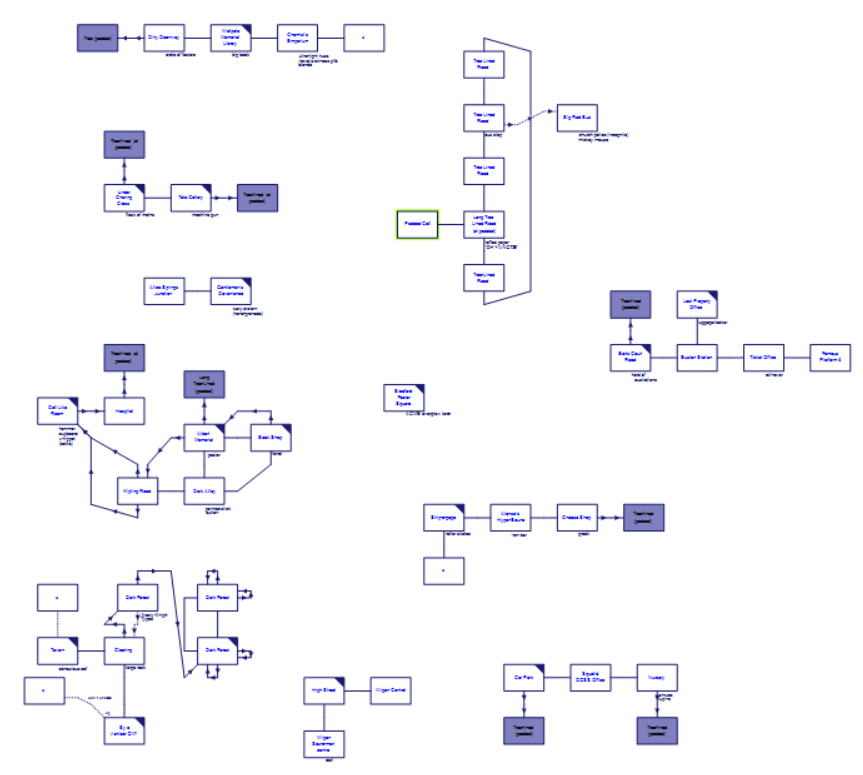
I don’t have anything resembling a complete map yet — the random aspect (and fact some directions will teleport you to the start, and you can’t tell which ones until you try) make my efforts scattershot, and I have some puzzles sticking me in some locations besides. Let me give a far-out view first, just to show general patterns:
Blue marks “teleport back to the start” rooms. The tag in the corner marks possible landing points (sometimes you get more than one in a section). You’ll also notice some rooms are completely closed in, and I’ve gotten myself stuck before, because the only way out seems to be via magic word, and the magic word only has a limited number of uses.
Above is one of the larger contiguous sections. Going “up” at the vertical cliff requires gear, you get stopped by an “oaf” trying to go north at the tavern, and while you can get past the Nasty Knight Types in order to enter the Dark Forest (they want a shrubbery for heading south, but will let you go north), the Dark Forest consists of two rooms where you get stuck in an endless loop.
I know where the shrubbery is — it is for sale elsewhere, but on the run where I had this encounter I didn’t have the shrubbery in hand (again, the only movement is random, and you have a limited uses of the magic word).
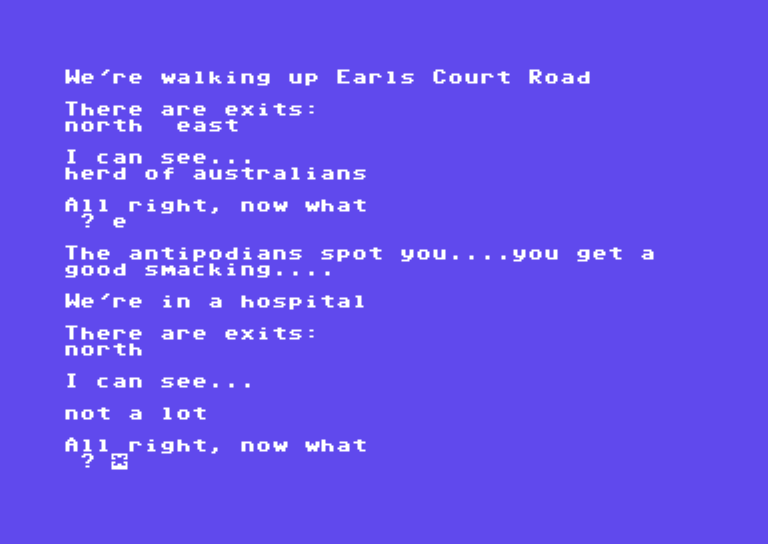
I have a hard time encapsulating all of what’s going on. Some of it is fairly raunchy (that Galahad scene from Holy Grail is in, you end up in the hospital; fortunately the hospital just lets you teleport back to the start). Some of it is plain confusing:
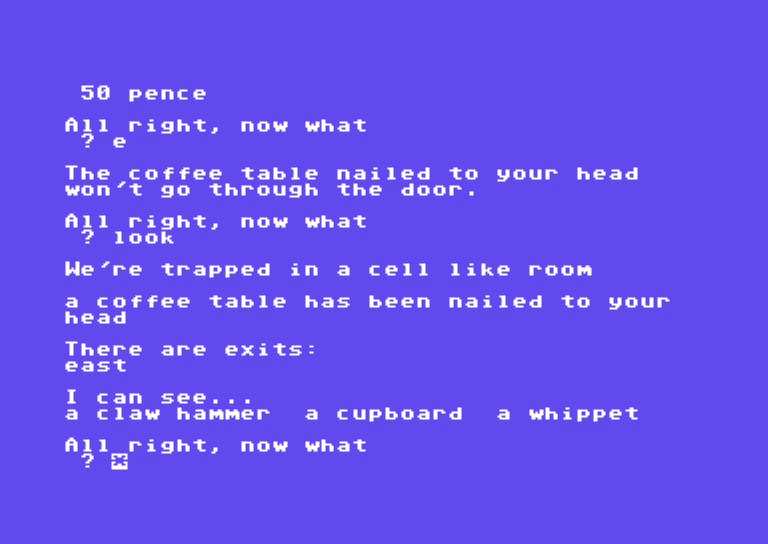
If you take the hammer somehow the table comes off and the whippet runs away. Is this another reference?
I’m not sure yet whether to be positive or negative about the game, although the number of softlocks I’ve hit is starting to tilt to a thumbs-down. Maybe there’s a way to manage the movement I’m not seeing. It’s simply very hard to test objects on things to see if they form solutions when there is very little guarantee I’ll have item X at puzzle Y.
I also don’t think the comedy is hitting, really — it’s so far just been references rather than actually trying to tell jokes — but I’ll reserve judgment on that until I manage to solve some puzzles (or grab for the walkthrough once I get frustrated by the randomness).


























































 Renga in Blue