A number of advertisements appeared in 1984 for the company Bug-Free, including in Popular Computing Weekly and Micro Adventurer magazine.

The four games being advertised (In Search of the Quill, Gunpowder Plot, Dr. Watt and the Darlics, Hells Bells) were all adventure games written by the person mentioned in the ad (J. Wright) so represented yet another one of our bedroom coders who self-published in the UK. The difference with J. Wright and our other bedroom coders is that J. stands for Jacqueline. This is the first author we’ve had of this sort that’s a woman.

Sinclair User, 1983, same address as Bug-Free.
Ms. Wright also continued her entrepreneurship as she shows up later in the 80s all the way through 1992 with a series of ads for a call-in hint line with eventual separate hint lines for separate games, and not just adventure games. 0891 445 926 was for First Samurai. As mentioned in The Adventure & Strategy Club publication, she was one of a whole group of people doing their own hintlines (Sue Roseblade, Joan Pancott, Sylvia Parry, Debbie Lawford, Mike Barton).
Now, the reason we are playing one of her games in 1982 is that the BASIC source code has a 1982 date and lists the company Jaxsoft. Neither I nor anyone else has been able to locate sales under the Jaxsoft label, but the ’82 UK games environment was such that tapes could have just been jammed in at the local computer store (or grocery store, or golfing store, or music instrument store, …) so I won’t necessarily call it unpublished. On the other hand, sometimes people would make up a “company name” for their own personal work. It isn’t certain either way.
The setting is colorful, although this is in the end another Treasure Hunt.
Travel through hell, purgatory, limbo, etc… Meet (among others) the undead, demons and the Angel of Death. Try to escape with B. Elzebub’s hoard and your sanity!
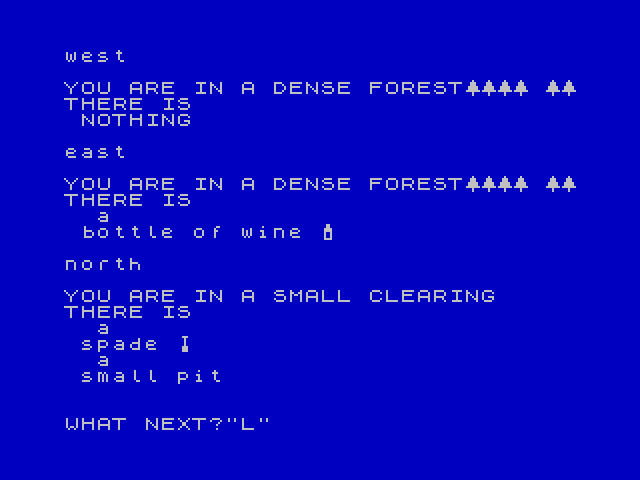
This has the simplistic minimalism of an early Hassett game, with a quite limited verb set: CUT, DIG, DRINK, KILL, UNLOCK, WAVE, JUMP. One thing it does have going for it (that I’ve yet to see in any game) is that the Spectrum character set attributes are used to make tiny graphics for the different objects.
Before things kick off, the game feels obliged to mention if you try to kill a monster, it will ask you with what weapon, and you can try to use your bare hands by just pressing ENTER. This will be important later.

The map is laid out in three sections, essentially aboveground, underground, and deep.
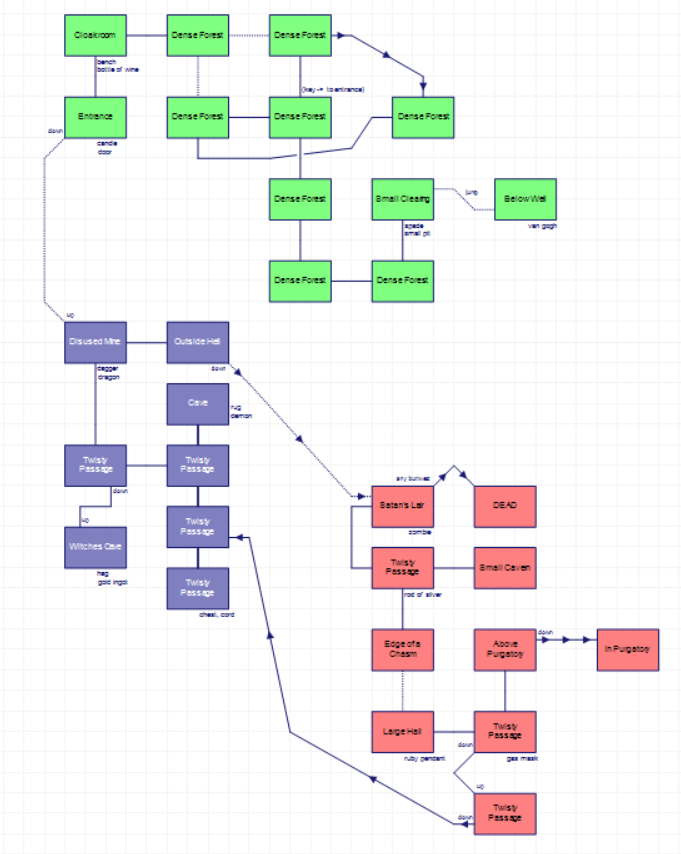
The first phase, aboveground, you need find a key for the locked door to go belowground. This involves taking the candle (you can’t go anywhere otherwise, I suppose this is deepest night) and stumble around the forest until you get to a room with a pit and a spade.
I was using the bottle of wine — the only other item I had other than the candle — to map rooms out. This game turns out not to have any “loops” but only an early one-way exit that makes things confusing. However, it isn’t like I’d know the game lacked loops until I had finished making the map show that in the first place!
Jumping in the pit is possible, but death. It needs to be returned to later.

This is also the sort of the game with no exits listed so you have to test every direction.
With the spade you can then test DIG in every room in the forest, eventually come across one where the game says
YOU FIND
SOMETHING.IT VANISHES
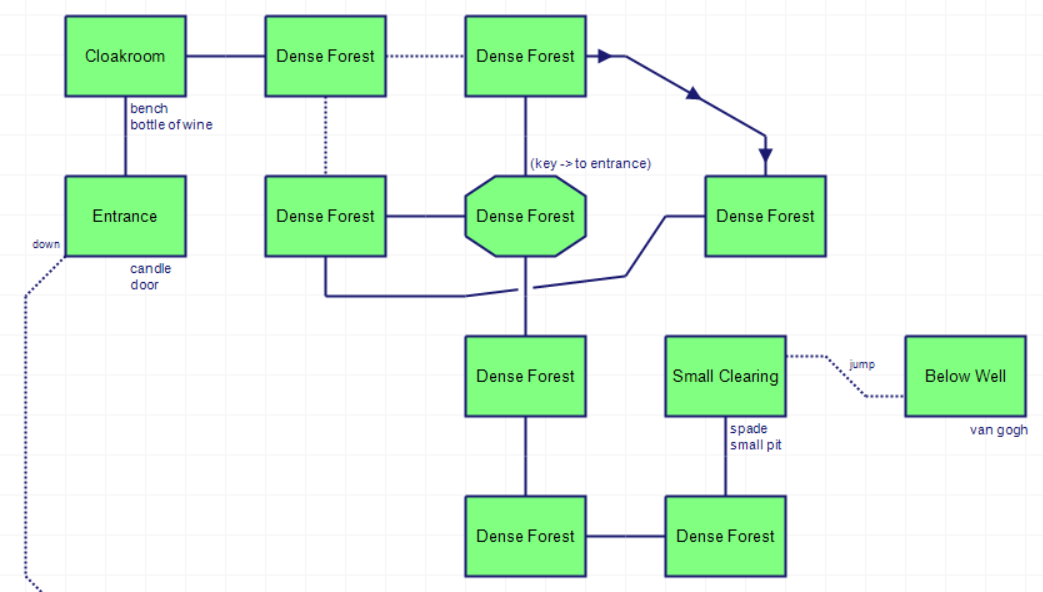
I have marked the “dig room” with an octagon. It is the only place digging is useful, but again, I didn’t know that, so for the rest of the game I tried DIG in every single room.
Having “something changed” in a narrative sense is interesting in that it makes for a slightly unexpected event: I was fully expecting to have an item in hand, but instead I was left fumbling through the forest again just in case the item showed up somewhere, and used DIG yet again on every room (in case the buried item re-buried itself somewhere). All that really happens is the key moved itself to the entrance room.

There’s an untakable “bench” to the north that I wasted time with thinking it might hide something, as it is the only item in the game that does nothing.
With the key you can unlock to the underground.

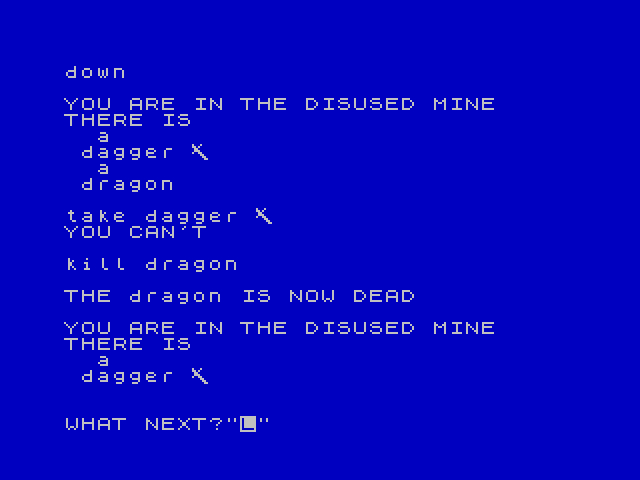
The very first room has a dagger and a dragon. The game informs you that YOU CAN’T if you try to take the dagger (you’re supposed to infer the dragon is stopping you — that’s true for messages in general in this game, like how you can’t go into the forest without the candle implies it is too dark but the game doesn’t say “too dark” or the like).
Since there’s no weapon otherwise aboveground, your only choice is to follow the curious directions at the start and try to KILL DRAGON and just press ENTER when the game asks you with what. This is invoking yet again the “kill the dragon with your bare hands” moment in Crowther/Woods Adventure.
A demon guarding a rug (a treasure) does not allow similar treatment: you need to use the dagger.

There’s elsewhere a “cord” around a chest where you need to CUT it (possibly a struggle for a player normally, but I had already made my verb list). Doing so yields a golden passkey, which lets you go down yet another level.


Giving a map of the lowest floor…
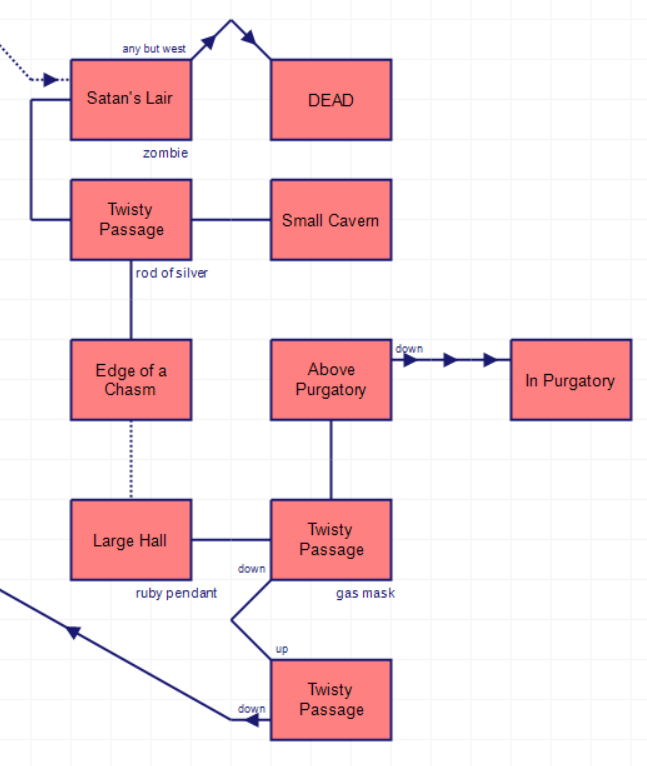
Purgatory is just a trap room. The game softlocks if you enter.
…the zombie is quite serious that the wrong way is death, although there is no logical method to figuring out the “right way” — you just have to die in other directions via an ANGEL OF DEATH until you find out west is correct.

Not interesting in a gameplay sense, but good for atmopshere. There’s not much otherwise that really gets across the “you’re in hell” message the game is supposed to have.
This is followed by a rod of silver, and then a chasm where you can immediately wave the rod of silver you just found to make a bridge.
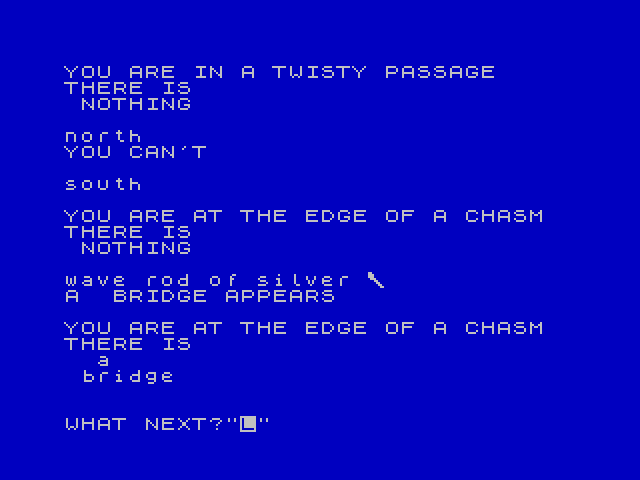
This is a puzzle for people who wouldn’t think to WAVE, I think — that is, this would make more sense for being someone’s first adventure game.
Other than that you can find a gas mask and ruby pendant and leave, going down which will end up somehow bringing you back to the underground floor. You are passing through twisty passages without much distinguishing them once the items are gone so I had the fun case of mapping out rooms without realizing I was just re-creating the map I had already made.
The gas mask goes back to the pit above ground, where you can jump in and find a Van Gogh.

Other than that, the rest of gameplay is about gathering the treasures you’ve run across and dropping them off at the start, where they will disappear if they count as points. The golden passkey is described as just a passkey after you first find it so it is the least likely to be remembered; I just went ahead and tried all my objects just in case and discovered it worked by accident.
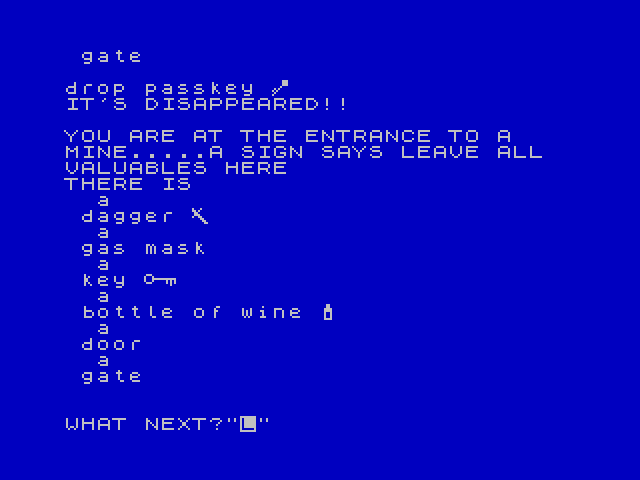
I was still stuck after so I was seemingly missing a treasure, meaning I had to go back and DIG everywhere yet again just in case I missed a secret. What I had overlooked is that UP and DOWN are directions that can be used arbitrarily, and in one of the twisty passages you can go DOWN to find a hag.
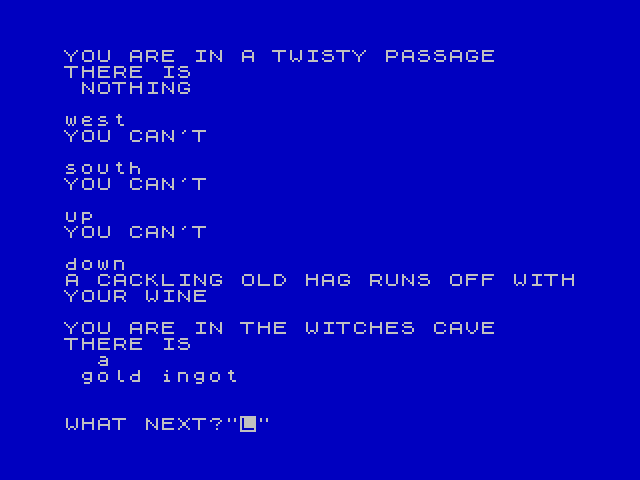
Not really a puzzle; the wine bottle works to stave off the hag as long as you have it in inventory. Someone who previously drank the wine (softlocking their game) would get stuck.
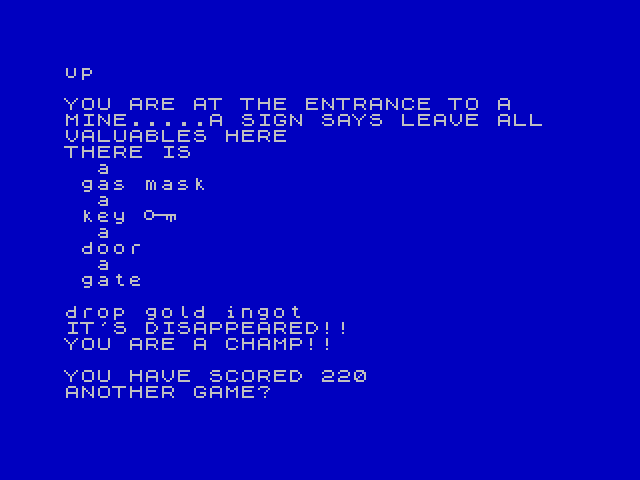
This has a “author’s first game” feel to it: the Treasure Hunt setup, random combination of monsters, straight-up copy of Crowther/Woods puzzles (even if the dragon is delivered in yet another novel way), the softlock room, the sudden-death exit room. However, the game was still solvable; the author didn’t try for anything overly ambitious requiring convoluted parser input, or go for a stretch like saying HI to a ghost. I had genuine fun which is all I’m really wanting from a bedroom coder’s first game. The others from J. Wright do not have a similar dating scheme so they will await us once we arrive at 1984.
For now, let’s visit a game with graphics that, like Rungistan, has animation, but uses it in an entirely different way.


 Renga in Blue
I think there may have been an error in the sentence – “the zombie is quite series the wrong way is death”
Are we likely to hit 1983 in 2024? Or do we have plenty more playthroughs to go?
going at a pretty good clip, but we should hit the 3/4ths mark in 2024 and the end in 2025.
Her other games sound fun, but CASA and Spectrum Computing have them listed as MIA, unfortunately. Is that incorrect?
Yes, although we’d love that not to be the case (if anyone has copies!),
just kind of hoping they show up by 2029 or whenever it is I get to 1984!
btw, she does have one other game available (the game is available as well as a scan of the tape cover), Add Venture from 1983 as published by AWA
https://spectrumcomputing.co.uk/entry/9033/ZX-Spectrum/Add_Venture
I’d never really looked at that one, with it not being a text adventure. However, I notice that the AWA Software advert from Popular Computing Weekly for 30th June 1983 also lists Hells Bells! So that’s taken the confirmed publication to at least a year earlier, and closer to the 1982 copyright.
oho, nice catch!
The visualisation of the inventory items is actually quite cute. It lends the look of a “casual game” to this text adventure way before casual games were even on the horizon. Furthermore, the cute little symbols are incongruous in a game called “Hells Bells”.
Yeah, if it is the same Jackie Wright, she started out by offering hints and tips on adventure games at home (as many of us did by post or by telephone back in the day) but then turned that hobby into a commercial operation, the “Guilding Light” telephone helpline, with multiple employees. As you rightly point out, its scope expanded beyond text adventures to cover other genres of computer and console games.
Do you know if The Guiding Light had their own newsletter? I seem to recall seeing that pop up in a few of the old magazine adventure game columns… Or maybe I’m misremembering?
Roger Garrett’s Adventureline club had a magazine called ‘The Guiding Light’, but I’m not sure if that was connected to Jackie’s enterprise. There were so many clubs, fanzines and magazines back then; many short-lived.
Actually, given that it looks like Jackie’s home number is listed as part of Roger’s Adventureline column in Your Computer, I guess there was a link between them. Geoff Rens is another adventurer who is often listed in Roger’s column too. Geoff was better known to us in the UK community as “The Grue”. He was a big Infocom fan and also wrote his own games.
Thanks for confirming that. Yeah, many of these old UK adventure fanzines seem totally lost now. I’ve managed to get hold of a few rarities over the years (I have some issues of Soothsayer and Spellbreaker, for instance). However, the one I’ve really been after is Orcsbane, but they’ve never popped up. I know that Nick Walkland was later involved in Confidental/Official Secrets, and seems to have some sort of online/social media presence, so I wonder if he could be contacted to see if he still has any copies that could be preserved and scanned in?
In various places we’ve got a large number of Adventure Probes archived now; but nowhere near a complete set given how long it was published for; as well as all of Red Herring, a chunk of From Beyond, some Goblin Gazettes, most of Adventure Coder/Adventure Workshop, etc.
I’d certainly be interested to see any issues of Soothsayer and Spellbreaker, if you were ever looking to share them with the community. I’m not sure how many issues of Orcsbane there were (not many, I think). I can’t recall off the top of my head if anyone has approached Nick about them.
Unfortunately, my whole magazine collection is packed up in a storage facility about 300 miles from my house, after a move last year. However, I’d be happy to send them along to be scanned in whenever I can finally get back up there and sort some stuff out.
Yeah, I think Orcsbane had only around 3 or 4 issues published, circa ’86-’87. IIRC, Walkland was part of a piece they did on Official Secrets in Retrogamer a few years back, but I’m not sure if Orcsbane was mentioned.
That reminds me, I’ve recently become intrigued by a couple of ads and mentions of a fanzine called The War Machine, written and published by M.W. Costello of Nottingham, circa 1981. You’ve probably come across this before, since you have the ad for his lost “Martian Adventure” up on 8bitag. Anyway, despite the wargaming-oriented title, it seems this fanzine also covered adventures, which would make it the first of its kind in the UK by several years, I believe. Tracking him across the old magazines, it appears that he also ran a TRS-80/Video Genie user’s group and newsletter, wrote a ZX-81 coding book, had some magazine type-ins published and was involved in White Dwarf’s computer game column, all in the early 80’s. I first ran across the ad for this fanzine in the BASUG newsletter, which I recently wrote something about in the comments to the final entry for the obscure game “Spelunker” here on this site, which you might find interesting in the context of your tracking of the early UK adventure game scene, specifically as it relates to their “Haunted Cave” conversion, circa 1980.
I think Mike (William) Costello is probably best know for his PBM ‘Ashes of Empire’ which apparently had great success in Germany as a PBM (you could buy the program to run your own computer-moderated games too) and later a board game. [Not to be confused with the Mike Singleton Amiga game of the same name]. I hadn’t made the connection between “Mike Costello” and the “M. W. Costello” of Martian Adventure. Those early computer users/pioneers seem to pop up everywhere once you start looking!