Back in the early 80s, Mike Taylor was just wanting to buy a copy of Skramble from Terminal Software for the VIC-20. It was one of the many, many, clones of the arcade game Scramble.
When he wrote in to order, he also mentioned “in passing” if they’d like to see the adventure game he had written. Indeed they did, and yes, all the companies in the UK was publishing tapes like a blizzard.
By our definitions, this was written as a private game (1982) that was published almost by chance a year later (1983). We probably should come up with a word for this, as it is different from a purely private game (like Danny Browne’s work) and a purely commercial game (The Mask of the Sun). The best example of this middle-state is Softporn Adventure which was written for friends, and the content meant the author had a great deal of failure trying to get the game to market before it got picked up by On-Line Systems (and eventually transformed into Leisure Suit Larry).
This was heavily influenced by Scott Adams (which could run on a memory-expanded VIC-20), rather than Crowther/Woods Adventure (which could not), and the author notes:
…it’s interesting to see how many conventions I unconsciously adopted from Scott Adams – things that I didn’t even recognise as being stylised until years later when I played very different games such as the original Crowther/Woods Adventure.
No lore to speak of this time:
The object of the game is to retrieve the Magic Mirror from wherever it might be in the programme’s landscape.
This kind of qualifies as a Treasure Hunt, but with only one item.
Also, this isn’t quite the bare-bones unmodified VIC-20; as the tape art indicates, 8K of expansion memory is required. This is still quite minimal and less than a standard TRS-80 game, and room descriptions are correspondingly succinct.
Just to give the main gimmick straightway, the general structure of this game seems to be an item relay. That is, the game passes through a series of “biomes”, there is an inventory limit of five, and a series of puzzles where you have to reckon with the fact you need to move more than five items from biome to biome. This doesn’t sound glamorous to the modern gamer, but the puzzles are otherwise fairly straightforward, so it’s what makes the game have sufficient density to be satisfying. (The very last puzzle is not of the same type and is just mean, but we’ll get to that.)
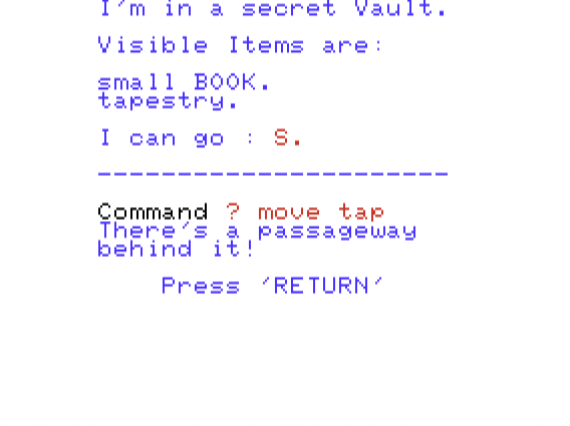
The game starts out in “your residence” and is reminiscent of Pirate Adventure starting in your apartment. There’s some hidden passages (like the one above) but the objects and rooms are minimal enough the secrets are generally meant to build atmosphere rather than be puzzling.
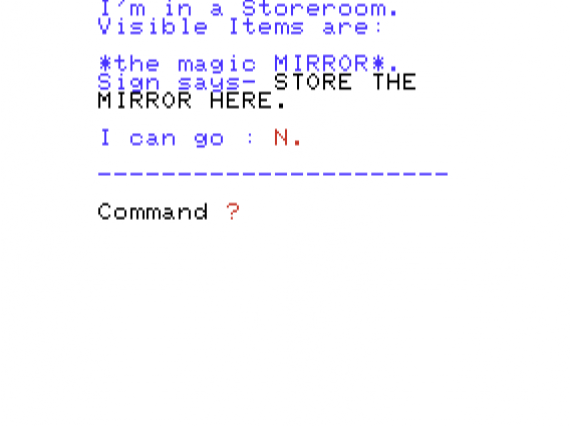
You can collect a BOOK, MEDAL, SWORD, KEY, AQUALUNG, and shiny TORCH, as well as find a Storeroom that indicates STORE THE MIRROR HERE. That is six items and we’re already hitting our item limit issue; to go to the next area you need to go out a window, but you can’t immediately go back again.
You instead need to find a LADDER at a rose bed, bring it back to the window, and then you can CLIMB LADDER back up to where the house is to get the sixth item.
In what I’ll call the “garden area” you can also find some SPECTACLES in order to read the BOOK which tells you a useful magic word is ZONK. The SPECTACLES and BOOK are no longer necessary at this point, and the ZONK word works if you are holding the torch.
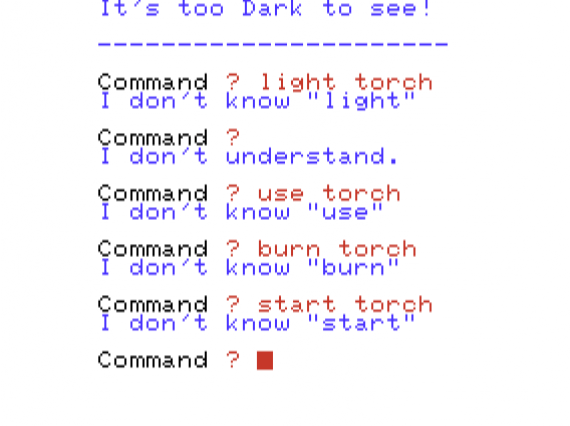
I had tested ZONK before picking up the torch, leading me to this scene later.
You need to do some guess-the-verb and FOLLOW PATH in order to get to an area with a pond, and a swamp with some WHISKY. To recap our item situation, we’ve got an AQUALUNG, MEDAL, SWORD, KEY, and TORCH, but WHISKY would bring our items up to six. Thinking perhaps I could loop back later I went forward with the five items, wearing the aqualung and jumping into the pond.
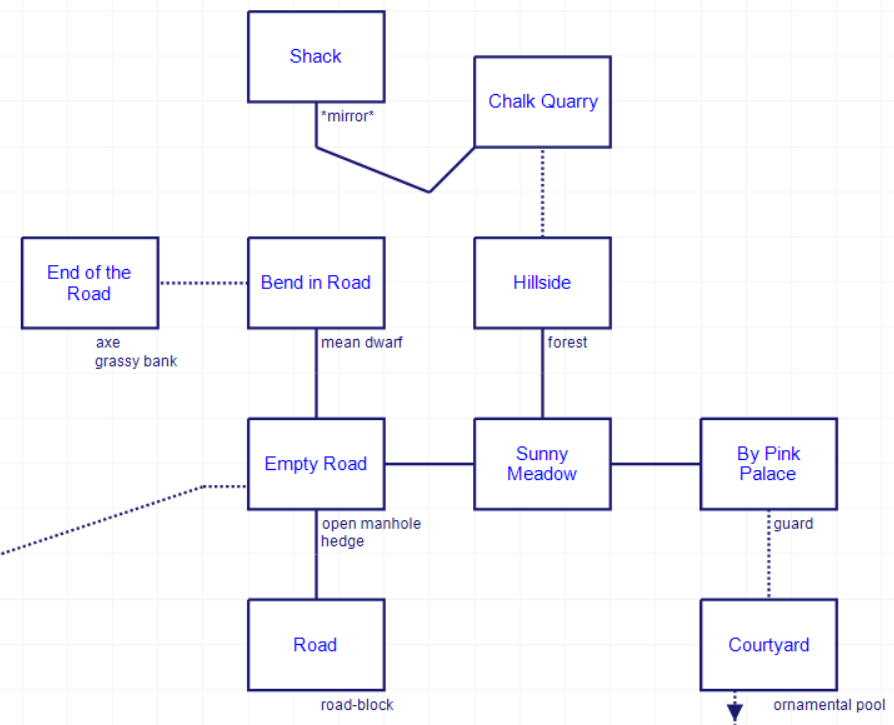
Unfortunately, this drops you at a “damp semidark chamber” (see lower left of the map above) where you can’t go back up again, so it’s another one-way trip, and this time, there’s no way of going back up. You can only move forward into darkness (see torch scene) to a stream which you can swim, followed by a chasm which you can jump.
Keeping with the general theme, jumping over the chasm with too many objects breaks your neck, so you have to carry two things — the torch and one other item — over by ferrying back and forth.
I found a “drunk ogre” on the other side and realized I needed that whisky after all (GIVE WHISKY just causes it to disappear, no description even of what happens, you can use your imagination). This is next to a “narrow tunnel” with a large rock hiding a canoe in one direction…
…and a deep lake in the other direction, which the canoe automatically gets used on (it’s too deep for swimming).
I was stumped here for a while; going out in the canoe seems to cause you to get stuck (see above) and I ended up dragging out my verb chart.
I didn’t need to go all the way to solve the puzzle, but here’s the complete chart for reference. LISTEN tracks as LIST or INVENTORY, while the words like SWING are being interpreted as different verbs; SWI stands for SWIM.
The majority of the game’s verbs require a noun, including, rather puzzlingly, LOOK. In order to show a room description you need to LOOK AROUND. This made it so the right command, WAIT (just the one word) was off my radar, but I went through typing it anyway and found out the canoe was steering itself:
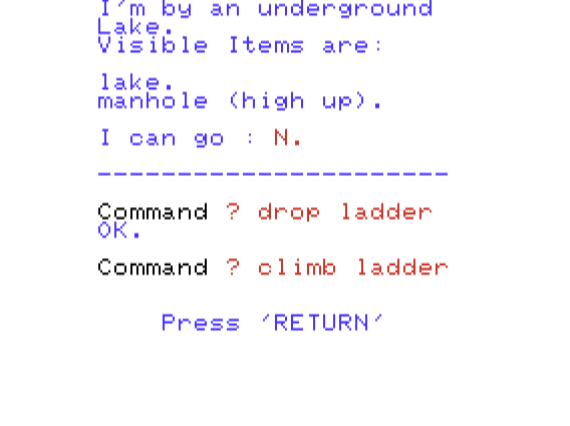
I found a manhole up high on the other side and realized I needed the LADDER from way back at the house. The problem was the pond was a one-way trip! I realized — given THROW was a verb, I could THROW items while next to the pond and they’d go in, and I could find them on the other side. This allowed me to redo the whole section — in multiple rounds — carrying over the WHISKY, MEDAL, SWORD, KEY, LADDER, AQUALUNG, and TORCH, eventually picking up the CANOE as well ferrying them all over to the manhole.
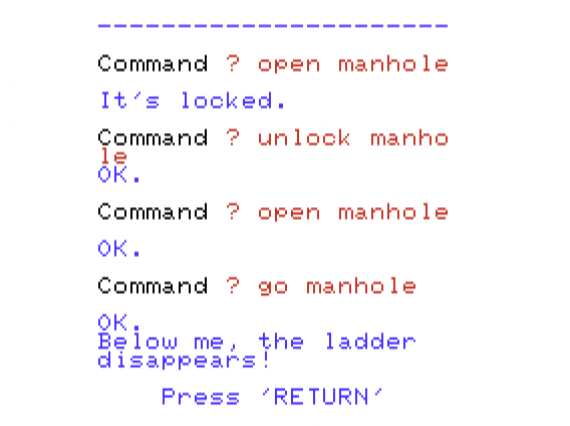
The ladder disappears under you as you go up the manhole, so this is another item check. What you need still is the SWORD, MEDAL, and AQUALUNG. (You also still need the ladder! … and yes, it disappeared … we’ll get back to that.)
There’s a “pink palace” with a guard that will take your MEDAL as a bribe.
This leaves open the palace which has a pool. If you have the aqualung worn, you can dive through the pool and make it back to the lake near the start, so we’ve found a way to loop back to the opening of the game.
The exit from the Courtyard is what goes back to the pond at the garden area.
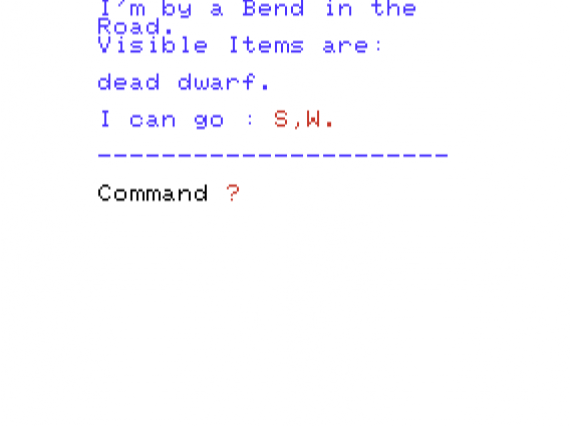
Other than that, there’s a mean dwarf (KILL DWARF with the sword)…
…where you can find an AXE just afterwards. You can then take the axe over to an “impenetrable forest” and CHOP FOREST to expose a new route.
This leads to the *MAGIC MIRROR*! With the mirror in hand I could then jump back to the pond, go back to the house at the start…
…and realize I didn’t have my ladder any more to reach the window. Drat.
It turns out the ladder has re-materialized back at the rose bed where you first found it. I was just visiting everywhere in a futile attempt to see if I could get something new to happen with the MIRROR (you can’t rub it, or wave it, or anything). So you can take the ladder after all, make your way back in the house to the Storeroom, and then, find one last nasty surprise:
LEAVE (which worked in Zodiac on a breakable object to indicate “set down gently”) gets the same smashing result. I was able to THROW the mirror (!) and it safely landed, but no winning condition, so I assume I hit a bug.
A winner is me?
I needed hints for this very last puzzle. Every other hidden object in the game has been associated with another object, but once — and only once during the game — it turns out you need to LOOK NAME-OF-ROOM to find an object. Back in the cellar (which has a sword) you need to LOOK CELLAR to find a second item.
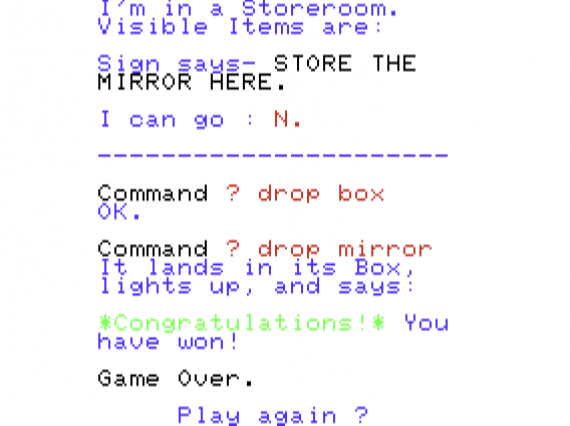
With the box at the Storeroom, you can safely drop the mirror.
Even with that final stumble, I found this enjoyable out of normal proportion for a minimalist game with no real “daemons” or other complexity which are usually needed to make difficult puzzles. The item-juggling took over sufficiently as a mechanic that I was engaged with the world beyond a simple apply-key-to-lock hunt, and out of the VIC-20 library this honestly was much more playable than Bruce Robinson’s work.
The author happens to be a longtime reader of this blog, so if I could ask some questions:
1.) Other than Pirate Adventure, what other Scott Adams games lent specific inspirations?
2.) Did the concept of shuffling items as a primary mechanic come from some Scott Adams moment in particular?
3.) Did you think at all about the possibility of publishing the game before the offhand mention to Terminal Software?
I was going to hit another reader-made game next. As of this writing Andrew Plotkin’s game Inhumane is listed at CASA Solution Archive as being written in 1982, so I had it queued up. However, reading the details, I found it was an Infidel parody, and since Infocom’s game Infidel wasn’t out until 1983, I knew something had to be wrong. The real release year is 1985 1984. So we have to pass by, but possibly Andrew is not upset about the game getting kicked far down along the queue (this was written when he was very young).
I still would like one more “breather game” before I take on my next monster, so I’ll try to find something random that will fit for next time.
Before I go on with Sharpsoft (and the history of this game in particular) I should briefly give an early history of Sharp personal computers, because it’s a bit of a mess and I need a reference as much as you do.
Sharp has been around since 1912 although not starting in electronics; the founder, Tokuji Hayakawa, got his first patent for a snap buckle. Three years later came the Ever-Sharp Pencil (and the source of the eventual name of the company Sharp).
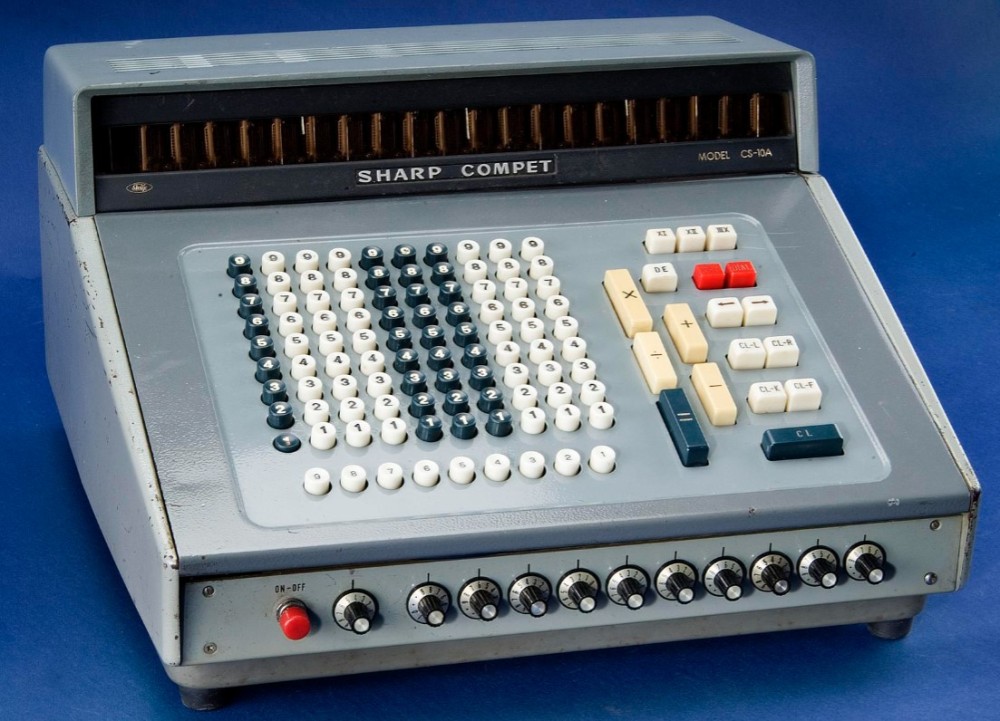
In the 1920s the company started in radio, and has had fingers in electronics ever since. Importantly, they were involved early with calculators, including (in 1964) the first all-transistorized desk calculator from Japan, the Sharp Compet CS-10A.
By the time they got involved with personal computers in 1978, they had been making calculators for over a decade, which helps to explain the keyboard on the MZ-80K.
From the Home Computer Museum in the Netherlands.
The K stands for “kit” — this was first sold as a kit computer although it started to be sold fully assembled in 1979.
From the people who I have read who have touched a real one, the keyboard is miserable to type on and feels like what would happen if a company used to calculator keys made a transition to personal computers. (Possibly also cribbing from the Commodore PET, but that doesn’t make things better.) You’ll also notice a lack of BACKSPACE which is why DELETE is being used instead for the same function in Escape from Colditz.
Sharp also put out a blizzard of computers in a very short time, which I feel again may harken back to their calculator roots a little, going by a quick product cycle. Riffing off the MZ-80K line is the MZ-80C, MZ-80K2, MZ-80K2E, and finally the MZ-80A from 1982 (being both a “new line” and ending the 80K line).
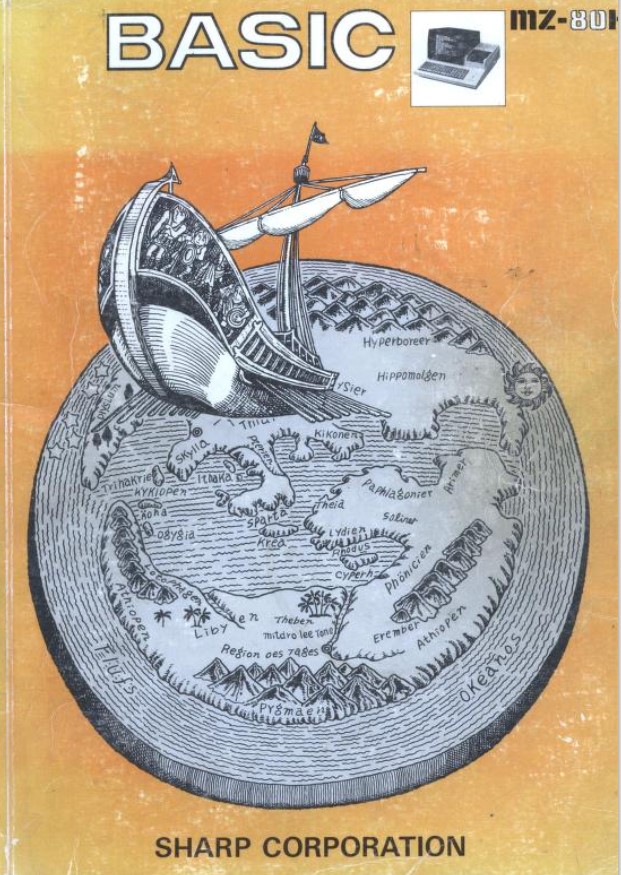
From a 1980 programming book for the MZ-80K.
There was also in 1981 a MZ-80B line offshoot that was for business computers; the Sharp X1 line (also launching in 1982, the same year as the 80A) was intended to have more powerful graphics, and was the line that eventually led to X68000, the only Sharp computer that “mainstream” retro-nerds tend to care about; it was analogously comparable to the PC-98 but more capable of handling “smooth scrolling” and arcade action.
To shorten things out…
1. first Sharp computer — 80K
2. next-gen continuation of 80K — 80A
3. business computer line – 80B
4. graphical line – X1
…with MZ-700 (that I played Secret Kingdom on) being a continuation of the 80A line, adding color.
The tape that was discovered for Escape for Colditz had copies for MZ-80K on one side and MZ-80A on the other. I played the 80K version. It must have been a later printing; the game was originally available in 1981 only for the 80K (the 80A wasn’t out yet).
Regarding the publisher Sharpsoft, they have an ad in January 1981 Personal Computer World indicating they’d been around since 1980, although the absolute earliest they could have been founded was from the start of Sharp computers in the UK, the October 1979 launch at the Birmingham International Business Show.
There are many graphics utility programs but PrintPlot’s advanced features make it unique. Essentially, the program enables the user to plot a static graphics display directly on the screen using enhanced cursor facilities. Once complete, the program will automatically convert the display into a series of Print statements contained within a subroutine. When required, the program can be instructed to delete itself, leaving only the display subroutines which can be incorporated into subsequent programs.
The contract mentions 15% royalties, and proves they were contracting out rather than just cranking out all their own software. I’m guessing Colditz was picked up as another contract like the one with Dr. T. Johnson, but I don’t have an author associated (nor any names associated with Sharpsoft themselves). I will keep digging.
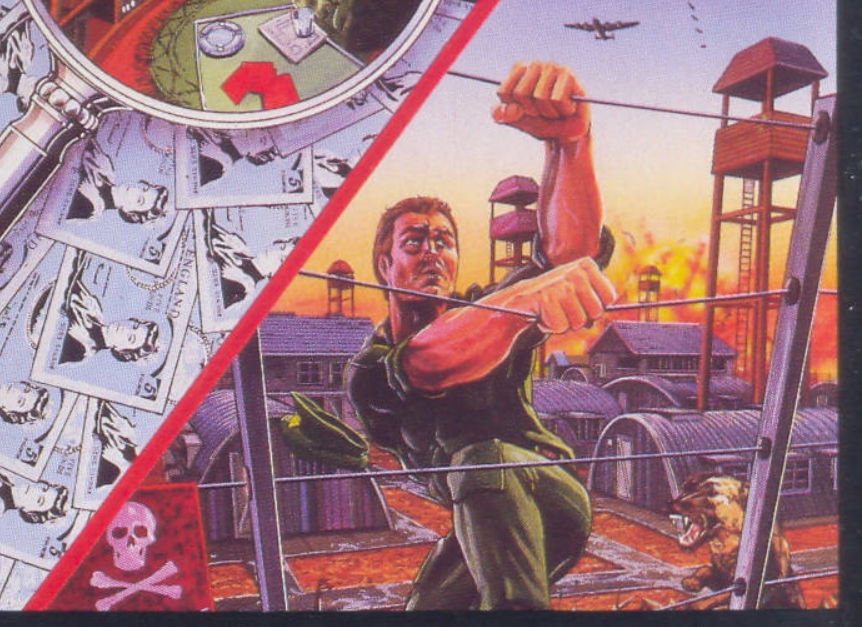
In the meantime, let’s break out the game! Which has us escaping from Castle Colditz (again). You can read the general historical background at that link; the shortened version is that Castle Colditz was an infamous Nazi POW camp considered “escape-proof” and a great deal of energy was put by prisoners into attempted escapes.
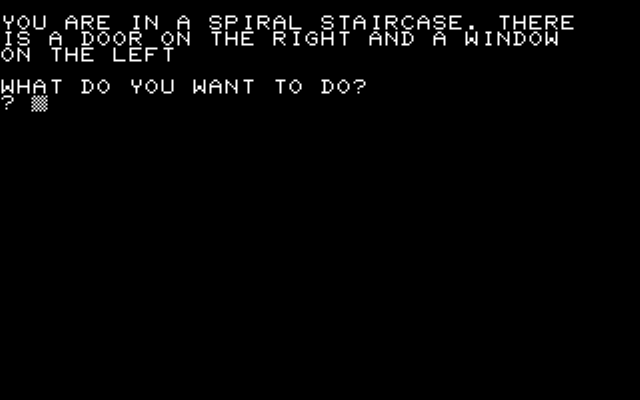
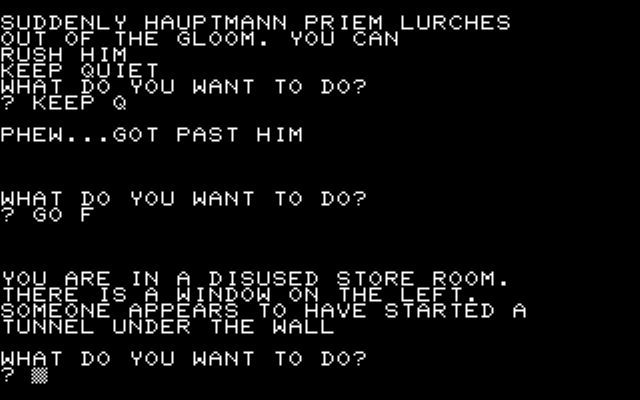
Note: LEFT, RIGHT, FORWARD, and BACK, not compass directions.
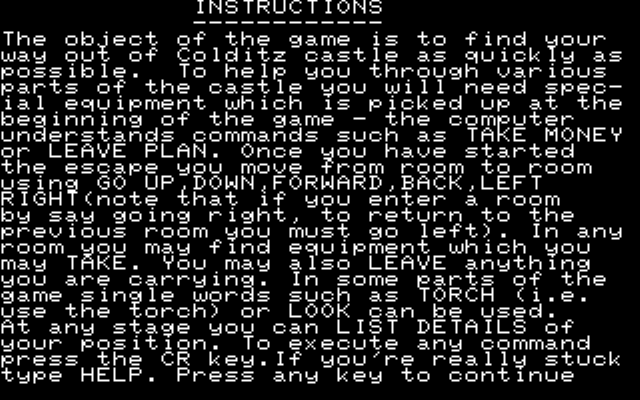
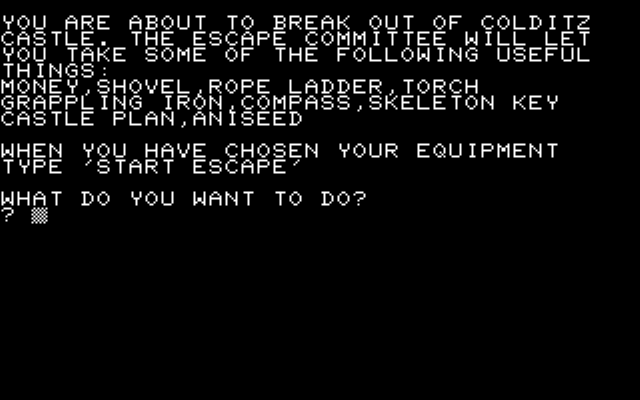
This time, oddly, we have a choice of equipment to start with. The Escape Committee consisted of POWs who did not attempt escape themselves but rather coordinated other escapes. The actual game effect is to be something akin to a gamebook (with the same unfortunate ramification of possibly softlocking the game before it even has started). You can carry a limit of four items.
I’m not 100% sure if the softlocking-on-start thing is true, because what this game is designed around is a short trek with a bunch of “alternate passages”, and some of the passages quite explicitly say what you need to pass through them. I made it through with a ROPE LADDER, a TORCH, some ANISEED (that’s for guard dogs, for some reason), and the CASTLE PLAN, which you can’t even leave the Committee room without taking.
Ideally — and I think this is what the author(s) were shooting for — you could pick any combination and find one unique route for passing through, then replay with a completely different set for a new route. In practice I don’t think it worked out, but I’ll be up-front and say my map isn’t comprehensive.
Before showing you the first part, I should mention one other unique “quality” to the game. The parser is a one-letter parser. It cuts off everything but the first letter of your command. I thought two letters was extreme, but it finally has been topped.
How does that even work for a parser, given T could be TAKE or THROW or literally any word starting with T? Well, the parser doesn’t actually do any verb-noun processing in the normal way; it takes the first letter of each word to form a combination. So GO UP gets turned into G U, GO DOWN gets turned into GD, GO FORWARD gets turned into GF, etc. which explains this part of the source code:
1010 A1$=”GUGDGFGBGLGR”:REM MOVES(6)
1011 A2$=”TMTSTLTTTITCTKTPTATRTUT1T2T3T4″
1012 REM TAKING EQUIPMENT
1013 A$=A1$+A2$+A3$
1014 A3$=”LMLSLLLTLILCLKLPLALRLUL1L2L3L4″
1015 REM LEAVING EQUIPMENT
1016 A4$=”SERHKQBHCPUALD”:REM OTHER COMMANDS
I’m not even sure what all of these things are, but LD is LOOK DETAILS (the equivalent of checking inventory plus getting a room description, although the game neglects to describe any objects sitting around in the room). KQ is KEEP QUIET, UA is USE ANISEED; fortunately this is prompted explicitly when it comes up.
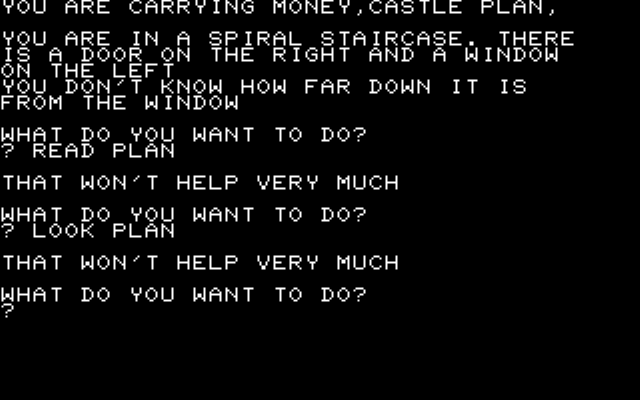
If you try to go down through the window the game states YOU DON’T KNOW HOW FAR DOWN IT IS FROM THE WINDOW; this is the very first possible alternate route where maybe there’s a way through but I don’t know what it is. The game doesn’t like to react to active use of items.
From my first run of the game, trying to treat this like a “normal” adventure game with a real parser and responsive world model and so forth. Even though you need the plan to start I don’t think it gets used during the game otherwise.
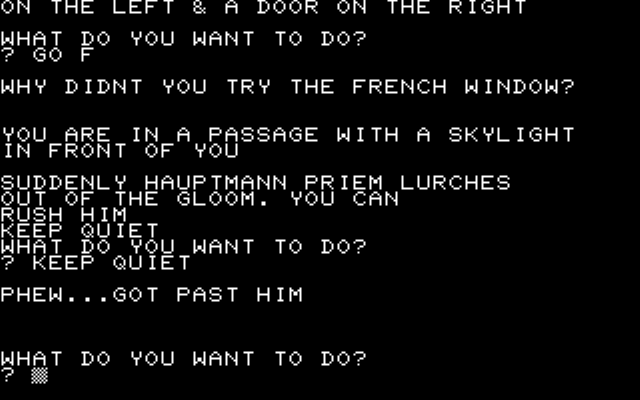
Also, if you skip by testing out the window the game will complain that you should have tried out the window. This mixed messaging stumped me for a lot longer than you might think; it took me a while to realize that any items that I was using were going to trigger between rooms (the ones I got to work, anyway) and the only other commands I ought to worry about are explicitly listed when one of the random guards comes up.
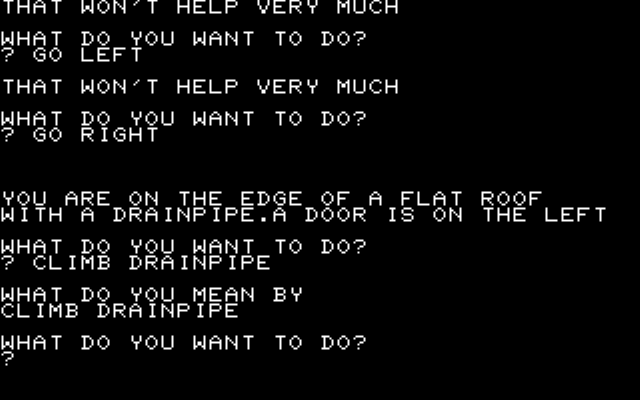
More early blundering, even though if you check the help it mentions CLIMB as a possible word. You’re just supposed to GO UP.
Here’s an example of a random guard:
Aniseed only works on dog guards, but as far as I can tell it always works. If you don’t have the appropriate defusing-object, you’ll have to resort to one of the other options which doesn’t always work.
If you fail at a check, you’ll flee and drop your equipment. Usually this isn’t a problem, unless you happen to flee in a direction where you need an item to get back. (Mind you, this doesn’t always make sense, like the exit that requires a rope ladder, which you somehow can travel back through without said rope ladder.)
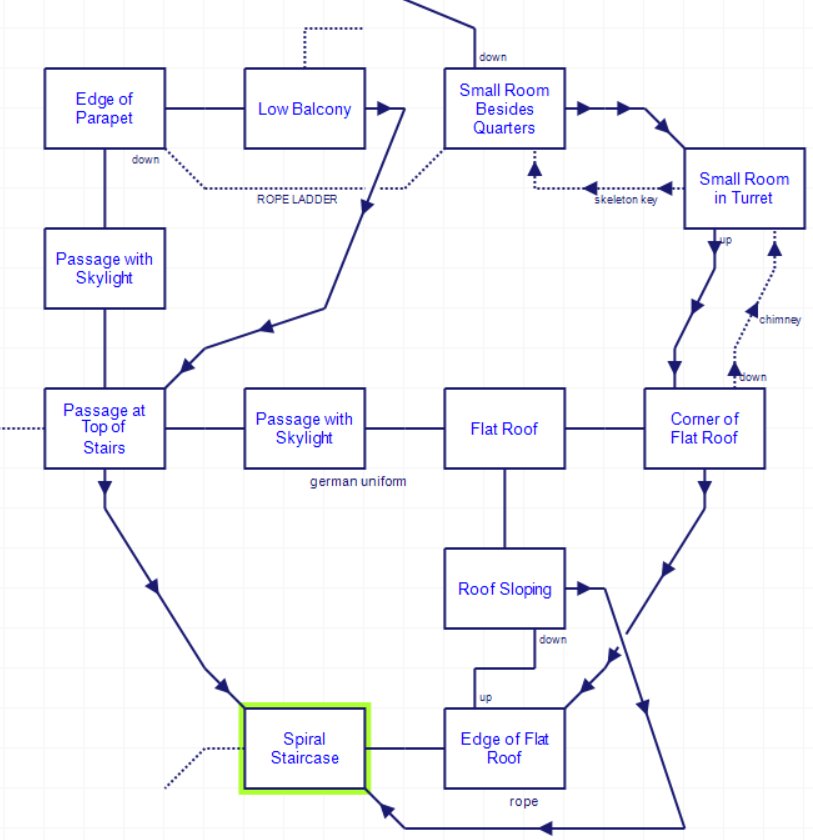
Because of all the parsing annoyances and general confusion the map took me a while to make, and I know this isn’t complete, but here’s my first part anyway:
Green marks the starting room.
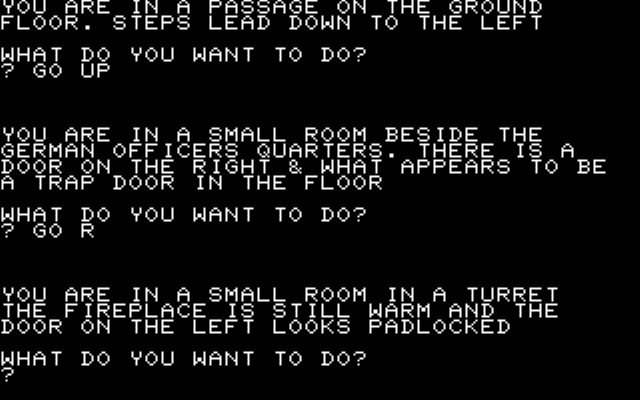
The “chimney” is one of those one-way confusion spots. The game says you have to go down a chimney if you GO DOWN at the “Corner of Flat Roof” but I never got anything to work. However, you can GO UP from the other side just fine.
The bottom of the chimney. The door to the left requires a skeleton key to open from this side, but no key entering from the other side. This makes sense with some locks but not on a padlock.
Another alternate route was a building that looked close; any attempt to JUMP failed. I assume the game wants you to be holding a specific object, but I can’t confirm that.
My failed navigation meant the only route that worked for me was while holding the ROPE LADDER (where the game quite explicitly says you need the ladder; I didn’t have it but immediately restarted the game to pick one at the start).
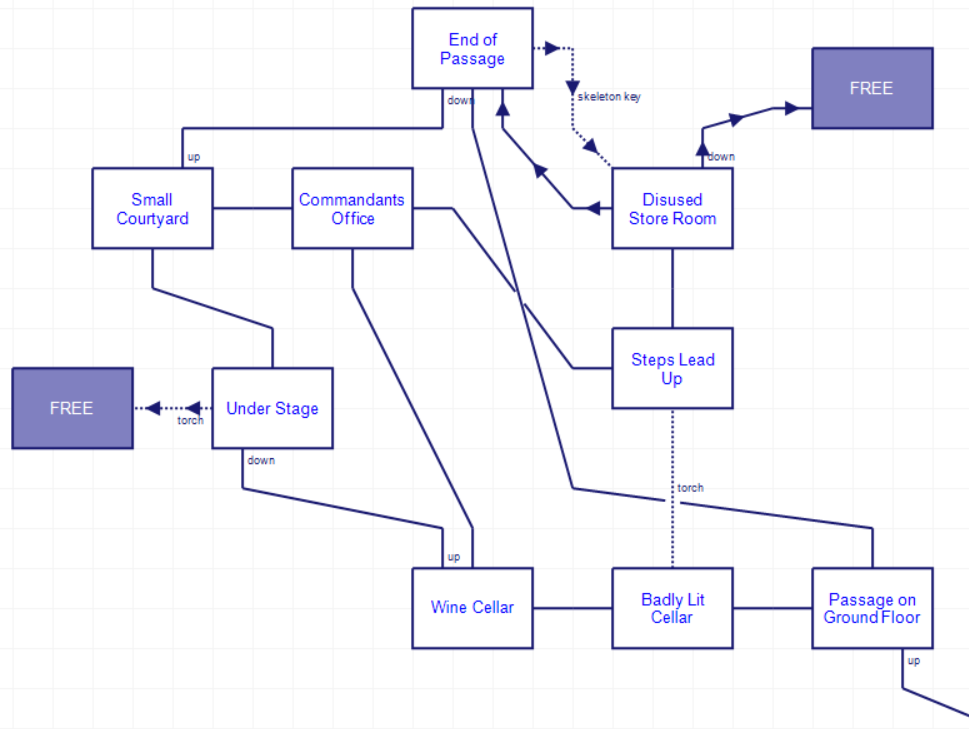
Once past this I got to the second part of the map:
There are two passages that require a torch, which I happened to have, but there’s a route through one of the exits that doesn’t need a torch so it is purely optional.
Reaching victory gives a little bit of British patriotism music, so I’ve dropped it in video form.
The dread and envy of them all.
No, this is not a great game. It almost feels like — especially because of the parser — like someone described an adventure game to the author(s) and they tried to write one based on the description, rather than the usual familiarity with Crowther/Woods Adventure. I do appreciate their concept was interesting, even if they didn’t pull it off: adventure game more as a strategy game, with choices at the beginning affecting the gameplay overall. If this was done properly there’d be agonizing over options in a way we have enough information to make an thoughtful choice (should I get money for bribes, or the aniseed) and it truly would be possible to get through with alternate routes — but not in a way so bare-bones that only one specific item is required.
I do think the game is short enough it is fun to noodle with once you understand the limits of the parser, and maybe someone (one of you reading this, I mean) can discover a few lurking secrets. Here’s that download link again, and remember to load using the third save state. With the CPU set at x4 (from the Control menu) the speed is tolerable, although keep in mind this is a wonky late-70s keyboard so you shouldn’t try to type fast.
We hit one part of the Eno/Stalag two-pack recently; Eno was a whimsical and short treasure hunt, while Stalag asks us to “Escape the German prison camp before its bombed”. When originally sold by PAL Creations, Eno was one of the “bonus game” choices and Stalag was one of the main ones, so theoretically speaking the company thought of Stalag the more substantial of the two games. Once again, we don’t have the Tandy Color Computer version but rather the one published in the UK by Dragon Data for the more-or-less-compatible Dragon 32.
I have discovered a letter by one of our authors (Paul Austin and Leroy C. Smith) but I’m going to save going over it until after we’re done with this game.
Rather than escaping a prison with active guards, the guards have already left, and we’re trying to get out before bombs drop. I’m not sure how realistic this scenario is but I’m willing to roll with it.
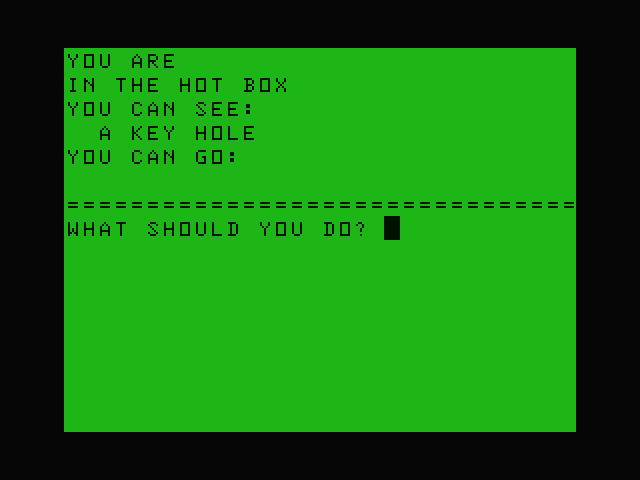
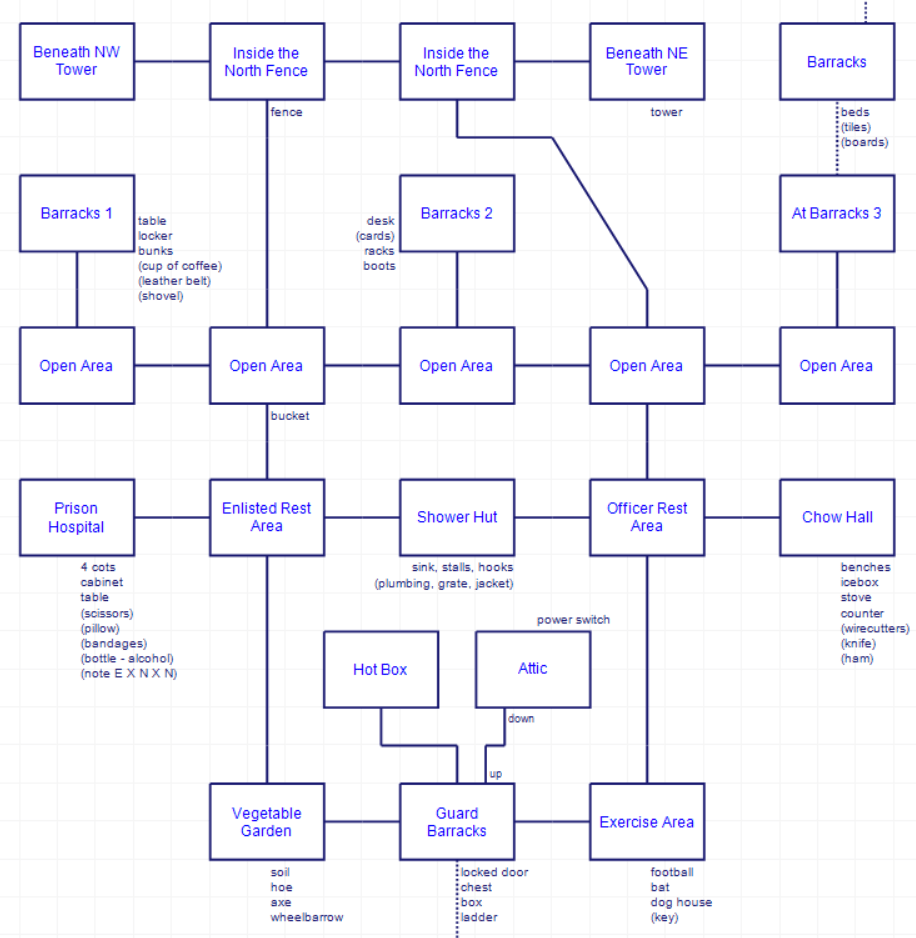
You start with a NEEDLE in your inventory and just PICK KEY in order to get out of the Hot Box. Then the map gets wide open. Most of what’s on the map below is accessible right away.
Most of the game’s map.
There’s far more items than you need. This is a little bit like the Eno aesthetic writ large. We had a similar open style with Earthquake but that game was better; everything was divided in stores, and in hitting a particular puzzle often involved thinking about what store you needed to visit. Here, there are some themed areas, but you also might just need a key hidden in a football near a dog house.
Just outside the hotbox, after escaping with the needle. Nothing here is relevant other than the door which has a number combination lock.
I will mention right away there’s a SHOVEL that’s necessary but annoying to find. It is stuffed in a LOCKER in one of the barracks, but if you LOOK LOCKER you will just find a BELT. You need to look a second time to find the shovel. I admit I’ve hit this type of puzzle multiple times now (usually with backpacks, but ok) and it catches me still about half the time. (I mean, why wouldn’t we see the shovel? It’s just a locker, it can’t be that hard to see what’s inside.)
The game’s excess of items isn’t just accidental, it is actively deceptive about possible escapes. For example, you can find WIRECUTTERS hidden at the Chow Hall, and take them over to fencing, and without anything else being done you get fried:
However, you can go up the ladder at the start and find a control for the electricity. Switch the controls off lets you safely touch the fence, but unfortunately, the wirecutters just break when you use them.
The entire route (including shutting off the power) is a red herring.
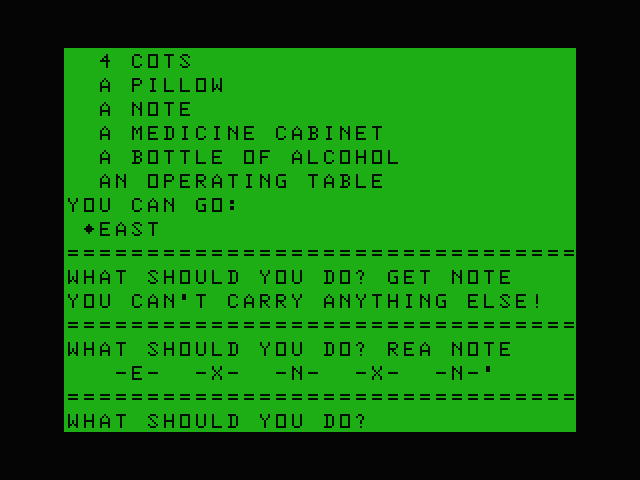
Another bit that might be a red herring. You can find the note by noticing a bulge in a pillow and applying scissors, but I never found the text here to be relevant.
The clue that is relevant is from a jacket hanging off a hook.
For mysterious adventure-game reasons the number goes to the lock at the start. The whole purpose of getting into the area past the lock is to then find a can opener randomly lying around.
Incidentally, you can also find a “depression” outside that you can use the shovel to turn into a “deep hole”. The game does not let you ENTER the hole and as far as I can tell the whole room is meaningless. It doesn’t even work as a red herring, really; at least having a land mine blow up trying to enter the hole or something along those lines would give confirmation this is the wrong route, but we don’t even have that pleasure.
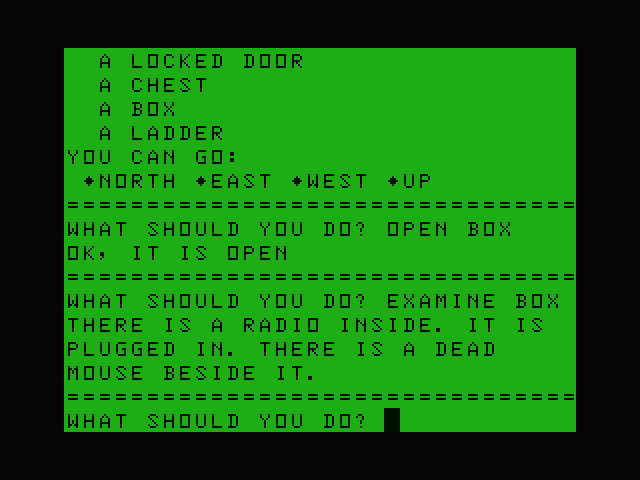
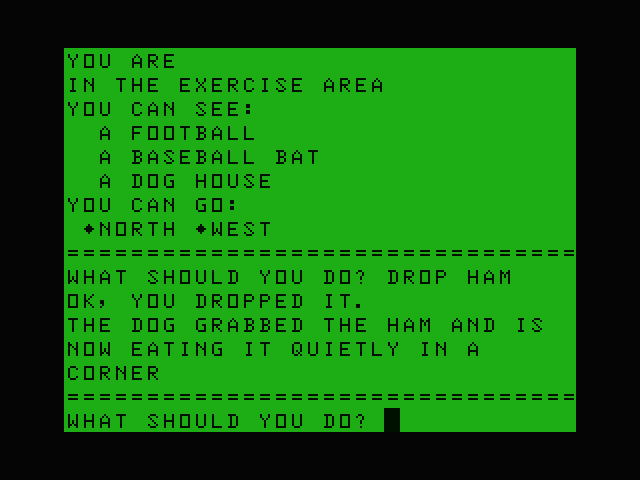
With the can opener you can get some ham from a can and use it to distract a dog, then get a football nearby, which as I already alluded to, can be cut open to find a key.
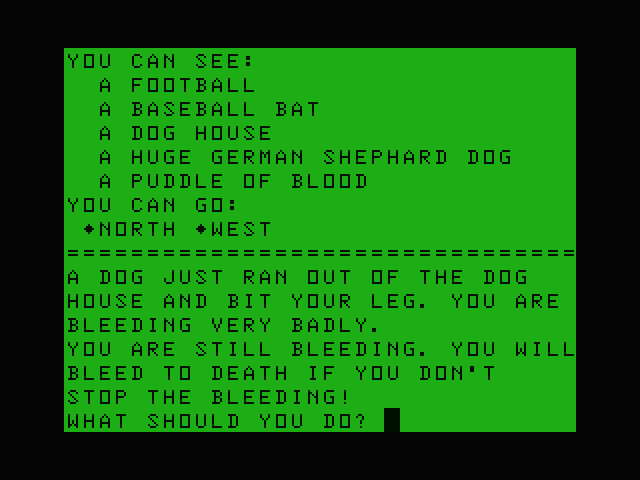
What happens without the ham. There’s bandages but there’s no command I could find to use them so you eventually just die. The only verbs are GET, DIG, CUT, LOOK, OPEN, PICK, PUSH, HELP, DROP, READ, CLOSE, EXAMINE. Did I also mention there’s no save game feature?
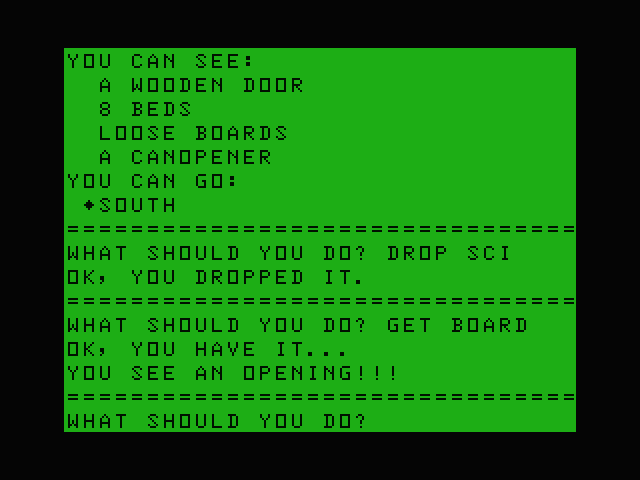
With the key you can get into a previously-padlocked barracks at the northeast part of the camp. Then you can move some tiles followed by some boards to find a secret hole.
You need to choose east as the route to get out. This more or less matches the map.
This sets up a sequel which was advertised but I have yet to find a copy.
Alastair at CASA calls this game “a considerable improvement on Eno” although I disagree; Eno may have been short but it was solvable without wasting time on bizarre dead-ends and the lack of a save feature didn’t really hurt it. Here, while the game is made up of simple elements (really, EXAMINE everything and try to bust an object open if it is suspicious) I found the gameplay sequence itself tedious. The bandages were especially egregious; the game gives its verb list up front so I can’t say the puzzle was guess the verb, but rather “guess that this thing you would think might have an effect actually doesn’t”.
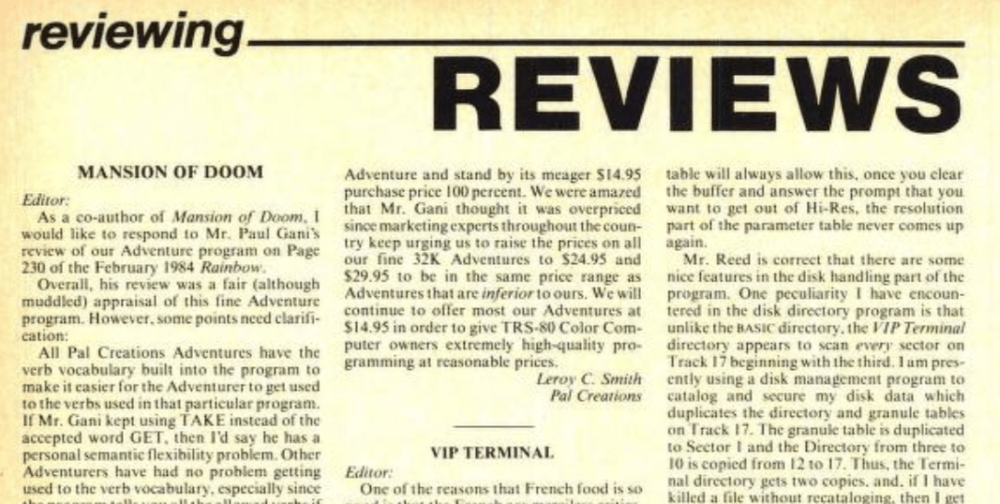
OK, back to that letter I mentioned. This is in regards to Mansion of Doom, another PAL Creations game I have yet to get to, and shows up in the May 1984 version of Rainbow magazine. The magazine had reviewed Mansion of Doom and Mr. Leroy C. Smith of Pal Creations had some complaints.
First, the review (by a Mr. Paul Gani) had complained about how the game accepts GET but not TAKE as a verb. The response:
If Mr. Gani kept using TAKE instead of the accepted word GET. then I’d say he has a personal semantic flexibility problem.
Second, in response to a complaint about the lack of saving games, Mr. Smith shows his prowess with market research:
We also decided against having a save feature in our Adventures since most people would rather try to solve an Adventure from start to finish. If they can’t solve it in one night, then all they have to do is turn the computer off. and they can try to solve it another day.
The people demand the lack of a feature! Furthermore, Mr. Gani found the game to be “overpriced”, which the author also had to respond to:
We stand by its meager $14.95 purchase price 100 percent. We were amazed that Mr. Gani thought it was overpriced since marketing experts throughout the country keep urging us to raise the prices on all our fine 32K Adventures to $24.95 and $29.95 to be in the same price range as Adventures that are inferior to ours.
Yes. Many marketing experts. I’m sure.
The complaints about GET/TAKE and the lack of save remind me of the book by Don Norman, The Design of Ordinary Things. One of the main theses of the book is that many “user errors” in product use are really designer errors. He cites an example of people on a particular piece of software mixing up the right time to press the ENTER key and the RETURN key; the designers were adamant about their design and users were blaming themselves for the error.
And did they ever lose their work as a result? “Oh, yes,” they said, “we do that a lot.”
Similarly, citing “personal semantic flexibility” as a reason not to add a single synonym reflects the same sort of user hostility (it isn’t like there aren’t synonyms! both EXAMINE and LOOK are verbs). Not including a save game feature is lazy and potentially a technical snarl, sure, but claiming the users are truly desiring this lack of a feature is incredible folly (since the ones that really don’t want to save their game don’t have to!)
Relatedly, here’s a short video on “Norman doors” which baffle their users who pull when they’re supposed to push. User error, or design error?
Maybe this is all a little harsh; we’ll get to Mansion of Doom (1982) eventually and see for ourselves.




























 Renga in Blue
