Back in the early 80s, Mike Taylor was just wanting to buy a copy of Skramble from Terminal Software for the VIC-20. It was one of the many, many, clones of the arcade game Scramble.
When he wrote in to order, he also mentioned “in passing” if they’d like to see the adventure game he had written. Indeed they did, and yes, all the companies in the UK was publishing tapes like a blizzard.
By our definitions, this was written as a private game (1982) that was published almost by chance a year later (1983). We probably should come up with a word for this, as it is different from a purely private game (like Danny Browne’s work) and a purely commercial game (The Mask of the Sun). The best example of this middle-state is Softporn Adventure which was written for friends, and the content meant the author had a great deal of failure trying to get the game to market before it got picked up by On-Line Systems (and eventually transformed into Leisure Suit Larry).

From Mike Taylor’s webpage.
This was heavily influenced by Scott Adams (which could run on a memory-expanded VIC-20), rather than Crowther/Woods Adventure (which could not), and the author notes:
…it’s interesting to see how many conventions I unconsciously adopted from Scott Adams – things that I didn’t even recognise as being stylised until years later when I played very different games such as the original Crowther/Woods Adventure.
No lore to speak of this time:
The object of the game is to retrieve the Magic Mirror from wherever it might be in the programme’s landscape.
This kind of qualifies as a Treasure Hunt, but with only one item.
Also, this isn’t quite the bare-bones unmodified VIC-20; as the tape art indicates, 8K of expansion memory is required. This is still quite minimal and less than a standard TRS-80 game, and room descriptions are correspondingly succinct.
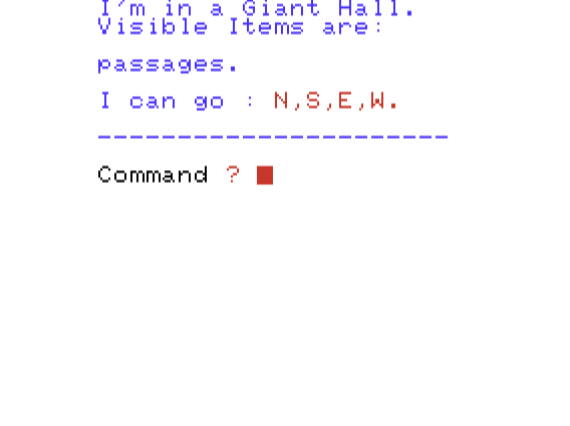
Just to give the main gimmick straightway, the general structure of this game seems to be an item relay. That is, the game passes through a series of “biomes”, there is an inventory limit of five, and a series of puzzles where you have to reckon with the fact you need to move more than five items from biome to biome. This doesn’t sound glamorous to the modern gamer, but the puzzles are otherwise fairly straightforward, so it’s what makes the game have sufficient density to be satisfying. (The very last puzzle is not of the same type and is just mean, but we’ll get to that.)
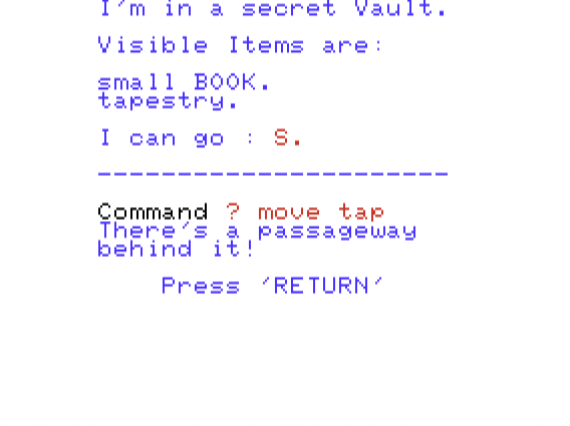
The game starts out in “your residence” and is reminiscent of Pirate Adventure starting in your apartment. There’s some hidden passages (like the one above) but the objects and rooms are minimal enough the secrets are generally meant to build atmosphere rather than be puzzling.

You can collect a BOOK, MEDAL, SWORD, KEY, AQUALUNG, and shiny TORCH, as well as find a Storeroom that indicates STORE THE MIRROR HERE. That is six items and we’re already hitting our item limit issue; to go to the next area you need to go out a window, but you can’t immediately go back again.

You instead need to find a LADDER at a rose bed, bring it back to the window, and then you can CLIMB LADDER back up to where the house is to get the sixth item.

In what I’ll call the “garden area” you can also find some SPECTACLES in order to read the BOOK which tells you a useful magic word is ZONK. The SPECTACLES and BOOK are no longer necessary at this point, and the ZONK word works if you are holding the torch.
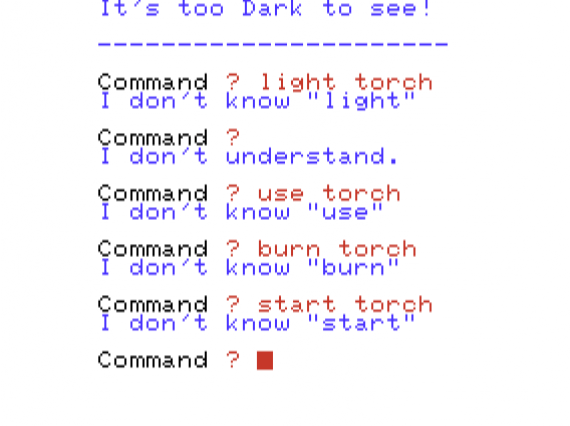
I had tested ZONK before picking up the torch, leading me to this scene later.
You need to do some guess-the-verb and FOLLOW PATH in order to get to an area with a pond, and a swamp with some WHISKY. To recap our item situation, we’ve got an AQUALUNG, MEDAL, SWORD, KEY, and TORCH, but WHISKY would bring our items up to six. Thinking perhaps I could loop back later I went forward with the five items, wearing the aqualung and jumping into the pond.

Unfortunately, this drops you at a “damp semidark chamber” (see lower left of the map above) where you can’t go back up again, so it’s another one-way trip, and this time, there’s no way of going back up. You can only move forward into darkness (see torch scene) to a stream which you can swim, followed by a chasm which you can jump.

Keeping with the general theme, jumping over the chasm with too many objects breaks your neck, so you have to carry two things — the torch and one other item — over by ferrying back and forth.
I found a “drunk ogre” on the other side and realized I needed that whisky after all (GIVE WHISKY just causes it to disappear, no description even of what happens, you can use your imagination). This is next to a “narrow tunnel” with a large rock hiding a canoe in one direction…

…and a deep lake in the other direction, which the canoe automatically gets used on (it’s too deep for swimming).

I was stumped here for a while; going out in the canoe seems to cause you to get stuck (see above) and I ended up dragging out my verb chart.

I didn’t need to go all the way to solve the puzzle, but here’s the complete chart for reference. LISTEN tracks as LIST or INVENTORY, while the words like SWING are being interpreted as different verbs; SWI stands for SWIM.
The majority of the game’s verbs require a noun, including, rather puzzlingly, LOOK. In order to show a room description you need to LOOK AROUND. This made it so the right command, WAIT (just the one word) was off my radar, but I went through typing it anyway and found out the canoe was steering itself:

I found a manhole up high on the other side and realized I needed the LADDER from way back at the house. The problem was the pond was a one-way trip! I realized — given THROW was a verb, I could THROW items while next to the pond and they’d go in, and I could find them on the other side. This allowed me to redo the whole section — in multiple rounds — carrying over the WHISKY, MEDAL, SWORD, KEY, LADDER, AQUALUNG, and TORCH, eventually picking up the CANOE as well ferrying them all over to the manhole.
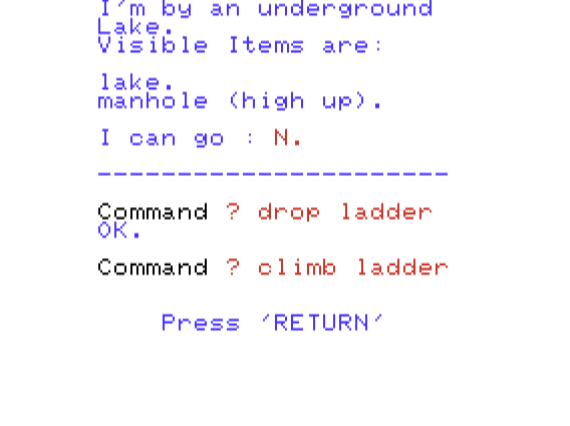

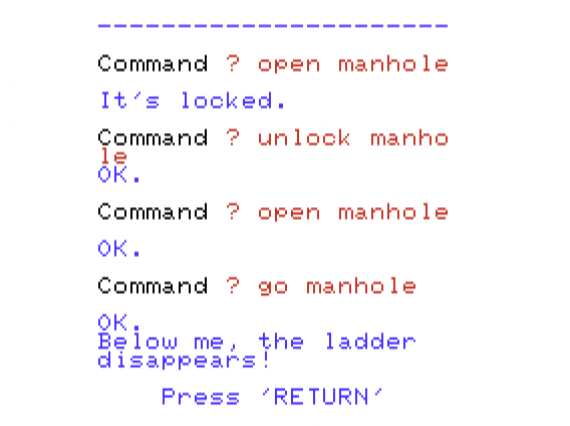
The ladder disappears under you as you go up the manhole, so this is another item check. What you need still is the SWORD, MEDAL, and AQUALUNG. (You also still need the ladder! … and yes, it disappeared … we’ll get back to that.)
There’s a “pink palace” with a guard that will take your MEDAL as a bribe.

This leaves open the palace which has a pool. If you have the aqualung worn, you can dive through the pool and make it back to the lake near the start, so we’ve found a way to loop back to the opening of the game.
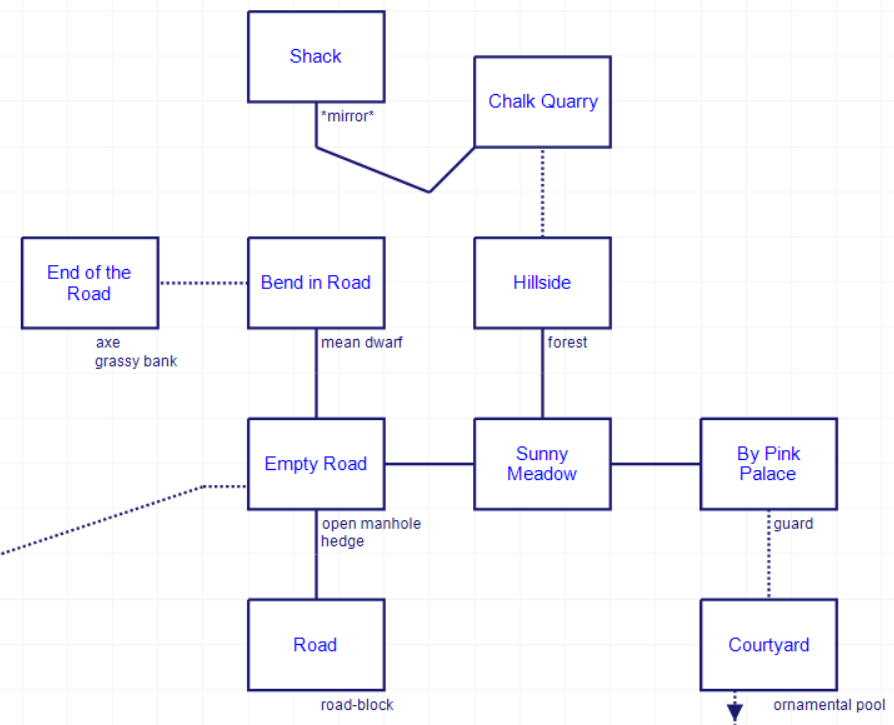
The exit from the Courtyard is what goes back to the pond at the garden area.
Other than that, there’s a mean dwarf (KILL DWARF with the sword)…
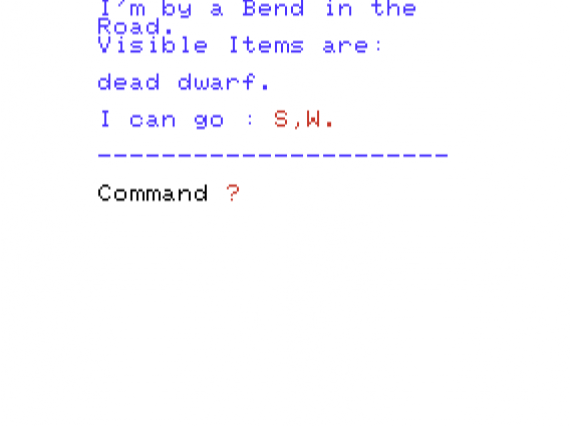
…where you can find an AXE just afterwards. You can then take the axe over to an “impenetrable forest” and CHOP FOREST to expose a new route.

This leads to the *MAGIC MIRROR*! With the mirror in hand I could then jump back to the pond, go back to the house at the start…
…and realize I didn’t have my ladder any more to reach the window. Drat.
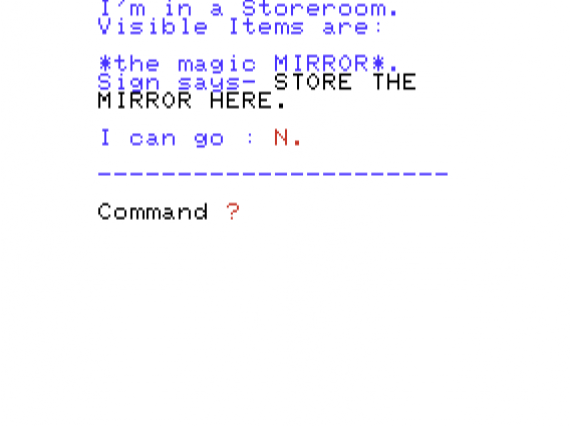
It turns out the ladder has re-materialized back at the rose bed where you first found it. I was just visiting everywhere in a futile attempt to see if I could get something new to happen with the MIRROR (you can’t rub it, or wave it, or anything). So you can take the ladder after all, make your way back in the house to the Storeroom, and then, find one last nasty surprise:

LEAVE (which worked in Zodiac on a breakable object to indicate “set down gently”) gets the same smashing result. I was able to THROW the mirror (!) and it safely landed, but no winning condition, so I assume I hit a bug.
A winner is me?
I needed hints for this very last puzzle. Every other hidden object in the game has been associated with another object, but once — and only once during the game — it turns out you need to LOOK NAME-OF-ROOM to find an object. Back in the cellar (which has a sword) you need to LOOK CELLAR to find a second item.

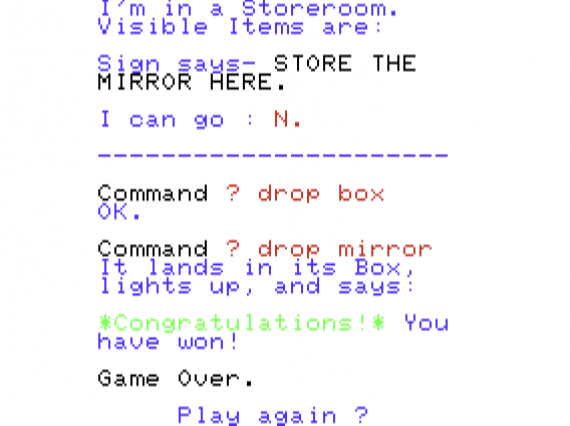
With the box at the Storeroom, you can safely drop the mirror.
Even with that final stumble, I found this enjoyable out of normal proportion for a minimalist game with no real “daemons” or other complexity which are usually needed to make difficult puzzles. The item-juggling took over sufficiently as a mechanic that I was engaged with the world beyond a simple apply-key-to-lock hunt, and out of the VIC-20 library this honestly was much more playable than Bruce Robinson’s work.
The author happens to be a longtime reader of this blog, so if I could ask some questions:
1.) Other than Pirate Adventure, what other Scott Adams games lent specific inspirations?
2.) Did the concept of shuffling items as a primary mechanic come from some Scott Adams moment in particular?
3.) Did you think at all about the possibility of publishing the game before the offhand mention to Terminal Software?
I was going to hit another reader-made game next. As of this writing Andrew Plotkin’s game Inhumane is listed at CASA Solution Archive as being written in 1982, so I had it queued up. However, reading the details, I found it was an Infidel parody, and since Infocom’s game Infidel wasn’t out until 1983, I knew something had to be wrong. The real release year is 1985 1984. So we have to pass by, but possibly Andrew is not upset about the game getting kicked far down along the queue (this was written when he was very young).
I still would like one more “breather game” before I take on my next monster, so I’ll try to find something random that will fit for next time.


 Renga in Blue
At last, we meet again — but this time the advantage is mine!
(whisper whisper) 1985? Dammit.
I suspect that I released _Inhumane_ in 1984, really. I would have been riffing on a *recent* game. And it’s listed in Schuette’s second book, which was published Nov 1985.
Now, the real prize would be my *first* Infocom parody game, _Enchanter 2_. That must have been written in 1983, because I didn’t yet know that Infocom’s sequel would be called _Sorcerer_! However, _Enchanter 2_ does not appear to have survived anywhere.
IFDB has ’85. I can put ’84 though!
Was it distributed somehow, or did Enchanter 2 not leave past your own house?
Thanks! Actually, I made the IFDB change, since you reminded me.
I released both games the same way: I posted them on Apple 2 pirate BBS sites. I mean, BBSes for pirated Apple 2 software. The thrill of 1200-baud software uploads.
What happened after that is obscure. The Inhumane image on Archive.org got a “crack screen” from somewhere; I certainly don’t know who did that. (There was no disk protection to crack, of course.)
Did you try literally STORE MIRROR?
Doesn’t understand the word store.
It was the first thing that occurred to me. I don’t know if I ever would have found the box without looking it up. We’ve had games with the EXAMINE ROOMNAME trick (like Arrow of Death) but this never got established as a pattern.
Hello! Author here. It never occurred to me that anyone would THROW MIRROR, and I am just relieved that I coded the winning condition in a way where this didn’t trigger it! That would have been an extremely bizarre ending.
I admit I found myself laughing at the DROP MIRROR / GAME OVER screenshot above, but I am a bit ashamed that the solution required something so out-of-band as LOOK CELLAR. At the very least, I should have made it SEARCH. There were a couple of other Ouch moments for me in reading through your experiences, but on the whole I think I got off as lightly as I could have reasonably hoped!
In case you didn’t notice it on my own site’s page about this game — http://www.miketaylor.org.uk/tech/advent/mm/ — the ugly BASIC source code is available. (I won’t add a second link or this comment will likely get spammed. It’s easy to find within the page I just linked.) Skim-reading it now, I enjoy line 2570.
To answer your questions, Jason …
Actually, I’m pretty I’d never even played Pirate Adventure at this point. I think Adventureland was my only experience. I have no idea now, 42 years on, why it was the magic mirror from that game that became the object of this one.
I don’t think I ever had that in mind as a primary mechanic. I think in my own mind the game was more about puzzles, and the shuffling was just a delaying tactic. There’s nothing like that in Adventureland, which as I said was my only point of reference. (I know Adventureland ridiculously well. I am pretty sure I could still solve it totally blind, just typing commands without looking at the screen.)
I wish I’d kept notes! I don’t think so, though. For my second published game (Nosferatu) I went straight back to Terminal, but that was heavily based on a game I’d co-written with my friend Myles on his dad’s Video Genie, so its bones at least also predate any thought of commercial value.
By the time I wrote the Causes of Chaos for the Commodore 64, I was writing to be published.
>I don’t think I ever had that in mind as a primary mechanic.
I mean, it turned out that way: you had the one-too-many items at the start and had to bring the ladder over to get back, you had the puzzle throwing into the pond, the chasm where you couldn’t be carrying too much, you had the ladder get re-used and then disappear (I spent a while mentally trying to figure out how to loop around and rescue the ladder)
That ended up making the action dynamic. Without that you had a lot of puzzles with straight object correspondence (whisky -> ogre, sword -> dwarf, medal -> guard, etc)
You’re absolutely right. I got lucky. I wish I could say I planned it that way, but I didn’t. And I concede that the object-to-puzzle correspondences are otherwise pretty straightforward. It’s a shame that the two puzzles that actually held you up were WAIT in the lake and LOOK CELLAR — the two that are not really cued at all. I feel bad now :-)
What I feel best about in this game is Michael Lambert’s 2009 comment:
That’s what I remember about Magic Mirror, and I was glad it landed that way for someone else.