This game returns rewinds us back in time a bit to February 1980.
That was extraordinarily early in our journey. While Scott Adams (with Alexis) had cranked out his first six games, and Greg Hassett had a library of work, there were only a handful of adventure games available on home computers otherwise. Dog Star Adventure had been printed in Softside, but there otherwise guidance was limited how to write an adventure game, and you had odd experiments like Dante’s Inferno from Softside January 1980, which was done entirely with movement.
Treasure Hunts were still heavily the norm, making up 2/3rds of games.
1979 is the most representative part of chart here. By the end of 1980 the share of Treasure Hunt plots compared to others became less than half.
Magical Journey also brings us back to a familiar name: Peter Kirsch. He has been the editor (and often author) of the Adventure of the Month series (Arrow One was the latest one featured here). Not long ago I found, in a 1982 volume by Hayden (the book publisher who also put out Crime Stopper) a Softside compilation that also included an adventure game by Kirsch dated Februrary 1980.
Via The Internet Archive. Some games are reprints, some (like Magical Journey) appear here for the first time. I assume Softside couldn’t fit every game submission, especially ones prior to the August of 1980 when they went full-sized.
The REM statement giving the author and date on the first line is missing from all current archived versions.
MAGICAL JOURNEY
BY PETER KIRSCH
FINAL VERSION
FEB. 1980
Hence I technically had this game on my list, but as 19xx.
It is nice to have both temporal and author context; it’s one thing to play an author we’ve seen a lot of now produce something with a “retrograde” feel of collect-the-treasures (his later work went heavy on “cinematic scenes”) but we can also see a little bit of his “scene based” approach in primal form.
There’s incidentally only the TRS-80 version; the porting to Atari and Apple II didn’t happen until the Adventure of the Month series started.
Fun innovation to start: you have a sack for the treasures, meaning you don’t have to worry about the inventory limit in regard to treasures (of course, wouldn’t get rid of the inventory limit entirely, early 1980 here).
This was intended to be a quick game to throw out but I ran into a wrinkle fairly quickly. But to narrate like everything is normal, you start in a bog-standard forest, climb a standard tree, grab some twigs (see above), find a shovel, climb a mountain…
…then go down into darkness. It asks you to make light. I was puzzled at first and thought I had missed something, but no, I had scooped everything up available.
W/S/E in the opening Forest just loop.
That leaves the TWIGS, which I certainly don’t visualize as being light-providing in size, but I tried RUB TWIGS anyway, whereupon the game said WHAT? and then showed me the room description.
Doing some deciphering, I found the line in question that was supposed to trigger (by searching for the word TWIG).
930 IFD(B)13THEN950:ELSEIFE$=”IGS”IFI(2)=1THENDK=1:R$=”BURNING TWIGS”:K3=2:GOSUB1100:H$(2)=R$:PRINT”GOOD DEDUCTION! YOU HAVE CREATED A SMALL FIRE AND YOU CAN SEE!”:GOTO5000
Wild note: the game looks at the last three letters of the noun to find out if you have, in fact, typed in the word TWIGS. I have never seen this in a parser before. Finding the comparison line in the book:
930 IFD(B)13THEN950:ELSEIFE$=”IGS”IFI(2)=1THENDK=1:R$=”BURNING TWIGS”:K3=2:GOSUB1100:H$(2)=R$:PRINT”GOOD DEDUCTION! YOU HAVE CREATED A SMALL FIRE AND YOU CAN SEE!”:GOTO5000
That’s, erm, exactly the same. Well.
I decided to try to keep going — maybe the bug was only isolated. You explore the tunnel here a little, find a locked door and a spot that’s soft…
…dig in what is apparently a one way passage to land in a forest…
…and find multiple colored trees with multiple colored keys hiding and a note. Trying to read the note gets the message WHAT?
830 IFD(B)6THEN850:ELSEIFE$=”OTE”IFI(12)=AORI(12)=1OR(A-20)”*(I(12)=0)THEN?”NOTE SAYS: “CHR$(34)”THERE ARE 17 TREASURES HIDDEN. CAN YOU FIND THEM ALLPRINT”CHR$(34):GOTO380
Well, here is a typo at least. A-20 is supposed to be A=20. But even fixing that, you can’t read the note.
So I’m going to have to do some repair to the code and report back. I did manage to explore out a bit more and I can give a few teaser screenshots.
This is broken too. Your bottle does not fill.
It does seem like that Kirsch already has the “continuous journey” idea in mind given the treasure-holding sack and the one way passage, although I’m unclear if I skipped anything, and if those skips were because I missed a puzzle or if the game’s code is literally broken.
I suppose having to diagnose type-in typos makes for the authentic early-1980 experience!
Last time I had left off in town, near the fringes of two mazes. First, though, I needed to visit a beach:
You are on a rocky beach at the estuary of some mighty river. A road leads to the northwest.
Rather like Zork III, you’re supposed to wait. There’s no cue or clue to this.
> wait
OK.
> wait
OK.
> wait
OK.
In the distance, there is drifting a large wooden chest.
> wait
OK.
There is a large wooden chest drifting a few yards offshore.
> wait
OK.
There is a large wooden chest bobbing about in the waves at your feet.
> open chest
What e’er it be, ’tis wondrous heavy, but you wrench it open straight. If the sea’s stomach be o’ercharged with gold, ’tis a good constraint of fortune it belches upon you.
O most potent gods! What’s here? A corse! Shrouded in cloth of state, balm’d and entreasur’d with spices.
She is alive, she moves. You manage to help pull her out before the chest is again pulled away from you by the waves.
Her name is Thamis, and she leaves you the spices in gratitude before departing to seek her lost family.
There is a large wooden chest drifting a few yards offshore.
You are on the beach.
There are exotic spices here!
That’s supposed to be Thaisa, daughter of King Simonides, who in the play Pericles is rescued by some fishermen and brought back to life.
There’s not really great reason to wait here nor reason to expect something is coming, except for the severe lack of red herrings in Phoenix games. (Although remember that cloud? That is a red herring, and I think perhaps the first I’ve ever seen in one of these.)
This makes the puzzle painful but not impossible; however, there’s a moment that’s even worse. You can keep waiting for another effect.
OK.
A small wooden chest is washed up at your feet.
> get chest
OK.
> inv
You are holding:
A ten times barred-up chest.
The chest (via Richard II) will foil being opened, you have to deal with it later.
ROSALIND maze next:
You are in the forest of Arden. High on a nearby tree there is fixed a piece of paper bearing the name ROSALIND.
This doesn’t sound so bad when I describe it, but in practice it was hard to spot what’s going on. For the majority of the “gimmick” Phoenix mazes (all of them, in this game) I’m used to some sort of random generation aspect that resets upon exiting the maze. Here the maze is generated only once, so it is possible to leave and come back.
The gimmick is then that if you are in a room marked “ROSALIND” you are on the right track, otherwise you are off of it. If you meet ROSALIND again, you’re back to the first room of the appropriate path.
The next part is kind of arbitrary (…sort of a common attribute for this last leg of the game) but you find a sleeping man and can say MORTIMER to wake him, the word the starling has been saying in the cage. You don’t need the starling after this point and can go back and get the tame shrew.
Suddenly the starling croaks “Mortimer!”
You are in a clearing in the forest of Arden.
There is a sleeping man here.
> MORTIMER
The cry of MORTIMER! arouses the sleeping man; in the undergrowth you hear a disturbance and see a green and gilded snake, which was waiting to wreath itself about his neck, slip away with indented glides. The man is grateful to you for waking him in so timely a fashion and says “Should you ever be in the tavern, call for my friend Parolles!” He then loses himself in the forest.
The name is randomly generated but thankfully the game does not bust saves here.
After this comes the fog maze, which I’ve already talked about. I should mention that, structurally, entering here is a one-way trip, which means the whole business with the teleporting basket/treasures needs to be utilized before this point because otherwise you’ll hit your inventory limit. As you’ll see, you still need two of the treasures, and it is hard to predict which two.
You are in the middle of a drooping fog as black as Acheron (sic).
It is impossible even to see the ground.
> w
>From the gloom there comes a voice which you seemingly recognise as that of the poor tormented creature that lived in the hovel, although in the fog you see nothing. He leads you for a while and then stops at (he says) the very brim of a cliff whose high and bending head looks fearfully in the confined deep. You then hear him no more.
You are in the middle of a drooping fog as black as Acheron (sic).
It is impossible even to see the ground.
> jump
You fall forward, with your eyes shut. After a while you open them to see…
You are at the foot of a high cliff, at whose dread summit you can now see a creature above all strangeness. Methinks his eyes are two full moons; he has a thousand noses, horns whelk’d and wav’d like the enridged sea: it is some fiend. Therefore, thou happy father, think that the clearest gods, who make them honours of men’s impossibilities, have preserv’d thee.
The valley you are in leads down to the east towards a Brave New World.
There is a longbow here.
All this is incidentally a King Lear reference. This is the part where the Earl of Gloucester is depressed and wants to commit suicide, but Edgar (his oldest son) tricks him in disguise (as “Poor Tom”) by taking him to what he says is the top of a cliff, but is really the bottom. Gloucester faints, and Edgar (now in a different disguise) acts like Gloucester fell down the cliff and was saved by the gods, who didn’t want him to die yet.
Then comes the house where I can shoot the arrow (this was correct)…
> shoot arrow
Let your disclaiming from a purposed evil free you so far in our most generous thoughts, for you have shot your arrow o’er the house and hurt a brother.
…and the constable, who is simply zeroing in on the fact you have a weapon (the longbow). You need to leave it behind to go in. Before showing that, a side trip:
You are at a dead end, the only exit being to the north.
There is a fretful porpentine here.
To get the pointy beast, we need to be carrying one of the treasures. I’ll give you the full list and see if you can figure it out.
There is a pair of yellow stockings here, made of silk and bearing the name Malvolio!
There is a diamond necklace here!
The Plantagenet crown is here!
There is a miniature portrait of the lady Portia here!
There is a gold ring here!
There is a sceptre here, which shows the force of temporal power!
A pearl is here, left by a base Indian, though richer than all his tribe!
There is a figured goblet here!
There are three thousand ducats here!
There is a scroll here.
There is a bracelet here!+
There is a ten times barred-up chest here.
There are exotic spices here!
There is a topaz here!
There is an antique viola here!
There is a signed copy of the Iliad here!
The Boar’s Head Drinking Trophy is here!
There is a furred robe here!
There is a valuable Touchstone here!
There is a piece of agate here, carved into the likeness of Queen Mab!
Some Shakespeare productions go all-out with Malvolio’s yellow stockings; they double as porcupine protection when used on the hands.
With the aid of Malvolio’s yellow stockings you succeed in grasping the porpentine. It then fastens itself to your shoulder.
Utah Shakespeare Festival, David Pichette in Twelfth Night.
Returning to the main track:
> e
You are in what appears to be a tavern, although it is quite deserted. There are various exits, apparently sealed off, but also a small archway to the west and a larger one to the east.
This is where you can use the word from the forest, and the ten-times barred chest gets resolved.
A man in courtly dress enters at your summoning, to whom you explain the nature of your Adventures in Arden. He sees that you are carrying a barred chest, which he opens for you. Inside there is a sapphire! The courtier hands you the jewel from the ten-times barred up chest, and goes.
Moving on, I found I had already defeated another obstacle (“a mighty Colossus lying here, evidently slain by a
poisoned arrow”) and was able to grab a “highly-inflated bladder which appears to have been used as a balloon at some Twelfth-Night party.”.
Trying to move on I was stopped by Lady Portia, and I expect everyone else playing this game was too:
You pass the lady Portia, who asks you what you did with the ring. If you had known the virtue of the ring, or half her worthiness that gave the ring, or your own honour to contain the ring, you would not then have parted with the ring. In fact you were best to cut your left hand off and swear that you lost the ring defending it.
At least it is a direct reference to the end of The Merchant of Venice! The gold ring is the other treasure you need to keep rather than send forward with the magic basket.
Reloading and returning with the gold ring in hand leads to the final two obstacles.
You pass the lady Portia, who notes approvingly that you still have her ring with you.
You are in a street. To the west lies the colossus, to the north there are some rather unexciting streets, and to the east lies a gorgeous palace, outside which there stands a watchman. He is thin, for watching breeds leanness, leanness is all gaunt. For some must watch, while some must sleep: so runs the world away.
I solved the watchman first, but that’s the actual end of the game, so let’s head north:
> n
You are in a network of streets: they lead NE, NW and S.
> ne
You are in a network of streets: they lead NW, SW and S.
> nw
A goldsmith passes you in the street and greets you as Arthur of Ephesus, and tells you that he has made a chain for you in accordance with your orders. Although you feel that you are part of some great comedy of errors, the goldsmith insists on leaving the chain with you.
(This is using the same name given earlier at entering Brave New World. The gold chain confusion happens in the play Comedy of Errors.)
If you then leave through the streets, the goldsmith realizes his error and gets his chain back. You are instead meant to explode the balloon to scare him away from his residence. This could have been absurd on the level of a bad Discworld puzzle, but we’re also down to the end of the game, and the balloon is the only unused object, so–
> explode bladder
You manage to rupture the bladder by striking it against the quills of the porpentine. It explodes with a loud
>> BANG <<
which makes the porpentine look even more fretful, and pieces fly in all directions.
There is a noise of general alarums and excursions, and the goldsmith rushes up, agitatedly muttering something along the lines of "Burglars! Gunpowder! Hoist with my own petard!"
He then runs into his shop to investigate, carefully re-locking the door behind him.
To get by the watchman, you just then hurl the poor porpentine.
You grab the porpentine, despite its prickliness, and hurl it at the watchman. The creature darts its quills fretfully at him, and he struggles to shake it off. You seize on the opportunity to dash past him, just evading a falling portcullis, and run down a passage to find that…
You have arrived at the palace. There is a formidable array of courtly characters here, some, such as Portia, King Richard and Thamis, known to you, and others, such as Coriolanus, Rosencrantz and Guildenstern (who are NOT dead) and Silvia (who is she?) previously unknown. They congratulate you on staying the course.
There is a diamond necklace here!
The Plantagenet crown is here!
There is a miniature portrait of the lady Portia here!
There is a sceptre here, which shows the force of temporal power!
A pearl is here, left by a base Indian, though richer than all his tribe!
There is a figured goblet here!
There are three thousand ducats here!
There is an Egyptian vase here!
There is a bracelet here!
There are exotic spices here!
There is a topaz here!
There is an antique viola here!
There is a signed copy of the Iliad here!
The Boar’s Head Drinking Trophy is here!
There is a furred robe here!
There is a valuable Touchstone here!
There is a piece of agate here, carved into the likeness of Queen Mab!
You are holding:
A sapphire.
A golden chain.
A laundry basket.
A gold ring.
A pair of yellow stockings.
A shrew in a cage.
You scored 425 points out of a maximum of 425.
You are entitled to the title King, aye, every inch a king!
You may now return to the twentieth century confident of your own prowess!
Of note: as far as I can tell, there is only one ending, no matter your point score. Arriving without having sent over any treasures, for instance:
You scored 255 points out of a maximum of 425.
This entitles you to the title Thane of Cawdor.
This means to beat the game you technically just need to get the shield via stabbing (the whole ghost scene in summer I believe you can skip), get the gold ring and stockings from Lady Portia (requiring solving the Spring variant of the puzzle with the frog toe and the knights), handle the man in the hovel (which requires getting the word from Ariel), and make it through the end sequence with the colossus and porpentine. Being able to skip treasures is not unusual — even Acheton allowed a few missing — but this is the first time I’ve seen the end text otherwise be unchanged.
Theoretically, this means the game can be approached a different angle in terms of fairness — if a puzzle is really tough to solve (I give the crown to finding the second chest at the beach) it can be discarded as merely optional to the whole enterprise. One could even think of the extra treasures as “post-game content” akin to the challenge levels of modern games.
To close things out, I’m going to clip some portions of reviews and comment on them.
Sinclair User, December 1989.
You don’t have to know much about Shakespeare to play the game, because although the situations come from the Bard of Avon’s well-known plays, the solutions are the usual adventure stuff; get newt’s eye, put in cauldron, pick up torch, and like that. To some extent this makes the whole thing pointless; it’s just a series of Shakespearian references splodged together, without actually testing your knowledge or appreciation of the works; a bit like someone reeling off lots of jokes but forgetting the punchlines.
This is from ’89 when the commercial version of the game came out, and makes a fascinating contrast with modern norms (and the spirited debate in the comments of these posts). The reviewer here was upset that Shakespeare trivia knowledge is not required. The “fax box” also says it is a game that it is a “Text only adventure that may help with your Shakespeare” which suggests the reviewer approached it sincerely as an educational game!
Modern norms have the dependence on outside knowledge in adventure games as an anathema (Graham Nelson in his Bill of Rights puts the concept at number 16, “Not to need to be American”.) There’s really two questions here: 1. just how dependent is the game on knowing Shakespeare, really? and 2. how bad is outside knowledge in the first place as a game design move?
For point 1, as I’ve already observed a few times, knowing Shakespeare at least helps with some aspects conceptually. Knowing that Cassandra is in reference to the gift of prophecy, for instance, can help realize she is warning you about deadly maze obstacles. (But again, it isn’t necessary, and I personally only found out about this particular reference after solving the puzzle.) I think what is more interesting (in a game-design-theoretic sense) is how familiarity with Shakespeare helps not so much solving a puzzle actively as much as parsing what is going on with the language. Consider the nourishing meat pie
You are on a moor. The ground is black here, as though scorched. The only path leads to the north, but there is a hovel to the southeast.
There is a nourishing meat pie here.
> get pie
OK.
> eat pie
Although the cheer be poor, ’twill fill your stomach. You eat of it with pleasure until a man dressed as a cook enters and reveals to you that two of the ingredients in the pie were named Chiron and Demetrius. ‘Tis true; witness his knife’s sharp point… I’m afraid he stabs you.
I immediately realized the reference to Pies Made of People, but imagine someone who was not familiar with Titus Andronicus. The text is not terribly explicit about what “Chiron and Demetrius” even refers to and the line after switches action in an almost abstract way. All this is simply a simplification of Titus’s lines in the original play:
Why, there they are, both bakèd in this pie,
Whereof their mother daintily hath fed,
Eating the flesh that she herself hath bred.
’Tis true, ’tis true! Witness my knife’s sharp point.
Later, at the cliff (the one at the fog where you jump), I admit I was somewhat overwhelmed by the language and had simply tried JUMP because it was the typical adventure-game thing to do at cliffs, but a less canny player with the same confusion might get stuck for longer. I haven’t seen King Lear, so I didn’t know the reference until I looked it up.
Regarding question 2 — how bad is having the references, really? — I’m not so sure they’re terrible in this context. This isn’t like a traditional fantasy that suddenly expects you to recognize the rules of cricket. The fact we’re being subjected to a blizzard of Shakespeare references is given up front, and I had genuine fun learning about characters I didn’t know and scenes I didn’t remember. I think the idea of a game being intentionally past its bounds is not intrinsically terrible as long as the “educational” part is telegraphed.
Now on to some modern takes! I’m referring to the reviews via the IFDB page.
In reference to the puzzles:
…the ones in the last of the three structural sections of the game appeared to overuse the “try a random object in a random situation and see what happens” kind of approach (at least, to me) but most of them were logical and elegant.
— Valentine Kopteltsev
I put “solve” between quotation marks because there are very few actual puzzles in Avon. There are many unannounced death-traps, a lot of riddles where you get only one chance and you must have found a clue beforehand (no lucky guesses!) and a few easy mazes.
— Rovarsson
Two very different takes, here. Logical and elegant, or “very few actual puzzles”?
Contrast with Murdac is useful here. In that game (for example), there was a moment where you revive a Frankenstein-type monster, use a plank to make a previously dangerous passage safe, then make sure to dive in an alcove out the way so it pushes forward until it busts through a physical wall that was previously a barrier. This involves holistic thinking about the entire map, the physical situation, and the items the player is carrying.
While I wouldn’t call Avon puzzles “self-contained” exactly, but in terms of physical space they tend to be isolated. The seasons makes for some continuity across time rather than space that needs to be accounted for; otherwise, they are structured via a web of references where you need to spot that, for example, a particular word causes a particular effect.
I think the latter part of the game (post-cliff) really does feel a bit like Just One Riddle After Another (although to be fair it made about 5% of my total gameplay). By contrast, the flipping between seasons was the wrinkle that really made me think of the game as an adventure game rather than just a sequence of puzzles, as I had to worry over (for instance) the fact that the toe of frog works to solve both a spring and a summer puzzle.
The approach is different; not worse, but different. For a player who likes to “inhabit” the worlds they are exploring — imagine they are physically lifting that lantern to read the words on the wall, and listen to the drip of water — I can understand why it might not come off so well. If you approach the text of the game a cavalcade of wordplay, it feels much more pleasant.
Or maybe I’m off–
The whole was a perfect exercise in mimetic immersion for me and I really felt I was in Shakespearean England when I played this.
— Canalboy
Not every game can and should have the same goals. Avon tried for something relatively unique (Graham Nelson did The Tempest, but that’s still a much different animal) and I feel like there’s some untapped corners of the game design possibility space coming out; essentially the classic “wordplay game” (like Counterfeit Monkey) being done by reference and allusion as much as by the simple fact one word anagrams into another.
Coming up: two short games, followed by a Dr. Who game that, oddly enough, does not originate from the UK.
(My prior posts on Avon are needed for this one to make sense. Start reading here.)
If you were to quit, you would score 374 points out of a maximum of 425.
So I am definitely closer to the end than expected. It turns out putting treasures in the basket gets them to somewhere Good as the score increases. That doesn’t mean they all should go in the basket, though!
Some of the insights that follow came on my own, some came from hints provided by Morningstar in my last post (thanks much) and some came from a walkthrough (mainly when I was worried I was softlocking something due to saved game shenanigans again, although I looked up some other things while I was at it).
Rather than insight-sequence (where I explain the order I solved things, and where I got them from), I’ll do the puzzles in narrative sequence, starting with the farmer.
You are at the remains of a chicken farm. A fox has clearly visited this place and killed half the stock. The only way the farmhands will let you go is back to the west.
A farmer is standing here bemoaning the loss of his livestock.
“What! all my pretty chickens and their dam, at one fell swoop?” he mutters. “I asked my keeper, Puck, to get the fox’s earth seen to, but he went away saying that he’d put a hurdle round the earth in forty minutes (and that was hours ago.)”
I mentioned I had trouble even conceiving what to do here, and that was really the core of my problem. Was I supposed to find more chickens? Find Puck? Find a fox? Scare off the farmer and farmhands so I can get by? Do some funky magic word that causes the farmer to turn into a hat?
The answer is none of these, although the last question above was the closest. I need to warp back to the moment of entering the town with the drug squad:
A rather dull-looking constable appears, cries “HAVOC”, and lets slip the dogs of war. In fact, a small chihuahua appears and stands barking at you.
“Drug squad,” says the constable. “I must search you for certain substances.”
In fact he finds nothing prohibited and he and the dog slope off.
This keeps you from taking the season-warping potion to the north part of the map. I theorized maybe it was possible to slip the drug by, but what I should have been paying attention to was the summoning of the chihuahua. Specifically, it is done by the constable crying HAVOC. Back to the farmer:
> havoc
A small chihuahua appears, barking wildly. “Of course!” says the farmer, “that’s just what I wanted. I don’t think a hurdle would have kept the fox in anyway. A dog’s a much better idea. But I must reward you – take this touchstone – they say that it’s of great value to alchemists.”
So the basic question I should have been asking was: how do I get a replacement animal for guarding the remaining chickens? I likely would have happened upon the solution faster. I can see how that kind of makes sense with the text, but the Shakespeare layer was befuddling me.
This moment was fascinating in an abstract puzzle-solving-philosophy sense, but let’s move on: it turns out I was entirely done with Winter after this encounter (I know this with certainty from peeking at the walkthrough). I was also done, as I suspected, with Spring, so I could jump to Summer:
You are in a walled graveyard. For those making a return journey, the way out is to the west, as the eastern exit is blocked by impenetrable grass. However there is more graveyard to the north.
This puzzle was about the grass. Here I was stymied by the grass and any verbs I attempted were rebuffed to the extent I suspected this puzzle needed to be solved “from the other side”, so to speak, but no, I had already had the means to solve this, and it was totally reasonable. I needed to make a stop here when I was being an ass:
Feeling a bit of an ass, you munch your way through the barrier of long grass and succeed in clearing a path through it. You are outside a disused chapel (to your east). There is newly-made track back to the west.
This just yields a treasure (a pearl), but still counts as progress.
Lady Portia and the caskets, 1892 engraving.
Then I prodded more at the puzzle where you get warm and melt after Lady Portia’s final gift. Morningstar’s hint led me to think the toe of frog (which allows swimming) helps with cooling off, and indeed it does: swimming will cool you off. But the problem is, the toe of frog only works on one season, and I needed it to survive the knights (from Spring). So was I solving the knights problem wrong?
After laborious testing I finally buckled to the walkthrough (in fact, this is the puzzle I wondered about softlocks so it caused me to break open the walkthrough in the first place) and found out, you could go to the river and —
> wash
You wash your face and feel much cooler as a result.
This is my nomination for worst puzzle in the game. Note that only WASH, alone, by itself works, or WASH FACE. However, there’s no reason to suspect that a face wash does the trick, since you just “feel warm” as you are dying. So really the only reasonable thing is to somehow type WASH alone, because … ???
I don’t know. Through all of the Phoenix games I’ve felt like while I have had to occasionally guess the verb (see Hezarin and shouting) I’ve never had to worry about phrasing in general; the parser has generally been well-behaved. This violation stung rather like the dagger being plunged into King Duncan.
As far as I can tell the puzzle doesn’t even make a good Shakespeare reference! Yes, the line about “melt, thaw, and resolve itself into a dew” is from Hamlet, but it doesn’t constitute a strong enough connection to really justify the puzzle existing in the first place. Why does finding the third treasure cause us to start melting? I still don’t know, and that’s after reading the walkthrough on the section (which was provided by the company Topologika itself to people reviewing the game).
With that taken care of, and another peek at the walkthrough to be sure, I had essentially everything prior to the capitol (with Cleopatra, the shrew, the Rosalind maze, etc.) resolved. I’ve gotten a smidge farther there as well but I think the narrative will be best all in one go, after I’ve finished the game, which I predict will be with my next post.
This post is mostly intended to lay out exactly everywhere I’m stuck (for my benefit just as much as yours) although I have made some small progress, including to a new area.
I will officially declare this the threshold if people want to drop full on spoiler hints, but please do so in ROT13 (unless you are “playing along” and have not checked hints, in which case feel free to use plaintext). I’d still like to hit my goal of finishing by the end of February.
But first, that progress I mentioned–
Romeo and Juliet at the balcony, Illustrated London News (1855), wood engraving.
Last time I had leaped off a balcony to my doom, but I hadn’t tried it (as Matt W. suggested in the comments) while holding the bat wool. Seemed logical enough:
You are on the ground floor of Dunsinnin. There is an exit to the north and some steps up.
There is a sceptre here, which shows the force of temporal power!
> get
OK.
> u
You are on the first floor of Dunsinnin. There is a balcony to the south
(Soft! what light through yonder window breaks?) and some steps down.
> s
You are on the balcony of Dunsinnin, which looks out over Birnham wood. The only (apparent) way to go now is back to the north.
> jump
As you leap off the balcony the bat’s wool begins to grow, taking the form of a giant bat, to which you clutch desperately. On the bat’s back you do fly, getting an Ariel view of the wood. After a while you land and the bat’s wool regains its former state.
You are standing on a flat plain. From here it seems that all the world’s a stage, and all the men and women merely players: they have their exits and their entrances to the north, south, east and west.
Regarding the scepter (or rather, “sceptre”), it has more attached to its treasure description than normal.
> look
You are in a cell, which clearly belongs to some holy man, as you can tell from the religious decoration of the room. The only way out is by a door to the northeast.
Is this a dagger you see before you? Yes, I believe so.
There is a bat’s wool here.
There is a dog’s tongue here.
There is a diamond necklace here!
There is a large laundry basket here.
There is a miniature portrait of the lady Portia here!
There is a gold ring here!
There is a nourishing meat pie here. There is a sceptre here, which shows the force of temporal power!
There is a figured goblet here!
There is a shield here.
There is a clerical collar lying discarded here.
There is a piece of paper here bearing the word “TEABAG”.
There is a topaz here!
There is an antique viola here!
There is a signed copy of the Iliad here!
The Boar’s Head Drinking Trophy is here!
There is a furred robe here!
There is a piece of agate here, carved into the likeness of Queen Mab!
(This is not every treasure I’ve found, but a lot of them. The likeness of Queen Mab also feels suspicious but not as much as the force of temporal power.)
Phoenix games have not shied away from having a treasure also be a utility item, but this game (seemingly) hasn’t gone that route. I still have fair certainty the scepter will be used in the future. Perhaps it will be used to go to the future? My maximum score (so far) suggests I really am missing a whole section of game, which might be a fall season for the grand finale section of Avon. (Are there any notable fall scenes in Shakespeare, though?)
Another breakthrough involved the Undiscovered Country, which I’ve finally waded through. I had a “scroll” from the capitol that I always suspected was connected with the mazes…
> read scroll
The scroll bears the following message:
‘By indirections find directions out.’
> read scroll
The scroll bears the following message:
‘What do you read, my lord? Words, words, words.’
> read scroll
The scroll bears the following message:
‘Though this be madness, yet there is method in ‘t.’
…but I hadn’t apparently tested reading the scroll while in the Undiscovered Country itself, as the scroll text changes.
> read scroll
The scroll bears the following message:
‘When the wind is southerly I know a hawk from a handsaw.’
This gives fairly transparent directions for each direction to go.
> read scroll
The scroll bears the following message:
‘Then westward ho! Grace and good disposition attend your ladyship!’
There are two exceptions, one being a text for “BACK”. (“You yourself, sir, should be old as I am, if, like a crab,
you could go backward.”) BACK is an understood verb in the game, but it isn’t a common one, and I’m still unclear what actual action is being undertook here (are we walking backwards, maybe?) Of course, this game has been halfway in wordplay-world where actions aren’t meant to always be literal, but rather perhaps punning.
The other exception you’ll see in a moment. After enough successful moves you find the princess Imogen from Cymbeline, a play I knew nothing about. (Set in very early Roman Britain, ~10-14 AD, involving the vassal king. The 2014 movie changes the premise: “For years Cymbeline, King of the Briton Motorcycle Club, has maintained an uneasy peace with the Roman Police Force.”)
You are in the undiscovered country, from whose bourn no traveller returns. There are paths in various directions.
The princess Imogen is here. Sleep, the ape of death, lies upon her.
On her wrist there is a valuable bracelet!
We can steal the bracelet just like the play and walk away. Alternatively, we can kiss and/or wake Imogen, either before or after taking the bracelet.
> kiss imogen
One kiss! Rubies unparagon’d, how clearly they do’t! You notice, on her left breast, a mole cinque-spotted, like the crimson drops i’ the bottom of a cowslip.
> wake imogen
The princess wakes with a yawn and wanders away with the bracelet.
The kiss description in particular is colorful enough to be suspicious, as is the fact taking the bracelet gives you no points. I think I’m missing some puzzle juncture here (it comes straight from the play, though), but I’ll list it out when I give my full Unsolved Report.
To get out from the princess encounter, you need to follow a special scroll message.
The scroll bears the following message:
‘I am but mad north-northwest.’
It’s not “go north, then go northwest”. It’s as one single command. I have never, ever seen this in a text adventure before.
> nnw
You are on the bank of a river which flows from the north and disappears over a waterfall. There is also a maze of paths to the southeast.
Cymbeline, Act II. Iachimo steals a bracelet from the sleeping Imogen. Art by Samuel Begg from the late 19th century.
Before my Unsolved Report, I need to mention I snuck by one of the other mazes, the one in the fog. This was a matter of order of operations; after you have dealt with the hovel (where you say FATHOM which was obtained from Ariel) you get an encounter there.
From the gloom there comes a voice which you seemingly recognise as that of the poor tormented creature that lived in the hovel, although in the fog you see nothing. He leads you for a while and then stops at (he says) the very brim of a cliff whose high and bending head looks fearfully in the confined deep. You then hear him no more.
You can then jump down to a completely new area! It first asks you for a name, which knowing Phoenix has to be an exact particular name or you softlock.
> jump
You fall forward, with your eyes shut. After a while you open them to see…
You are at the foot of a high cliff, at whose dread summit you can now see a creature above all strangeness. Methinks his eyes are two full moons; he has a thousand noses, horns whelk’d and wav’d like the enridged sea: it is some fiend. Therefore, thou happy father, think that the clearest gods, who make them honours of men’s impossibilities, have preserv’d thee.
The valley you are in leads down to the east towards a Brave New World.
There is a longbow here.
> e
Some are born great, some achieve greatness, and some have greatness thrust upon them…
Since you are fast achieving greatness, what name would you wish to go under?
Arthur
O Arthur, Arthur! Wherefore art thou Arthur?
What’s in a name? that which we call a rose by any other name would smell as sweet. Thank you.
You are at the edge of the Brave New World. To the east you see a high house with a small opening in the wall, to the west a steep valley, and to the south a track.
The track goes to a dead end with a “fretful porpentine”, the house is a little more cryptic.
You attempt to enter the house, but a constable seizes on you as a potential trouble-maker and bundles you out again.
I’m very puzzled what the best approach is. Maybe there’s a name we could have picked to avoid trouble-maker status? Or some item from our vast array of treasures would prove our respectability? Or maybe some action way back in a previous season marked us for a softlock right at this moment?
You can also (given the longbow, plus the arrow you can get right before the maze) shoot an arrow, but I’m again mystified, in this case even how to parse what happened.
> shoot arrow
Let your disclaiming from a purposed evil free you so far in our most generous thoughts, for you have shot your arrow o’er the house and hurt a brother.
That’s everything new, so let’s do the updated meta-map.
I can confirm now (or at least be 95% sure) I’m not missing any region to the south. The Rosalind maze may hide a new area, and I suspect the Brave New World section goes farther (maybe a lot farther). I still haven’t broken 200 and the maximum score is 425.
WINTER PROBLEMS UNSOLVED
Just the farmer and the chickens. I don’t have a single iota which direction to go on this puzzle.
Also possible: you can sneak by the drug-sniffing dog with the phial, meaning you can enter the Eastcheap town in a different season (and get back over to the main part of the game via some other method, as the town is usually only accessible in winter).
I am extremely skeptical there’s a way past the bear, but I should list it just in case.
SPRING PROBLEMS UNSOLVED
Nothing really? You need to eat the toe of frog in order to swim (allowing you to survive the knight attack) and the effect seems to only last through spring, meaning it is tempting to suggest it gets used elsewhere; there’s a beach in the town past the capitol, for instance, which has nothing there, suggesting it is a possible embarking point or final destination.
Speaking of the capitol, spring is during the Ides of March so you get stabbed; my suspicion is you simply have to wait until summer, but again I want to mention the event just in case.
SUMMER PROBLEMS UNSOLVED
Surviving getting the third treasure from Lady Portia (I still turn warm and melt upon winning the last contest). There’s a decently long timer suggesting you can get pretty far across the map while affected.
Does the sleeping princess lead to anything useful other than the treasure she wears?
I’m still unclear what the starling does (“Mortimer” which it says does get recognized as a magic word, though) and I also haven’t found a use for the shrew.
The Rosalind maze is still unsolved, and I haven’t been able to do anything once in the Brave New World area past the fog maze.
ANY-SEASON PROBLEMS UNSOLVED
There’s technically some “impenetrable” grass at the graveyard which is present in all seasons.
You are in a walled graveyard. For those making a return journey, the way out is to the west, as the eastern exit is blocked by impenetrable grass. However there is more graveyard to the north.
It has resist my attempts to the extent I think it comes into play as an exit rather than entrance (for instance, maybe the Brave New World area loops back and exits here).
The cloud that might be a whale, camel, or weasel still presents nothing useful. It comes from a scene in Hamlet…
Hamlet: Do you see yonder cloud that’s almost in shape of a camel?
Polonius: By the mass, and ‘tis like a camel, indeed.
Hamlet: Methinks it is like a weasel.
Polonius: It is backed like a weasel.
Hamlet: Or like a whale?
Polonius: Very like a whale.
…and maybe it is just for color … but knowing this author, everything is important.
I feel like I am both closing in on victory and getting farther away from it, insofar as the last remaining puzzles seem to be stumpers indeed.
Not quite succumbing to hints yet but probably next time if I can’t push any farther.
From a Royal Shakespeare Company production of The Tempest, where Ariel and Prospero discuss Ariel previously being trapped in a pine.
First, a fairly straightforward bit of progress, applying the dagger (previously used to stab a king):
You are in the enchanted forest.
There is a pine tree here, from which a continuous melancholy howling emanates.
> cut tree
You hack at the pine tree, which splits. A spirit flies out, apparently imprisoned here a dozen years ago by the foul witch Sycorax. In return for its freedom it tells you that it has some power over the many other spirits around here and recites “Full fathom five thy father lies” to you. This, it says, may ward you against other powers. It then goes hence with diligence (after all, it needs pine no longer!)
I wasn’t thinking of The Tempest specifically (although certainly knowing something is “trapped within” would help) but rather just running through ye olde verb list again. I usually don’t associate a dagger with tree-cutting so the action did not occur to me normally.
I tested each of the words said by Ariel and found that “fathom” was recognized as a magic word (even though it did nothing in particular). Testing around in various places I found it was useful in springtime, at the hovel:
> s
You are on a moor. The ground is black here, as though scorched.
The only path leads to the north, but there is a hovel to the southeast.
There is a nourishing meat pie here.
> se
You attempt to enter the hovel, which is gloomy and sinister-looking, but you run out in terror when you hear maniacal laughter and the words “Fathom and half, fathom and half! Poor Tom!”
> fathom
A poor demented being rushes from the hovel, gibbering:
Child Rowland to the dark tower came,
His word was still, Fie, foh and fum,
I smell the blood of a British man.
and then vanishes over the moor.
This left a “figured goblet” (a treasure) available in the hovel for me to take.
I also had some progress with Cleopatra.
You are on the barge. Various attendants are busily rushing hither and thither (and back again). There are steps down to the hold and to the north are the docks.
The Queen of Egypt is here. On a burnish’d throne she sits. Age cannot wither her nor custom stale her infinite variety.
Nearby in a shop was an Egyptian vase, and it seemed like the two went together, but a snake came out and caused Death before I could tote one to the other:
Disturbed by the motion, an asp emerges from the vase you are carrying. I wish you all joy of the worm. Poor venomous fool, it is angry, and dispatches you.
The snake doesn’t wiggle out right away, and you can take a little bit of action still before it activates. So I ended up just dropping the vase after moving one room, then picking it up again, and repeating the process until I made it to Cleopatra. This was an odd puzzle in a physical-reality sense — it seems like dropping the vase would make the snake more likely to come out rather than toting it to its destination all in one go — but I realized the programming underneath seemed to be cued to simply consecutive turns held, hence the solution.
> THROW VASE
An asp tumbles out of the vase. It fastens itself to the queen’s breast and with its sharp teeth this knot intrinsicate of life at once unties.
> LOOK
You are on the barge. Various attendants are busily rushing hither and thither (and back again). There are steps down to the hold and to the north are the docks.
There is an asp squirming here.
There is an Egyptian vase here!
The Queen of Egypt lies here, dead, but she looks like sleep as she would catch another Antony. On her breast there is a vent of blood, and something blown; the like is on her arm. It is an aspic’s trail.
> D
You are in the hold of Cleopatra’s barge. It is damp and you can hear the creaking of timbers and the scurrying noises made by rodents.
There is an exceptionally tame shrew sitting here looking lost.
You can’t just take the tame shrew along without some help, but nearby there’s a cage with a starling.
You are at the end of a wharf. The only way out is to the northeast.
There is a cage here, containing a starling.
Sometimes the starling croaks “Mortimer”. That’s a reference to a character from one of the historical plays (Henry IV, Part 1), who is in prison at the time of the story. This suggests you should let the bird out. The bird actually stays in place, suggesting there is a useful place to deposit the creature, but I haven’t found where that is yet.
With the cage in hand we can pick up the shrew. We can let the shrew out anywhere we like and pick it up again, but I haven’t found a use yet for the shrew either.
While I was hanging out at the wharf I tried CLEAN HANDS (I still had bloody hands, recall you get them in summer if you kill the king in the winter) and it worked. I happened to be carrying the dog’s tongue which works (the game says you clean yourself off with the tongue).
This is needed because I also found the scene where bloody hands are a hinderance. If you go back to the mansion with the caskets, there’s one room, a dining hall, which is empty in winter and spring, but filled in summer.
You are in a palatial dining hall, which is set as for some great banquet. All the seats are taken except for the one at the head of the table. There are archways to the east, southeast and south.
You are unable to sit down with bloody hands. (Too self-conscious.) With them cleaned via being in an area with water + holding the dog’s tongue, you can get one of the most colorful scenes of the game (so far).
> sit
You sit down to the feast. To your horror a ghastly vision appears and shakes its gory locks at you. It is the ghost of the Scotsman you have so foully slain! You stand and address this shadow, this unreal mockery, which only you can see. This displaces the mirth of the guests, who stand not upon the order of their going, but go at once. The ghost then avaunts and quits your sight, melting into the wall to your northeast.
Now the Wood comes into play.
> ne
You find yourself able to pass through the northeastern wall as though yourself a ghost.
You are in Birnham wood. There are paths in various directions but the whole wood seems to be moving about.
At the milestone from before, if you want a little an opening appears to the southwest. At a later wooden post the same thing happens.
Suddenly the trees part to reveal a path to the southwest.
You are in Birnham wood. There are paths in various directions but the whole wood seems to be moving about.
There is an old milestone here.
> sw
The trees move and the path to your northeast is blocked once more. You are in Birnham wood. There are paths in various directions but the whole wood seems to be moving about.
Go into the woods deep enough and you find a building with a mysterious scepter.
You are at the centre of the wood. To the south is a cottage which probably belongs to a retired criminal, for it bears the name Dunsinnin.
> s
You are on the ground floor of Dunsinnin. There is an exit to the north and some steps up.
There is a sceptre here, which shows the force of temporal power!
Also, you can go to the balcony and jump off and die. For reasons.
> u
You are on the first floor of Dunsinnin. There is a balcony to the south
(Soft! what light through yonder window breaks?) and some steps down.
> s
You are on the balcony of Dunsinnin, which looks out over Birnham wood.
The only (apparent) way to go now is back to the north.
> jump
You throw yourself off the balcony and methinks I see thee, now thou art so slow, as one dead in the bottom of a tomb.
With that resolved (mostly) I turned my attention back to the weird circumstance with the caskets. Last time I had found two clues: a “password” delivered by a jester and a name written on a letter. The syllables GO (for gold) SI (for silver) and LE (for lead) were mixed amongst the names, and even though I tried what I thought was the most logical thing (taking the first two syllables and using them as a guide for which caskets to open) it didn’t work.
I was foiled by two things. One is that if you save your game after receiving the password/name but before opening the caskets, the pattern no longer works, and you have softlocked the game. There’s a clue to this but I only realized in retrospect (it will still be important later):
> save
How oft the sight of means to do ill deeds makes ill deeds done!
Game saved.
(Yes, you’re supposed to realize that “the sight of means to do ill deeds” is the “you lost” message.)
I also had one time I did the sequence where I did not save and I still had the issue (I was thinking of Hezarin which intentionally corrupts your save file in similar circumstances). After enough prodding (including some testing from people in my comments) I tried the combination again and it worked. With a password of Goselida:
> open gold
The casket is empty. Shielded from your view, the Lady Portia performs a rearrangement of the contents of the caskets and invites you to open a second casket.
Choose again. Which casket will ye open now?
silver
You open the second casket, which contains a miniature portrait.
The lady Portia picks up her caskets and leaves, murmuring “Sweet, adieu.”
A maid then enters, invites you to try your luck again later and withdraws again.
You are in the lady’s boudoir.
There is a miniature portrait of the lady Portia here!
Bah. Maybe I had some sort of autosave on? Or an interpreter bug? Either way, relying on the meta-interface here is extraordinarily dangerous and bound to run into issues that have nothing to do with the player’s thought processes.
I racked up the second treasure (a gold ring) through similar circumstances but I was stumped after. Deciding to test something else, I went from a save file at the forest, moved myself over past the Capitol to where the Egypt area is, and saved my game.
Upon saving my game, I got the “sight of means to do ill deeds” message. Uh oh!
Somehow, between one save game and the other, I had run across a clue. It wasn’t that many rooms, so checking step by step, I realized I should have been paying more attention at the Capitol:
You are in the Capitol, a large building filled with people in white togas, who are listening to the famous orator Legosinius. For the less patient, there are exits to the west and southeast.
There is a scroll here.
Legosinius (groan). Making a beeline to the caskets and then trying LEAD and GOLD worked, yielding some of Malvolio’s socks (?). However, after this happened (if I took or left behind the socks) I started to die:
You feel very warm.
You are on a long east-west track.
> e
You feel very warm.
I’m afraid that your too too solid flesh has just started to melt, thaw, and resolve itself into a dew!
You should have died hereafter.
You scored 131 points out of a maximum of 425.
Once more into the breach, dear friend?
In addition to that baffler, the farmer with missing chickens, and three mazes (Undiscovered Country, Rosalind, and the fog), I’ve also got the odd bit here and there which might be meaningful, like a cloud which changes between a weasel, camel, and whale (no idea, no verb I’ve tried has worked). And of course instead of searching for puzzles I might simply try using my unused items everywhere (like bat wool, the last witch ingredient, and the tame shrew). Still, I’m not even technically halfway in terms of points, so I suspect there’s a whole new chunk of game yet to be prodded at.
So I resolved two puzzles from last time during summer, resolved (probably) one during spring, and made headway on a puzzle that spans all three seasons and might be one of the most cryptic in the game.
The general theming was: what object from one Shakespeare play could be used to help with a dilemma from another?
From PcwWiki.
I was still stuck on the Puck/farmer dilemma, which I’m starting to suspect is resolved via some sort of wordplay.
You are at the remains of a chicken farm. A fox has clearly visited this place and killed half the stock. The only way the farmhands will let you go is back to the west.
“What! all my pretty chickens and their dam, at one fell swoop?” he mutters. “I asked my keeper, Puck, to get the fox’s earth seen to, but he went away saying that he’d put a hurdle round the earth in forty minutes (and that was hours ago.)”
This he repeats, over and over again, trying to understand the tragedy.
(Incidentally, the words “chicken”, “puck”, “dam”, “hurdle”, “fox”, and “girdle” are not understood, so none play a part in resolving the puzzle. Not like it is shocking, really, given how many things have been resolved in a lateral way.)
That was the last “winter area” puzzle (I think) but I decided to wallop a bit more on spring and summer. I started going with the assumption that if a location was unimportant in two other seasons, it had to be important in the third. There was a battlefield with Richard III muttering about the winter of our discontent; it seemed like I needed to return to the battlefield later, and indeed, in summer, I found the “kingly hunchback” crying about his kingdom for a horse.
Hogarth showing his friend David Garrick as Richard III. Via the Met.
If you’ve been paying attention in my previous posts, you may already know the resolution for this dilemma.
You are on Bosworth field. There is battle raging all round you. The only safe way out is to the north.
A kingly hunchback is fighting here. Hopelessly outnumbered he cries “A horse! A horse! My kingdom for a horse!” Your appearance on the scene, complete with ass’s head causes his enemies to flee in terror.
The king thanks you, removes the ass’s head from you and departs. You find that he has left his crown under a nearby bush.
You are on Bosworth field. There is battle raging all round you. The only safe way out is to the north.
The Plantagenet crown is here!
So you get your head turned into an ass in Midsummer Night’s Dream-land, then utilize said ass-head to help Richard III. Makes sense.
Another object I hadn’t messed around with yet was the meat pie. I always am hesitant to test eating things in games (it often makes the food disappear and softlock the game), but here I needed to be hesitant for another reason:
There is a nourishing meat pie here.
> get pie
OK.
> eat pie
Although the cheer be poor, ’twill fill your stomach. You eat of it with pleasure until a man dressed as a cook enters and reveals to you that two of the ingredients in the pie were named Chiron and Demetrius. ‘Tis true; witness his knife’s sharp point… I’m afraid he stabs you.
That’s the pie made out of people! (See: Titus Andronicus.) I didn’t think much of this scene yet, but later, while off the computer, it suddenly struck me that the meat pie would solve an entirely different dilemma: the merchant who wants a pound of flesh. In the play (Merchant of Venice) this results in a dramatic court scene as Shylock tries to get his pound of flesh, but here, we already have the flesh pre-cooked:
As you pass the moneylender’s premises, their owner comes out to greet you. Scenting business, he offers to lend you 3,000 ducats until you next meet, the security to be a pound of flesh.
Three thousand ducats. ‘Tis a good round sum.
Wilt thou borrow it from the moneylender?
yes
The moneylender gives you the money and goes back into his establishment.
You are at the docks. Roads lead to the north, southwest and southeast.
To the south is a barge; its poop is beaten gold, purple the sails
and so perfumed that the winds are love sick with them.
> drop ducats
OK.
> inv
You are holding:
A scroll.
A meat pie.
There’s the smell of blood upon your hands.
> n
The moneylender accosts you as you pass, saying “I would have my bond.”
Since you do not have the ducats, the moneylender demands a pound of flesh from you. Fortunately you are able to persuade him to accept that disgusting pie you were carrying: he takes it from you and then he leaves.
For my third puzzle, I was trying to resolve (in Spring) being attacked by knights.
You open the door and enter the house.
The door slams behind you and you hear sounds of a key turning in the lock.
You are in the kitchen of a small house. There are several doors leading from it, all of which appear to be locked.
There is a letter here, addressed to Mistress Golesind and signed
‘Thine own true knight,
By day or night,
Or any kind of light
With all his might,
For thee to fight,
John Falstaff.
> wave trophy
Nothing of great import happens.
Suddenly the door opens and several knights armed with swords rush in. They brand you as an intruder and promptly slay you.
I did a little structural solving first and realized there was no way to really attack the knights directly, so I needed to hide. One laundry basket (from The Merry Wives of Windsor) later:
Do you want to get into the basket?
YES
You are in the basket. It is a very tight fit and you are unable to move your hands.
Do you wish to spend any more time cooped up in the basket?
YES
Suddenly you hear sounds of people entering the room. They pick up the laundry basket, with you inside it, and carry it off. After a while there is a mighty SPLOSH! and you are tossed into the river.
Unfortunately the current is too strong for you and you are swept under and drowned.
Well, that’s not quite it, but I already got one magic power from the witches, maybe swimming? The frog toe seemed promising but holding had no effect.
I baffled for a while, but if you’ve been paying attention to my little playing quirks, you might realize the problem. I hadn’t tested eating the frog toe before getting tossed in the river.
The frog’s toe that you ate gives you tremendous swimming ability: the torrent roars and you do buffet it, with lusty sinews, throwing it aside. You are able to struggle to land, narrowly escaping being swept over a waterfall.
Voila! Unfortunately, going through that whole sequence seemed to yield me nothing. The letter in the building can’t be picked up (you only have one turn that must be used going in the basket). So maybe the information is important?
I realized that the name Mistress Golesind sometimes changed (like Mistress Legosind) and I also compared it with passwords I had been getting from Yorick the Jester way back at the graveyard (like SILEGODA). Maybe it is supposed to be
SI/LE/GO/DA = silver/lead/gold/??
LE/GO/SI/ND = lead/gold/silver/??
That is, these match the materials of the caskets. Back in the mansion, we were offered to open two caskets, remember; it turns out this offer is given in every season. Since we are offered two caskets per season, we can open six caskets.
This suggests opening the caskets in order as given by the password and the name, concatenating the six materials (SI + LE + GO + LE + GO + SI), but my testing this yielded no treasure. (You get a smoothed ice, a perfumed violet, and a painted lily, but this seems to happen if you just guess randomly.) So I’m not sure what to do here. I feel like I’m missing something. Yes, you can mash up DA and ND to get D AND, but from there …?
> OPEN GOLD
The casket is empty. Shielded from your view, the Lady Portia performs a rearrangement of the contents of the caskets and invites you to open a second casket.
Choose again. Which casket will ye open now?
LEAD
You open the second casket, which contains a perfumed violet.
The lady Portia picks up her caskets and leaves, murmuring “Sweet, adieu.”
That’s essentially everything for now, except one bonus thing. I found if you go back in the graveyard in summer (where you meet a live Yorick in winter) you can find a Yorick skull. Then you can go back to the witches, who will happily trade the rest of their items for the skull. This means you can get the last two items (wool of bat, tongue of dog) instead of just one of them! (Or maybe the skull is really what you need, the game is willing to be that evil.)
The gravedigger scene in Hamlet, from a Wentworth engraving in 1870.
My first discovery since my last session was that if I drink the season-changing portion at the Friar’s Cell where it starts, then any items there are safe. I had drunk the potion there right away so had it mentally “discarded”, but I had an intuition later I hadn’t actually tested the room properly. I hadn’t been carrying any treasures because I didn’t have any yet.
A demonstration:
You drink the potion. Presently through all your being there runs a cold and drowsy humour and your eyes’ windows fall like death. In this borrow’d likeness of shrunk death you continue and then awake much later as from a pleasant sleep to see…
You are in a cell, which clearly belongs to some holy man, as you can tell from the religious decoration of the room. The only way out is by a door to the northeast.
There is a phial here, containing a potion of mandragora.
Is this a dagger you see before you? Yes, I believe so.
There is a diamond necklace here!
There is a large laundry basket here.
There is a shield here.
There is a clerical collar lying discarded here.
There is a piece of paper here bearing the word “STANDARD”.
There is a topaz here!
There is an antique viola here!
There is a signed copy of the Iliad here!
The Friar’s room after thus became my home base to stash treasures, even though it doesn’t seem to be the Final destination, wherever that may be. (The laundry basket seems like it ought to hold items for you, but things put inside disappear. They might disappear somewhere useful, but I haven’t work out where that is yet.)
While this was no guarantee yet, the natural gravity of the potion to the room near the hub led me to try to focus on the winter village and see if I could resolve as much as possible without thinking about a season change.
Falstaff statue at Stratford Upon Avon. Photo CC BY 3.0 by Tanya Dedyukhina.
The first puzzle to fall was the drinking contest. I ran across the solution semi-accidentally. I decided eating the bread (the bread where you get locked in the gaol when trying to escape after taking it) might cause an interesting effect, although I wasn’t anticipating it being the full-on deciding factor. Behold:
You and Sir John Falstaff enter into the drinking contest. Your training (eating a loaf of bread) stands you in good stead. “O monstrous! but one half-pennyworth of bread to this intolerable deal of sack!” gasp the spectators, as you drink Sir John under the table.
The landlady, one Mistress Quickly, calls for a celebration, that anyone should take from Sir John the drinking championship of Eastcheap. A case of the finest Malmsey is carried in from a nearby room and you all carouse merrily. Eventually you are pushed into the street in a state of intoxication, where you awake to see that…
You are in Eastcheap. The Boar’s Head Inn lies to your north, the road from the town runs south here, and the street goes east and west here.
The Boar’s Head Drinking Trophy is here!
The half-pennyworth of bread line is from Henry IV, Part 1. I must add I have been very impressed with the author’s ability to shift between Shakespeare plays at will and with very disparate elements still have them make sense together. (The only other game, or rather puzzle we’ve seen this at, is with Cain’s Jawbone, where you had a portion of text that deceptively incorporated bits of Oscar Wilde in order to be confusing as to what character was speaking.) Phoenix games always have had respectable prose but I was worried putting a grandmaster like Shakespeare up might make everything seem weak in comparison; rather, the amalgam becomes something quite readable and new.
As explicitly mentioned in our victory, the “finest Malmsey” has been used, which means our entree into the back door should now be safe.
You are in a storeroom attached to the Boar’s Head Inn.
The only apparent exit is to the south.
There is a wooden spear firmly attached to the wall here.
The spear, being fixed in place, did not seem terribly useful. I ran through my verb list just to see if anything seemed handy. I’ll pause and give you a chance to spot it.
We’re supposed to SHAKE SPEAR. Ha ha. Ha ha ha. (I didn’t really solve it as much as brute force go through my list, but I realized right before I hit enter that this command had to be right.)
> SHAKE SPEAR
A secret panel in the wall slides away, revealing a passage
to the north.
You are in a storeroom attached to the Boar’s Head Inn.
There is an exit south and a secret passageway north.
There is a wooden spear firmly attached to the wall here.
> N
You are in a dark and dusty cellar, whose only exit is back to the south. On the wall is written
KING LEAR WILL SELECT ONE GIRL.
There is a piece of agate here, carved into the likeness of Queen Mab!
Now I discovered once again I was unable to save, which I once again took as a hint. The line about KING LEAR WILL SELECT ONE GIRL must be usable now in such a way that it is a puzzle which of the three that Lear wants you to pick from is correct.
“To which of my daughters, Regan, Goneril and Cordelia, shall I leave the largest share of my kingdom?” demands the king.
GONERIL
“Let it be so,” says the king, who evidently agrees with your judgement.
Your diplomatic acquiescence with the king’s will brings you a reward: “Through tatter’d clothes small vices do appear; robes and furr’d gowns hide all.”
This lands you a robe as a treasure.
Goneril has the word ONE in it. Another playthrough gave the clue KING LEAR SPEAKS IN ANGER (pick Regan, an anagram of anger). I’m not sure what Cordelia’s clue is.
This meant I had two of the puzzles down, but I was now stuck in the village because of the stealing bread. I baffled over this a long time. There’s a sign you can see before getting arrested…
You are in the entrance to the town gaol; a large sign here bears the words “IF MUSIC BE THE FOOD OF LOVE, PLAY ****”.
For the righteous, the only exit is back to the north.
…but I had no idea how to fill in the blank (the Twelfth Night quote is “play on”).
Getting arrested takes away all your inventory, so I figured the solution had to be some sort of obtuse command.
You are in a cell in the town gaol. Somebody is whistling “Rule Britannia” outside. There are NO exits right now.
Messing about with the parser, I found that “rule” was an understood verb. (I tried “sing rule” and it got me “You will be able to rule when you become king.”) On a whim I tried a command that was more a statement than a designated action:
> RULE BRITANNIA
Quite so.
As you no doubt know, Rule Britannia is part of a masque called Alfred, written by Thomas Arne (1710-1778). The words were written by James Thomson (1700-1748), and begin
When Britain first at Heaven’s Command
Arose from out the azure main…
Alfred was first performed in 1740 in the presence of the Prince of Wales. Wagner later said that the whole English character could be expressed in the first eight notes. Wagner’s own music was rather more expansive in style.
A little like asking WHAT IS A GRUE? in Zork. Testing out the various words that got mentioned:
> ALFRED
I don’t understand that!
> ARNE
Your cry of ARNE brings the gaoler who is delighted at finding one who recognizes his musical tastes. “We two alone will sing like birds i’ the cage. If music be the food of love, play ARNE!”
You join in with him in various ballads, namely settings of “Where the bee sucks, there suck I”, “Under the greenwood tree”, “Blow, blow thou winter wind”, and “When daisies pied and violets blue”. He is then only too happy to give you your freedom.
Groan. But at least I’m through! And I just have the pesky farmer to deal with in the winter town, and I am truly deeply baffled about it.
A farmer is standing here bemoaning the loss of his livestock.
“What! all my pretty chickens and their dam, at one fell swoop?” he mutters. “I asked my keeper, Puck, to get the fox’s earth seen to, but he went away saying that he’d put a hurdle round the earth in forty minutes (and that was hours ago.)”
Still, I managed to hurdle some things I did not expect, so maybe it will fall as well. I’m still leagues away from wanting to ask for help, at least.
This was the charter, the charter of the land,
And guardian angels sang this strain;
Rule, Britannia! Britannia rule the waves;
Britons never will be slaves
The nations not so blest as thee,
Must in their turns to tyrants fall;
While thou shalt flourish great and free,
The dread and envy of them all.
Clear progress, and also the distinct feeling I’m sinking deeper.
Scene from Hamlet. Michael Goodman again, from an early 19th century printing of Shakespeare.
To start with, let me mention a location I neglected last time near the ice floe:
You are at a cliff edge. A sign here says:
“YOU CAN CALL SPIRITS FROM THE VASTY DEEP.
BUT WILL THEY COME WHEN YOU DO CALL FOR THEM?”
The only way to go is back to the northwest.
I can’t say there’s one distinct “magical” place but it felt like if anywhere needed a magic word it’d be here, so I tried my various selections and found BRANDY (obtained from Hamlet’s ghost-father) summoned a treasure.
A spirit emerges from the vasty deep, sees your clerical collar, and recognises (as it thinks) its master, the local priest.
“Good Sir Topas, they have laid me here in hideous darkness. The house is as dark as ignorance, though ignorance were dark as hell,” it moans, “but this shall advantage thee.”
“I wish to buy my freedom,” it continues, and, depositing a small object in front of you, the spirit vanishes.
You are at the edge of the vasty deep.
There is a topaz here!
Notice how merely holding the clerical collar (which helped save me from strangulation last time) was enough to solve a secondary puzzle. That seems to be a common thread, with “passive” puzzle solving. However, there are so many parts of the game where I am clueless I appreciate a few puzzles being auto-solved.
Jumping back to where I left off last time, there was a “Moorish gentlemen” who told me to “Go and see my agent, who lives near here” and that “The name is written in code on this paper. You’ll be recompensed.”
I had ASTHMA my first time through; on a second playthrough the paper said OVERSEAS.
I intended to save afterwards, but the game didn’t let me. I took this to be a clue. I decided the use of the paper must be immediately after finding it, and it must be the kind of situation where save-abuse would make the puzzle “too easy”; that is, we’re looking at some way of expressing the answer which involves choosing from a small number of options (rather than so many that it would be impossible to solve the puzzle without realizing the code). This is what led me shortly after to:
You are in Illyria Court. The main street is back to the west, but there are directions to various residences, as follows:
North: Olivia
Northeast: (Sir Andrew) Aguecheek
East: Fabian
Southeast: (Count) Orsino
South: Malvolio.
I realized this fit the prompt; only five choices, and even though a wrong one kills, with only five it’d be an easy save-restore cycle. Based on the author’s previous games (particularly Hamil) I took the message to be a literal cryptogram. OVERSEAS, based on the message length, can only change to Malvolio.
> S
Ah! Othello must have sent you!” says the occupant of the dwelling you enter. “You deserve some sort of recompense for the perils you have been through. But go quickly now!”
You are bundled hastily out into the street, and look about you to see…
You are in Illyria Court.
There is an antique viola here!
Unfortunately, my remaining Eastcheap issues (like the drinking contest, the chickens, and the king splitting his kingdom, the bread-stealing scene) have so far gone unresolved. If I knew for certain the town wasn’t reachable other than in winter, I’d have an easier time, but if there really is a sneaky way to get in (bypassing the drug squad) and potion-warp to spring that could indicate one or more of the puzzles above can’t be solved in the current season.
I did solve one more winter issue, way back at Lady Portia with the caskets. I mentioned that nearby there was a realistic statue of a woman; I noticed, noodling around with seasons, that statue disappears post-winter, so any puzzle has to be resolved in winter.
Given none of my items seemed helpful, I decided to noodle with making a verb list, which I hadn’t done yet. For this game testing is just a matter of typing the verb, if it is understood the game asks (supposing as an example the verb “smash”) “smash what?” If not understood, the game says “I don’t understand that!”
KISS turned out to hit paydirt:
> kiss statue
O! she’s warm. If this be magic, let it be an act lawful as eating. You perceive that she stirs. ‘Tis the lady Hermione, long supposed dead. She drops a necklace of diamonds at your feet and then she leaves.
Oho! We are starting to rack up treasures (the viola and copy of the Iliad and the topaz all count) but I haven’t found a good place to put them yet. This is especially troubling because changing seasons causes them to disappear (I guess laying around for two months is bait for thieves, eh?)
I reached the point I decided I needed to noodle around with seasons some more — note how finding out the statue disappeared helped me solve the puzzle, so information later can help with winter — and I realized, after warping to spring, that I still had some potion left. (Somehow I thought the phial disappeared with the treasures.) So I tried the potion again and…
There is a calendar here, which gives the date as June 24th.
…yes, we can also go to summer. This changes the map yet again.
First off, this resets the witches (again), so you can now get a third item from them. I still haven’t found a use for the non-newt items.
The most obvious thing to me was to try first was to head to the forest which had a Midsummer Night’s Dream reference in the text (“swifter than the moon’s sphere”).
Suddenly … a charm is thrown!
O monstrous! O strange! Thou art changed! Bless thee! Thou art translated!
To put it bluntly, you seem to have had an ass’s head put on you.
You are in the mystic wood.
OK, fair. Nothing has come off the assinating as of yet, other than it looks funny in inventory:
> inv
You have an ass’s head on you, and are holding:
A toe of frog.
A laundry basket.
A shield.
A dog-collar (which you are wearing).
A dagger.
There’s the smell of blood upon your hands.
Note the last line, where our murder of King Duncan to obtain the shield has not gone unpunished. Out, damned spot!
> clean hands
I’m afraid that all the perfumes of Arabia will not sweeten these little hands. Maybe something else will, if you can find what it is.
Again, I haven’t had the upshot yet (I assume somewhere we’ll find smelling like blood leads to our demise).
Since it is no longer the Ides of March, it is safe to pass through the building where we got stabbed (to the east of the magic forest area), leading to a whole new map section:
My assumption is this area cannot be accessed outside of summer, but maybe we could get here in winter if the bear is somehow manageable. The season gimmick adds the extra complexity that — even given there are no red herrings — some obstacles may be unpassable, and the way to “solve” the puzzle is simply to use a different season.
You are in the Capitol, a large building filled with people in white togas, who are listening to the famous orator Golesinius. For the less patient, there are exits to the west and southeast.
There is a scroll here.
> get scroll
OK.
> se
You are in the centre of a prosperous Southern town. To the northwest is the Capitol and there are roads to the south and east. In the distance you can see the cloud-capped towers, the gorgeous palaces and the solemn temples – such stuff as dreams are made on.
Going east from here gets you pummeled by the slings and arrows of fortune, but if you have a shield you can survive.
As you pass down the street a sudden volley of slings and arrows crashes against your shield. You carry on walking, to avoid further outrageous fortune.
The scroll from the Capitol incidentally rotates through a few messages, like “By indirections find directions out.” I suspect this might be a hint for one of the two mazes immediately after. Heading north gets you into a wood (with a paper marked ROSALIND)…
You are in the forest of Arden. High on a nearby tree there is fixed a piece of paper bearing the name ROSALIND.
> n
You are lost in the forest of Arden.
…going east instead goes into fog.
You are in the middle of a drooping fog as black as Acheron (sic).
It is impossible even to see the ground.
> w
You wander about in the fog and eventually blunder over a cliff.
They seem to be entirely distinct mazes right next to each other, and both of them of the “gimmick” variety. Dropping items doesn’t work at all the fog — the game explicitly says you can’t see the ground — and items don’t persist if you drop them in the forest.
Heading south into town there’s a shop with an Egyptian vase, and a barge with the Queen of Egypt.
You are on the barge. Various attendants are busily rushing hither and thither (and back again). There are steps down to the hold and to the north are the docks.
There is an Egyptian vase here!
The Queen of Egypt is here. On a burnish’d throne she sits. Age cannot wither her nor custom stale her infinite variety.
> n
The Queen does not want you to leave the barge.
“O! never was there queen so mightily betrayed!” she claims. Her attendants bar your exit, but you yourself rather feel that here is your space and that kingdoms are but play.
You also can get bothered by a moneylender:
As you pass the moneylender’s premises, their owner comes out to greet you. Scenting business, he offers to lend you 3,000 ducats until you next meet, the security to be a pound of flesh. Three thousand ducats. ‘Tis a good round sum.
Wilt thou borrow it from the moneylender?
I haven’t tried promising the pound of flesh yet.
That’s enough new events for the moment. Just to recap, we now have three seasons: winter, spring, and summer. Passing through them is one-way. Some events are only available in particular seasons; for example, the statue of a woman and Yorick (the jester) are only available in winter, and the scene where you’re trapped in a kitchen and get attacked by knights only happens in spring. (In summer, the room is locked up again.)
Looking at the meta-map…
…one town seems to be winter-only, and one town seems to be summer-only, with the central area mostly open during all three seasons. There may still be some chunks missing; I highly suspect there’s a way to get past the Undiscovered Country at the river, for instance, which could open up a new section to the south.
Is fall a season too? I’m not sure; the potion does definitely vanish after two uses, so if there’s an extra method of warping time one more time it requires an item later. Honestly, everything’s complex enough to keep track of as it is.
Since last time I have focused on trying to map everything out, before deciding what items / people / events go together to form solutions. I managed to stumble across a few solutions anyway.
Postcard that came with the Topologika version of Avon. Clockwise from the upper left: Hall’s Croft, Mary Arden’s House, Anne Hathaway’s Cottage, Shakespeare’s Birthplace.
First, a zoomed-out view showing everything I’ve seen so far:
The center, as mentioned last time, is a stage, immediately adjacent to a scene with three witches. (You incidentally get a second choice of item returning at the change in season, so I’m now 99.9% sure an eye of newt is the correct starting choice. Still not sure on the second, where the choices are toe of frog, wool of bat, and tongue of dog.)
Going east from the stage arrives at what I’ll call the forest area:
There’s a dagger and a laundry basket hanging out in the open that are easy to obtain.
You are on an east-west path, with a side passage to the north.
Is this a dagger you see before you? Yes, I believe so.
The laundry basket, curiously, prompts you to put items inside or to go inside yourself. You can then hide while inside and then repeatedly get prompted if you want to leave yet or not. I tried the laundry basket hiding on the nearby bear and it didn’t work. No luck with the dagger either:
You are on a bare and hostile moor. There is more moor to the south, a path to the west and a large building to the east.
There is a ferocious bear pursuing you!
> throw dagger
You fumble, and the dagger falls at your feet.
The bear pursues you, catches you and tears out your shoulder bone.
The “large building” is the Ides of March place I mentioned last time (although I’ve only visited in spring); to the south there’s a moor I’ve also only visited in spring, with a meat pie and a curious hovel.
You are on a moor. The ground is black here, as though scorched. The only path leads to the north, but there is a hovel to the southeast.
There is a nourishing meat pie here.
> se
You attempt to enter the hovel, which is gloomy and sinister-looking, but you run out in terror when you hear maniacal laughter and the words
“Bless thy five wits! Tom’s a cold. O! do de, do de, do de.
There’s also an enchanted forest with a mysterious pine, but I suspect we might need to warp to midsummer for something to happen.
You are in a magical wood. It feels as though spirits do wander here, swifter than the moon’s sphere. There are paths to the east and southeast.
> e
You are in another part of the forest. There is music in the air, marvellous sweet music. There are paths off to the west and southwest.
There is a pine tree here, from which a continuous melancholy howling emanates.
Finally, there’s a battlefield (see the winter of our discontent comment from last time) and a graveyard with a worm and a fellow of infinite jest. (“Alas, poor Yorick! I knew him, Horatio.”)
You encounter the king’s jester, a fellow of infinite jest, of most excellent fancy, alas greatly aged. He entertains you awhile and then totters away, wheezing “Don’t forget: the password is Golesida!”
You are in a walled graveyard. For those making a return journey, the way out is to the west, as the eastern exit is blocked by impenetrable grass.
Going back to the stage hub and going south arrives at what I’ll call the river area:
There’s a river you jump in (and die going over a waterfall) if you feel so inclined, and a bearded Scotsman.
You are on the bank of the river, which flows towards you down an unclimbable gorge and continues eastwards.
There is a large bearded Scotsman here, carrying a shield.
> swim
You leap into the angry flood.
Unfortunately the current is too strong for you and you are swept under and drowned.
For a less suicidal but more homicidal route, you can just try killing the Scotsman using the dagger from the forest area.
> kill scotsman
Confusion now hath made its masterpiece! With a gasp of “O, treachery!” the Scotsman dies. Thou hast played most foully.
You are on the river bank by the gorge.
There is a large bearded Scotsman here, brutally slain.
There is a shield here.
You can pick up the shield, which I haven’t found a use for. I’d expect some stronger reaction otherwise (like a group of angry Scotsmen gets revenge a few turns later) but maybe it is a much-delayed sort of thing.
Other than that, there’s the Undiscovered Country, which starts out seeming like it might be a maze.
> se
You are in the undiscovered country, from whose bourn no traveller returns. There are paths in various directions.
If you check the map, you’ll see all four cardinal directions (N/S/E/W) lead back to the previous room. If you take all four, you’ll land in a new “Undiscovered Country” with no exits.
With this regard your currents turn awry and lose the name of action…
You are at the bourn of the undiscovered country, from which no traveller returns!
Going back to the stage and heading west to what I’ll call the Portia section…
…there is, first off, that calendar and potion of sleep which changes the season to spring. There’s a building to the west that is closed off in winter but can be entered in spring, but with an unfortunate demise shortly afer:
You open the door and enter the house.
The door slams behind you and you hear sounds of a key turning in the lock.
You are in the kitchen of a small house. There are several doors leading from it, all of which appear to be locked.
There is a letter here, addressed to Mistress Legosind and signed
‘Thine own true knight,
By day or night,
Or any kind of light
With all his might,
For thee to fight,
John Falstaff.
> e
You can’t go in that direction!
Suddenly the door opens and several knights armed with swords rush in. They brand you as an intruder and promptly slay you.
To the northwest there is a larger building including a “very realistic life-sized statue of a woman” (I have not been able to get any verbs to do anything) and an encounter with Lady Portia.
You are in a spaciously furnished chamber, which is clearly the boudoir of some elegant lady. Luxurious tapestries line the walls, the pile on the carpet is even deeper than that in most Adventure games, and there is a four-poster bed in one corner.
There are exits to the east and north.
There are three caskets here: one of gold, one of silver and one of lead!
The elegant lady who owns the apartment invites you to open a casket.
> open lead
The casket is empty. Shielded from your view, the Lady Portia performs a rearrangement of the contents of the caskets and invites you to open a second casket.
Choose again. Which casket will ye open now?
gold
You open the second casket, which contains a piece of smoothed ice.
The lady Portia picks up her caskets and leaves, murmuring “Sweet, adieu.”
Portia’s from The Merchant of Venice. She is bound by a curious will from her father where suitors who want to win her hand in marriage try to pick a casket (gold, silver, or lead); picking the correct one yields Portia’s portrait.
RANDOM PERSONAL TRIVIA: The first time I ever saw The Merchant of Venice was in 2004, the Al Pacino version (full video here). I was completely unfamiliar with the play, so much so I had no idea if it was categorized as comedy or tragedy. In the court scene where Shylock tries to get his pound of flesh I didn’t know if it was going to end in a bloodbath or not.
Heading back to the stage once more, and going north with a slight northwest turn, is a small area which I’ll call the Birnham wood.
Nothing much here at all, just a “milestone” in one of the locations.
You are in Birnham wood. There are paths in various directions.
There is an old milestone here.
My suspicion is this will only become important at season number 3, but I may just have the wrong verb to get the milestone to do something.
Heading northeast from the witches goes past an ice flow (which melts, remember, in spring), into the town of Eastcheap. Since the ice floe is a chasm in spring I haven’t seen the town in spring.
You are at the southern edge of a thrilling region of thick-ribbed ice – an ice floe, no less. There is a path back to the SW and a track north over the ice.
Note that you also have an odd encounter here:
A rather dull-looking constable appears, cries “HAVOC”, and lets slip the dogs of war. In fact, a small chihuahua appears and stands barking at you.
“Drug squad,” says the constable. “I must search you for certain substances.”
In fact he finds nothing prohibited and he and the dog slope off.
If you try to bring the season-changing potion in, that gets confiscated. So this prevents you from jumping over the chasm the easy way to check the town in spring. This means either
a.) the town just can’t be visited in spring at all
b.) the chasm can be jumped over, or there’s some alternate route to the town
c.) the drug squad can be outwitted, you can go to the town in spring, and then make it back to the stage by some other means
The most immediate encounter in town is with Falstaff, who is having a drinking contest.
You are in the Boar’s Head Inn, a place of great merriment. A large fat man called Sir John Falstaff is challenging all-comers to a drinking contest.
Do you wish to join the drinking bout with Falstaff?
yes
You are not able to compete with such a seasoned campaigner as Sir John Falstaff, and are soon thrown out of the tavern into the street, where you awake to see that…
There’s a side door you can try to enter the tavern but you get bonked on the head by a wine casket and die.
Nearby there’s also a Moorish gentlemen who kills you (“thou art to die”), unless you are wearing a clerical collar you find lying around the town:
A wild-eyed Moorish gentleman jumps at you from the shadows with a cry of “Thou art to die!” Fortunately the clerical collar you are wearing protects you from being strangled and you are able to break free.
The Moor is very apologetic, and mutters about someone called Des the moaner who once beat him at Reversi by cheating. “Go and see my agent, who lives near here,” he says. “The name is written in code on this paper. You’ll be recompensed.”
He runs off, shouting “Blow me about in winds! roast me in sulphur! Wash me in steep-down gulfs of liquid fire!”
You are in a particularly dark cul-de-sac at the end of Eastcheap. The only way out is back to the east.
There is a piece of paper here bearing the word “ASTHMA”.
There’s a gaol (which you can land in by trying to leave town with a bread from a baker, no idea if this is a trap or needed to win)…
The guards arrest you as you attempt to leave the town, claiming that you stole a loaf of bread from somebody. You are sent directly to gaol (& do not collect 200 pounds.)
You are in a cell in the town gaol. Somebody is whistling “Rule Britannia” outside. There are NO exits right now.
…and a series of five houses all which have deathtraps. I’m not understanding this section at all.
You are in Illyria Court. The main street is back to the west, but there are directions to various residences, as follows:
North: Olivia
Northeast: (Sir Andrew) Aguecheek
East: Fabian
Southeast: (Count) Orsino
South: Malvolio.
> n
The occupant of that particular dwelling is not at home. However they have left some mantraps for unwelcome visitors; a hit, a very palpable hit!
Still going! Lots and lots of scenes and everything non-linear! There’s a scene with the king and the daughters (as mentioned last time), and across from that is a farmer who has lost his chickens.
You are at the remains of a chicken farm. A fox has clearly visited this place and killed half the stock. The only way the farmhands will let you go is back to the west.
A farmer is standing here bemoaning the loss of his livestock.
“What! all my pretty chickens and their dam, at one fell swoop?” he mutters. “I asked my keeper, Puck, to get the fox’s earth seen to, but he went away saying that he’d put a hurdle round the earth in forty minutes (and that was hours ago.)”
This he repeats, over and over again, trying to understand the tragedy.
Finally, there’s a curious maze of sorts. It’s not really a maze in the normal sense; it acts like the haunted house in Murdac (I think) where you have to take a path north between NE and NW choices, and sometimes the choice is deadly, and when the choice is deadly you get a cryptic warning:
You are in a maze of mountain paths. There are exits to the northeast, northwest and south.
Is this a dagger you see before you? Yes, I believe so.
> NE
Cassandra runs past you, raving:
“Lend me ten thousand eyes, and I will fill them with prophetic tears!”
A death scene for good measure:
Cassandra runs past you, raving:
“Behold, distraction, frenzy, and amazement, Like witless anticks, one another meet.”
You are in a maze of mountain paths. There are exits to the northeast, northwest and south.
> NW
Some loose rubble falls on you, and you die with the words of Cassandra in your ears:
“Look! how thou diest; look how thy eye turns pale;
Look! how thy wounds do bleed at many vents…”
Head to the north enough times in a row safely and you can pick up a copy of the Iliad, which counts as a treasure with a ! mark. I got to it randomly without really figuring out the puzzle entirely, so that might be that. (Going south is always safe, so you can skedaddle to the exit once you make it north.)
From the play Troilus and Cressida, as drawn by Michael Goodman. Cassandra received the divine gift of truthful prophecy but also the divine curse she would never be believed.
One more encounter: a lake with a fisherman. I was already holding a worm when I entered, so I inadvertently solved a puzzle.
There is an angler fishing here. He seems to be having little success.
The angler looks up as you enter, seizes the worm from you with a cry of glee and starts to fish. In no time he has hooked a massive trout. In gratitude he decides to share the fish with you and promptly grills it over a fire that he lights. You have taken your first bite when…
The ghost of some dead king (possibly Hamlet’s father) appears.
“A man may fish with the worm that hath eat of a king, and eat of the fish that hath fed of that worm,” he declaims reproachfully. “A king may go progress through the guts of a beggar.”
The angler flees in terror. The ghost melts away, saying:
“From me you will inherit spiritual powers. The word that will prove effective to you in these matters is BRANDY.”
You are by a small lake. Moonlight shines down encouragingly. The town itself is to the north.
That’s a hefty chunk and even if I could keep going I decided I needed to report in. I haven’t used any of the magic words I’ve been racking up (golesida, brandy, asthma) so I expect I can make headway elsewhere.
with Hamil and Murdac being Partington’s (he was also one of the trio of authors on Acheton). I’ve gotten used to their particular quirks and rules, such as the possibility of a softlock if you do things in the wrong order. Frankly, within the confines of accepting the Phoenix norms, Murdac is one of the best classic treasure-hunt adventures I’ve played, so I was looking forward to Avon.
Avon has its own atmosphere due to being heavily drawn from Shakespeare. The setup is “you’ve fallen into a Shakespeare-based world, now get out”.
One day, after watching (or perhaps reading) too many Shakespeare plays, you find yourself wandering around a wondrously enchanted land. Here they use a richer language than is usual and you come across scenes which may remind you of certain Shakespearean plays.
How you are going to return successfully to the present day is something that you will have to find out for yourself but it may be worthwhile to keep any valuables you come across.
The general effect is not that of typical fantasy (that is, not like Hamil or Murdac). I wouldn’t call it “surrealism” as much as “tilted realism” where characters and objects and plot blur and swap places; it almost feels like one of the Andrew Schultz wordplay-based games or the Shake a Tower section of Nord and Bert Couldn’t Make Head or Tail of It. Consider the opening room:
You are standing on a flat plain. From here it seems that all the world’s a stage, and all the men and women merely players: they have their exits and their entrances to the north, south, east and west.
The text gives the appearance that the players of the world are also the same thing as the exits.
The introductory help incidentally claims
An exhaustive knowledge of the Shakespearean canon is not necessary, as in most cases just the problems rather than the solutions are pinched from Shakespeare.
but given I’ve already used Shakespeare knowledge to aid in one puzzle (as I’ll get to), this might not entirely be the truth.
Speaking of Phoenix mainframe norms, immediately to the north of the starting room the game pulls out a similar “pick your item” trick to Brand X / Philosopher’s Quest.
You are on a wild heath. So foul and fair a day you have not seen. A path leads off to the south, there is a forest path to the northwest, and a chilly wind blows down a path to the northeast.
What are these so wither’d and wild in their attire? They should be women but their beards forbid thee to interpret that they are so.
The witches are prepared to give you one of the following objects:
An eye of newt.
A toe of frog.
A wool of bat.
A tongue of dog.
Which object will you take?
I think the right pick here is eye of newt. This is because not long after the start of the game, the world goes dark
It is growing dark… too dark to see with the naked eye.
but if you have the eye of newt, it provides light (“Fortunately the newt’s eye provides a dull illumination.”) Philosopher’s Quest had a trick where you could get two items but I don’t see any such loophole here. I may be missing something, though; for one thing, Philosopher’s Quest had an alternate way to get one item as long as you didn’t pick it! So I’ll keep with getting the eye but will remain suspicious in case a situation really seems like it could use some frog toe.
Just to the west of the starting stage is a calendar turned to January 6, and just off of that is one of the coolest gimmicks of the game.
> w
You are in the market place. To the east there seems to be some kind of stage, and there are dwellings to the northwest (large), west (medium-sized) and southwest (small).
There is a calendar here, which gives the date as January 6th.
> sw
You are in a cell, which clearly belongs to some holy man, as you can tell from the religious decoration of the room. The only way out is by a door to the northeast.
There is a phial here, containing a potion of mandragora.
> get mandragora
OK.
> drink mandragora
You drink the potion. Presently through all your being there runs a cold and drowsy humour and your eyes’ windows fall like death. In this borrow’d likeness of shrunk death you continue and then awake much later as from a pleasant sleep to see…
That’s the potion intended to cause Juliet to have the appearance of dying, but really go to sleep for two days. Here, it affects quite a few more than two days, because if you go back and look at the calendar, it has now changed to March 15th.
That means that at the start of the game, the season is winter, but you can change it to spring. (This is the puzzle I mentioned where knowing the reference helped understand it.) This causes some of the rooms to be different. For example, there’s an ice floe that you can pass over during winter to get to a large section of rooms to the north, but by spring, that ice floe has melted.
Or you can have more subtle interactions, like with Richard III:
> s
You encounter a kingly figure, sadly rather hunchbacked. He mutters that it now is the winter of his discontent, and hobbles off. You are in a field. The ground is in tip-top condition, should anybody ever wish to fight a battle here. You can retreat northwards.
This meeting does not occur if you arrive at the field in spring. However, what you can do in spring is get yourself stabbed:
As you enter the building, you realise with a shudder that it is now the Ides of March. There are cries of “Liberty! Freedom! Tyranny is dead!” and you are stabbed by several men in togas. With a cry of “Hate, you brute?” you give a reproachful look at the nearest of your assailants and expire.
Karl Theodor von Piloty, 1865, The Murder of Julius Ceasar.
I have no idea what this building is like in winter, because if I try to approach in winter I get chased (and killed) by a bear. Of course the bear only shows up in winter because it is from The Winter’s Tale.
A savage clamor!
Well may I get aboard! This is the chase.
I am gone forever!
He exits, pursued by a bear.
(That’s from the actual play, not the game.)
One last general observation about the game is that this seems to have “scripted scenes” far more than most Phoenix games except maybe Hezarin. I’m reminded of the ICL game Quest which randomly has you pick between Basil Wolstegnome and Maria Gnomesick at a Gnome of the Year show; here, you are asked, King Lear style, to decide which daughter gets a kingdom:
You are in a gorgeous palace. A King here is arguing with his courtiers as to the best way to divide up his kingdom. As you arrive, they decide to ask your advice, Heaven knows why.
“To which of my daughters, Regan, Goneril and Cordelia, shall I leave the largest share of my kingdom?” demands the king.
I have yet to resolve this issue; I went with Cordelia and the king was displeased:
“Mend your speech a little, lest you may mar your fortunes.” says the king, who evidently disagrees with your decision. “Hence, and avoid my sight! Vassal! Miscreant!”
In fact, I have yet to resolve much in the way of puzzles at all, and I even still have a few question marks on my map, so I’ll report back next time with a full accounting of all environs. I will say (based on the back cover of the commercial version of the game referring to “three dates”, see image at the top of this post) it is likely that we’ll have at least one more season to warp to and cause all the rooms to change, meaning this game could be very long and deep indeed.


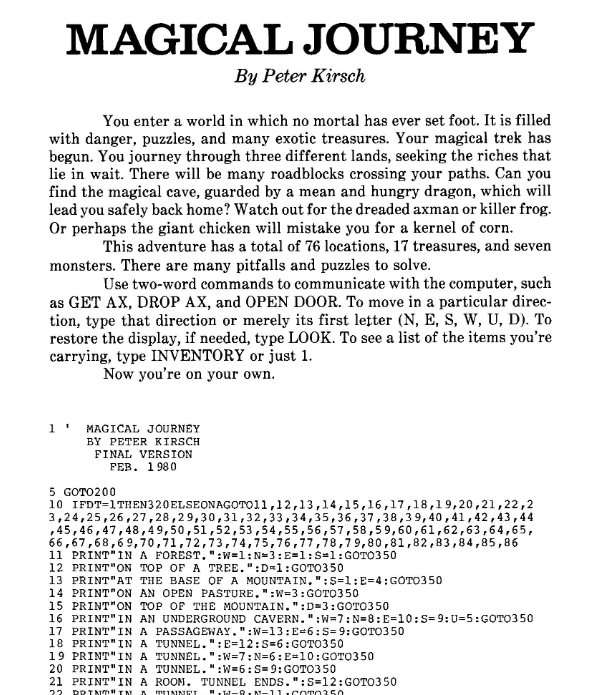


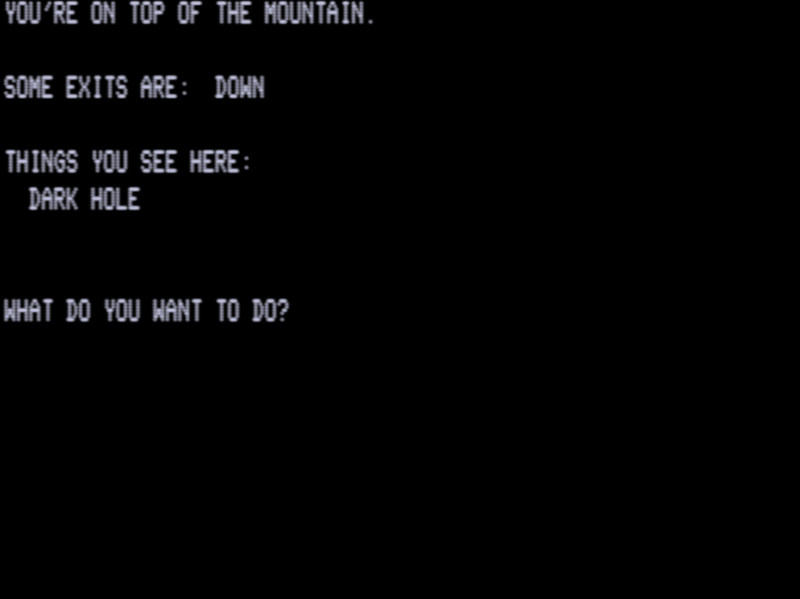


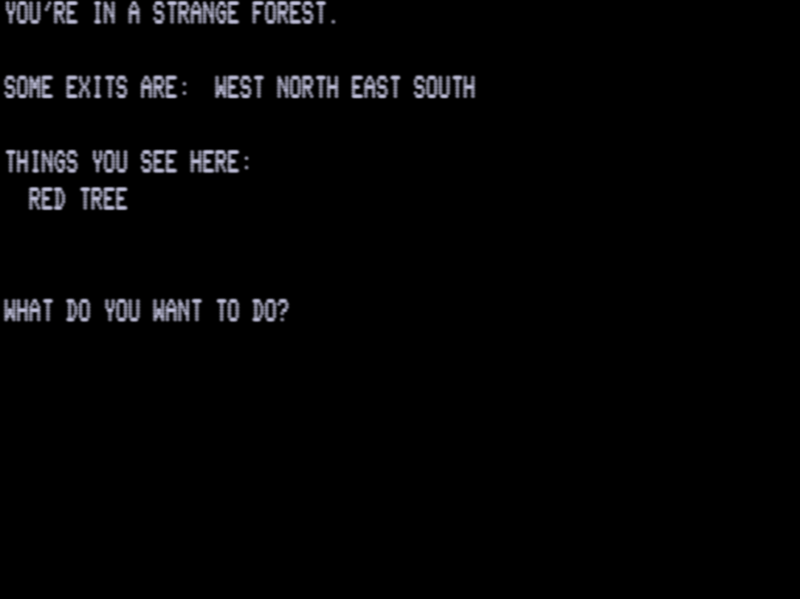
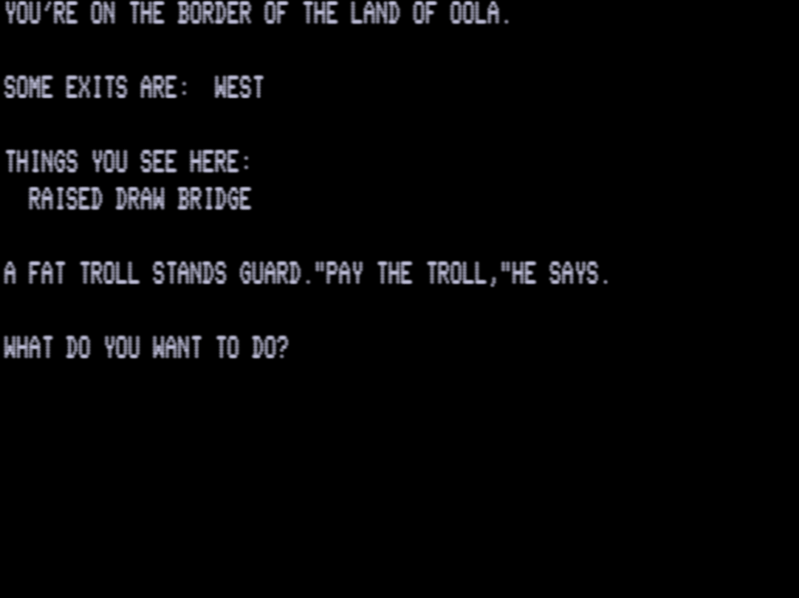

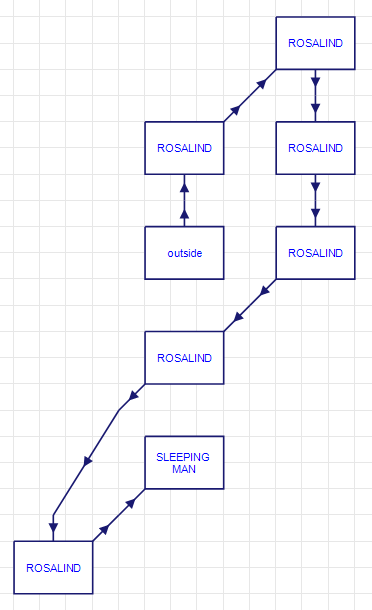

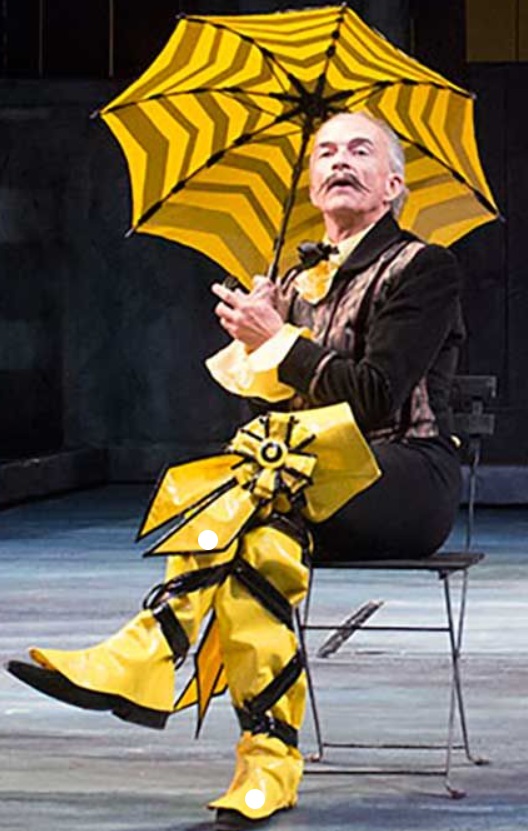


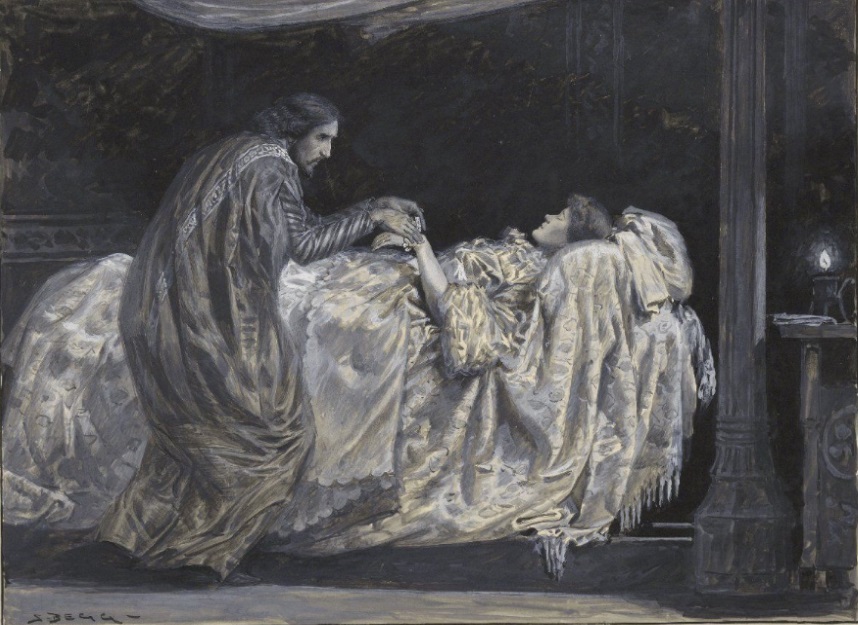


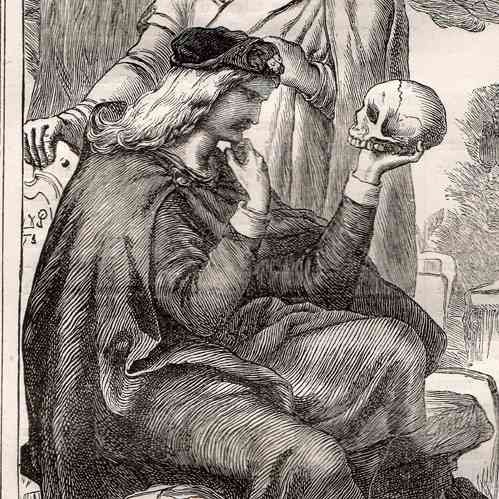

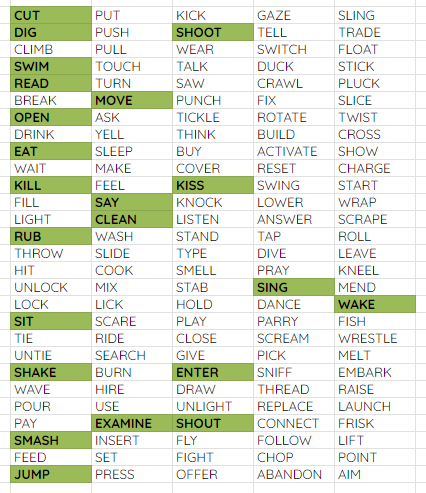


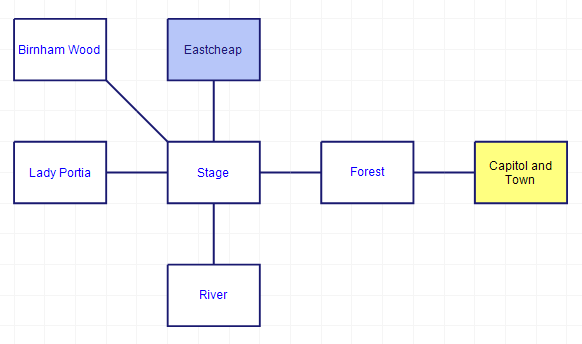


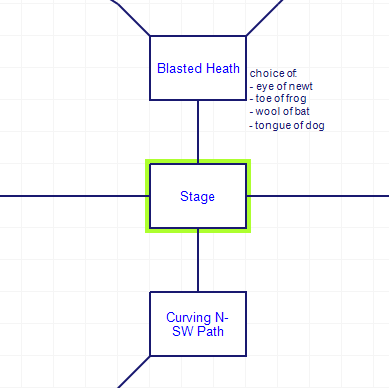


 Renga in Blue
.jpg)