This is the only game of Paul Fellows, published by Acornsoft for the Electron and BBC Micro.

Closeup from the front cover, via Everygamegoing.
Paul was working on a graduate degree at Cambridge when he had a friend (Steve Barlow) who was working on building an Acorn Atom. This intrigued him enough to get the computer bug, and he managed to get a BBC Micro early and started writing software (while, according to this video interview, he “should have been studying for his degree, really”). His first set of publications through Acornsoft was a trio of chemistry software (Chemical Analysis, Chemical Simulations, Chemical Structures) which he followed up with Sphinx Adventure.
He had encountered Crowther/Woods Adventure secreted away at a mainframe at the radio observatory server at Cambridge and was blown away, finding that “the idea that the computer could understand English text and react appropriately just seemed awesome.” He wanted to write his own in an attempt to understand how parsing syntax worked.
Note this is slightly different to some of our other origin stories. Rather than falling for the idea of a world in the computer, our author here was particularly fascinated with the parser. When he later joined Acornsoft right out of college and his projects included the compiler S-Pascal, where supposedly he re-purposed the same parser code (presumably in a conceptual sense and not using the literal code).
There’s a cassette version from 1982 and a disk version from a year later but I couldn’t find any compelling reason not just to play the initial cassette release.

Being that Mr. Fellows went straight from Crowther/Woods Adventure to this game, it is unsurprisingly another treasure crawl: in this case we need to bring the treasures to the titular Sphinx. The main gimmick — Adventure kind of did this too, but not many ran with it — is that the game (according to the instructions) keeps careful track of score “penalties” for “errors”.

Original Adventure had point deductions for using hints and resurrection, so this seems to be the logical extension of the idea.

The building is an “old blacksmith’s forge” with a lamp and a set of keys. The bottle is instead just right to the south of the start location. No food or water for the bottle, but don’t worry Adventure superfans, you’ll see them soon enough.

The wilderness level has more or less than same conceptual geography as original Adventure also, as various directions lead to a Forest location which more or less serves to randomly loop back to the main map. I didn’t even put the Forest on my own map:

Rather than unlocking a grate to go inside the “cave environs” you just need to go down at the valley of doom.


You may have noticed so far no “diagonal” directions (ne/se/nw/sw). The game doesn’t understand any of those abbreviations so I do think (unusually for a heavily-inspired-by-Adventure game) they have been dropped entirely.
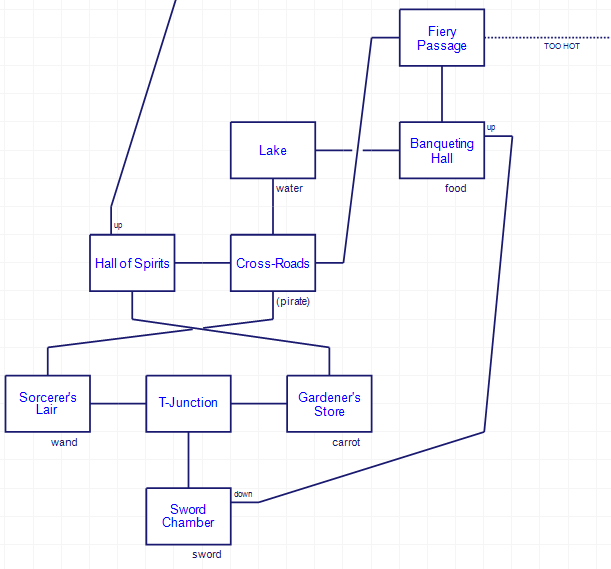
The small opening map mostly serves to dish out some items to the player: a carrot, a sword, a wand, some food, and a lake where the long-anticipated water can be found.
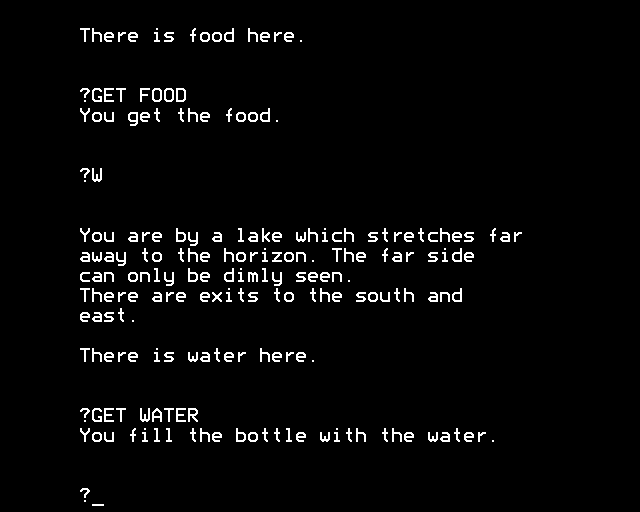
There’s a pirate hanging out at a “Cross-Roads” that will steal stuff as you walk by (just one item in particular, and not necessarily a treasure). You can instead attack, and the game does a strange riff on killing-a-dragon prompt from the original:

The dwarves are incidentally in; the first one throws an axe you can keep, and when they re-appear they still throw axes (just the axes now disappear). They do not seem to be restricted to any particular area and I even met one while wandering outside.
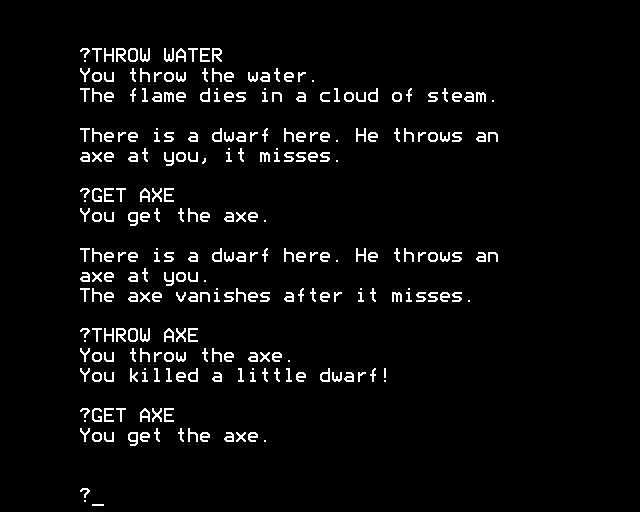
The very top of that screenshot also demonstrates me solving what is more or less the first puzzle of the game, in a “fiery passage” where you can’t go down one passage because it is too hot, but you can throw the water from the bottle in order to cool it down. This leads to another area which is slightly messier:
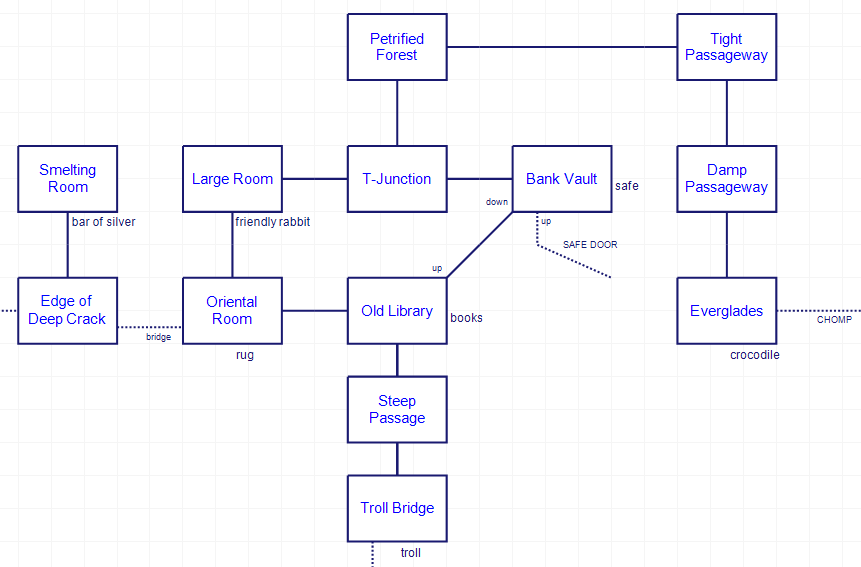
There’s our first treasure (a silver bar, no exclamation mark, you have to check if your score goes up) as well as a “deep crack” that is “too wide to jump” to start. Still keeping with cribbing off Adventure, you just need to wave the wand:
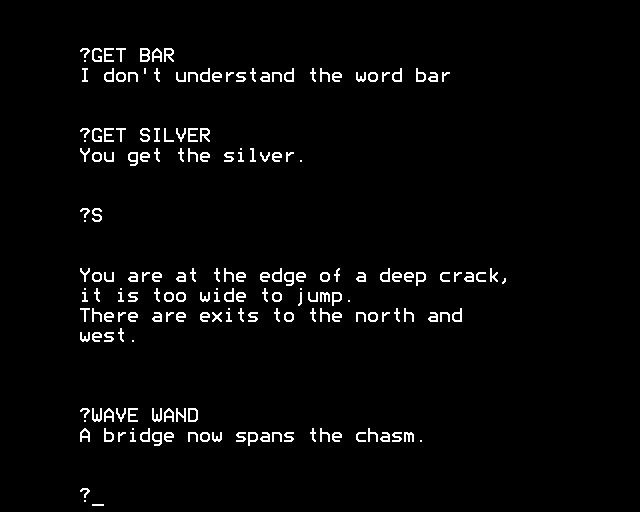
I might sound snarky at the re-use, I appreciate not having to do this everywhere. (I think. Maybe the wand has more uses.)
Then there’s an “oriental room” with a rug, a “straw room” with a friendly rabbit who will eat your carrot if you’re up for handing it over…

It will instead follow you if you don’t do this, so I suspect this is the wrong moment for using the carrot.
…a safe that has “no obvious handle”…

The books mentioned are from an “old library”; the hint suggests that the lake earlier (that we got the bottle water from) can be crossed.
…and a very typical troll with a toll bridge. Of course.

I’ve tried crossing by using the silver bar (which I’m sure is wrong) and there’s a friendly bear that follows the player around without even having to feed it, but I’ll save discussing the area past the troll bridge for next time.
Also, for some reason, there’s the Everglades.
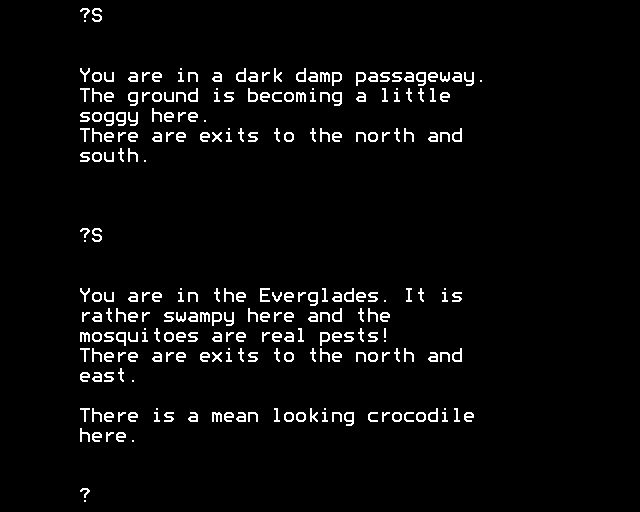
This is unabashedly old-school and in the way that doesn’t bother to add realism to geography (on the other hand, only using cardinal directions makes things easier to map!) The author may have simply been going for ease of play: the inventory limit is also much more generous than normal (if there even is one?) This gives an overall atmosphere less aggressive than normal (despite deadly dwarves as usual) and tries to convey a light jaunt so far.
Mind you, maybe there’s a very tight lamp limit or some murderously-hard puzzles later. At the moment this feels out of place compared to other British games.


 Renga in Blue
I found a bug when entering the Hall of the Mountain King location back in early 2021. Details are on the Stardot forum if you are interested. Paul Fellows also has his say re the game.
I thought that was only on the disk version? (I didn’t read that closely, trying to avoid spoilers.) I am playing the original ‘82 cassette version.
That will be simon pure I am sure. The lack of a save game option was odd but there was a clever way round it. This game received a lot of negative reviews in days of yore but I was always impressed.
Pingback: Sphinx Adventure: Text Arrangement as User Interface | Renga in Blue