The old Gothic church, so the locals say, used to have a veritable labyrinth of passages beneath it, but the whereabouts of the entrance to the passages has long since been forgotten. The church itself has fallen into disuse for a variety of reasons, the main one being the sinister aura that surrounds one of the large tombs in the church graveyard. The church’s treasures have long since disappeared without a trace.
An ancient local legend, all but forgotten now, tells of a vast underground land inhabited by weird monsters guarding wonderful treasures. Could there be any connection between this legend and the lost treasures? By the way, if you do find any treasure, take it back to the church, and lay it on the altar – after all, it doesn’t belong to you!
CATACOMBS is a large and complex adventure which is definitely not for beginners. Many of the puzzles to be solved are unusual, with ingenious solutions, and will stretch your imagination to its limits.
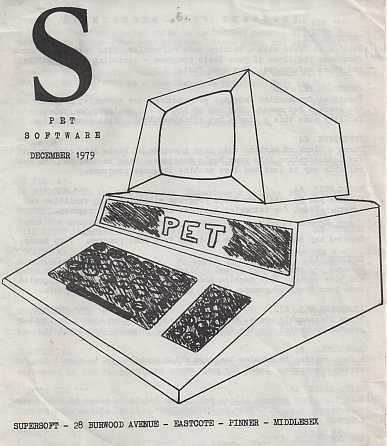
Supersoft December 1979 catalog cover, as uploaded by the co-founder of Supersoft to Wikipedia.
This is a game I vacillated on if I was even going to play it or not (or at least, play it anytime soon).
Back in the halcyon days of January 2020, when I was generating my 1981 list of games, one of the prominent “lost game” companies was Supersoft. We’ve seen them before with Hitch Hiker’s Guide and the saga involving a lawsuit.
They were not the only adventure game Supersoft published that year, and a Personal Computing Ad from November 1981 lists
Hitch-Hiker’s Guide £16
Goblin Towers £14
Cracks of Doom £14
Catacombs £27
Weird Wood £25
Cornucopia £35
Three of these are by Brian Cotton, and all are lost in their 1981 form (Commodore PET). Goblin Towers exists in a later 1984 form for C64. Brian Cotton eventually (through 1981-1982) had a series of five games (Catacombs, Witch Hunt, Cornucopia, Forestland, Goblin Towers) where I had them sorted as either 1984 games or “lost”.
Based on the earliest advertising anyone has been able to track (“anyone” mainly being Gareth Pitchford) Catacombs was the first of the games and started being advertised March 1981. The timing here — that is, the exact month of March 1981 — has an enormous amount of significance, as our Quest for the First Britventure in 1981 mostly stopped at The Golden Baton and a May 1981 ad. Our quest would have ended there had it not been blown away by the existence of A. Knight’s Galactic Hitchhiker from 1980. But Galactic Hitchhiker was a one-person-game sold by a one-person-company, that is, not sold by a real “professional” distributor like Molimerx or Supersoft.
By having an ad date of March 1981, Catacombs is the first original “professional distributed” British adventure game.
And… we don’t have the original anymore, nor the early C64 version (which, based on the Cotton games we do have, probably just involved copying the source code from the PET verbatim). There was yet another version made as part of a “Classics Revisited” set from 1986/1987, for a wide variety of platforms…

…but at least for Catacombs, those versions were all lost too in 2020. I had Catacombs sorted in my “I guess we’ll never see what it’s like” folder, marked with grim digital red. There I thought it would remain, until in 2022 a collector stepped forward and uploaded the entire Classic Revisited set to oldgames.ru (in DOS format). Suddenly, as of September of last year, it became possible to play all of them.
This stuck me with a dilemma; Catacombs is extremely important in British adventure game history. We can say British adventures on personal computer started with Galactic Hitchhiker but British adventure games as an industry started with Catacombs. But is it worth it to play a “remix” which I knew to be different?
Eh, whatever. I’ll be getting to playing this in the 2030s sometime anyway, might as well check it out early.
Some quick history on Supersoft before starting the journey–

Pearl Wellard (left) and Peter Calver (right) were accountants in 1978 who both worked at the same company. The company obtained a computer (a PET, the “proper business computer” of the Trinity) and the pair was the ones who ended up setting up the system. After that they got hooked enough to start writing and selling their own PET software under the name Supersoft.
There wasn’t software for the PET in those days. There were only about 1000 PETs in the country.
The pair ended up giving their jobs up after 18 months to work at Supersoft full-time.
Our turnover in the first year was £2000 — in the second year it increased to £100,000.
There’s not a great deal of info on the duo’s early years otherwise (Peter has done interviews, but mainly because of their purchase of Audiogenic in the mid-80s. Who cares about that old PET software, right?) I did want to share a bizarre excerpt I found from a freeform “gossip column” in the January 1981 issue of Personal Computer World, that is, from two months before Catacombs got published:
Supersoft’s Peter Calver has a PET name for partner Pearl Wellard. Pearl has threatened the Editor with all sorts of dire horrors if he reveals that it’s Pearl*****. (A prize for the first correct entry.)
I think we’ve had enough preface, but I should add one other thing: based on the thread at CASA, one puzzle has a bug that makes it unsolvable and one puzzle is currently unsolved. This is a hunt-the-treasure game where you are supposed to gather everything together, type SCORE, and pat yourself on the back for a job well done, so there’s no “ending text” anyway (people have extracted the text to confirm). I think the max score is ~240 out of 250? It is difficult to check without spoilers.
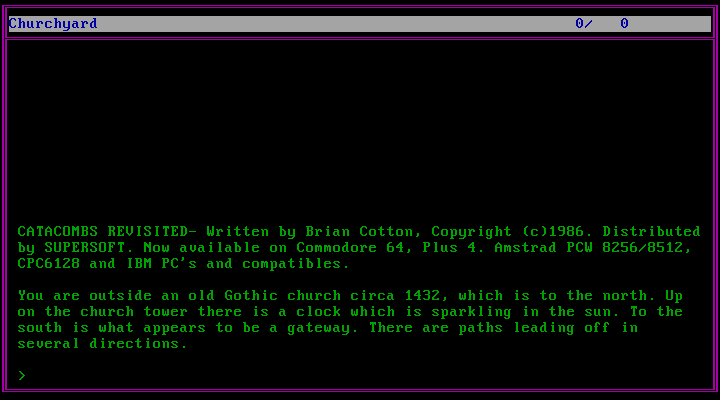
For my first session I decided to explore freeform, without even making a map, just to see what I was up against. Poking in the church I quickly found the altar where the treasures were destined to go (at least according to the ad copy in the catalog).
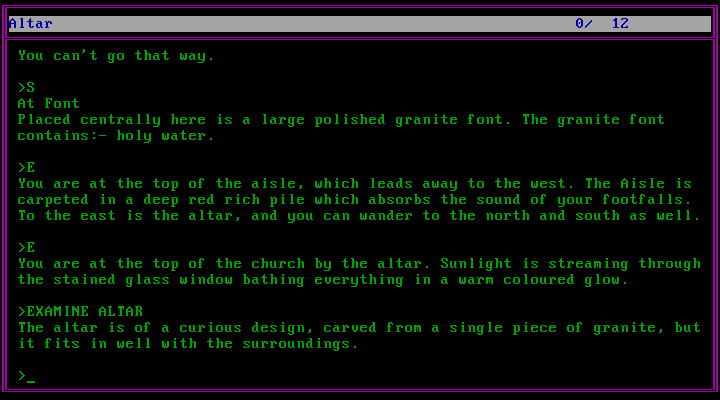
I found a notice board which felt Zork-ish.
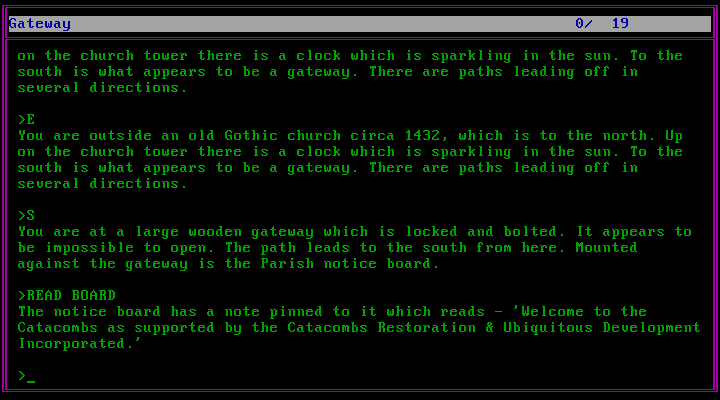
Trying to wander away from the church, all I found was a maze.
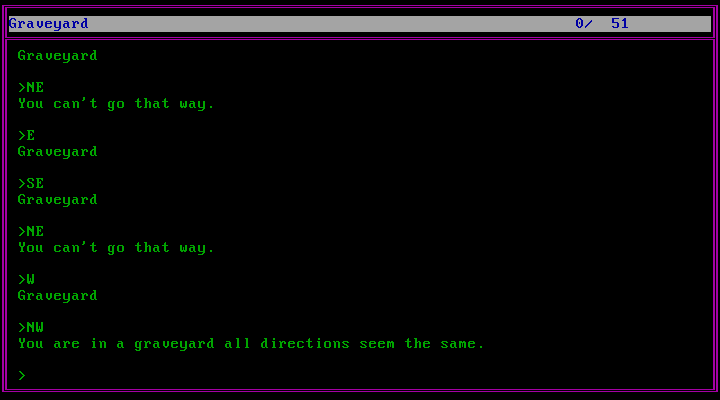
Avast, casual exploration foiled! … I guess I’ll whip out the maps and start taking in things seriously next time, and share what some of the puzzles are like.
(In the meantime, could someone let me know what the actual theoretical high score is, given the bug?)


 Renga in Blue

I am away at the moment so I cannot check but this game is difficult. Not Phoenix level difficult but the inventory limit is a real pain and there are soft locks aplenty. It is the also the only game I have played that uses the verb “to stamp.” Cornucopia is even harder (and even larger).
I scored 240 but it was a real struggle. There are some clever puzzles in here. Like many early games working out the correct order to choreograph the puzzles is half the battle.
I find it fascinating that an “expert level” game was essentially the first published outside of the A. Knight game
I gather there were sufficient imports it isn’t like people hadn’t seen a Scott Adams game, but still a curious choice
Most of these early British games always scare me with stories of their difficulty, but this one looks fun and not quite in that very difficult way. Well, maybe, if someone from Oldgames.ru drops by saying he couldn’t beat it, that bodes interestingly for the difficulty, since from what I can tell usually reviewers there actually beat the games they play.
This game, if memory serves me correctly has a very nasty maze indeed. Stamping changes part of the layout so it is a real pain to map. Unfortunately I won’t be home until next Sunday so I can’t check. I remember a Zombie and a clever puzzle with a hot water tap.
Pingback: Catacombs: Fueled by the Very Rocks Themselves | Renga in Blue
I still have a PET version of Catacombs and Goblin Towers – they were a birthday present one year when I was a kid. Planning to play them again over Christmas with my son! Happy to add them to an archive if someone can point me to a good one.
Hi Andrew! That’d be great to have. if-archive should work out ok:
https://upload.ifarchive.org/cgi-bin/upload.py
Wow, that’s great to hear!
I’ve actually been working on trying to preserve the only known copy of Supersoft’s Weird Wood. The disk wasn’t in great shape, so it’s still an ongoing process.