This game was printed as a type-in, twice. The Amstrad version was in CPC Magazine, starting from page 53.
As we’ve seen before with type-ins (I think most significantly from Spelunker out of Byte magazine) the actual version that gets passed on to various archives had to be typed in by someone first, and that means there might be a typo that carries on, especially if the person doing the typing never really played through the game in question.
I don’t think the person who typed in Colditz on the Amstrad played the game.

Via CPC Magazine, number 7.
(Also, before proceeding on further, special thanks to everyone who helped me through French difficulties. Unfortunately working through the language still doesn’t help with coding difficulties!)
Last time I left off on a sentry with some keys that I need to abscord with. I had already tried to “kill” the sentry with no luck, and “coup” (which in some circumstances be “hit”) didn’t work, but I hadn’t tried to mystery verb ASSO.
The entire list tended to the infinitive tense, so having sit which would normally be s’asseoir seemed to violate the rule but I couldn’t come up with a better verb than that. Still, I considered the verb to still be in the mystery zone, so I went ahead and tried it on the sentry and it worked.

ASSO turns out to be ASSOMMER (knock out). After you say you want to knock out the sentry it asks you what with, and you specify the “barre” (or “barre de fer” if you want the full “bar of iron”).
I was then able to nab the keys and run over to the locked door. This opened an area with four new rooms.

The first room has a safe, which asks for a combination if you try to open it. If you fail at the opening an alarm sounds. I don’t know the combination yet.

To the west there’s some guards who capture you. Probably this room should just be avoided.

To the south there’s a torture room, with a desk and a metal plate locked with a padlock. Here is where things went wrong, because I tried to break (casser) the padlock, and the game asked me with what, and I gave the iron bar again, and then:

I had to dig out the source code.

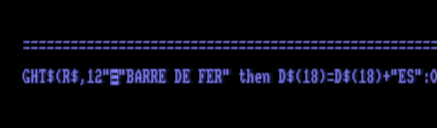
A quote mark symbol was supposed to be a parentheses (see above), so I was able to fix it. It could be a file corruption rather than a typo, but spotting one made me nervous about more. As it turns out, rightfully so, because the next room — an infirmary — had a broken lamp. Broken as in the game’s code, not the item itself.

No matter what I did, I could not refer to the lamp. Normally, I’d just pick it up, but the game claimed I couldn’t, and I was baffled enough I decided to peek at the walkthrough. Fortunately I didn’t spoil myself on anything, other than realize that if you try to follow the steps of the walkthrough, you are completely unable to pick up the lamp.
There must be another typo! Possibly more. I’m not sure if I really want to keep trucking with the Amstrad version, but I have been unable to download the Oric one (the site has some sort of security thing that doesn’t let me? or broken Javascript or something?) I may end up just having to blow any secrets and check the code line by line, but this admittedly follows the authentic type-in experience, where any players circa 1985 had to spoil themselves on the adventure by typing it in.


 Renga in Blue

It would be nice of the archive from which you downloaded this game received the fixed version.
About reviewing the source code line by line, it seems both a final fix but tedious, then again you definitely have the patience to do so.
Lance found a copy at another archive that seems to be typo-free, so fingers crossed!
I don’t think that players spoiled themselves a lot as the code was usually barely legible. Two-letter variable names and tons of GOTOs did’t help either. I don’t even think this was deliberate, more likely it was just the way people coded in BASIC back then.
Last time when I tried to reverse-engineer a C64 adventure to fill a gap in the C64 wiki it took more than one good hard look to understand what the game expected…
usually the main problem (this is from me who genuinely experienced it both in the 80s, where I did have the True Type In Experience, and very recently in the Project) is the plaintext, not the actual logic, since it can often be used to figure out puzzle solutions
Softside started to print their adventures “encrypted” style, like this listing for Operation Sabotage
https://archive.org/details/softside-magazine-47/page/n31/mode/2up?view=theater
Peter Kirsch (who wrote a ton of the Adventure of the Month) incidentally has a long break-down in the same issue of his adventure writing technical setup and a skeleton source code template
This is an example of what I’ve been thinking about:
https://archive.org/details/64er_sonderheft_1986_04/page/n123/mode/2up
Agreed that the plaintext gives away locations and items but to me at least, back then when I was younger and had more hair, didn’t give much away. Having a checksummer helped a lot, btw, as I also had more than enough of that special experience and typing in something like Operation Sabotage without one sound rather nightmarish to me.
If you feel inclined to try your hand on a German adventure once you reach 1986 I would be very grateful if you could have a look at “Wie im Eisen der Fuchs” (https://archive.org/details/d64_Wie_im_Eisen_der_Fuchs…_1986_Markt_Technik_de). It was part of the collection above, but only available on disc, and is an old bugbear of mine. Part of the issue is probably that items that you drop don’t seem to stay in place but get moved around (you are a detective and there are other people in the house, so there is at least a reason why this might happen – nevertheless it was sufficient for me to ragequit a couple of times).
Multiple years late so you probably already know this, but the Oric site only lets you download when you’re logged in. It does not say this anywhere.
This was throwing up site errors for me at the time. I imagine it was just buggy when I was trying.