Normally on this blog when we’ve seen the word “adventure” followed by a number, it is meant to designate one of the many modifications of Crowther/Woods Adventure, like Adventure 448. That’s not the case here. The author wanted to brag about the number of rooms. They might even be right to brag.

Yate, near Bristol, where today’s company comes from.
But to back up: this involves yet another one of those flash-in-the-pan UK companies founded around 1982, in this case a company named Foilkade Ltd., which seems to be by all evidence run solely by one person, C.J. Coombs. Starting in the December 1982 issue of Sinclair User, they advertised three games, Fantastic Voyage, Awari and Adventure 200, with a tack-on to the contest craze: an award for the first person who gives a correct solution to both Awari and Adventure.
I don’t know what a correct solution to the board game Awari would be like (maybe the game is completely non-random, so a procedure that beats the highest difficulty would work every time? isn’t that a game flaw?) Adventure is mentioned as having “over 200 places to explore in this machine code game using advanced data compression technique” and honestly, it really is impressive: we’re talking 16K of capacity, the same amount of space Scott Adams had to work with. (Also, the actual number according to the BBC Micro intro is 230 rooms.)
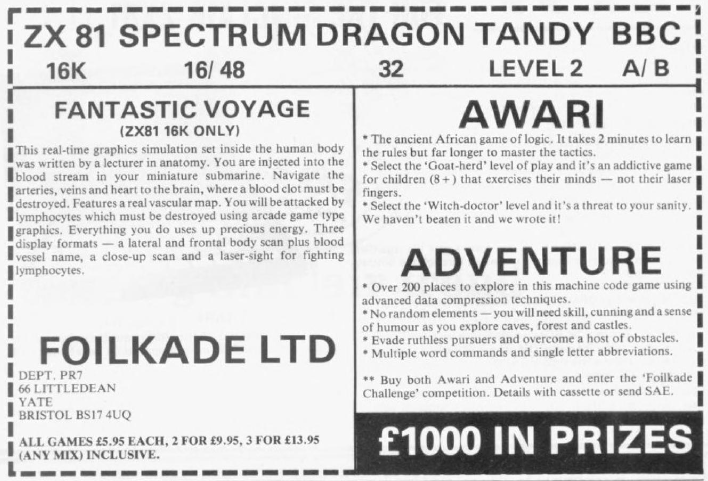
It wasn’t that silly to point to number of rooms as a metric in 1982, as while Level 9 managed dense worlds as well, it was hard technically for authors to provide the mainframe experience of a “world to get lost in” on the smaller machines.
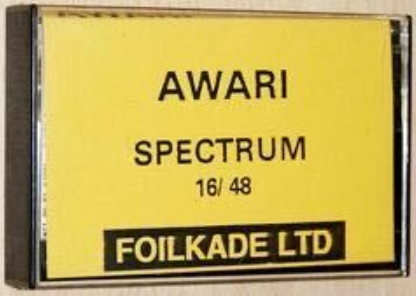
I never found a picture of the Adventure 200 case, but I think this Awari case is pretty indicative of the look. Via Pricecharting.
Despite some heavy advertising throughout 1983 (and decently positive mentions, like here in the book Sinclair QL Adventures) they poofed from history after that point. At least we can enjoy this one shot into the sands of history by Coombs.
At the very least, this one is allegedly long and complicated; Exemptus from CASA calls it “surprisingly vast and difficult” and there’s even a letter from a 1984 issue of Micro Adventurer which states roughly the same, as “Irene Feeney, of Basildon in Essex” gives an open offer for help for anyone sending a self-addressed envelope.
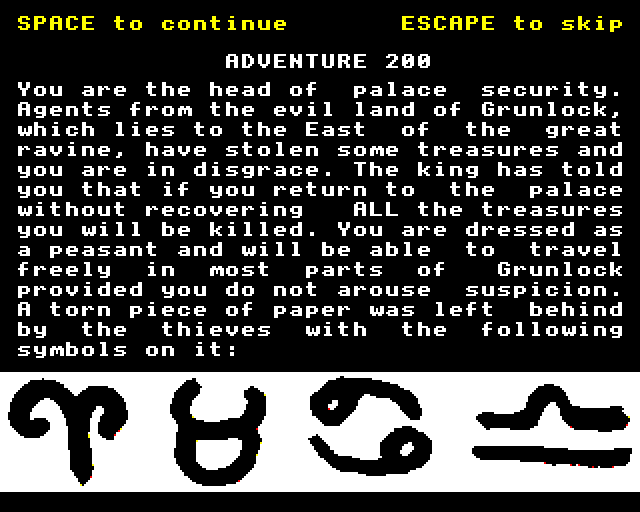
I’m playing on BBC Micro which has enough capacity to stuff the intro material without needing an extra instruction sheet. The premise is that all the treasures of your kingdom have been stolen and you are tasked with finding them while incognito. The only clue left behind is set of four symbols shown. I don’t know if this is meant to be Crowther/Woods style with gathering treasures from multiple rooms and this is just a creative way to kick things off, or if the treasures are realistically stored in a thieves’ hideout we need to infiltrate (like how Dragon Adventure only had treasure in the dragon’s lair). The “ALL the treasures” warning suggests the former to me.

You start just outside the palace, and going west kills you if you don’t have the treasures. I don’t think we’re using a trophy case room this time.
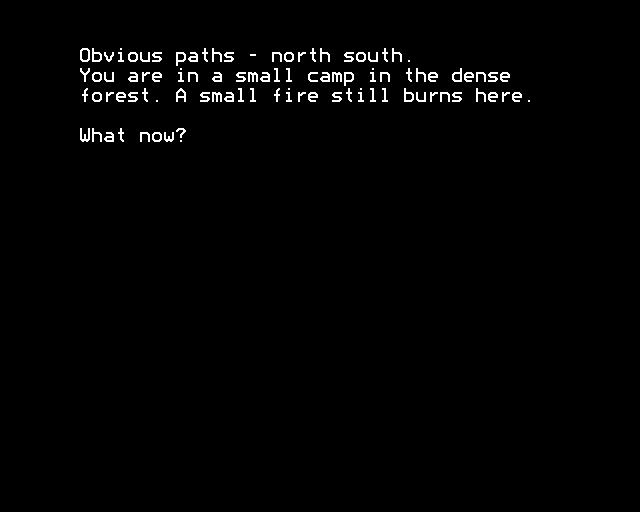
The thing that threw me most early off was the way exits are displayed. I’ve never seen this behavior before. Each room will always list a maximum of two exits as “obvious”. However, this is a perfectly regular map where rooms can most definitely have more than two exits. The campfire screenshot above only has exits north and south listed, but you can also go east and west. I only discovered this by arriving from the west, thinking it was odd for an open forest to have a one-way route, and tested going back even though it wasn’t listed as an exit.

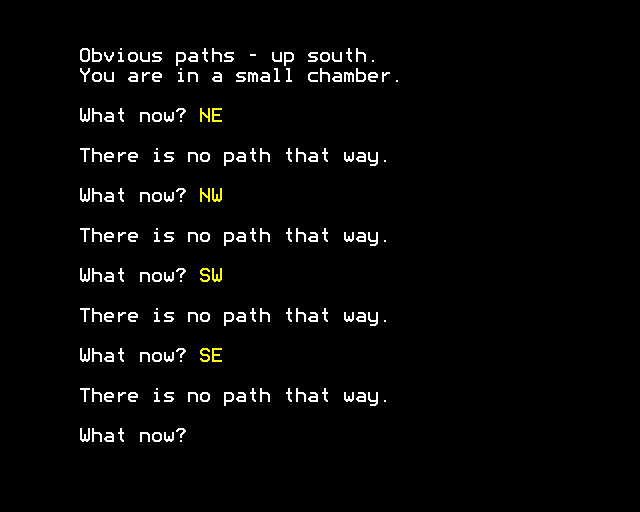
The upshot is, when making the map (first part above) I have to test every single exit in every single room. I’ve certainly had games like this before, but it is quite odd on a game that has a mechanism for listing exits. I’m not “working from scratch” at least, and in rooms which really do only have two exits, it makes things much faster since I can just plow through typing NW / N / NE etc. getting “There is no path that way” messages. Where path-searching is slow is when you find an exit, and then have to add it in, and go back to the original room and keep looking — but which exits did you already test? are you sure? better check all of them over again.
There’s one room in the early area that gives a “landscape view”. This is surprisingly common in early text adventures and I probably should give this sort of room an official moniker. Island Adventure had a tree you could climb to see there was a cave past a river. This kind of room gives a preview of what the journey of the game will be like.

I also wonder if the symbols given at the start just represent the “biome journey” we need to take through the game.
The only real item outside you find early is an axe and the only real obstacle is a straightforward troll. No talking or anything, all business.
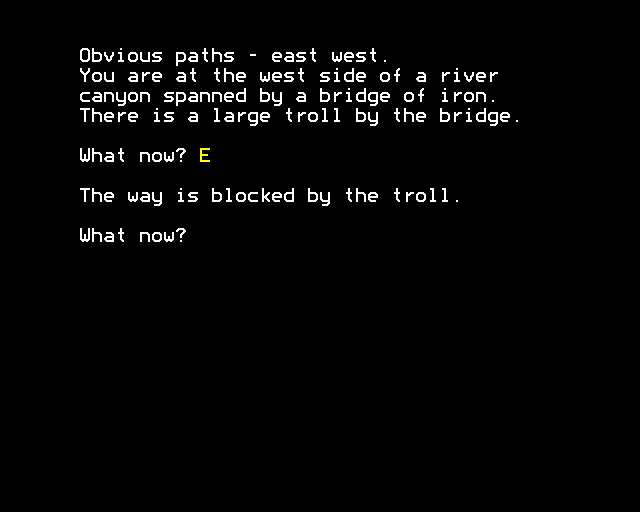
To satisfy the troll, you need an item from underground. Underground isn’t a large area, or at least not yet.
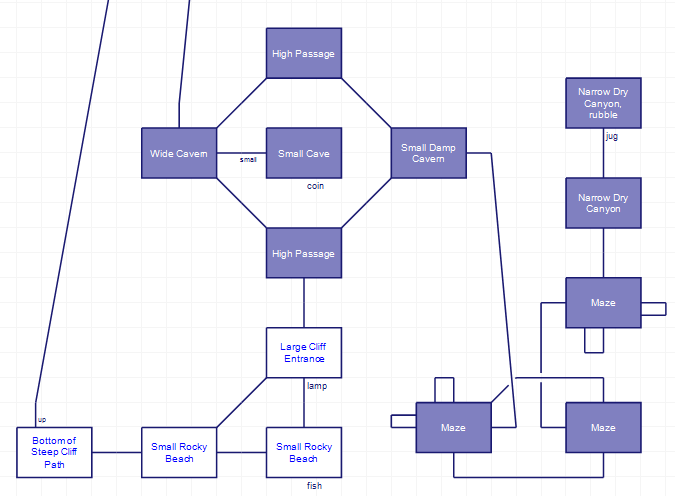
You need the lamp (conveniently at the mouth of the cave) to provide light to explore, but it requires a light source. Fortunately, that campfire I gave a screenshot of earlier works. (It is important to note this moment, as it means the game isn’t purely about doing actions on objects listed as separate from the “main text”, so I need to pay attention to room descriptions.)
The mazes are particularly curious. It almost felt like the even the author didn’t like mapping mazes but only included some rooms out of obligation.
One exit is described as too small for you to squeeze through, so you need to drop your items except your lamp (this technically counts as a puzzle, I guess) to find a coin within.
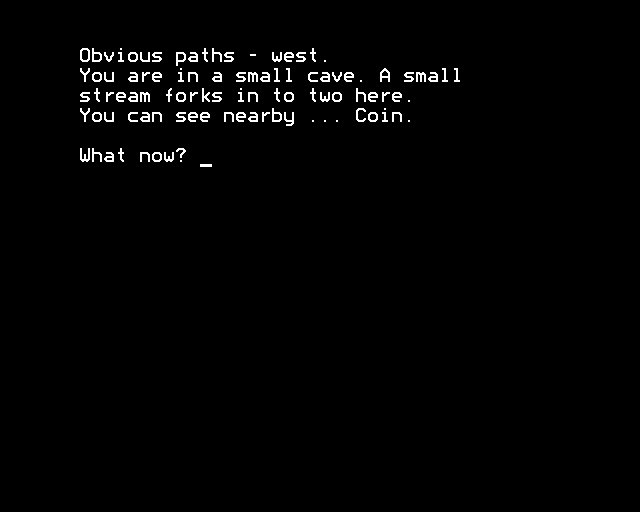
Other than that, there’s a fish and a jug lying around, and the jug breaks if you drop it. Not too exciting yet.
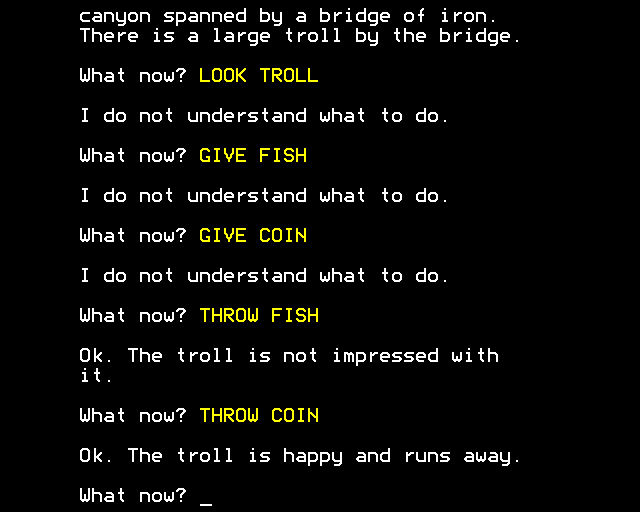
With the troll satisfied, this leads to a large landscape, one I haven’t fully mapped out yet, so I’ll save it for next time. I will say if this is truly in the “nightmarishly hard” category of works like Acheton the author clearly is trying for the slow-burn approach, and building with easier puzzles until giving harder ones. (Like, y’know, a normal modern game designer.) Of course maybe I already softlocked the game giving away the coin (could it be one of the treasures?) and I’ve already fallen into the author’s trap. We’ll see!

One of the places I found searching in the lands beyond the troll.


 Renga in Blue
Seems like this could be interesting!
Something that might be obvious, but since you did not mention it – the symbols correspond to the astrological zodiac sign symbols for Aries, Taurus, Cancer and Libra.
This opens up to a plethora of related puzzle possibilities through the vast amount of (confusing/confused) lore connected to astrology. Note for example that each sign corresponds to a “house” which has a 1-12 number (but also that sometimes the signs themselves are numbered in a 0-11 sequence!) and that every sign also belongs to a “domicile” (not to be confused with the house system) with a celestial body “ruler” (in order for these four: Mars, Venus, Moon, Venus again). Returning to the houses there is a different motto for each house (Vita, Lucrum, Genitor, Uxor) and they are associated with a certain area of worldly things corresponding to that motto. And of course the correspondence to times of the year – and so on.
Then, it could always be a red herring or going off on a completely different tangent of the game maker’s mind.
My guess is a security code for an alarm system that a thief had in their pocket. I need to play further to confirm but the general theming seems to be “easy to get in, hard to get out with the loot without being caught” (alternatively, “if Crowther Woods was a heist movie”)
I played this to completion last year and it is surprisingly complex and easy to soft lock. I will dig out my old notes and see what I can find.
As a bit of a heads-up (mild spoilers) gurer ner gjb pbvaf and guerr bowrpgf gung erznva hahfrq. I remember screwing up almost as many times as there are locations! The author is to be congratulated as he obviously had a real talent for construction and no little imaginative flair. I’ve c(o)ombed the internet but I don’t think he / she wrote any other games. It is somewhat reminiscent of another large, excellent and very intricate game called Castle Blackstar which you will be wrestling with (hopefully) next year.
Pingback: Adventure 200: Casing the Joint | Renga in Blue