(If you need to read my previous entries on Prisoner 2, here’s a handy link.)
I’ve reached the ending; really it was a matter of finding the keyhole, as the resolution with the Caretaker is identical with the original game. There are still were some absurd surprises along the way.
The first came from just returning to the court in order to scrounge up more cash and score. There’s more hangman, and it started with the same words as before, but then things got very strange indeed.

The word is QRBU.
Instead of providing real words, hangman started providing literally random combinations of letters. I know they are random because after finishing I consulted with David Mullich’s original design document, which you can find here.
If a random number between 1 and 2000 is less than the SCORE, then a word of 3 to 8 random letters is constructed, otherwise, one of these words are chosen: FREEDOM, LIBERTY, LICENSE, INDEPENDENT, AUTONOMY, SOVEREIGN, AUTARCHY, LIBERATION, ANARCHY, ESCAPE, RELEASE, HOPE, FREE, DIGNITY, INDIVIDUAL, RESPECT, or PRIVACY.
In other words, the higher your score is, the more likely you will get a gibberish word at the court. Once your score reaches 2000, the court will only provide gibberish words.

The word is XZKDFGQ.
After I had stocked up on as much score and credits as I thought I could pull off, I took a shot revisiting some locations. In the Theater in particular I got met by the Brotherhood, just like the first game.


In the middle of the word VOUCH.
The visual effect is to show text a few letters at a time scrolling across. There’s a whole scene where people are conversing:
DOES ANYONE HERE KNOW #?
I’VE BEEN WATCHING HIM.
They take a vote and you are able to be admitted and be given missions. I was given a mission to sit on a throne and say MARY HAD A LITTLE LAMB. Fortunately in this case I knew it was talking about: the “switchboard” location with one of the two mazes.
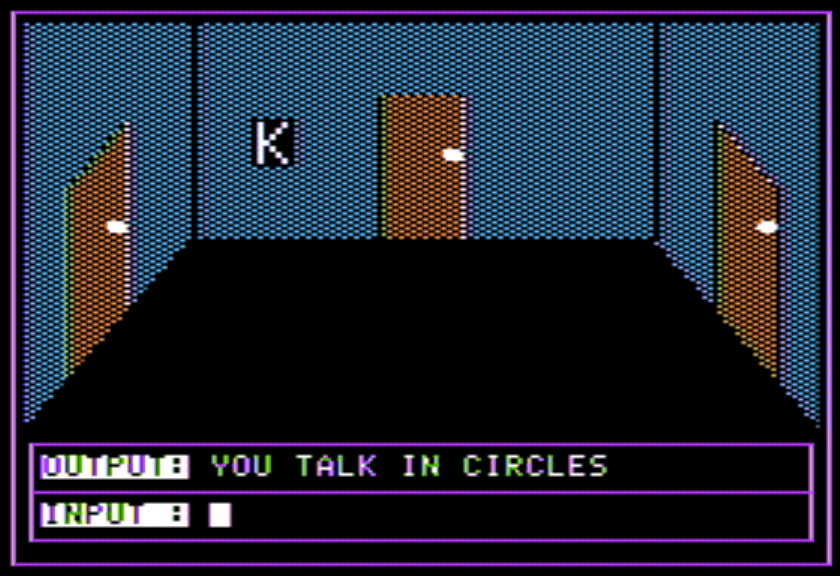
Some of the letters suggest directions, but some eventually do not, and I eventually just had to map the whole thing. The rooms are at least unique so you can treat it like an old-school Adventure map.

I will have to say in a way this is even worse than any of the bad ones I’ve mapped before (like the Adventure 500 Crazy Maze) insofar as the map is randomly generated. That is, if you leave and come back, the map will be entirely different. With the opening Castle, it isn’t tedious to map and there is a feeling of some humanity in the algorithm. With the maze here, it’s quite almost literally filling in a spreadsheet with arbitrary values.
To make a more lateral comparison: there are hand-made Sudoku puzzles and computer-generated ones. When the Sudoku craze first hit there were books with pages and pages of the computer generated puzzles, but I could never get engrossed in them like the ones made by humans (anything of the puzzle books published by Nikoli are hand-made puzzles, for instance). Some of this has to do with humans making interesting and creative logic in a way the algorithms were not, but some has to do with: the hand-made ones were pieces of art being sent into the universe, part of a person’s life being experienced. Solving them is like sharing a piece of humanity.
Prisoner 2 making the map-truly-random-maze-by-hand aspect part of the experience bump up against the feeling of inhumanity is part of the Point, of course, just like trying to solve a hangman game with random letters. Akin to the first game, it was a point I could admire more at a meta-level rather than when I was burning hours of my own time trying to baffle over what was going on.
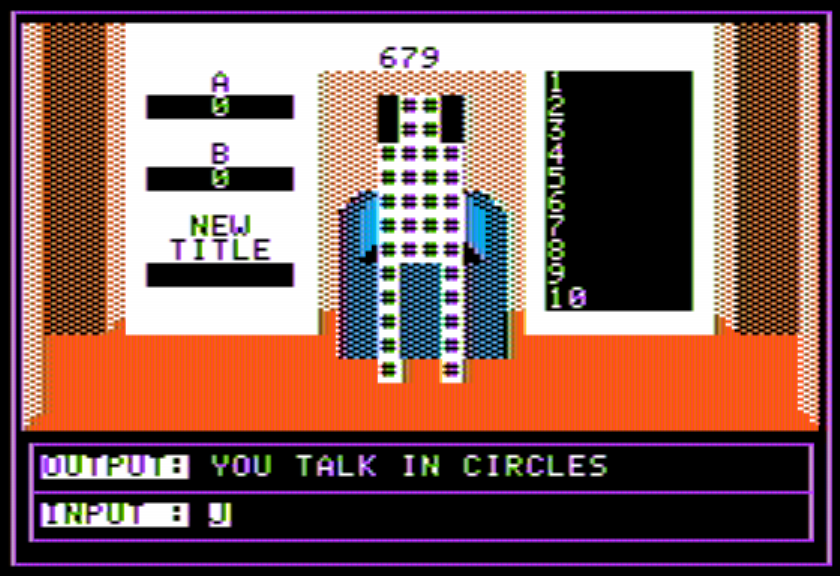
Moving on: the throne (shown above) is in the maze. You can SIT and get the curious display shown (confirming later with the design notes, this is all that happens, the A and B displays mean nothing). Typing MARY HAD A LITTLE LAMB here will fulfill the request of the Brotherhood. You can go back, get the hint AN ISLAND IS NO MAN, and get a new quest. This animation shows the one I got:

For this one (“RUN THE ISLAND”, “TO THE SHRINKS”), you need to go back to the hospital and the bit where you can “break the source code”.
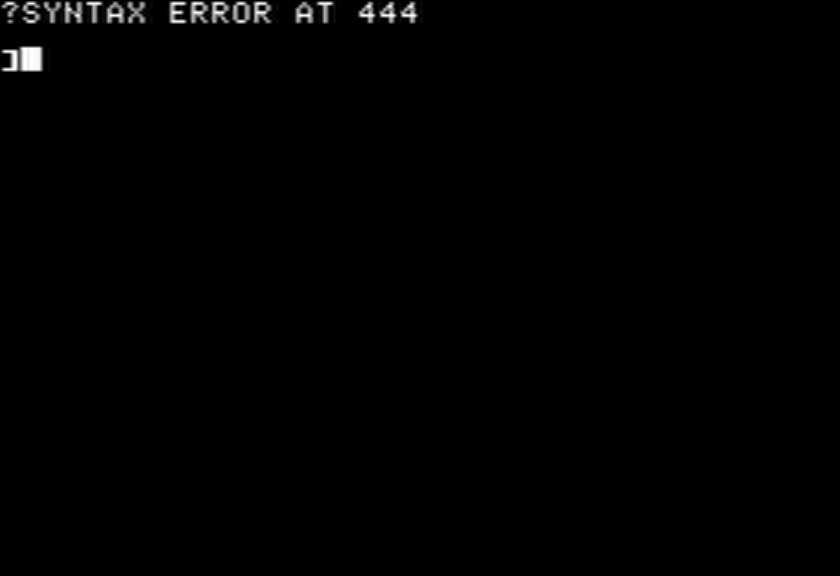
From here, type RUN THE ISLAND. Then the game will respond that the subject has delusions of grandeur, but you’ll also have fulfilled the Brotherhood’s request, and they’ll give you the hint (?) DRINK AND BE MERRY.
From here I got a mission to go to the newspaper and set the headline to DEUS EX MACHINA. The original game made it a puzzle where you had to put in the right ASCII codes. Here it is a little easier; you simply shuffle letters around until the text becomes what you want:

This sends you back to the Castle, but you can then return to the Brotherhood and get the hint “THE TRUTH SHALL REVEAL THE PLUG”.
After this I got a mission repeat (shrinks again). Looking over the design doc, there’s only one other mission, to set the file cabinet at the Carnival on fire. You can do that by buying MATCHES, then going to the bit where you can add weights, and typing the commands ESC and I. This moves the cursor one step up (this is just Apple II shenanigans). Then you can tap right-arrow until you get launched out of the carnival. If you have the mission you’ll then set the file cabinet on fire.
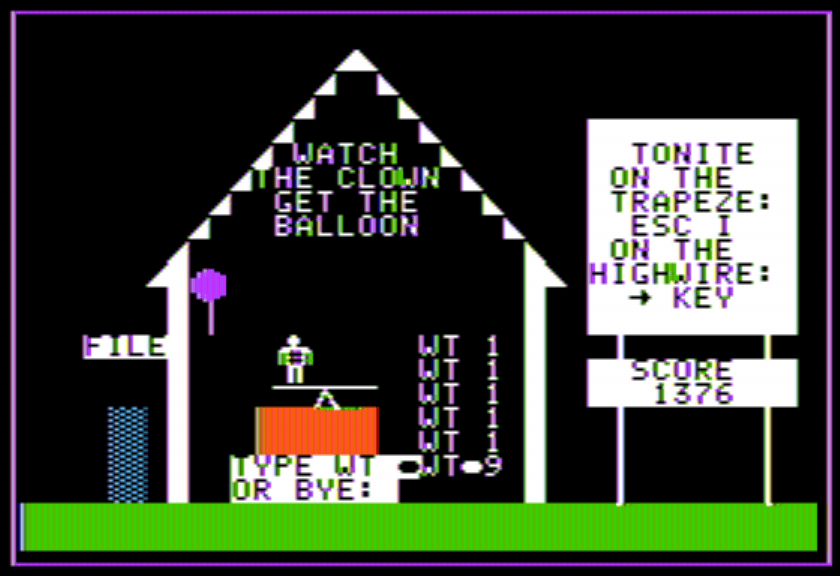
After pressing ESC-I, the cursor is to the right of “TYPE WT”.
Yes, that’s a fairly obscure string of text there, but at least in this version of the game I just followed the literal directions on screen over on the right side.
The hint received from the Brotherhood for doing this task is INPUT THE PLUG.
Anyway, as you might have surmised, the Brotherhood doesn’t do anything useful past this point; you can just repeat missions over and over. I still had no keyhole. I did wander and participate in some wacky activities, like math.

The result of typing “4”. According to the design document this whole section does nothing for the credits, score, or overall goal of the game. Except I suppose in a “feeling of despair” sense.
I finally found the keyhole in the other maze, at the Grail Hall, an entirely new building for this version of the Prisoner. It is just … another maze. At least this one was made by hand, but the opening rooms are indistinguishable so I spent a lot of time just wandering around.


Once you get deeper the rooms start to get very curious indeed.

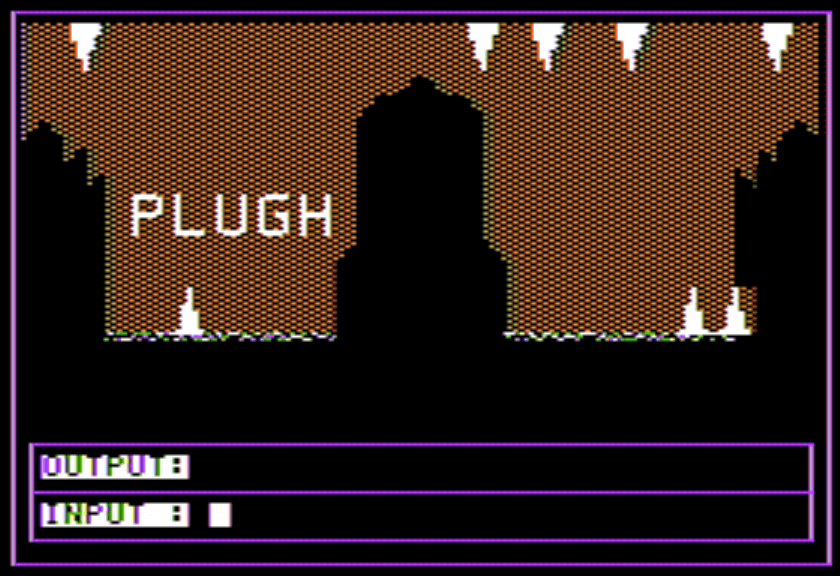
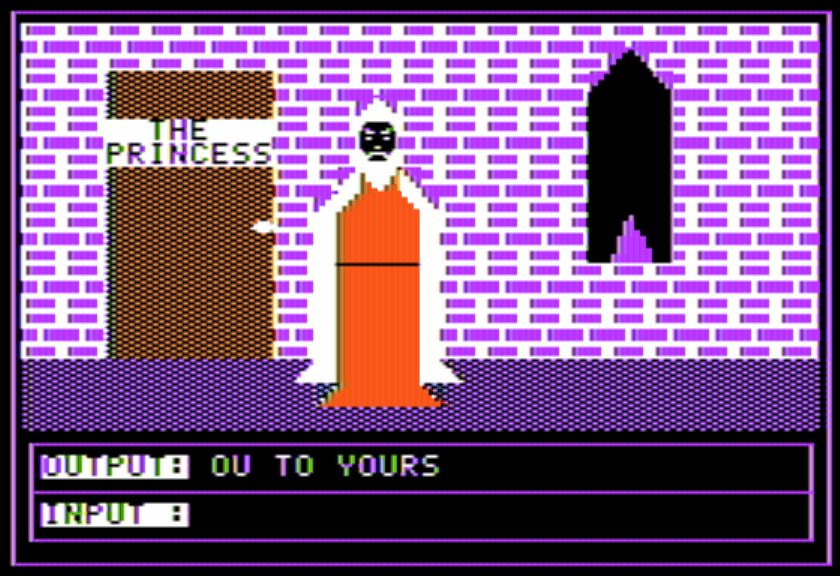
For the last one you get booted back to the Castle at the start, and yes, those are meant to be adventure game references, the last being The Wizard and the Princess from On-Line Systems. There’s also a Mystery House reference (where you get a MURDER flag set on your character if you get in there). The real route to go is FORWARD repeatedly, which is no doubt an intentional tweak by the author. (The most naïve thing a player will do upon finding their first maze is just going the same direction repeatedly, and authors put forward effort to make sure that would never work.)
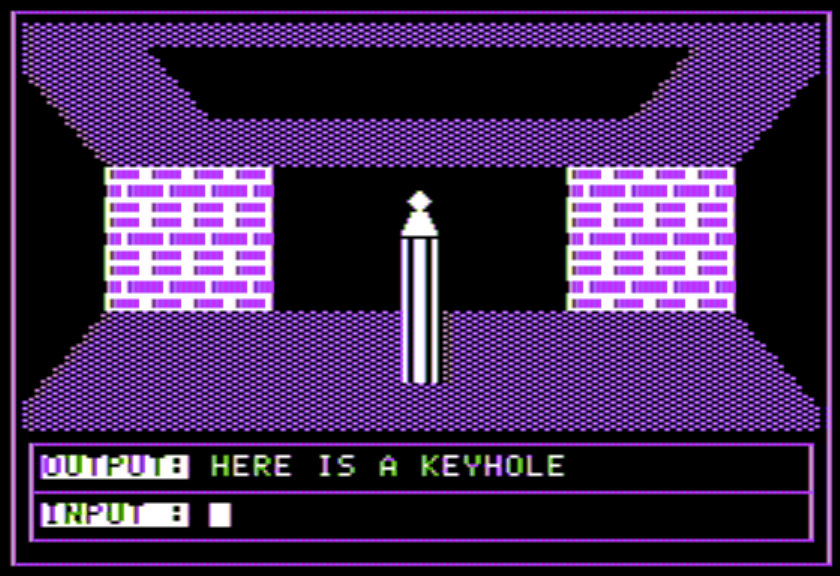

With keyhole in hand I could return to the Caretaker. The same phrase as in the previous game (THE ISLAND IS A COMPUTER GAME) worked, and it gives a setup that will let you “unplug the computer”.


The game references a Master of the Caretaker; here, it implies You were the master all along. This mirrors a bit in the slightly nonsensical troll ending of the original show The Prisoner, where Number 6 finally unmasks Number 1 and finds himself.

In the show, there’s a big goofy shootout and they drive to London and … people were upset. It was meant to be provocative. According to the creator Patrick McGoohan who was happy with the reception: “as long as people feel something, that’s the great thing, it’s when they’re walking around not thinking, not feeling, that’s tough, that’s where all the dangerous stuff is, cause when you get a mob like that, you can turn them in to the sort of gang that Hitler had.”
The Prisoner game ending makes slightly more sense; The Master is yourself, in that The Master really is yourself, you are the one choosing to play this computer game, you are the one that chooses to keep going even when given literally random words in Hangman, and plenty of encounters that make no progress.


This whole questline is in: where you can get cloned at the diner (by requesting you want ESCAPE rather than anything off the menu), but then you need to pay 10000, which you get via a loan from the bank, which you can get via the items mentioned above. All three take serious work to get. When you finally get yourself cloned a pirate ship appears and kills your clone with a cannonball (seriously!) and you get sent back to the Castle. No progress is made.
Unfortunately, trying to convey the lesson in interactive form — making the player suffer pain to teach about pain — is, again, better to read about than actually try. I’d say the original is superior not because the jank somehow provides some noble reinforcement, but rather, here, there were not only one but two old school mazes. The mapping time taught nothing new and fell into cliché rather than out of it; the adventure references didn’t really imply anything other than the author having a laugh.
But at least it was trying to say something; while I’ve managed to derive interest out of most of games we’ve looked at here, that’s only by contextualization as cultural artifacts (or at least object lessons in game design) rather than as self-contained art.
Still craving more slightly off-kilter Mullich antics? Take a trip over to the CRPG Addict and Mullich’s other Edu-Ware games from this time period:
Empire II: Interstellar Sharks (with a follow-up post)
The graphics share some commonalities with Prisoner 2, like doors with identical placement to the Prisoner 2 mazes and a “casino” that looks very similar.


 Renga in Blue
Thanks Jason as always for the playthrough, thoughtful analysis, and helping me to come to terms with long unresolved mysteries from my childhood.
The design document I linked is 100% comprehensive if you’re wondering anything else. (It really is “here is exactly what gets implemented where”, there’s no vagueness or mystery about it.)
It is fascinating. I’m reading through it now. I wonder, since “Mary” is its own word type as far as the parser, and “had a little lamb” do not seem to be recognized as valid commands, could you have just typed “Mary” to complete the brotherhood test?
I tried just MARY and it didn’t work.
Thank you for Let’s Playing this and satisfying my curiosity on how it differs from the first Prisoner! I think I agree that the first one is likely stronger (but then, it’s one of my top 5 all-time favorite games.) In particular, the upgrade to color graphics from brutally stark black and white is a downgrade of aesthetics for what this game is going for, and the apparent lack of the city-builder section is a massive blow. Still cool if you’re into “making the player suffer pain to teach about pain”, though!
the city builder is in!
you need to type # at the town hall, something I did not know until after I was done with everything.
That activates letting you take over. The design document gives details.
I remember almost all those missions now, so I know we got that far. But I don’t remember the ultimate ending you got, so I don’t think we finished! Maybe we hit something ambiguous and weren’t sure? Or maybe that’s when I left for college :-)
I’m surprised you didn’t complain about the game slowly printing out prompts one letter at a time, with annoying beeps. Fortunately there’s an in-game way to turn that off, and I thought it was in the switch house.
Oh yeah, that’s an emulator speed thing — I just cranked it. I think at IIe speeds (which is what I was doing) it wasn’t too bad, but on a 1982 machine it’s definitely too slow.