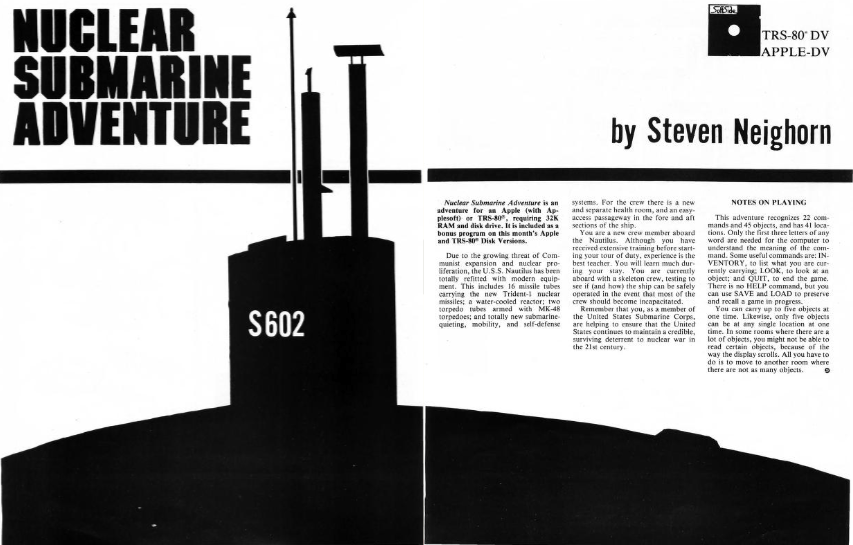
Due to the growing threat of Communist expansion and nuclear proliferation, the U.S.S. Nautilus has been totally refitted with modern equipment. This includes 16 missile tubes carrying the new Trident-1 nuclear missiles; a water-cooled reactor; two torpedo tubes armed with MK-48 torpedoes; and totally new submarine-quieting, mobility, and self-defense systems. For the crew there is a new and separate health room, and an easy access passageway in the fore and aft sections of the ship.
You are a new crew member aboard the Nautilus. Although you have received extensive training before starting your tour of duty, experience is the best teacher. You will learn much during your stay. You are currently aboard with a skeleton crew, testing to see if (and how) the ship can be safely operated in the event that most of the crew should become incapacitated.
Remember that you, as a member of the United States Submarine Corps, are helping to ensure that the United States continues to maintain a credible, surviving deterrent to nuclear war in the 21st century.
Steven Neighorn has graced this blog once before, with the game Crime Adventure. Specifically, at the age of 15, he made some kind of deal with Neil Bradley (aged 12) to get a game of Neil’s into Softside magazine; it made the October Game of the Month.
I have a little more information about that now. I found the previously missing Apple II source code, and that has Neighorn’s name (and only his name) in the comments. From the very last line:
2220 REM STEVEN C. NEIGHORN, A270, 8/3/81
So the sequence seems to be:
1. Neil Bradley wrote the game.
2. Steven Neighorn added his name to the credits (and probably did some editing…? I’d love his perspective) and sent it to Softside.
3. Peter Kirsch made TRS-80 and Atari ports, both which scrubbed the mention of Neighorn.
Neighorn did write other adventure games, including today’s, and I do think this one is almost certainly his (unless Neighorn somehow found an entirely different 12-year-old writing Apple II adventure games to take credit from). We are talking about a young teenager so I don’t think the debacle above is worth fussing over. Also, despite a couple awkward moments, this ended up being a much smoother game than Crime Adventure.
While this is a Softside game, this isn’t a type-in nor was it an Adventure of the Month. It had only TRS-80 and Apple II ports (no Atari).
This was a disk-version-only game. Softside came with a disk version for those who didn’t want to do all that typing, and sometimes they included extra games on the disk not printed in the paper.
I tried both but I was getting better vibes with the Apple, and based on Crime Adventure leaving credit on the Apple II version I’m guessing the original platform was Apple anyway.
(Assuming you are reading with something that sees YouTube embeds, I dropped a video link above for another “soundtrack to listen to while reading”, although it is more dramatic than this game needs.)
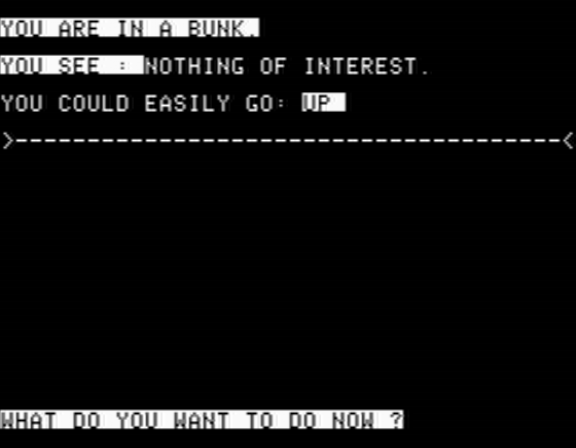
Things start relatively peaceful. The sub is at depth 0. A couple turns in (or right away, on TRS-80), disaster strikes.
You face several crisises:
a.) the electrical backup generator is damaged and will eventually shut down
b.) the nuclear power will eventually go critical
c.) the crew is all unconscious
d.) your ship is in the depths and needs to surface
e.) you’re hungry and short on food
The last one feels like silly adventure-dom, the other four come off as decent in a plot-integration sense even though they’re applying multiple timers. This game manages to mostly feel like objects are placed where objects ought to logically be placed, even though this is clearly a simplified little-to-no-research layout of a nuclear submarine.
Still, a submarine makes for a compact adventure map where it is completely realistic to have movement constrained. (See Nuclear Sub from 1980.)
I have this drawn as if the sub is facing the “east side” of the map, so right is “fore”, left is “aft”, down is “starboard”, up is “port”.
Exploring, the aft portion of the ship has an engine room with a broken drive train, next to a room with a generator.
There’s otherwise a hatch that just refuses to open for no specific reason, a bulkhead you’re not strong enough to open, and another bulkhead with a clear warning label sign that specifies how you will die if you try to open the thing and walk in:
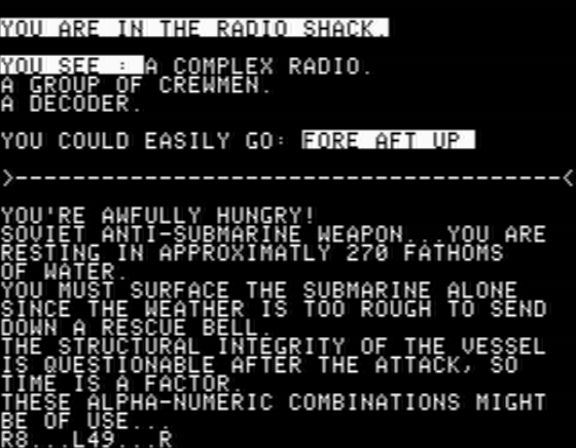
The middle part of the ship has controls: a “missile compartment”, a periscope room, a “main control room”, a “radio shack”, and an “access hatch” that requires the ship to be surfaced to be able to open. The radio shack has a broken radio, although it takes some effort to fix. The control room is the important part for the very start of the game:
This stops the meltdown.
The front part of the ship has a weight-training area…
This lets you open the bulkhead where you need to be strong back at the aft end of the ship. To save time, I’ll mention that bulkhead has a radio repair manual.
…some lockers that need keys (white and blue), a safe, a wrench (which you’ll need shortly), a stuck bulkhead, a bunk with a “decoder”, and some unconscious crew.
For the unconscious crew, there’s fortunately some smelling salts nearby that will get them active and following you. Then you’ll have what is presumably a large group of people following you through the rest of the game.
Once you have the crew woken up, you can open the bulkhead at the front of the ship and get a radio repair kit. This, combined with the repair manual, lets you fix the radio. Then as long as you PUT DECODER / RADIO you’ll get a message:
This is sending you code for a safe. Also this is before I worked out how to deal with hunger and I died a few turns later.
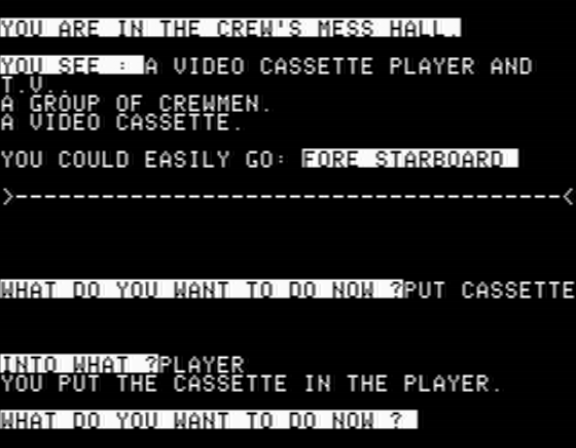
The safe has a tape recorder, and there’s a video player nearby that I had a _very_ hard time operating.
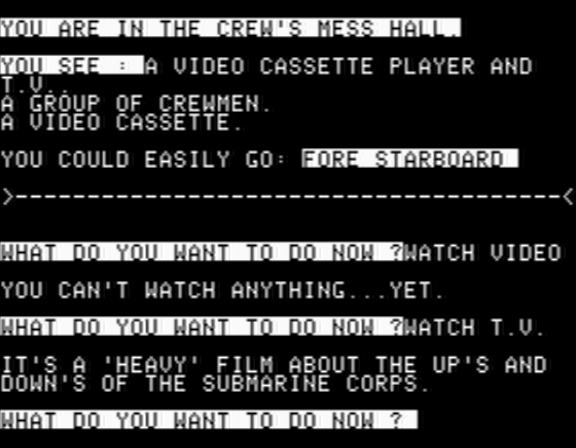
I tried lots of combinations of PUSH PLAY or START PLAYER or WATCH TV with no luck, and made a big list in the meantime to make sure I didn’t miss a verb. Instead I missed the game wanted the period marks with the television.
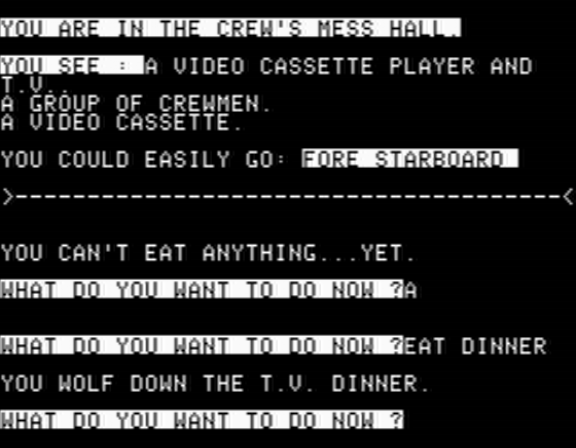
The room with the video player also is related to another difficulty: the hunger. There’s a “stores room” with a “frozen tv dinner” that you can cook in a stove; I got that far. But the game kept saying I couldn’t EAT it. That’s because eating it only works in the mess hall, even if you’re starving.
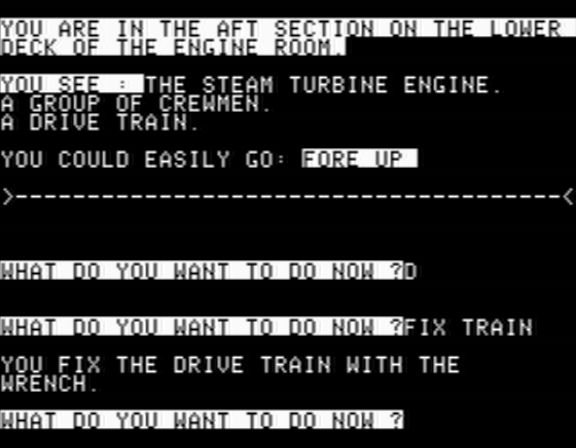
My next issue I resolved was power. This was just a matter of carting the wrench back to the broken drive train and saying FIX train. I was also able to use the wrench on the hatch (where the game didn’t give you any reason why the hatch was stuck) and find a white key.
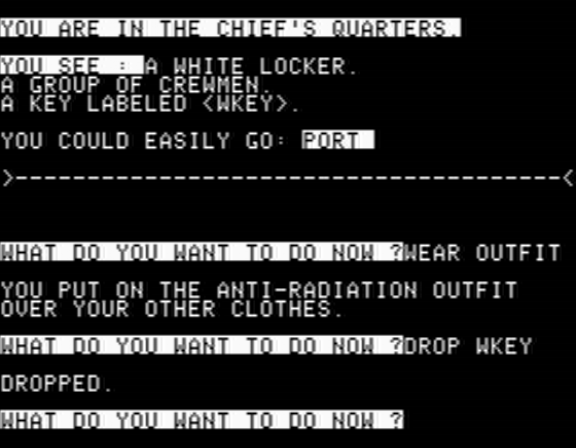
White key in hand, I found the corresponding white locker and got a radiation suit.
This let me plunge into the radioactive area (fortunately the crew does not follow) where … I found a blue key.
Yes, that could be more dramatic. The blue key let me get at a captain’s outfit, and then I was stuck.
I had all the problems solved except for surfacing the sub. I had messed with “ballast control” in order to swap from “dive” to “surface”, and I had a “remote microphone” to give commands, and I (it turns out correctly) had a guess I needed to captain’s uniform on to give the command and have it be accepted.
All attempts at saying “UP” or “SURFACE” failed. I could try “FIRE” and the game asked me what I wanted to fire (there’s missiles and torpedoes) but it told me I couldn’t use them yet.
I finally checked a walkthrough to realize I had to be standing in the right place to give the command, even though the microphone is described as giving commands remotely.
This lets you open one last rescue hatch and find rescue boats coming to find you.
What happened to the Soviets? I was expecting a dramatic firefight in the climax. Maybe the author planned one but couldn’t pull it off.
So I suppose that sounded underwhelming as described, but the meltdown and power issues hung over most of the game for me, so there was an implicit drama in each step — trying to rush to find the solution in time — that was provided even by something as mundane as discovering a TV dinner. And while I realize our author was likely the just the editor of Crime Adventure, this game satisfyingly didn’t have anything as weird as a secret golf course in the back yard of someone who got kidnapped, where you need to hit a ball in the hole in order to discover the secret room where they’re held.
More improvement could still be used. The nuclear reactor scene ended being potentially the least dramatic ever across all media, and while having weapons that don’t get used is theoretically fine, I was expecting a missile malfunction where it was threatening to launch and destroy the eastern seaboard or some deft-maneuvering scene where I had to outrun a Soviet convoy. Or a shootout with a spy aboard where Sean Connery tells me “be careful what you shoot at in here”.
I wouldn’t have been disappointed to get the game tossed on my January 1982 subscription disk, though.
In the 1970s and 1980s, with each new computer system that arrived — the ones that because semi-popular, anyway — there came a blizzard of new books. Because computers were closer to the metal, a lot of these were lists of programs (typically in BASIC) although there were also programming tutorials in BASIC as well.
A sub-genre of the BASIC programming book was the one specifically for programming adventures.
From 1984, 1984, and 1985.
While there’s a little discussion of making your own game in the Captain 80 Book of Basic Adventures, that book still served mostly as a vehicle to print existing adventures. Writing BASIC Adventure Programs for the TRS-80 by Frank DaCosta is the earliest book I’ve found to be solely devoted to learning how to program adventure games.
Frank DaCosta’s first book was How to Build Your Own Robot Pet from 1979, and it honestly has an impressive goal, as the book includes: “full details on building a navigation system (Soniscan), a hearing method (Excom), a way of talking (Audigen), and an understandable language and grammar (Fredian).” You can see at this blog someone’s attempt to make the robot described from the book, which took 3 years while mostly using authentic 1979 parts.
From Ezra’s Robots, which contains much more detail about the process.
The same book has an autobiographical blurb:
A Trinity Divinity School graduate, he lives in Hollywood, FL. with wife Cheryl.
The blurb from the adventure book just describes DaCosta as a “computer hobbyist” so it seems that he was working as a pastor and doing robots and computers on the side. He still is a pastor in Texas and you can see some pictures at his blog where he writes about training pastors in Rwanda.
What I’m unsure the author is even aware of (although I have sent a message) is that the book, while only being a minor influence in the United States where it was originally published, was a major influence in a different country, nearly the starting point for all text adventure games in a particular language.
I’ll return to that story later. For now, let’s discuss the book itself. It contains two games, Basements and Beasties and Mazies and Crazies. The latter is a top down ASCII action-adventure, sort of like Kingdom of Kroz or The Thor Trilogy. Hence I will not be playing it here, but here’s a video in case you’re curious:
Basements and Beasties is instead a traditional text adventure, and the way the book is structured is to give the code piece-by-piece in a way that makes “beta versions” of the game playable as it works up to a full listing.
For example, the book starts with the map, and a “table of directions” that most adventure game designs used…
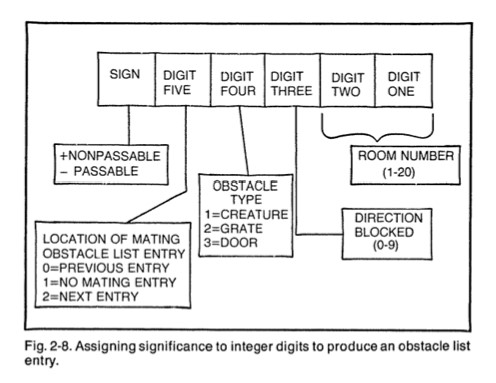
…and a relatively elaborate system for placing “obstacles”.
This section also claims “An adventure program is hardly complete without a maze.” Well, it was the 80s. (Honestly it is a little bewildering. One of my old projects from ’87 or so I didn’t keep — I was very, very, young — I included something like five or six mazes. It was just the thing to do!)
The first chunk gets summarized at the end of chapter 2:
1. A scenario is made up of rooms.
– You need a room list of short room names.
– You need a long description for each room.
– You need a room status array to indicate if a room is unvisited.
– You need a scenario map of room interrelations.
– You need a travel table defining entrances and exits.
2. A scenario is made complex by obstacles.
– You need living obstacles such as creatures.
– You need inanimate obstacles such as locked doors.
– You need an obstacle list defining the obstructions.
3. A scenario is occupied by objects.
– You need treasures, tools, and creatures.
– You need an object list of short object names.
– You need a long description of each object.
– You need an object status array to locate the objects.
With all the basic concepts defined, the book then starts writing actual code down.
Commands are added pieces by piece (motion, doors/items, combat, metacommands like SAVE) until a full source listing in chapter 9.
If you download the game from a site, like the version I have here at Github, it will be a reproduction of chapter 9. No typos I can find! This doesn’t sound bad, but–
The author isn’t done yet. He’s trying to follow the whole process of software production, and there’s still chapter 10, “improving the program”, full of optimization that do not make it into that source code. As is, doing one move takes about 11 seconds at authentic speeds (by comparison, Arctic Adventure from the Captain 80 book takes about 1.5 seconds).
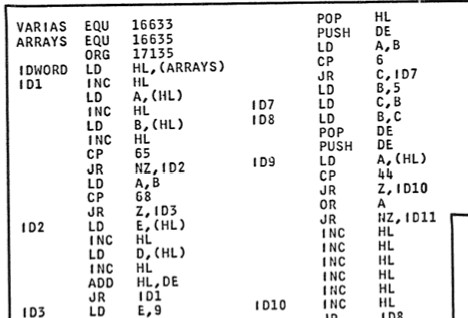
For example (as pointed out in chapter 10), when entering input, the game checks every word entered against every word listed in the word table, which is extremely slow, meaning if you feel inclined to swear at the game (perhaps inspired by French Colditz) you have to wait an agonizingly long time before the game tells you it doesn’t understand. As an alternative, the book provides actual machine code.
That … might be overkill? To compare to Arctic Adventure again, that game is solely in BASIC yet runs about 10 times as fast. The problem with Beasties seems to be that the game is not loading all its data into memory at once. That is, it makes a series of DATA lines containing verb names, object names, and so forth, and dynamically has the game pick which line of DATA to read (making convoluted use of the POKE and PEEK, commands long gone after the fall of 80s BASIC) as opposed to just having all the data get front-loaded into an array right at the start of the game. Look at one of the early lines of Arctic:
40 O = 41 : FOR A = 1 TO O : READ O$(A,1), O$(A,2), O$(A,3) : NEXT
This goes through lines written later in this format
1190 DATA Cave, 4, , Down, , , Ice brick, 0, , Trading post, 10, , Eskimo home, 10, , Eskimo, 12, , Cabinets full of supplies, 12, , Sign, 12, “The sign reads: We trade treasures for supplies.”, Polar bear, 11, , Flare gun, 11,
storing three aspects: the location, the object name, and potentially the object description. Every single object is read once and only once, then stored in the array O$ and only accessed in O$ from there on. Beasties, rather than storing all the information in an array, repeats reading DATA every time it gets used. DaCosta’s method is in a way much more clever but it has negative impact on the gameplay. On TRS-80 even on a max speed emulator a delay is noticeable enough to be painful.
I still gave it a serious try. Here’s a preview of what’s going to happen a lot during the game.
I ended up switching over to the port by Jim Gerrie for TRS MC-10 instead.
Fine, other than the command speed, how does the game play?
Well, it’s a little bit of the “slot machine” style. There’s not really any puzzles, unless you count finding a key and unlocking a door.
The point is simply to collect treasures and drop them in the starting room while also killing various monsters that appear. The problem is that the way combat works is:
a.) sometimes when you enter a room with a monster, you get killed outright
b.) if you don’t get killed outright, you use KILL MONSTER and may or may not hit
c.) if you miss, then the monster has a chance to kill you
On top of all that, there’s a wandering orc that can kill you in any room at any time, and he doesn’t seem to stay dead after you kill him.
I was not able to kill the spider with my axe but had to use a nearby “enchanted grenade” instead.
Once dying you have all your items drop where you died and you get sent back to the start (so you can rescue your items like an old school RPG). If you’ve unlocked any doors or deposited any treasures they stay, so getting to the end of the game is a matter of persistence and grumbling every time an orc appears and arbitrarily kills you again.
I don’t think we’ve had a Coke cameo since Crystal Cave.
There’s also no “ending screen”, you can just check your score and watch it go up, and there’s no acknowledgement if it is at maximum or not.
It’s not worth fussing that much over the gameplay, because this is a tutorial-programming game, like Planet Pincus; the simplicity is the point. While I haven’t seen evidence the book had influence in the US (it looks like nobody bothered to upgrade the parser and there were other sources by 1982 of text adventure templates to use) it apparently hit big in Hungary.
There were three Hungarian-language text adventures in 1985, but where the penchant for writing adventures really started in Hungary (according to the Rosetta Interactive Fiction blog) was 1986 with the publication of F. Dacosta’s book A kalandprogram írásának rejtelmei. (What “F.” stood for was a source of speculation for Hungarians.)
I am still unclear how the book ended up making it over the Iron Curtain, but (according to the aforementioned blog) its appearance coincided with a “népmozgalommá” (people’s movement) in creating adventure games.
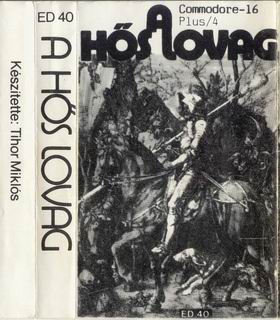
Some early Hungarian games directly used English sentence structure, which comes off as completely wrong in Hungarian. From the instructions for A hős lovag, one of Hungary’s first commercial games, it explains the player should type not EAT THE BREAD but (the Hungarian equivalent of) HE EAT BREAD. This is a format only used for people learning the language; the computer should be treated as if it, too, was a language learner. The instructions opine that perhaps in time the computer will recognize suffixes and learn to speak correct Hungarian.
So, returning to the moment of busting open a padlock, which crashed the game last time, I somehow didn’t notice there was also a passage to the east that opened.
However, I ignored that in favor of being able to take the lamp, which I wasn’t able to get last time. If you turn on the lamp and walk by the large gate at the exit with the guard, the guard spots you in the night.
So you want to wait until passing the guard safely into a corridor, where previously nothing was visible, but if you turn on the lamp, you see a previously missed door.
“Trap door” suggests this goes up, but once you cut the chains (the cutting pliers from the truck work) the exit that opens up is north.
Heading north, you can then find a small paper with a combination on it. This is the combination that works back on the safe (the one that previously sounded an alarm). Opening the safe yields a master key.
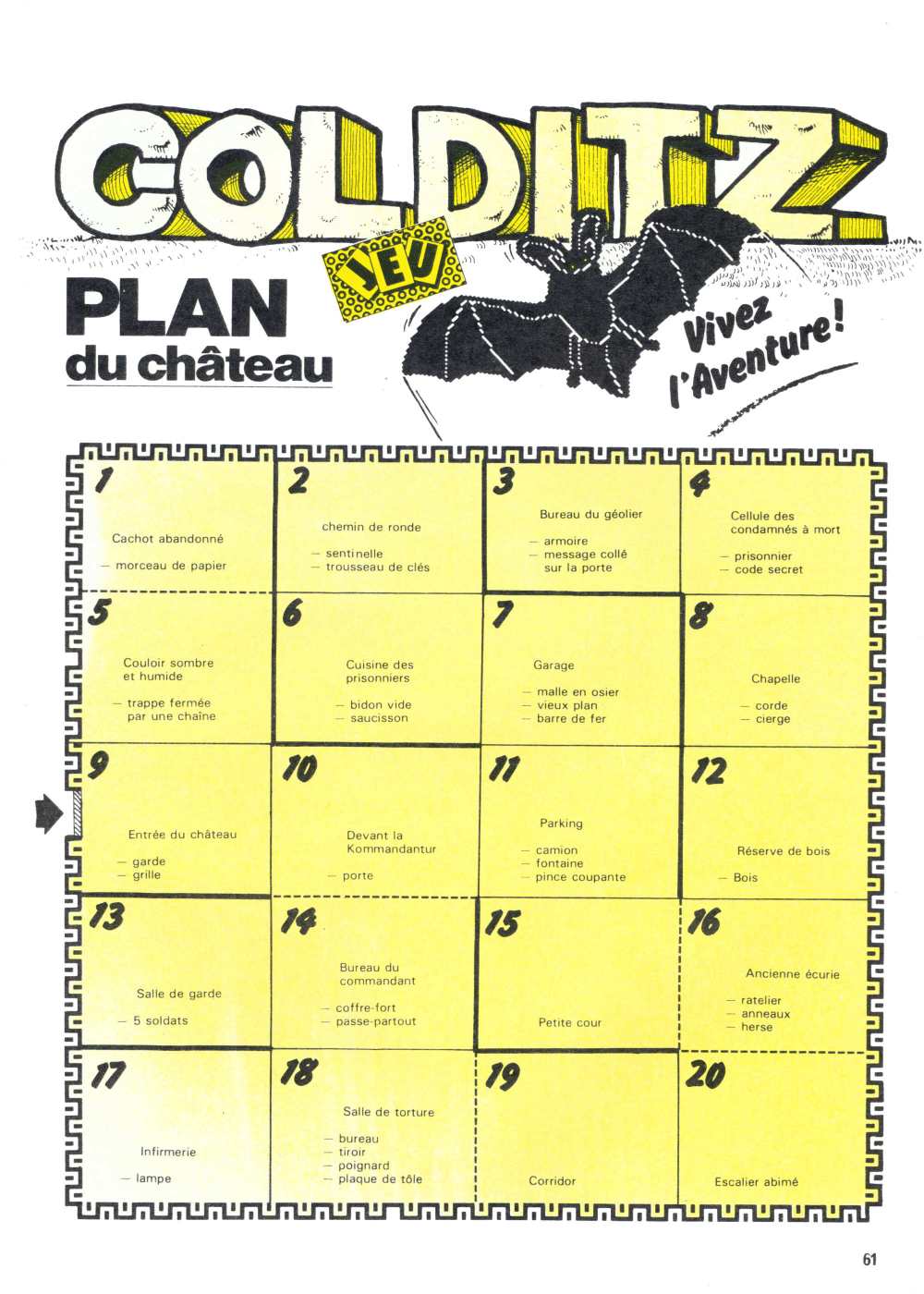
The entire map. Light blue are the rooms I hadn’t seen last time.
This was the end of the road for the moment. It turns out I needed to do one more thing and I could technically escape, but I hadn’t fulfilled the quest yet anyway, which was still to find the prisoner who had the code to blow up the rockets.
Now it was time to go in the new eastern route, the one unlocked by breaking the padlock…
…and die by falling in the dark on a staircase, oops! (“You had a deadly fall on the dark staircase.”) The lamp needed to be on, allowing visiting the final section of the game, an area of 5 rooms.
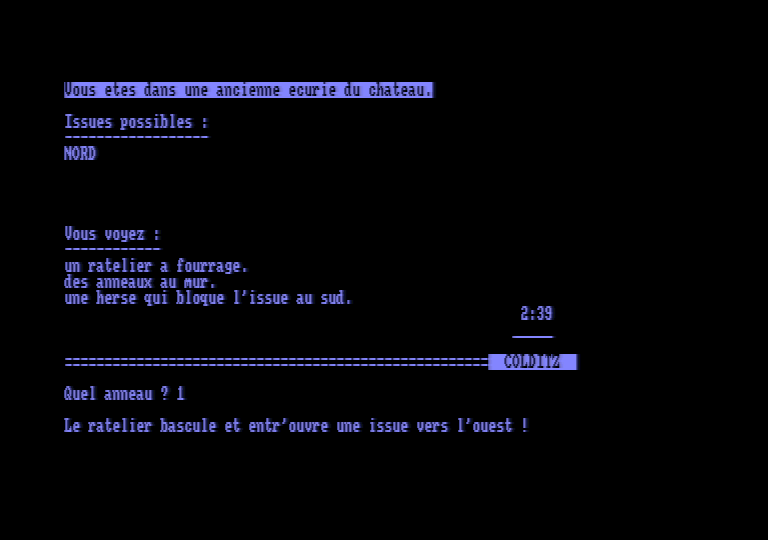
Stables just north of the staircase. There’s some rings attached to the wall, a portcullis blocking on our way back south, and a …trough, I think?
The small area has a room with some wood (not useful) a church with a candle and a rope (really not useful, especially the rope which rings a bell alerting guards), an office (useful, there’s a message about RING 1)…
…and the prisoner. The prisoner is thirsty. You can use the can from the start area and fill it with water in the fountain to take care of the thirst. (You’re not softlocked if you haven’t done this before entering the trapped area, since you can get out via means I’ll show in a moment.)
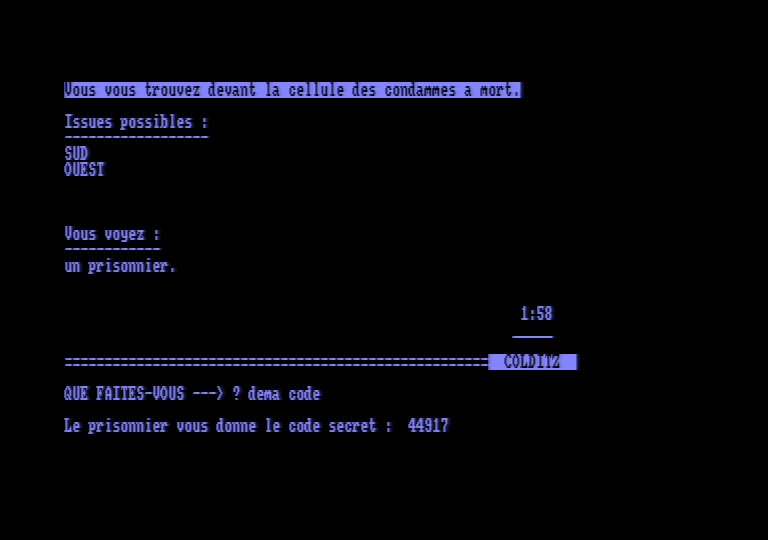
The prisoner — O’Donnel from the intro — says he knows “le code secret”. I had demander as a verb, so the next step was:
Blithely blowing past thinking about which article I should use in the French.
Now we just need to get out! The hint about the ring gets applied back in the stable, where you can turn the correct ring. (I think this is randomly generated, by the way, on each new game.) This opens a secret passage back to the Inner Courtyard.
Escape now requires getting past the guard at the gate. Frustratingly, the “bonk with an iron bar” trick doesn’t work again. The game is unclear why one guard differs from the other in this respect.
I got very stuck and had to check the walkthrough. It turns out I missed, back where there was a “bureau metallique”, the proper way to open it. It isn’t done by referring to the object, but by referring to a drawer. While I’ve seen this before even in English for me this is kind of tough, you’re referring to a noun that is essentially implied by the text.
This reveals a dagger that can be used to murder the front gate guard. (If you “kill” the earlier guard, the game talks about you being silly and nonsense; if you “knock out” the other guard, the game also talks about you being silly and nonsense. The parser needed some lighter messages for turning down actions.)
With the guard dead you can bust your way out of the gate (using the master key) to freedom.
You have done proud service to the Allies obtaining the secret code of the Luftwaffe. You will be decorated upon return to London. Congratulations!
With the exception of the drawer issue and the guard inconsistency, this was genuinely a straightforward game, one that I’d more or less put at par at the Scott/Alexis Adams game Pirate Adventure in terms of difficulty. It’s dark, turn on a lamp. The guard spots you with the lamp on, turn it off. A safe combination goes to a safe a few rooms away; a secret passage opens following a message in the same area. I’m genuinely curious about the reaction of the people the author tested the game on. I think, really, it’s a matter of this being the only French text adventure at the time other than Bilingual Adventure. There just wasn’t enough example set for how to present this sort of thing, and the sheer conceptual load of needing to cut, take, turn on, turn off, read, etc. has always needed a bit of nurturing.
The parser is impressive but wobbly. It’s fine to not understand something the player types, but it needs to be transparent to them what happened; it is easy to get thrown for a loop by doing something that seems normal (opening a desk, as opposed to referring to the drawer) and then get blown off by the parser with a response like “Vous trouvez ca drole?” (“do you think this is funny?”)
Still, the parser managed quite well given there wasn’t really precedent in the language, but unfortunately the audience reaction caused the author to stop writing adventure games. This is his only one.
From CPC Magazine.
One more note, just to maybe brighten (?) things up. For some reason French games allow swearing as a very standard mechanic. Colditz starts this grand tradition early.
A bunch of things have hit all at once, so I’ll just toss some items here:
Parsercomp 2023 is live! This is a competition intended for “traditional parser” games, where you type GET LAMP and all that. There’s a Classic category (11 games) and a Freestyle (5 games) where I believe the latter is intended to stretch the definition of “parser”. As of this writing there’s 8 days left to put ratings. If you just want to read about the games, Carl Muckenhoupt has been writing reviews at his blog, starting here.
Stuart Lloyd has a new gamebook here titled The Ravages of Hate, a “fan game” spin-off of The Coils of Hate. From the intro:
I remember the time I was first introduced to The Coils of Hate – one of my friends at primary school gave it to me thinking I would like it. He was right. It is a gamebook after all. I also remember the character I played – I picked Swordplay, Spells, Charms and Cunning, wanting to be both a warrior and a wizard in one. I wanted it all. However, the book took me ages to crack, but eventually I did. After a while, I forgot about it and went on to read other gamebooks.
However, 20 years on, when people started writing about gamebooks on the internet, I found out and rediscovered a great deal about The Coils of Hate. People wrote scathing reviews of it, citing its illogical choices, its numerous sudden deaths and its errors. This may have been true, but upon rereading it, I found a great deal of depth not found in almost all other gamebooks. First of all, there is a message of tolerance. The plight of the Judain was far too subtle a parallel for real life persecution to a 10 year old me, but I quickly found out about it and I realised that Mark Smith was trying to accomplish a lot in what at first glance is a book about killing a giant monster.
How far would you go to make a billionaire’s dreams come true? Find the unfindable and do the impossible? It’s all in a day’s work for an employee of Platinum Concierge.
Elite Status: Platinum Concierge is a 500,000-word interactive contemporary drama by Emily Short, with additional content by Hannah Powell-Smith, where your choices control the story. It’s entirely text-based—without graphics or sound effects—and fueled by the vast, unstoppable power of your imagination.
Charter a helicopter on fifteen minutes’ notice to bypass LA rush-hour traffic? Transport a priceless emerald-and-diamond necklace across three continents? Arrange a candlelit dinner in a cave with waiters rappelling down the walls? No problem at all. You have your pulse on every brand, trend, and connection of the still-new 21st century.
And she led the team but I still think it counts as an Emily Short game: Mask of the Rose, a Fallen London dating sin spinoff, launched on Steam.
Aaron Reed has a new article, for those who couldn’t get enough of the 50 Years of Text Games series, this time on the ultra-obscure “book game” The Antagonists from 1985.
A missing submersible, a group of rich adventurers who vanished on the way to the wreck of the RMS Lusitania and, on top of it all, the Interim CEO of OceanThrill (owner and operator of the missing Kepler 1 sub) murdered at his own private beachfront … you follow in the footsteps of a weary yet witty detective and his adorably mouthy female partner as they uncover a deep web of lies, intrigue and subversion.
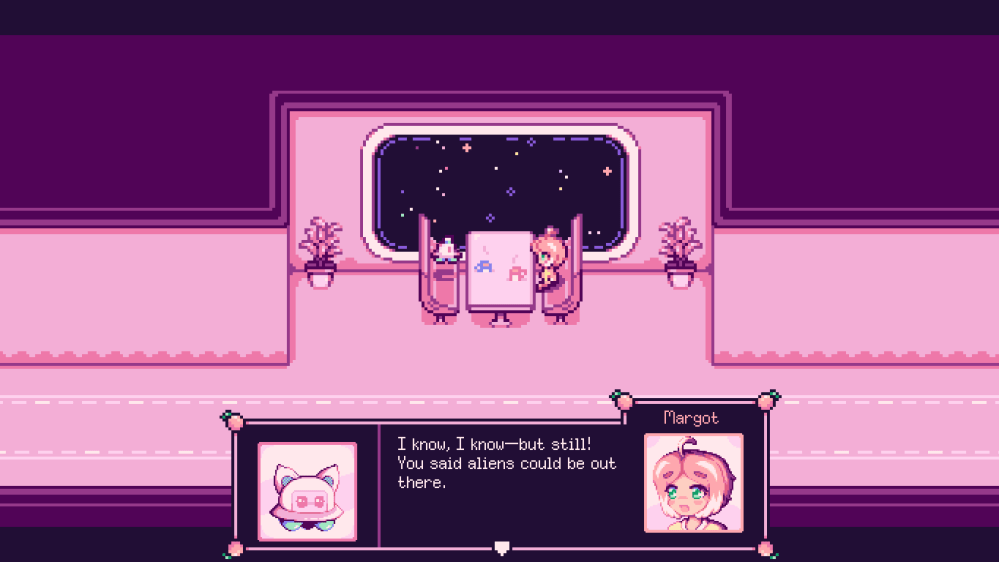
And finally, if you just want to relax a bit with a slice of life, just yesterday the author Clover just released the game Peaches Interplanetary, where you can name your own price.
Margot’s dream is to roam the stars, providing peaches to all. For, even on the harshest of moons, everyone deserves a fresh peach! But, is she ready? And more importantly: are the peaches?
(Also, I have a working version of Colditz now. New post likely tomorrow.)
This game was printed as a type-in, twice. The Amstrad version was in CPC Magazine, starting from page 53.
As we’ve seen before with type-ins (I think most significantly from Spelunker out of Byte magazine) the actual version that gets passed on to various archives had to be typed in by someone first, and that means there might be a typo that carries on, especially if the person doing the typing never really played through the game in question.
I don’t think the person who typed in Colditz on the Amstrad played the game.
Via CPC Magazine, number 7.
(Also, before proceeding on further, special thanks to everyone who helped me through French difficulties. Unfortunately working through the language still doesn’t help with coding difficulties!)
Last time I left off on a sentry with some keys that I need to abscord with. I had already tried to “kill” the sentry with no luck, and “coup” (which in some circumstances be “hit”) didn’t work, but I hadn’t tried to mystery verb ASSO.
The entire list tended to the infinitive tense, so having sit which would normally be s’asseoir seemed to violate the rule but I couldn’t come up with a better verb than that. Still, I considered the verb to still be in the mystery zone, so I went ahead and tried it on the sentry and it worked.
ASSO turns out to be ASSOMMER (knock out). After you say you want to knock out the sentry it asks you what with, and you specify the “barre” (or “barre de fer” if you want the full “bar of iron”).
I was then able to nab the keys and run over to the locked door. This opened an area with four new rooms.
The first room has a safe, which asks for a combination if you try to open it. If you fail at the opening an alarm sounds. I don’t know the combination yet.
To the west there’s some guards who capture you. Probably this room should just be avoided.
To the south there’s a torture room, with a desk and a metal plate locked with a padlock. Here is where things went wrong, because I tried to break (casser) the padlock, and the game asked me with what, and I gave the iron bar again, and then:
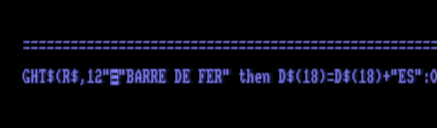
I had to dig out the source code.
A quote mark symbol was supposed to be a parentheses (see above), so I was able to fix it. It could be a file corruption rather than a typo, but spotting one made me nervous about more. As it turns out, rightfully so, because the next room — an infirmary — had a broken lamp. Broken as in the game’s code, not the item itself.
No matter what I did, I could not refer to the lamp. Normally, I’d just pick it up, but the game claimed I couldn’t, and I was baffled enough I decided to peek at the walkthrough. Fortunately I didn’t spoil myself on anything, other than realize that if you try to follow the steps of the walkthrough, you are completely unable to pick up the lamp.
There must be another typo! Possibly more. I’m not sure if I really want to keep trucking with the Amstrad version, but I have been unable to download the Oric one (the site has some sort of security thing that doesn’t let me? or broken Javascript or something?) I may end up just having to blow any secrets and check the code line by line, but this admittedly follows the authentic type-in experience, where any players circa 1985 had to spoil themselves on the adventure by typing it in.
After World War II ended, Germany was split into four “occupation zones”, with Russia in the northeast, the UK in the northwest, France in the southwest, and the US in the southeast. The US, British, and French sections made up West Germany; the Russian section was East Germany.
This arrangement meant French military forces were stationed in Germany, which is important for our story.
From Micro Systèmes Number 5, May/June 1979. Other than these three computers the TRS-80 was the main personal computer in France circa 1979. The Proteus III is a wildly obscure local system that was text-only and ran on a Motorola 6800.
(Before going on, I’ll preface that most of what follows comes from Hugo Labrande, who has extensive research on early French text adventures as well as interviews here, here and here.)
The author of today’s game, Marcel Le Jeune, got his start with electronics with a Texas Instruments calculator in the early 70s; his first computer was a PDP-8 he encountered while at French military school. He then went on as an electronic warfare specialist, being stationed in Germany from 1977 to 1982.
He had access there to American military bases and their duty-free shops, and thus was able to be a very early owner of a TRS-80 as well as get exposure to US magazines and software. He most particularly remembers the adventure game Pyramid of Doom, although it wasn’t necessarily officially obtained, as he had a Parisian friend who kept him supplied in tape copies sent by mail.
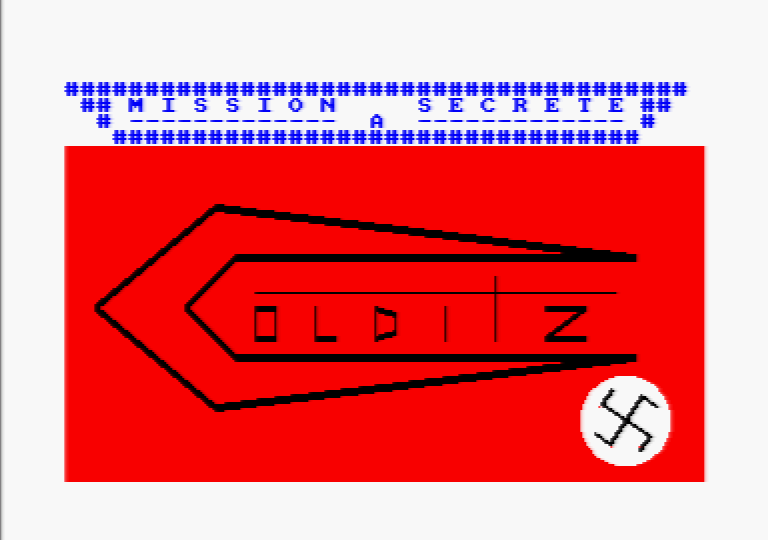
His early exposure to adventure games is likely what led him to be one of the first people from France to create an adventure game; in fact, since Bilingual Adventure was just a modified port of Crowther/Woods, we can say Mission secrète à Colditz is the first original adventure game in French. (That we know of. Making a statement like this invites being outdated in six months when something new comes up.)
While he wrote it in the 1979-1980 period (according to his memory) it wasn’t published, but rather sent to friends and demonstrated to both friends and family. Viewers were amazed at the flexibility of the parser (it’s a bit of a sneak, more on that in a moment) but Marcel was generally frustrated at the reception as people were stumped, and when he tried to help, the response was
Je n’aurais jamais pensé à faire ça!
that is, “I would never have thought of doing that!”
Much later — after returning to France — he became editor of the magazine CPC, dedicated to the Amstrad, and had Stéphane Cloirec port the source code directly from the TRS-80. There was also a version published in the pages of an Oric magazine. The TRS-80 source is lost so I went with the Amstrad version to play.
Now, since my French is terrible, I gave myself a little more advantage than I usually do straight from the beginning: I extracted the verb list. All of the verbs only have the first four letters, so I made my best guess as to what verbs match.
(I works for Inventory and there’s also direction abbreviations. Feel free to point out any alternatives or outright mistakes, I’ve already made some edits based on comments.)
I mentioned some subterfuge in the parser. The game only looks at the first four characters for the verb and the end portion for the noun. That means there can be sentences and phrasings in the middle which are entirely ignored. Hugo Labrande also points out a finesse to account for the fact that in French, writing an adjective after the noun is normal: the game hand-checks nouns and possible noun-adjective pairs together in order to parse things correctly.
IF RIGHT$(R$,5)=”PINCE”OR RIGHT$(R$,14)=”PINCE COUPANTE”
Still unsure on the parser, I checked the first line (and only the first line) of a walkthrough, and it said
Ouvrir la porte du camion
that is, open the door of the truck, but OUVR CAMION works just as well. The practical upshot is the parser can ignore articles someone would normally use (parsing “prendre la lampe” ignores “la”). From what I gather (although I would appreciate a native speaker’s perspective) leaving out the “la” in “la lampe” feels much odder than leaving out “THE” when typing GET LAMP. So this keeps the coding simplicity of what is more-or-less a two word parser while accommodating the change in language.
However, notice the sample includes “la porte” (the door) which is totally unnecessary. I’m wondering if part of the issue with sampling the game for friends was that the author was “showing off” too much; having too many ways to communicate can make it difficult to teach how to play a regular text adventure.
The upshot of all this is I can just type VERB NOUN for commands and ignore everything else.
The game’s premise:
In 1943, we have been summoned to London about a secret mission; one of “our best agents”, Captain Jim O’Donnel, had been on a parachute mission to obtain secret codes allowing V2 rockets to be destroyed in-flight. While he was able to get the code he wasn’t able to send it, and has been locked away at the fortress of Colditz.
We are sent on a secret mission to Colditz to get this code. We’ve snuck into the castle by hiding in a truck, and
Il est un peu plus de 21 heures, la nuit est noir …
B O N N E C H A N C E !
(We arrive just after 21:00, the night is dark, good luck!)
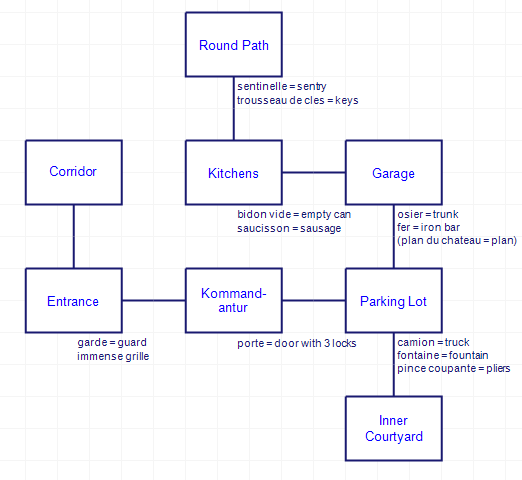
I’ve prodded enough to at least make an initial map:
The “plan” that’s in the trunk just to the north of the starting room is unfortunately “old and all moldy” so doesn’t have any useful information. (That’s “building plan” as in map, not “plan” as in list of steps.)
The two spots with guards (Entrance, Round Path) haven’t raised any alerts yet, but I also haven’t tried to antagonize the guards, or try to poison sausage and feed it to them, or something like that.
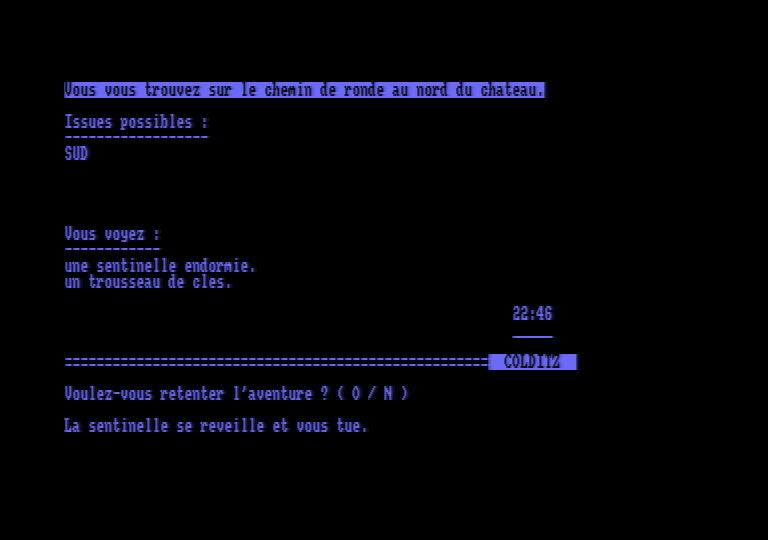
Except for this. I tried to take the keys and the sentry woke up and killed me.
This might be a game I might normally take care of in one chunk in English but I’m willing to split into two or three parts here to give it the time it needs. I’m going to try to solve it as honestly as possible, but if all else fails I do have a full walkthrough so I can at least write about what’s supposed to happen even if my reaction is “Je n’aurais jamais pensé à faire ça!”
Well. I never thought I’d say this about what is in some senses a bare-bones Adventure spin-off where the only real verbs are LOCK, UNLOCK, DROP, TAKE, DIG, and THROW, but the ending sequence of this is completely badass.
In fact, I’ve got a soundtrack to play while reading once we hit the appropriate moment.
Let’s tackle the pyramid first. Part of my issue was a misunderstanding of the game’s (admittedly sparse) feedback system. I got the impression the “you are thirsty” messages in the desert started a little later if you had water with you, so the water was being drunk automatically. This is not the case.
I’ll tell you right now this is enough to get up to and inside the pyramid, but you’ll die on the way out unless you take a quick trip to a “dry water hole” that’s also near. The spade comes in handy:
With some extra refreshment for the walk back, we can plunge into the pyramid itself.
No trick here, just don’t go southeast.
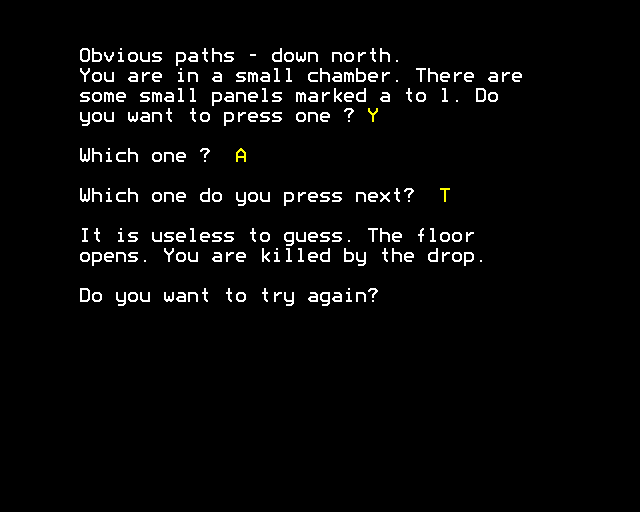
After two straightforward levels clearly meaning to match the geography of the pyramid, you get into a room with panels you need to push.
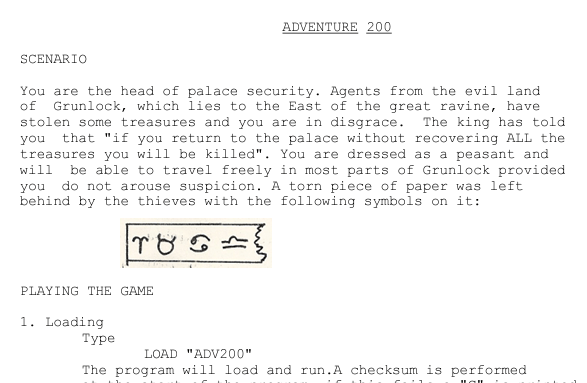
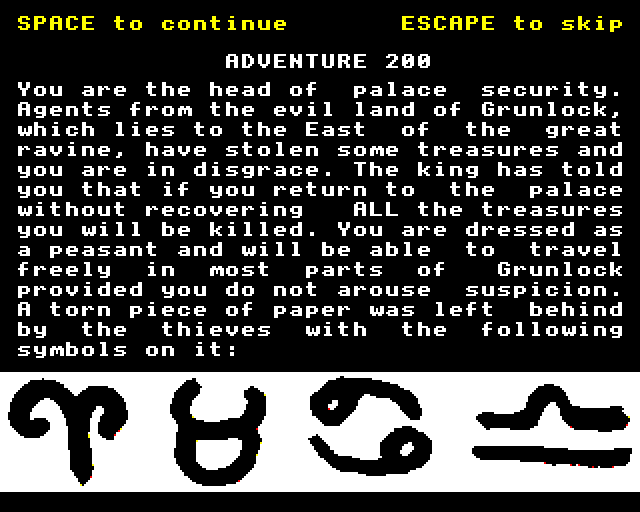
Remember those symbols from the torn paper? This is where they come into play.
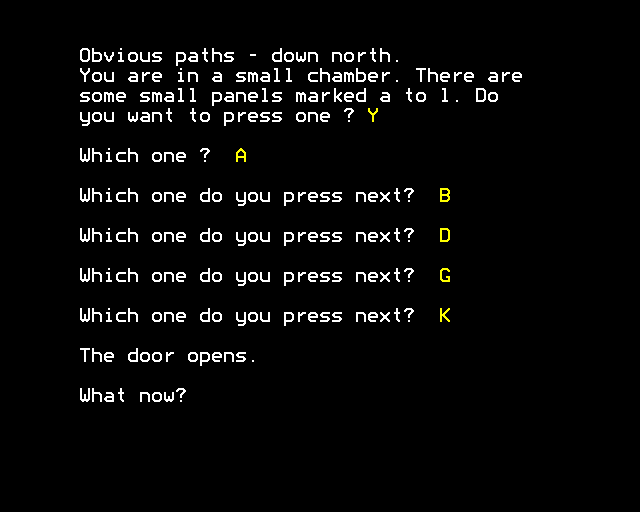
I confess I solved the puzzle, and then back-solved the clue’s relation. The game needs a five letter sequence. I got lucky and picked A as my first letter, then quickly found by just doing brute force that B needed to be the second letter and D the third. Giving it some thought I assumed sequence going on (1, 2, 4, 7, 11, etc.) with +1, +2, +3, +4 and so forth so I put G and then K as the letters and got through.
What happened is that the symbols are Zodiac signs, and they correspond to the first, second, fourth, and seventh months of the typical sequence (in letters, A, B, D, G). You’re still supposed to spot the sequence for the 5th letter so I guess I didn’t bypass the intended solution by too much.
The rest of the pyramid is a maze, and then a seal by a sleeping guard. I assume there is some thing that will cause the guard to wake up and kill you (the bird?) but I just grabbed the seal safely and left. The big trick is the water on the way back, and like the diamonds, this time you don’t get a chase from stealing the treasure.
Having resolved the pyramid I was able to deal with the dogs (as from my last post) using the side-route in the forest to evade them.
Then came the mace, which despite my glib dismissal last time, turned out — for purposes of escape — to be the most interesting treasure of all.
Now is when to cue the music.
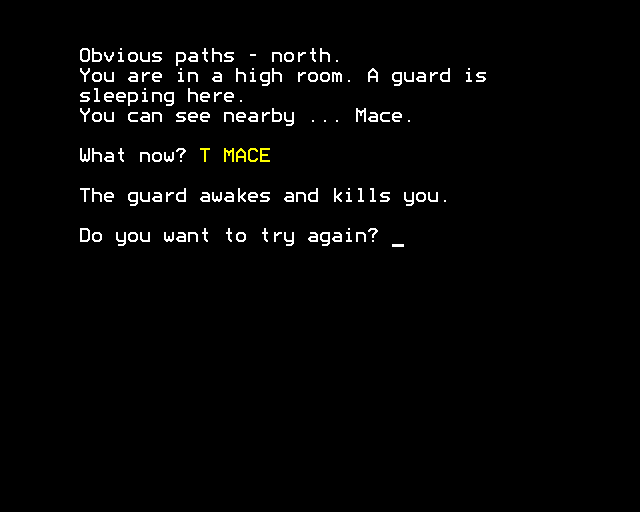
So you can safely go into the mace-maze and grab the mace without trouble. However, as soon as you step out of the maze, the guard you stole from is awake.
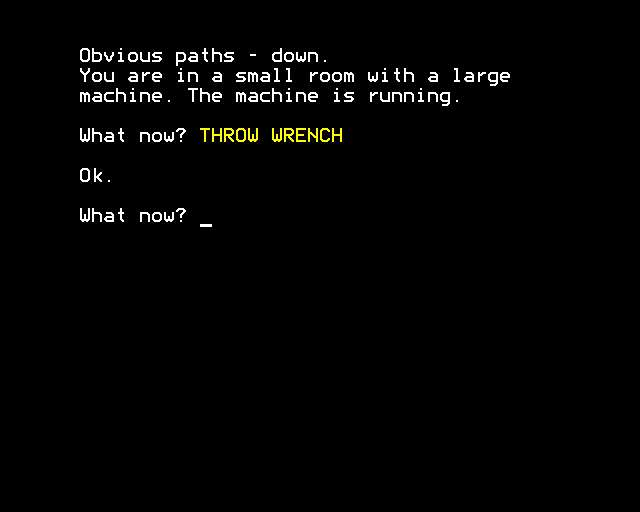
If you try to make a run for it you won’t make it. The guard gets you at the exit to the coal mine. However, keep in mind we had deactivated the dangerous-gas-cleaning mechanism by removing a wrench. There’s nothing stopping us from throwing the wrench back in.
Now, when we leave the mine, the whole thing blows up, including the guard chasing us, and we snatch our sunglasses mid-air and walk slowly away.
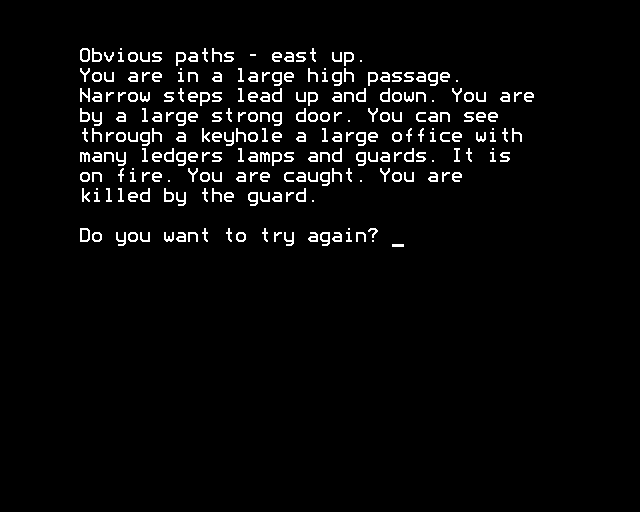
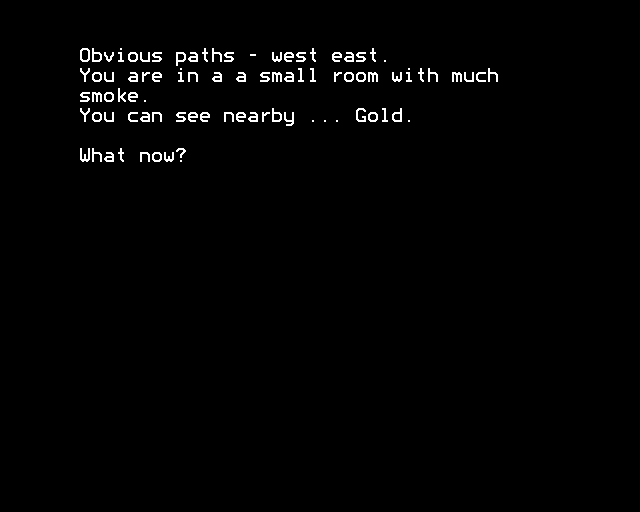
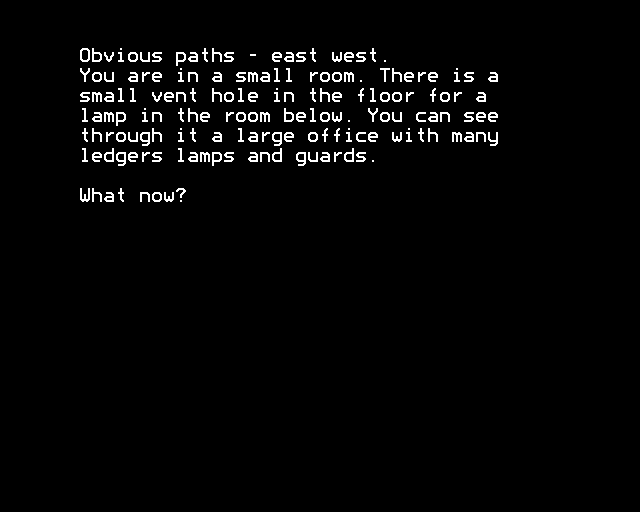
We still have the room of many guards to deal with, but our pyromaniac journey has not ended. Our jug is now empty of drinking water and we can go fill up with brandy, then return to the vent above the room. The room is described as having many lamps, and, well:
This results in absolute chaos and a lot of ways to die.
The main thing to observe here — which you can see from the screenshot above — is that the main office has keyholes, on both sides. Before you even start the fire going you lock the west side. Then you still have time to go into the east side and grab a treasure from there.
But if you just try to run away then, the guards catch you, so you also lock that door upon leaving too, leaving the guards completely trapped and crispy.
This gives you all the treasures: gold, diamonds, ring, seal, and mace. The mace is oversized (I think the rest can be hidden in our clothes, but not the mace), so that guard in the tower I was worried about spots it.
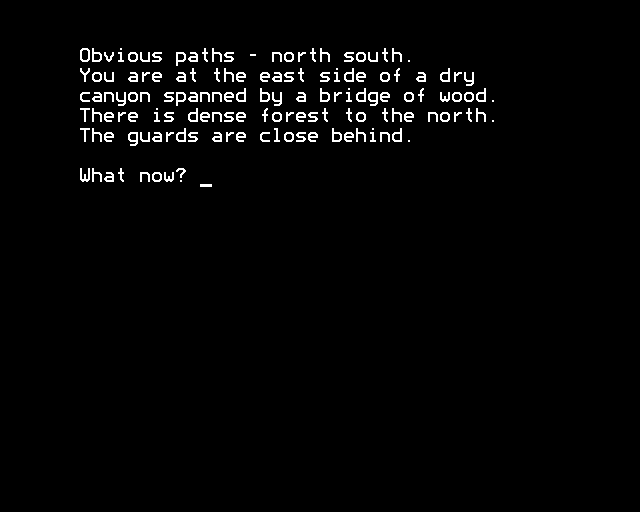
Now we’re on the run (if you hang out at the tower, the guard straight kills you). So you make a beeline to the west, but as you reach the wooden bridge there are guards right behind you.
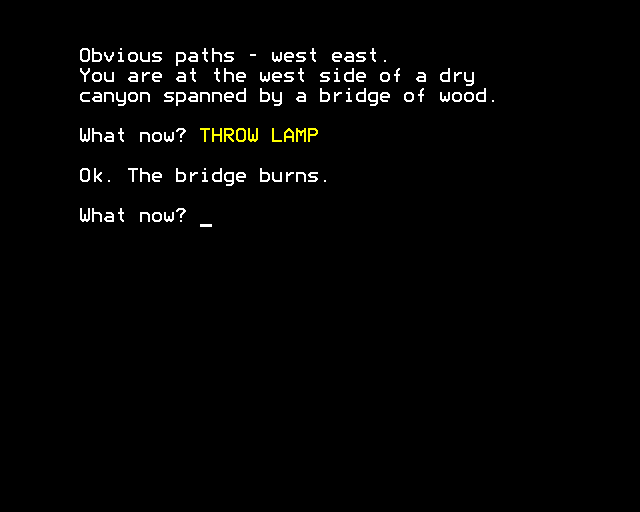
The … wooden bridge … can you guess what’s going to happen next?
Fortunately this doesn’t destroy the lamp and we can pick it up again and still use it as a life source. Still making a run for it, there’s no troll visible on the east side of the bridge so we go across to the west side and die.
Oops! This turned out to be pretty hard and I had to check for hints. The problem here is that the troll spots your mace if you have it, and decides to just kill you and take it rather than deal with asking for a paltry offering. So you cannot take the mace across the bridge. What to do?
Back near the very beginning, we found the jug at a “narrow dry canyon” that was blocked by rubble. It turns out on the east side of the canyon you can find the matching room that goes with above the same room!
Now after crossing the bridge we can just retrieve the mace from the other side. But the troll still wants a treasure.
That jug we’ve been carrying around smashes if we try to drop it. Now we want to drop it, because it makes crystals that the troll likes (fortunately for my momentum in the game, I had figured this out before this moment, the troll killing us because of the mace was the hard part).
With all five treasures we can finally arrive back home in victory.
OK you can stop the music if you want.
Yeah. Phew. That was some elaborate sequencing. The author really took the idea of “easy to get in, tough to get out” and managed to run with it. I find this game violated most of my general rules for complex puzzles. Namely, that without timer daemons or player status effects, they tend to require either hard-to-find verbs or things hidden in obscure ways. This game had neither, but rather had complex location effects.
That is, consider the moment where the guards are chasing at the wooden bridge. There’s technically no timer running. When you try to move on, the game checks if you’ve burned the bridge, and if not, it kills you. This almost plays a little bit like “drama time” (a game like Colonel’s Bequest where some events wait for you to be physically present before they happen) because the verb list is so short there isn’t strong motivation to hang around in a particular location, so it feels natural to have time move forward along with movement.
In the desert, where you’re thirsty, you can do as many commands within an individual room as you like without getting thirstier; it is only moving to another desert room that increases the thirst. (Other than the digging, it isn’t like the time is proportional. If you think about it, a lot of text adventures that have effect X trigger in five turns can be a little nonsensical, as running down a long hall is considered the same amount of time as examining five things.)
One other game design wrinkle is the use of a technique which is not recommended at all for a modern game, but nonetheless gets a unique effect. (See: the text version of Cranston Manor compared with the graphical one, where the maze-like town opening led to a much greater sense of place, but it was still an awful maze.) Here, there’s some “hidden effects” where the game is willing to silently check if you have a particular item. For example, the guard at the diamonds wakes up if you have the bird. The game doesn’t even tell you why the guard woke up, so it leads to a strong paranoia where you are thinking not only about what items you should be carrying but what items you should not be carrying. This adds a second combinatorial level of puzzle complexity, but — well, it really is also genuinely unfair.
The mace/troll puzzle at the end particularly hit this hard. The behavior of the troll changing was non-obvious enough I was concerned I had hit a genuine bug. On the other hand, it is a.) logical the troll would change behavior if they see you with the massive treasure and b.) logical they would just spring up on you unawares. Working this out the “normal” way requires a lateral leap that isn’t really achievable any other way. Yet, I would personally never include the puzzle as-is in a modern game design. (It also isn’t 100% clear from the geography that the canyon edge you throw the mace at is the same canyon on the other side, it would have been a better puzzle had the geography been rigorous enough — that is, where distances are clear and exact — to allow seeing this naturally.)
Despite all that (and the endless mazes) this ended up being one of my highlights of 1982, if nothing else for the technical high-wire act. The author C.J. Coombs was clearly running up against the edge of what was possible (with only enough space, for example, to casually describe a room of guards being set on fire in a few words) so I had extra anticipation seeing just how complex he could take things with such simple foundations.
Coming up next: Il est un peu plus de 21 heures, la nuit est noire … BONNE CHANCE!
I’m as puzzled as you are and any speculations on what the picture is meant to depict are welcome.
One of the puzzles I left off on last time involved a farmer very, very, upset at our theft of a spade.
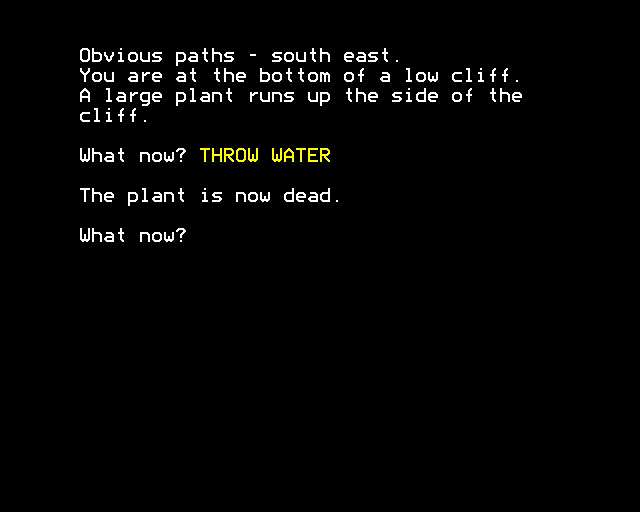
K speculated about chopping down the plant, which didn’t work. However, nearby there’s a “beach section” which has some brandy, and I tried refilling the jug with that and tossing to no effect. It was rather later that I realized that the beach also has access to a completely different kind of water which might be hurtful rather than helpful.
I like how the saltwater is still “water” but it has an opposite effect.
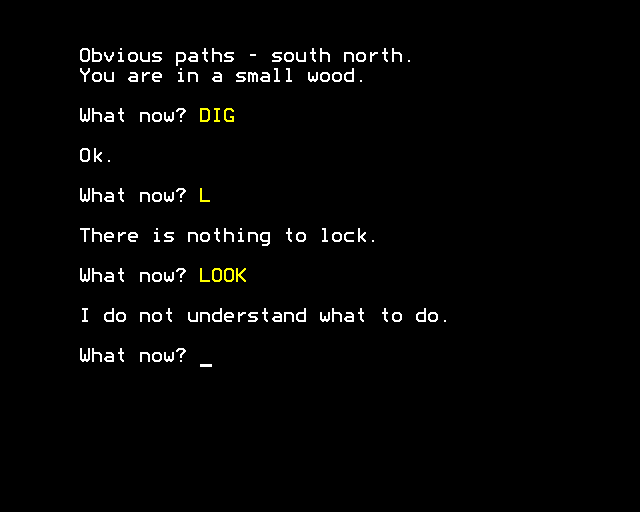
After killing the plant it was safe to tote the spade away. I fortunately zeroed in fairly quickly on a good place to take it, as there was a “flower” in a “small wood” which seemed like it could have other plants.
The game’s weird lack of feedback here is hiding the fact I dug up some garlic.
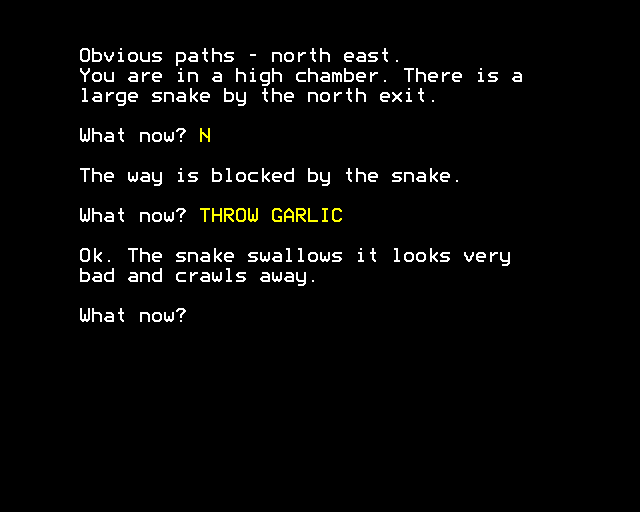
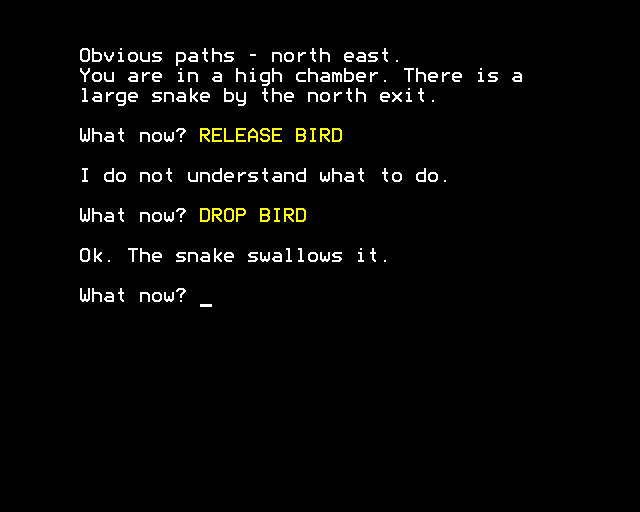
One of the other things I had been experimenting with is the snake; since I knew it ate the bird, I tried poisoning various things and essentially chucking my entire inventory to see what would happen. Behold:
This leads to a “maze” which is just a single room that goes nowhere. Hmmm.
I rewound a bit and kept the garlic in case that was a softlock. Fortunately, there’s a bit later garlic is quite obviously helpful, so I guess it was. (One of the common themes in the game is having bits of the map change in their nature, so I can’t say the snake is entirely useless to deal with. Maybe, even, on the final escape from the kingdom, the snake will be moved as guard duty, and we’ll have needed to take it out earlier, and the room behind it is unneeded.)
Both Voltgloss and K also sharply observed how the dust covered bird is like the “canary in the coal mine”, and I should try taking it back with me to the maze to see what happened. I tried to do so and … nothing happened. By nothing I mean no explosions. I briefly thought perhaps the bird was preventing them somehow (??). A brief show of what going boom looks like:
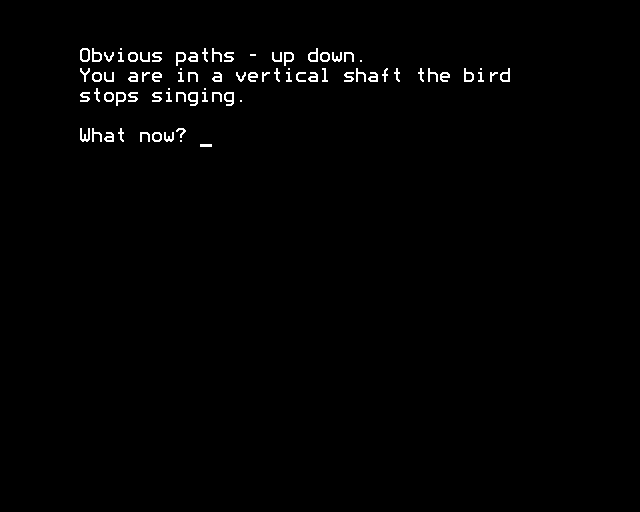
On a later run (I was experimenting with a few things) I tried to go in again with the bird and found this time an entirely different reaction. Sometimes it would sing, and sometimes it would stop singing.
In the “stop singing” rooms, those are the places where most or all of the exits are deadly. After some more puzzling, I realized the only thing significant that changed between the runs is in one I had nabbed the wrench from the broken machine, and in the other I didn’t. Going back in the broken machine room after taking the wrench along served to clarify: the machine (I assume pumping out the dangerous gases) starts working again once you take the wrench.
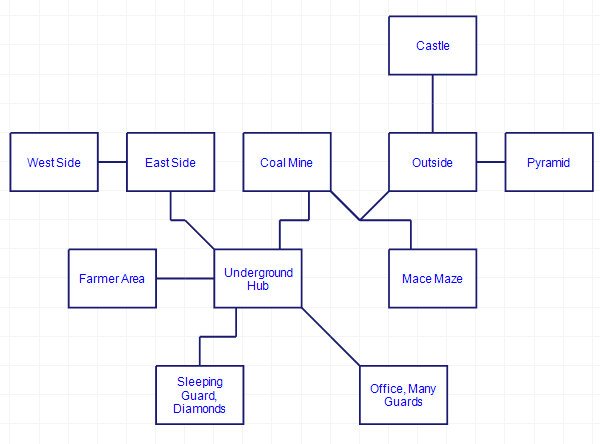
With that cleared up, I went back over all the rooms that killed me before to look for exits, and I found an entirely new area, in fact multiple new areas. Here’s a meta-map:
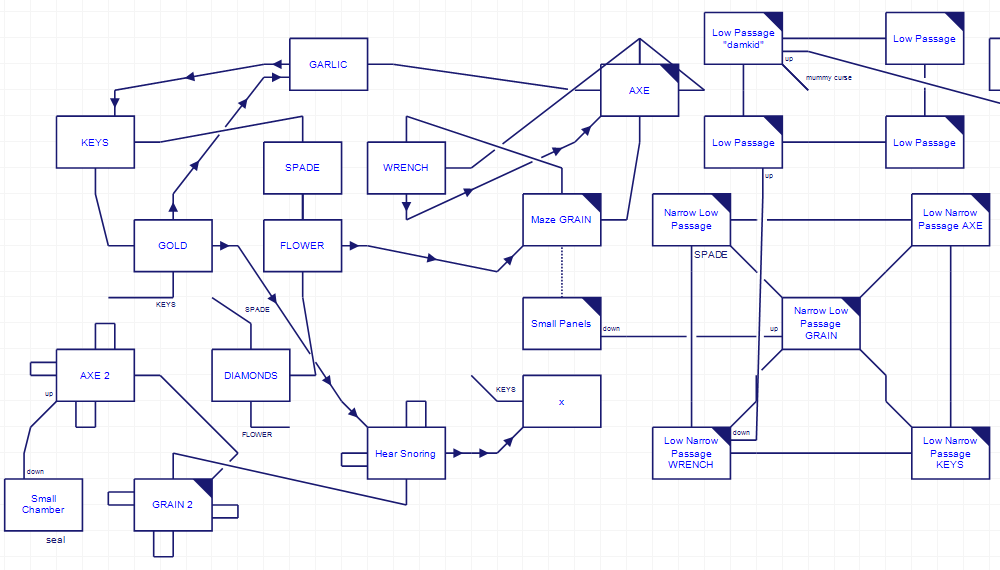
To be clear, this is meant to show the interconnectivity of the various regions, and isn’t exact about directions. Once getting by the coal maze you get into a “mace maze”, a small outdoors section, a castle, and a pyramid. (Well, theoretically a pyramid. I haven’t solved that part yet, but I have dealt with the others.)
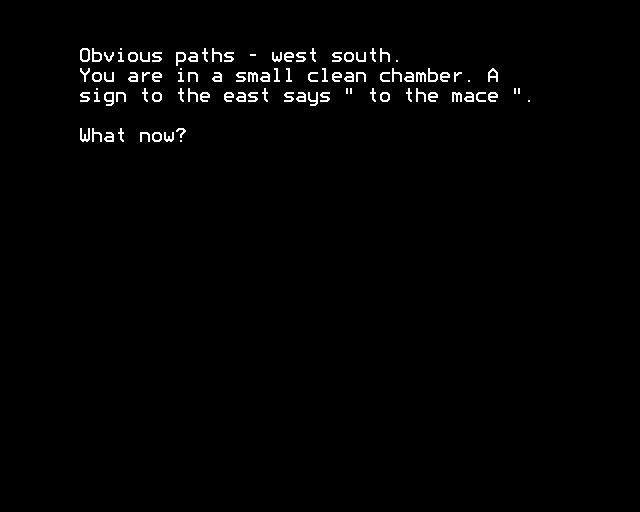
The mace maze is prefaced by a room with a simple sign.
The maze itself is a nightmare. Remember what I said about maybe the author not being interested in mazes? They’re interested, they just saved the pain for this section.
I confess, after realizing there was zero gimmick and I just needed to not only drop objects in rooms but tote them along to places farther in the maze (because I didn’t have enough objects for every single place) that I just looked up the route. I’ll suffer for your entertainment if it seems necessary but there just was no new point being made here.
I’m not entirely sure what causes the guard of the mace to wake up, but a second visit with a minimal inventory allowed me to grab the mace safely.
For the pyramid, well, it’s in a desert, and I die of thirst. That’s even having water being toted along in a jug. I’m wondering if I can somehow scrounge a second container.
As far as I’ve gotten. One more step kills.
The castle I’ve been able to both tackle and (probably) finish.
That’s because the castle seems to be almost entirely abandoned.
There’s at least a semi-logical reason, because if you follow the path all the way through, you reach a vampire.
If you’re holding a garlic (I told you it was obvious) you can enter safely, and retrieve a ring, I presume one of the treasures we’re trying to rescue. However, now the game’s theme kicks in. We aren’t in the clear yet.
Ominous! But this isn’t a timed thing, rather there are two locations where the dogs can show up. One is if you try to head east to the Pyramid.
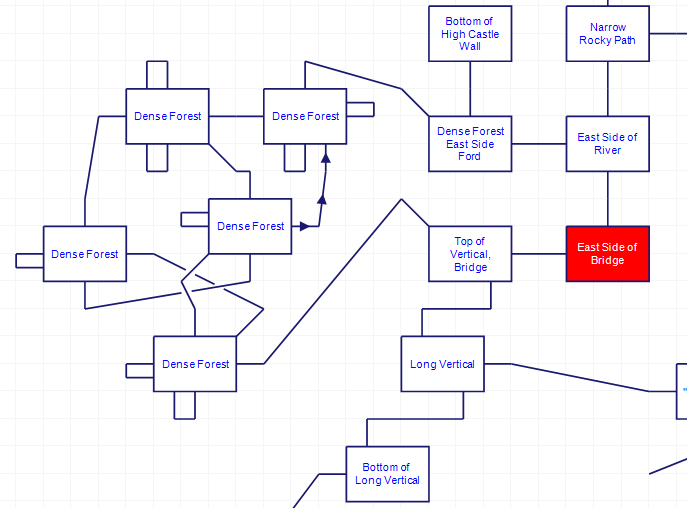
The other is if you try to head south to the bridge and get back to the mine. Fortunately, you can use another semi-maze section and pass through a forest the long way to evade the dogs.
(The red spot is death, but the Dense Forest lets you take the long way around.)
The bad thing is that having the ring means the pyramid is now closed off. So that’s another softlock. At least in this case the treasures need to be gathered in a particular sequence.
I do suspect (just based on my room count) I’m starting to close in on the ending. I need to work out how to make it in the pyramid, drive off the people in the room under heavy guard, and then somehow make it out safely with all the treasures. I have a suspicion the last task will be the most difficult.
So, despite this game doing heavy borrowing from Crowther/Woods Adventure (troll at bridge, plant you water to make big, giant snake) it manages to pull a very interesting high concept. It gets somewhat hinted at in the manual:
It is best to explore well before attempting to take anything back as this often raises the alarm and causes you no end of trouble as various people chase you. THERE ARE NO RANDOM FACTORS – if you are killed you did something to cause it – there will be a sensible explanation and a solution.
Remember, the premise is that we are entering an “enemy kingdom” in disguise to retrieve the treasures. This means there are parts of the game that are easy to get in, but hard to get out. In other words, this is as if rather than just being in the classic adventure genre, this is a heist.
I’ll give some examples along the way. Let’s tour the evil land of Grunlock:
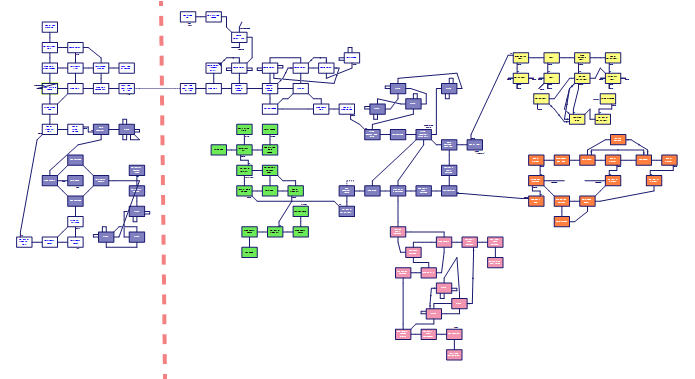
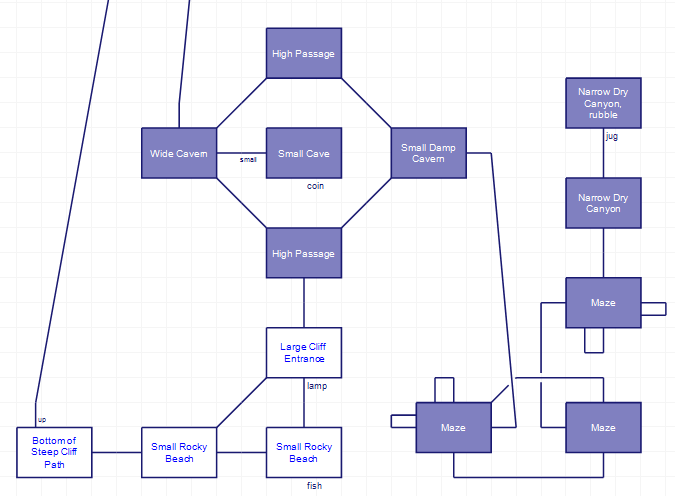
My map so far. Based on room count I’ve only seen half of them. The boundary between the kingdoms is marked with a red dotted line.
I count six areas in the eastern section (this is kind of arbitrary, but it makes sense somewhat). First off is the above-ground portion, the first part reached:
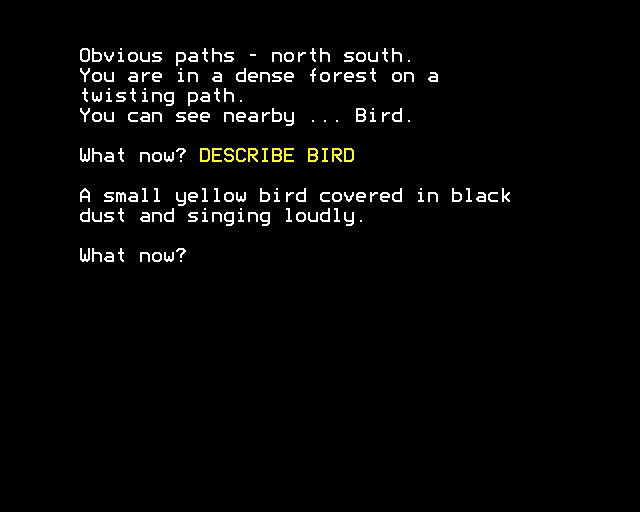
Most of this area is “dense forest”, although there’s a canyon crossed by a wooden bridge that seems ominous (it isn’t an obstacle, but I could easily see something causing it to burn/collapse if our adventures go awry). There’s also a classic Adventure bird:
DESCRIBE is the game’s version of EXAMINE. This is the first game since Journey I think we’ve had where DESCRIBE stands in for EXAMINE. It can be shortened to DE.
There’s also a small building, although it is not the Adventure Special.
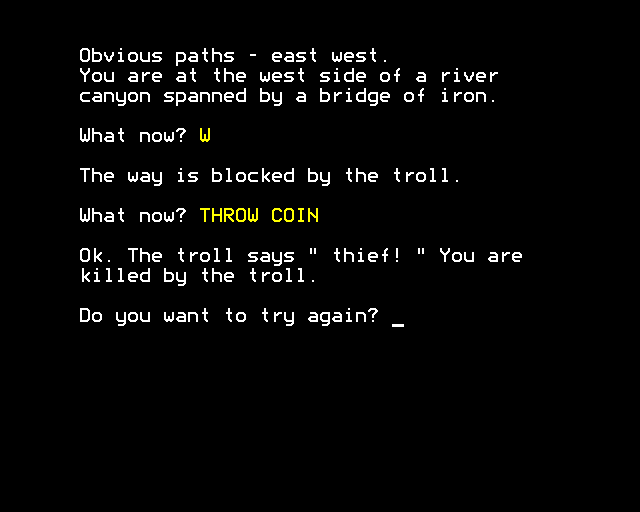
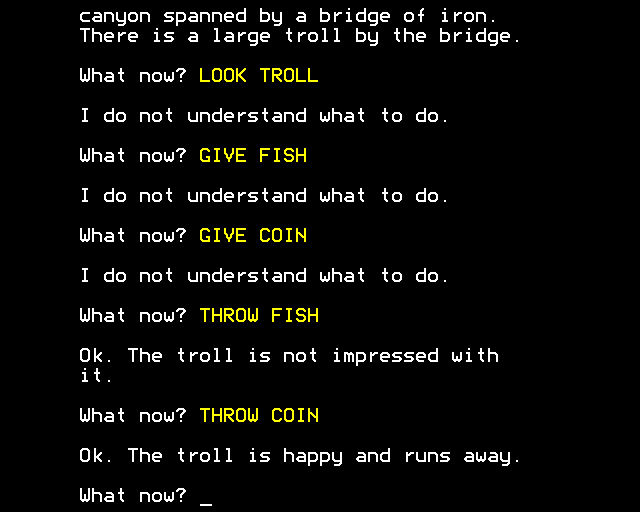
This is where the troll lives. That’s the same coin that we tossed him before crossing the bridge, and if we try to go back, and use the coin for a toll, he kills us.
This is very similar to how you can throw the eggs and reclaim them via magic in original Adventure — the troll will be mad we frustrated the toll. I’m wondering if this moment is how the author got the conceptual theming I was talking about earlier.
(The upshot is I don’t think I’ve softlocked the game by tossing the coin earlier in the game to the troll, but there needs to be some trickery in order to get back over the river. Still, maybe there’s a sneaky way to get from the west to the east side in a one-way fashion, and the coin gets used on the way back? Since we found the coin on the west side, not in the evil kingdom, I don’t think it counts as one of the stolen treasures.)
Other than that there’s a flower (“A small white flower with a strong smell”) and a “pothole” to go down deeper.
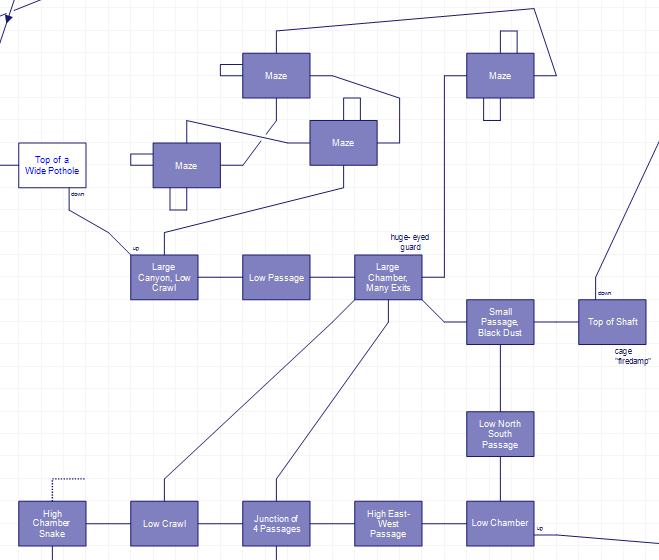
These are mostly straightforward junctions and passages, except for the “huge eyed guard” which you have to go by to go in or out. The guard does not react … yet.
This will mostly definitely be a problem later.
There’s also a classic “snake blocking a door” that looks like the one from Adventure.
I should also point out there’s another one of the odd “maze” sections the game has been putting in. Rather than the game putting one big tough maze to map, there’s just been little ones.
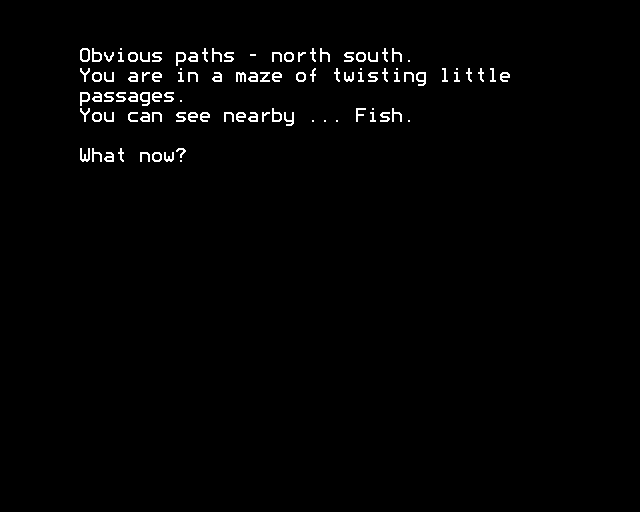
Using a Fish to map things out. Incidentally, if you take the fish from its original spot it gets described as a “dead fish”, which suggests another way I may have already softlocked the game.
Moving on to an area with a spring where I have solved a genuine puzzle:
Other than the spring (where you can load up on water, although that’s true a couple places) the useful part is past a sleeping guard, where there’s a chest.
I am proud to say I nailed this puzzle first time.
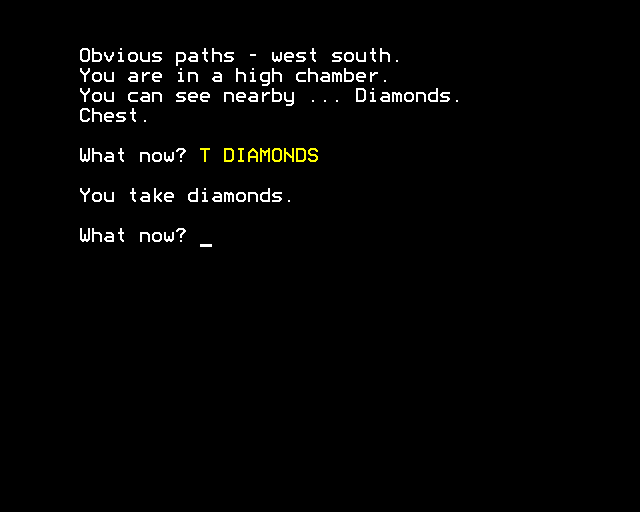
Specifically, I locked the chest back again, then ran to the south where there’s a room that’s otherwise empty and not useful. Then, after the guard had left, I was able to scarf away with the diamonds, this time without making any noise.
Heist complete! The diamonds don’t attract the attention of the “huge eyed guard” incidentally, so it isn’t just holding a treasure that activates them.
Off to the northeast, there’s a small genuine maze.
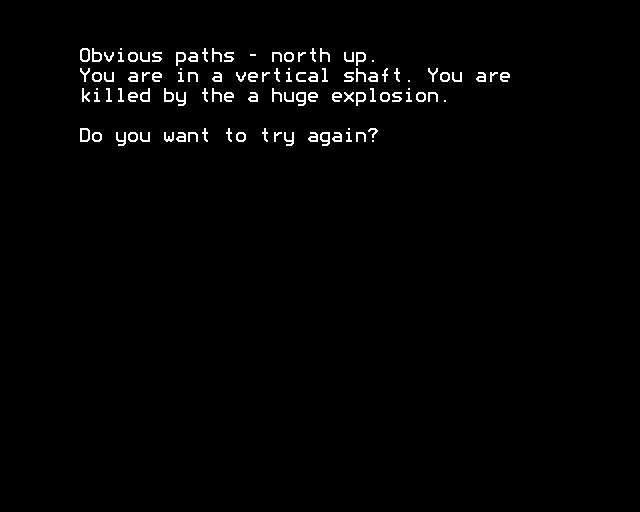
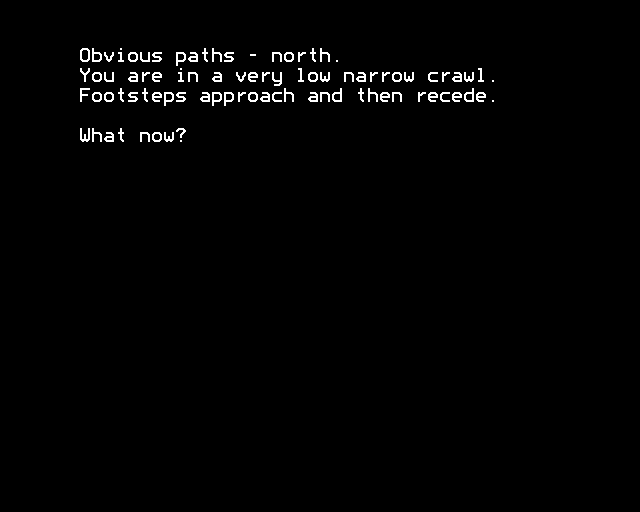
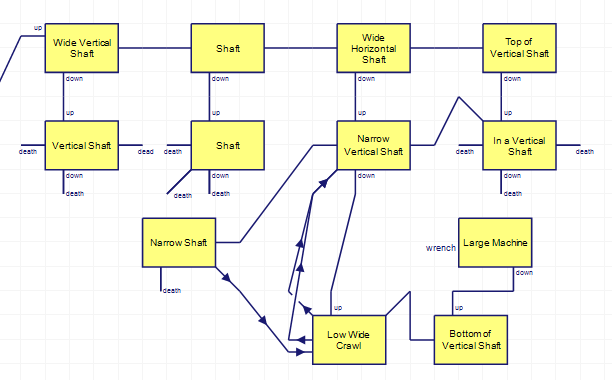
Specifically, you’re in an area with “shafts” where some of the exits explode and kill you. This seems to be consistent and just a matter of mapping things out.
You get a wrench at the end (by a non-functional machine which the game doesn’t let you noodle with), so maybe that’s it.
Going to the southeast, there’s a “kitchen” a “dining room”, and a room with a lot of guards.
You can make your way around and above the room itself. I have a feeling I’m supposed to drop something in on them that will cause them either to run away or pass out.
The last section I’ll call the “farmer area”.
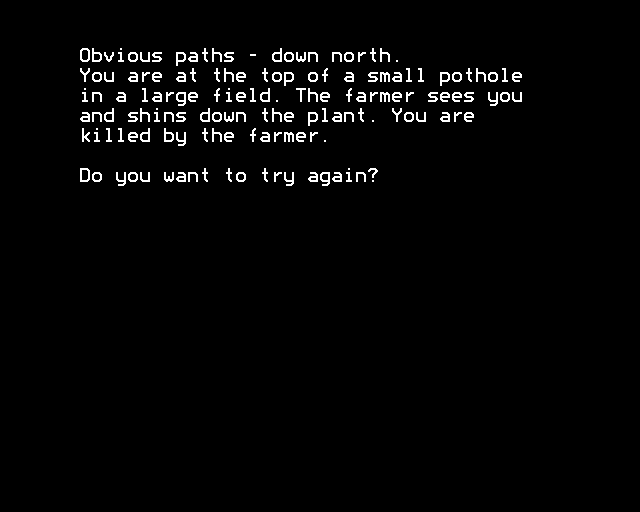
There’s the classic plant you need to water to get higher, where you can find a grainery (where you can safely grab the grain) and a small building (which is locked, and has a spade). If you try to get away with the spade, though, you get stopped at the “Top of Small Pothole” room.
The spade enables the verb DIG which I’m sure will be necessary somewhere, but isn’t helpful anywhere in the farmer area.
With the grain absconded with you can go back and feed the bird way back in the dense forest area and capture it in a cage.
Then you can take it to the snake, where you might expect it to chase the snake away.
Sorry, it isn’t going to be that easy!
I have some theories to test and things to prod at, but I’m fairly confident I’ve got this set of areas thoroughly mapped. Other than the snake I need to deal with the guard room and the farmer, so it doesn’t seem like a lot of hanging obstacles; there may also be obstacles (the wooden bridge, the guard in the tower) I just haven’t activated yet.
One last thing to mention: I did go through my standard verb list looking to see what the game understands.
This is an extremely small list. In may in fact be a record for a game that has a parser and no USE command. Just DIG, DRINK, LIGHT, THROW, LOCK, UNLOCK. I guess in some sense that’s all you need? For watering a plant, that’s throw. I assume you attack with the axe with throw as well. No need for OPEN when anything that needs opening is locked. It’s fascinating that there’s some very complicated depths upcoming using such simple communication (not even USE covering for the lack of verbs!)
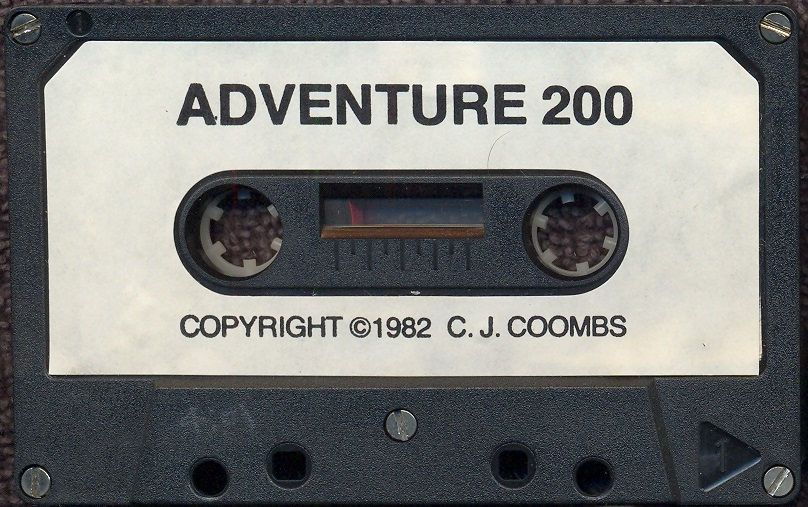
Normally on this blog when we’ve seen the word “adventure” followed by a number, it is meant to designate one of the many modifications of Crowther/Woods Adventure, like Adventure 448. That’s not the case here. The author wanted to brag about the number of rooms. They might even be right to brag.
Yate, near Bristol, where today’s company comes from.
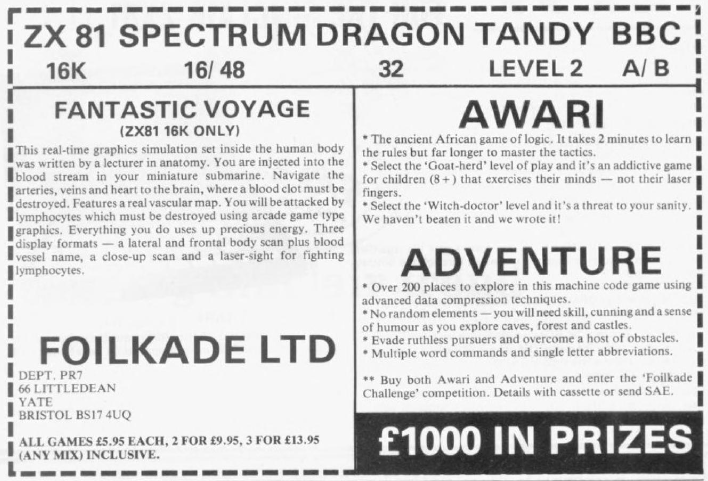
But to back up: this involves yet another one of those flash-in-the-pan UK companies founded around 1982, in this case a company named Foilkade Ltd., which seems to be by all evidence run solely by one person, C.J. Coombs. Starting in the December 1982 issue of Sinclair User, they advertised three games, Fantastic Voyage, Awari and Adventure 200, with a tack-on to the contest craze: an award for the first person who gives a correct solution to both Awari and Adventure.
I don’t know what a correct solution to the board game Awari would be like (maybe the game is completely non-random, so a procedure that beats the highest difficulty would work every time? isn’t that a game flaw?) Adventure is mentioned as having “over 200 places to explore in this machine code game using advanced data compression technique” and honestly, it really is impressive: we’re talking 16K of capacity, the same amount of space Scott Adams had to work with. (Also, the actual number according to the BBC Micro intro is 230 rooms.)
It wasn’t that silly to point to number of rooms as a metric in 1982, as while Level 9 managed dense worlds as well, it was hard technically for authors to provide the mainframe experience of a “world to get lost in” on the smaller machines.
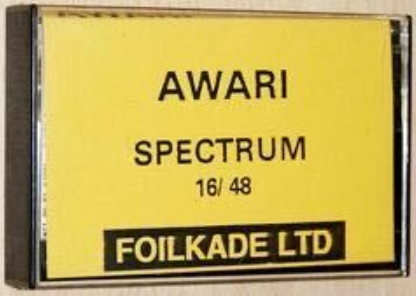
I never found a picture of the Adventure 200 case, but I think this Awari case is pretty indicative of the look. Via Pricecharting.
Despite some heavy advertising throughout 1983 (and decently positive mentions, like here in the book Sinclair QL Adventures) they poofed from history after that point. At least we can enjoy this one shot into the sands of history by Coombs.
At the very least, this one is allegedly long and complicated; Exemptus from CASA calls it “surprisingly vast and difficult” and there’s even a letter from a 1984 issue of Micro Adventurer which states roughly the same, as “Irene Feeney, of Basildon in Essex” gives an open offer for help for anyone sending a self-addressed envelope.
I’m playing on BBC Micro which has enough capacity to stuff the intro material without needing an extra instruction sheet. The premise is that all the treasures of your kingdom have been stolen and you are tasked with finding them while incognito. The only clue left behind is set of four symbols shown. I don’t know if this is meant to be Crowther/Woods style with gathering treasures from multiple rooms and this is just a creative way to kick things off, or if the treasures are realistically stored in a thieves’ hideout we need to infiltrate (like how Dragon Adventure only had treasure in the dragon’s lair). The “ALL the treasures” warning suggests the former to me.
You start just outside the palace, and going west kills you if you don’t have the treasures. I don’t think we’re using a trophy case room this time.
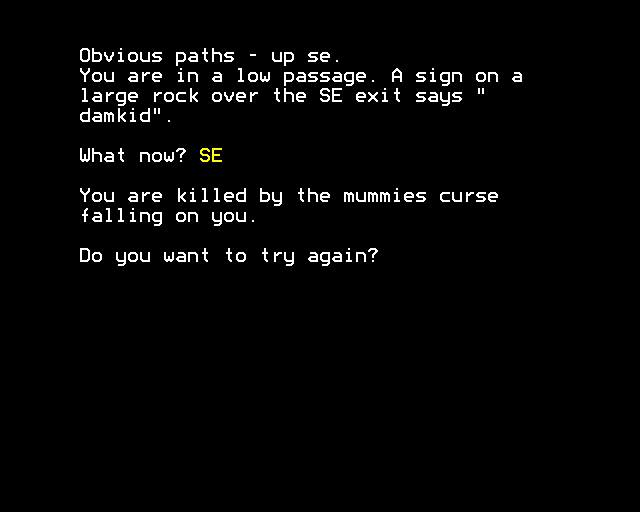
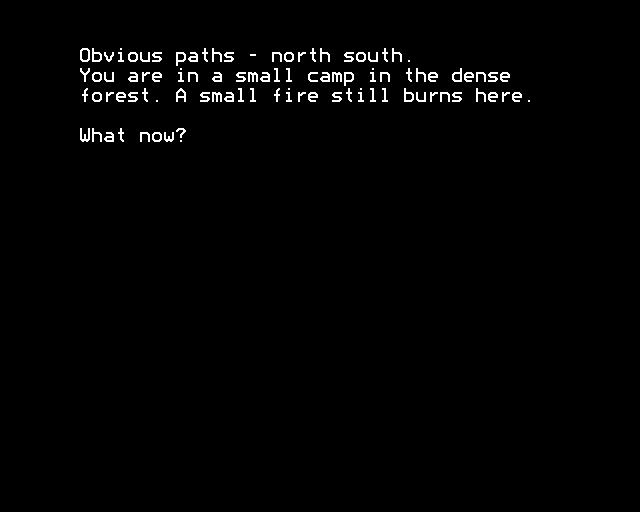
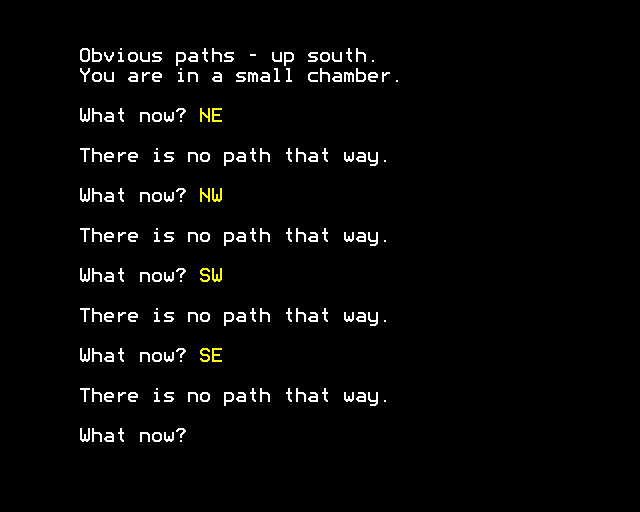
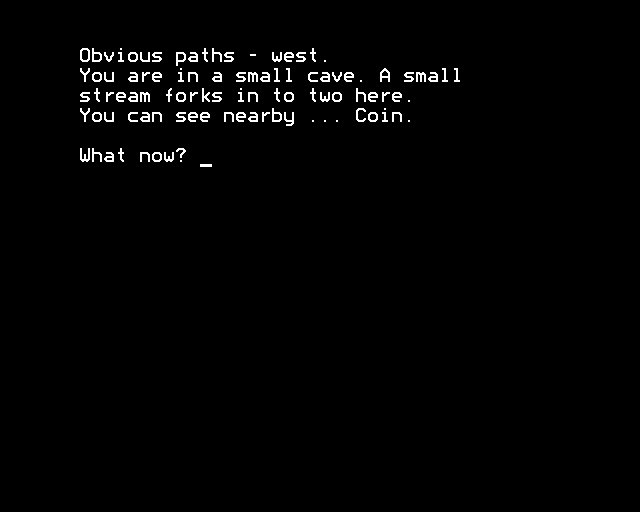
The thing that threw me most early off was the way exits are displayed. I’ve never seen this behavior before. Each room will always list a maximum of two exits as “obvious”. However, this is a perfectly regular map where rooms can most definitely have more than two exits. The campfire screenshot above only has exits north and south listed, but you can also go east and west. I only discovered this by arriving from the west, thinking it was odd for an open forest to have a one-way route, and tested going back even though it wasn’t listed as an exit.
The upshot is, when making the map (first part above) I have to test every single exit in every single room. I’ve certainly had games like this before, but it is quite odd on a game that has a mechanism for listing exits. I’m not “working from scratch” at least, and in rooms which really do only have two exits, it makes things much faster since I can just plow through typing NW / N / NE etc. getting “There is no path that way” messages. Where path-searching is slow is when you find an exit, and then have to add it in, and go back to the original room and keep looking — but which exits did you already test? are you sure? better check all of them over again.
There’s one room in the early area that gives a “landscape view”. This is surprisingly common in early text adventures and I probably should give this sort of room an official moniker. Island Adventure had a tree you could climb to see there was a cave past a river. This kind of room gives a preview of what the journey of the game will be like.
I also wonder if the symbols given at the start just represent the “biome journey” we need to take through the game.
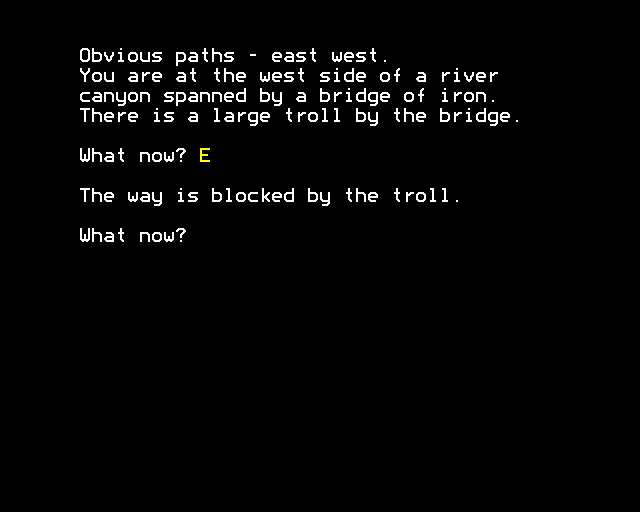
The only real item outside you find early is an axe and the only real obstacle is a straightforward troll. No talking or anything, all business.
To satisfy the troll, you need an item from underground. Underground isn’t a large area, or at least not yet.
You need the lamp (conveniently at the mouth of the cave) to provide light to explore, but it requires a light source. Fortunately, that campfire I gave a screenshot of earlier works. (It is important to note this moment, as it means the game isn’t purely about doing actions on objects listed as separate from the “main text”, so I need to pay attention to room descriptions.)
The mazes are particularly curious. It almost felt like the even the author didn’t like mapping mazes but only included some rooms out of obligation.
One exit is described as too small for you to squeeze through, so you need to drop your items except your lamp (this technically counts as a puzzle, I guess) to find a coin within.
Other than that, there’s a fish and a jug lying around, and the jug breaks if you drop it. Not too exciting yet.
With the troll satisfied, this leads to a large landscape, one I haven’t fully mapped out yet, so I’ll save it for next time. I will say if this is truly in the “nightmarishly hard” category of works like Acheton the author clearly is trying for the slow-burn approach, and building with easier puzzles until giving harder ones. (Like, y’know, a normal modern game designer.) Of course maybe I already softlocked the game giving away the coin (could it be one of the treasures?) and I’ve already fallen into the author’s trap. We’ll see!
One of the places I found searching in the lands beyond the troll.






















































 Renga in Blue
