This is instead by John Olson. Note the vowel. He was originally from Illinois, and after getting a Bachelor’s degree moved to Kansas in 1976 to teach math at Hoxie High School. He eventually also picked up a job teaching at Colby Community College starting with college algebra, then branching into computer science.
In the area of computer science, we were using Radio Shack TRS-80 computers that had a Z-80 microprocessor. The era of personal computers had arrived.
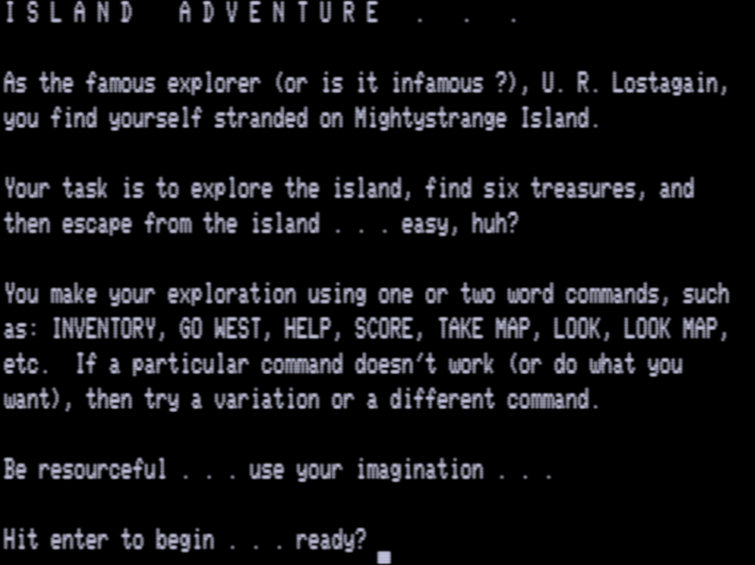
In the fall of 1981 he wrote Island Adventure “For Fun” (as he says in the comments) before it eventually winged its way to CLOAD Magazine to be published in their May 1982 issue. Given the single vowel change, plus TRS-80 as a platform, plus both authors being published in the same tapemag; it is understandable why they’d be lumped together. But (other than them of course being different people) we have a teenager vs. adult enthusiast contrast, and the formats of gameplay themselves are fairly different.
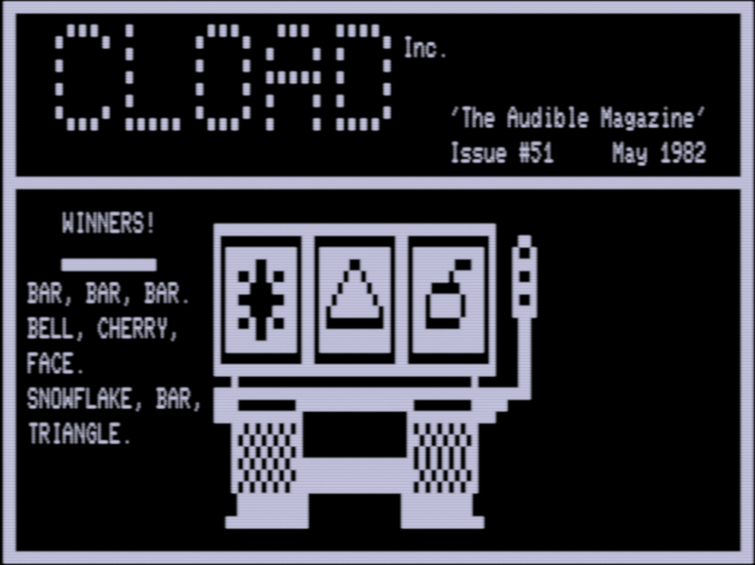
Before getting into the game itself, let’s focus a little back on the CLOAD issue in question, which kicks off with the editor unraveling:
For headache, take aspirin. For tension…
Not another dumb question??!! I’ll have the editorial tomorrow! Ad by Thursday. Oh, no! A bug in a program? Tom, get to work. What do you mean, I’m not a nice guy anymore? My attitude needs a tune-up? I should take a vacation? But I had a REAL one 3 years ago. What do I need another one for? Oh, Robin mentions that I WILL take a vacation. I see. Won’t the shop fall apart without me? No? How will I survive a week without computers? How does it feel to be needed…
Quite often the past gets seen through polished lenses, so it is interesting to see these moments demonstrating: despite most of these objects now being forgotten cultural debris, they were still work for the people that produced them.
How long did it take to copy all the tapes? How long did it take to lay out a 4 page newsletter by hand? How much time was spent making the animated “slot machine” cover?
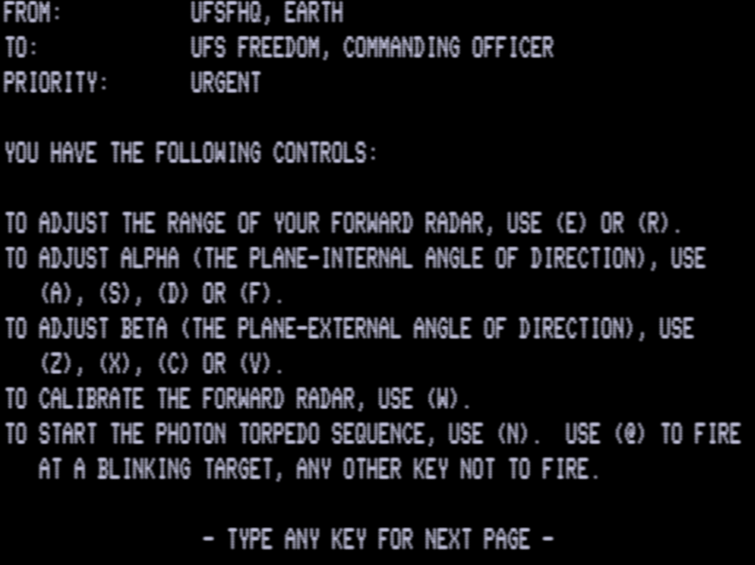
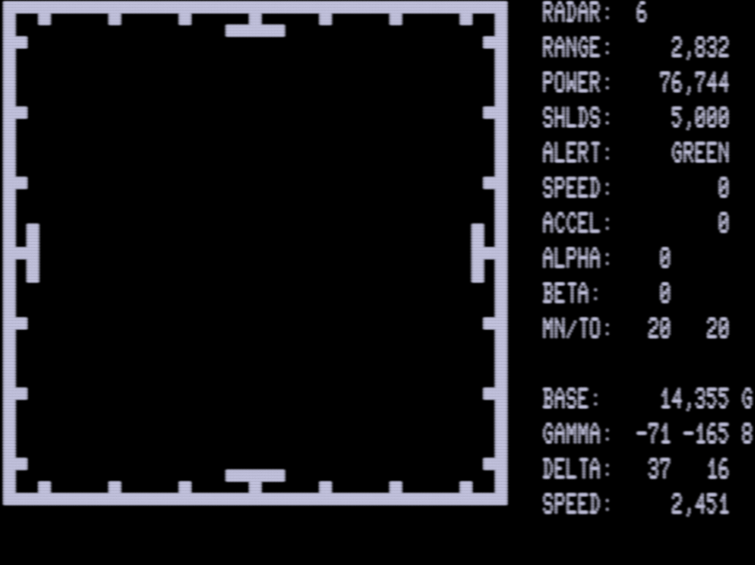
Barring this moment right now when I’m mentioning it, most of these things will fall into historical dust. Adventures were really popular and oftentimes much better preserved than the games they were packaged with; did the people at the time already know Island Adventure might survive at least a bit longer than Math Drill, or (to make a fairer comparison) Destiny, a weirdly elaborate space flight sim by Scott Richmond where you need to destroy a Klingon base?
Seriously, what? Also, it is my greatest aspiration someone will be searching for the modern Bungie game and accidentally pull this up instead.
But we have only time for the Island. Maybe a Space Sims Addict will pass through again one day.
If I didn’t know about the naming confusion, this game would puzzle me; it is much simpler than Frankenstein Adventure, or really almost anything we’ve played lately. I have to go back to the early work of Greg Hassett to make a comparison: very little in the way of puzzles, with most of the treasures in the open. Hassett at least tossed in a few static or random enemies to mix things up, but this is really an abandoned island.
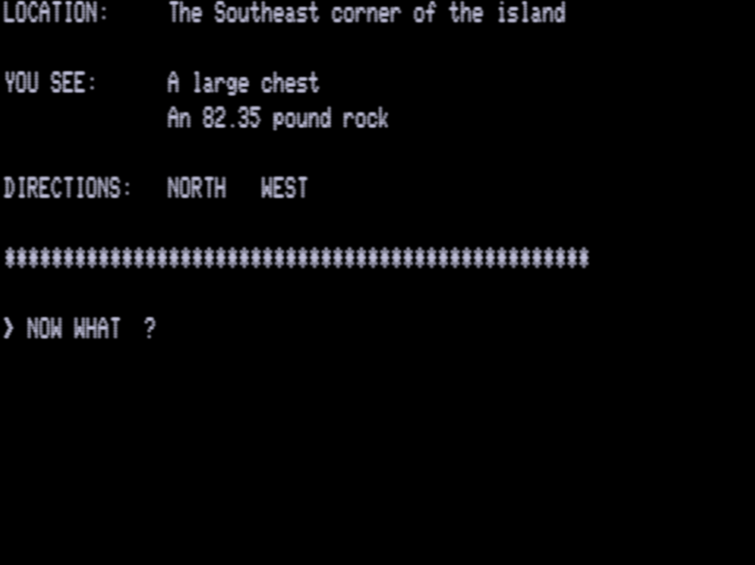
The main interest is a lot of red herrings. For example, trying to OPEN the chest at start says “that’s not allowed / possible”. You can pick up the very specifically measured 82.35 pound rock (we’re an adventurer, I guess we’ve had practice) but it is useful for nothing.
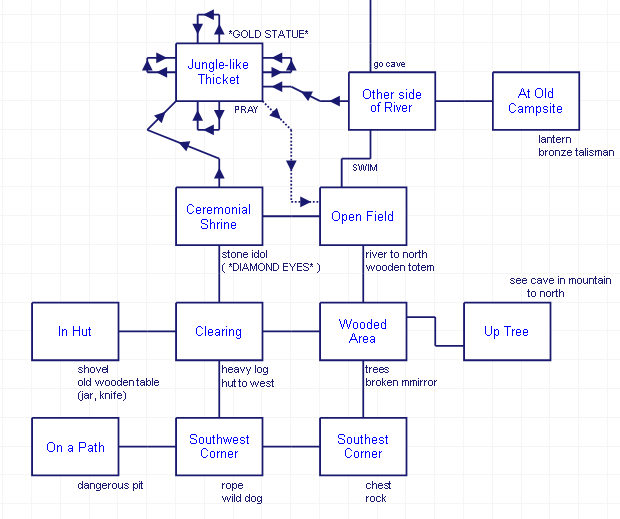
Looking over the map of the south part of the island, to the west there’s a wild dog (a “St. Bernard”), a rope, and a “dangerous looking pit”, all which are red herrings. Heavy log and broken mirror directly to the north? Also red herrings.
Out of the three items in the hut above (shovel, jar, knife) only the knife is useful. DIG isn’t even recognized as a verb. You can’t scoop up any water with the jar even though there’s a river nearby (not like it’d be useful in any puzzles anyway).
Where the knife is useful. I’ve been taught to fear taking eyes out of idols in other adventure games, like how in Acheton doing this would set off an enemy that would chase you the rest of the game.
North of the diamond eyes scene above there is a jungle where all directions (n/s/e/w) loop. There’s a *GOLD STATUE* so you have to go in there. Taking a cue from the nearby religious items our protagonist is looting, I tried PRAY.
This leads the player to safety.
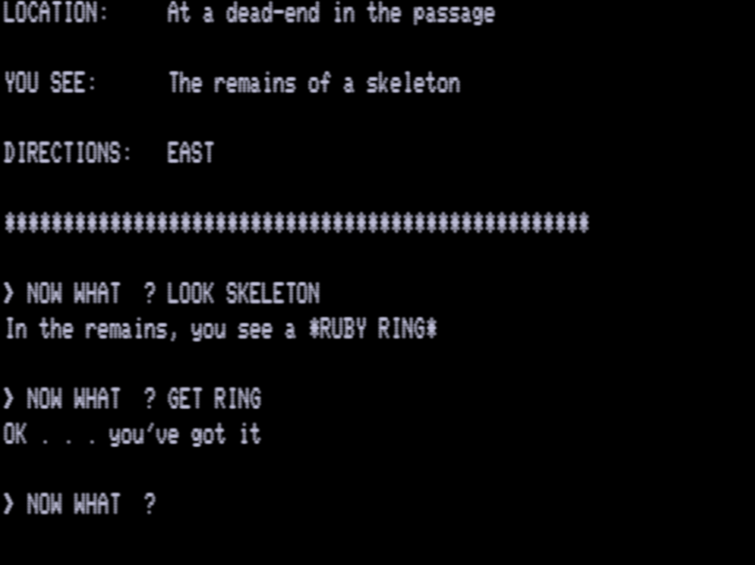
Swimming over a river, you can find a lantern which you need to be holding to enter a cave. There you can find multiple treasures just lying around.
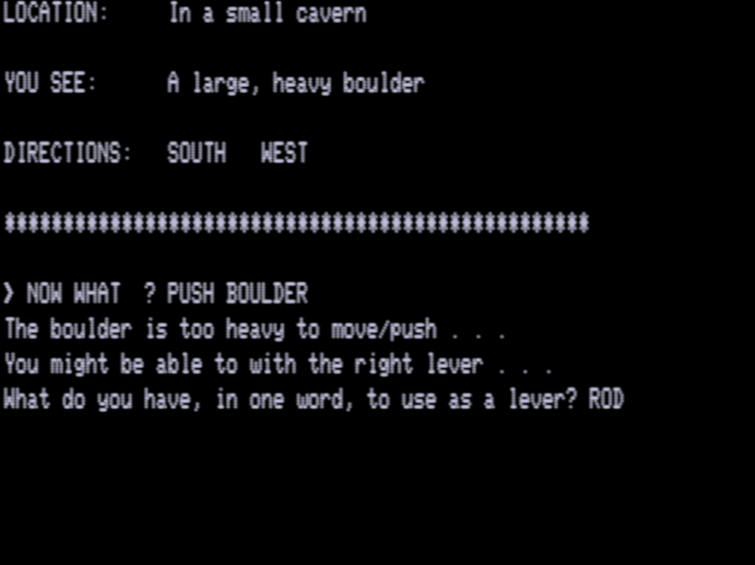
The only obstacle remaining is a boulder too heavy to move, but fortunately immediately adjacent is an iron rod.
Outside there’s one more treasure (a pearl necklace) and a boat, where you can drop all the stuff you’ve scooped up and win. There’s a max inventory limit of five and there are six treasures so it takes at least two trips.
Honestly, I think the red herrings perhaps weren’t meant as red herrings at all; rather, this was just being written “for fun” so at some point the dog etc. got left in and ignored once it was possible to get from the start to the end.
I can’t begrudge this game being written; this is the sort of starter game lots of people from the era tried to make. I’m just a little surprised it got published (unlike the closest comparison game from 1982, Smurf Adventure), but perhaps refer back to the over-worked editor trying to crank out monthly tapes. If nothing else, Olson came back with three more games, and one of them (Gymnasium Adventure, written 1982, published 1983) I’ve played before and I remember being decent. It’s set at a high school, so perhaps a few in-jokes on the part of the author helped.
I finished; out of all the Softside games this was the most elaborate, despite remaining in a small map the entire game. The closest analogy I can think of is the VIC-20 game Moon Base Alpha which crammed multiple obstacles in a tiny space just based on necessity; here, there’s more expansive memory to work with, but the density is just scaled up with 11 ingredients to juggle making up the various brews which end up having to be made in a specific order.
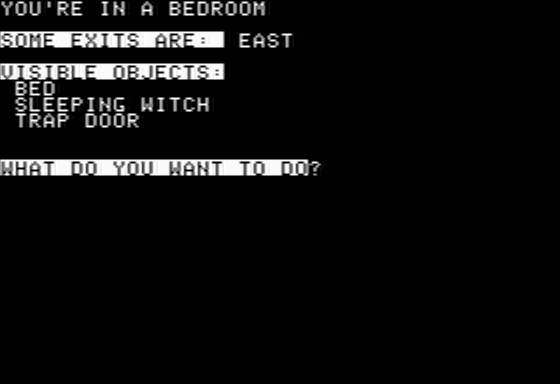
Since getting stuck last time I made a verb list (see above). One of the unused verbs was “MOVE” which I decided to try applying to a bunch of things; the thing it works on is the bed the witch is sleeping on (!). I guess that bracelet magic is strong stuff.
(This is one of those odd cases where — based on someone maybe finding the shovel first thing — that someone who lucks onto finding the pillow and wand more quickly might have trouble later, not even realizing there is a genuine magic effect at play, and it isn’t just the witch is a heavy sleeper. Well, the witch might still be a heavy sleeper, because the bracelet doesn’t work on the cat, as you’ll see later.)
The bottle definitely struck me as useful — I still hadn’t found anything to carry water yet, for instance — and a spider leg was on one of the lists but no spider. Even with the new loot I still meandered for a bit and checked help (Gaming After 40’s walkthrough, he does thing in a much different sequence than me). I had previously tried to BREAK some locked cabinets but I apparently wasn’t holding the AXE. Ugh! Normally it getes
SORRY YOU CAN’T DO THAT
but having the AXE in inventory turns it into a SMASHED CUPBOARD, with a plethora of helpful items: a SUGAR CUBE, some CATNIP, and some SEEDS.
Reflecting on the puzzle, I had the BASEBALL BAT along had I had often been picking up the AXE to test things, so I mentally assumed I had tried my best shot at breaking it; I didn’t have the thought “did I have my axe with me?” as much as I assumed it was tested via osmosis. I can’t really begrudge the bat not working — after all, you’re busting through wood — but I would have preferred some kind of message indicating you’ve got the wrong tool for the job. The game doesn’t have disk space for such niceties, though.
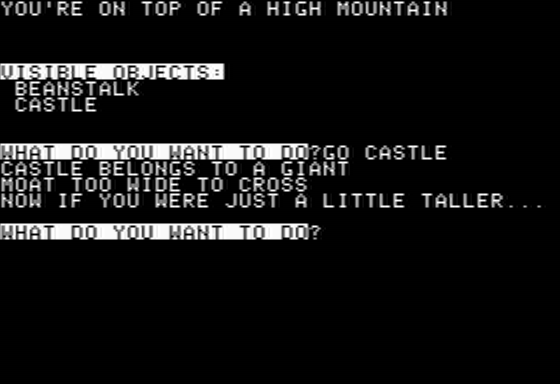
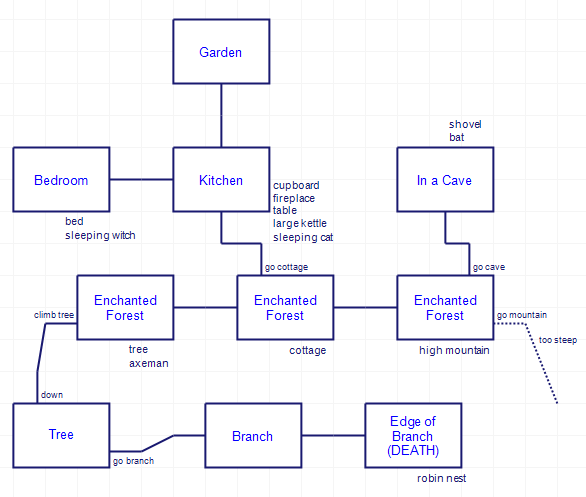
I quite quickly took the seeds outside to the garden and tried to PLANT them. You have to come back later (10 turns?) and you can find a beanstalk has grown, which then can be climbed up to the castle. The whole “too steep” thing earlier was a ruse, there’s no way to climb up the mountain. Funny that a beanstalk is easier.
This indicated to me immediately that growth (spit, tears, egg, hair) was needed first (in the walkthrough I mentioned, Dale Dobson went through and interesting sequence where he had more trouble figuring this out). I still didn’t have hair, although I should have been supicious of the dirty piece of metal: it needed cleaning, and then could help get the hair.
I had already tried to clean it before as the outdoors mentions periodic bursts of rain, but you can’t refer to WATER when it gets described. I tried GET WATER while holding the bottle during rain also with no luck. It turns out (yes, I had to check Dale Dobson) that you need to set the bottle down, then wait for some rain. It almost seems like the rain is showing up before you are able to accomplish any action.
That is, the rain shower visible right now has no effect. You have to drop the bottle, then move back and forth until a rain shower happens again, and then you have a bottle of water. Not illogical exactly but it doesn’t quite fit my visualization of the timing.
With the bottle of water I was able to finally clean the metal and find out it was SCISSORS. Well, now I know what to do:
OK, yanking out your hair by your hands would be painful, I get it. At least there’s a moment later where the scissors are definitely required.
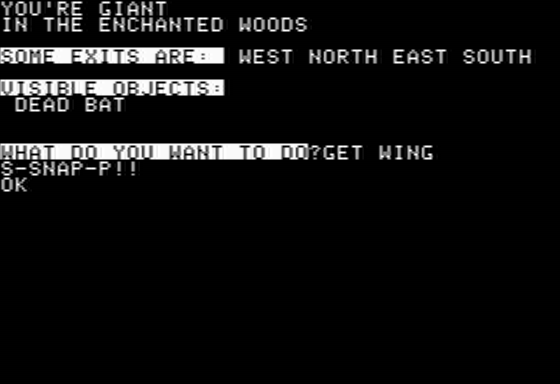
Moving the kettle to the fire and waving the wand, I was able to form a BREW and chug it. The game then says YOU’RE GIANT over every room description. I made a beeline for the castle:
Ah-ha, so invisibility next? But would one cancel the other? It turns out, no: you can be giant and invisible at the same time. But invisibility is quite short-lived, so what you need to do is drink the brew right before the camera, then deal with it right then (the shrink potion comes later).
Zipping things ahead, I now needed: snake venom, human blood, nail clippings, cat whiskers. Scissors work on nails, easy enough. The bat I could get blood from, although I was having trouble because I was still trying to use the verb BAT; you need to refer straight for the thing you want out of it, BLOOD, by typing GET BLOOD while holding the bottle.
While I’m at it, the same applies for the third potion, where you need a different ingredient from the same bat so just type GET WING and not CUT BAT or the like.
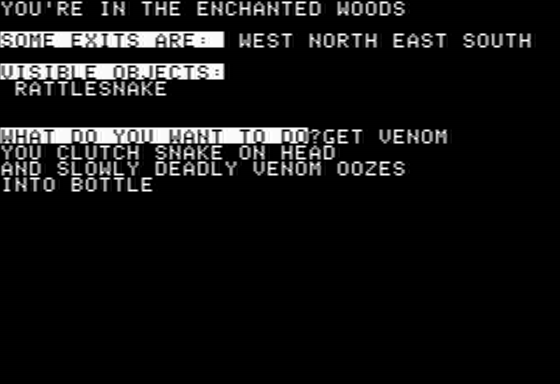
Snake venom, again: there’s a rattlesnake in the woods, but GET SNAKE doesn’t cut it, you need to specifically type GET VENOM.
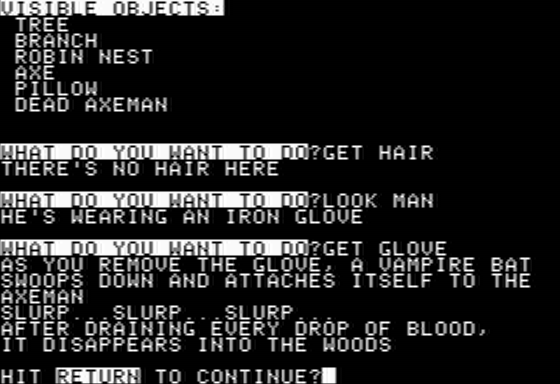
Be sure you’re wearing the iron glove from the AXEMAN while doing this!
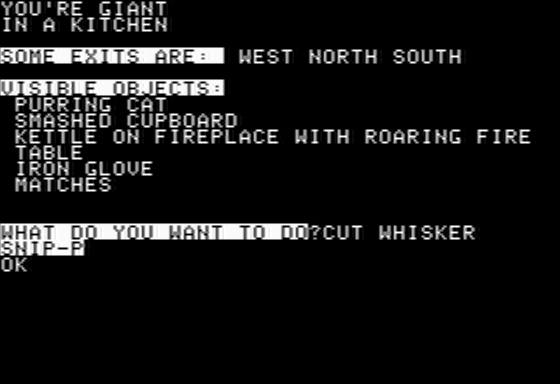
The whisker gave me a smidge of trouble. I could drop the catnip to get a PURRING CAT but then it got made at me again if I tried to just GET WHISKER. The key here is to use scissors and CUT it instead so the cat doesn’t go ouchy. Fair enough.
Brew in hand, it was time to head back to the castle and go invisible. If you go east there’s a control for the camera, and that’s the entire defenses neutralized. I guess the kidnapper is out on holiday somewhere leaving the princess behind.
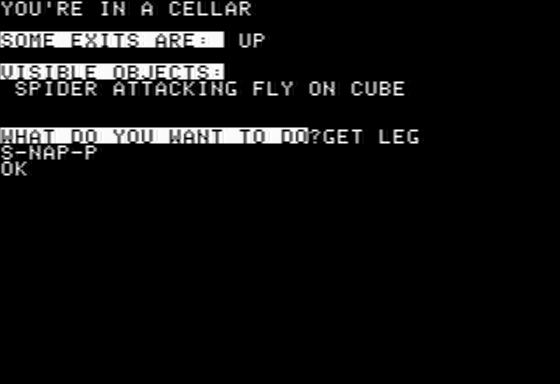
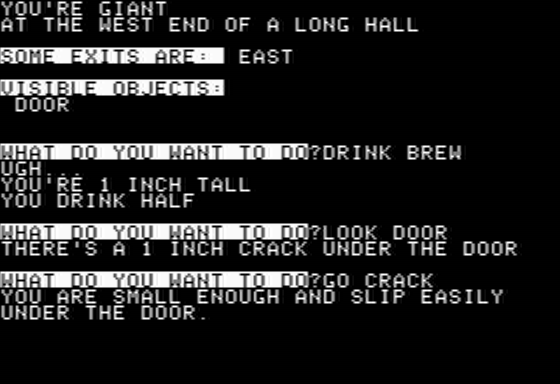
The other direction has a locked door which doesn’t break; it’s time for the third potion. Bat wing + spider leg + water. The spider leg required getting a sugar cube over to some flies in the forest, dropping the flies at the web, and then GET LEG (again, any reference to the SPIDER itself is unhelpful).
With the shrinking potion you can slip under the door where the princess is.
And then comes what is honestly and genuinely a great puzzle. It doesn’t require a huge leap of thought, but it requires a slightly lateral assumption from how the game has gone so far.
You know enough information to figure it out. I’ll pause with a picture so you can think about it.
From the April 1981 Softside, same issue as the one advertising Witches’ Brew.
In the prior instances you drank the potion yourself to perform some action, but the shrinking potion you only needed to drink half, so there’s still some left. Rather than you drinking the rest, the princess can drink the rest instead, meaning she’ll get too small for the shackles to hold her.
I needed to pick up the princess, and move back and forth a few tiems to get this message, which feels like a glitch.
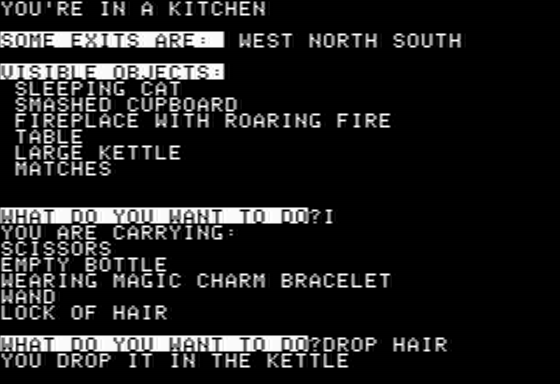
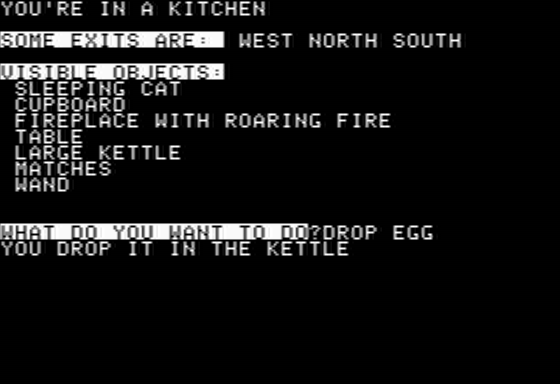
And that’s a wrap! Clearly, Kirsch has the creative chops for an adventure, but I really would have liked to see what he could do with more technical capabilities. This had lots of fiddly aspects due to the simple VERB NOUN setup, like how you DROP an item in the kitchen to put it in the kettle, but that means you can accidentally mix in an ingredient you didn’t mean to (like put the wing in too early). The reference to taking a WING or a LEG of a creature makes sense but in practice felt wobbly if it’d even work. There was very little help for if you were doing an action wrong (and no intentionality, like HIT CUPBOARDS WITH AXE).
At the very least, it is promising to know Kirsch was expanding his repertoire. Just in terms of gameplay I still found his simpler work (like Kidnapped or Around the World in Eighty Days) to be more satisfying just because I didn’t have nearly as much parser struggle.
So I have some big, fist-pump and jump-up and yell kind of news. I realize for 99.999…etc…9% of the population it is completely unimportant, but it was exciting to me. I found an Apple II version of Witches’ Brew. In fact, I found multiple Apple II copies of the Adventure of the Month, filling in many gaps.
They were distributed on “Adventure Pack #1” by The 202 Alliance, an Apple II distribution network that also worked with crack groups, the folks who broke copy protection in the 80s. It’s on the Asimov archive as D3110ADV.SDK in a directory called shk_images and I hope you understand why it took a bit of work to find.
The first thing I did was make a beeline for Black Hole Adventure’s source code, as I had the theory (due to there being no author name) that maybe some credit was present on the Apple II source but removed from the other two versions (as had happened with other Adventures of the Month). Alas, no luck.
SIDE NOTE: I know I called that game rubbish and it really is, but it also has multiple endings in a way that is highly unusual for 1980 and doesn’t really come back until Deadline in 1982. One thing I’ve noticed generally about old adventure history is how innovations appear buried in jank games; people weren’t putting the pieces together and getting, say, multiple plot endings based on in-game actions plus an in-game automap plus dynamic changing locations plus (and so forth) all in the same package.
Anyway, voila:
I’ll play with the Apple version for the rest of this game just to commemorate the moment (I’ve got some more Atari coming soon anyway). There isn’t any inherent superiority to Apple and there’s even a smidge of missing content. You see, the book on the table of the witch’s house has multiple pages. I suspected this already but the parser was giving me a fuss until I tried TURN PAGE (not a noun listed in the game, you just have to guess).
The Apple equivalent doesn’t have the colorful ads on the bottom of each page.
Also, BONUS SURPRISE:
TRS-80 too! This time it came in an email attachment from LanHawk.
I’m not using this version though, because it seems to have either an oddity or a straight-up bug. The cave above should have a SHOVEL and a BAT but you can’t see either. The same issue happens elsewhere; various objects seem to be invisible that are clearly visible in the other two ports. Still the TRS-80 version was useful to have, because of this from the source code:
Not only do the comments (not present in other versions) definitively mark the game as by Peter Kirsch, but it gives something of a work schedule; this wasn’t written all in the month it was published, but rather was a revised version of a game written near the end of 1981.
Going back to the gameplay, the biggest breakthrough I had was realizing that wearing the magic charm bracelet made me essentially immune from the witch altogether. I had tested looking at the witch or even just looking at the bed and running across the death sequence from last time. However, I hadn’t tested this after wearing the bracelet, and managed to find a pillow and matches on the bed and a wand on the witch; I could filch all of them.
The wand of course is necessary for anything in the book. To summarize more succinctly:
invisibility: snake venom, human blood, nail clippings, cat whiskers
growth: saliva, tears, human hair, egg
shrinking: spider leg, bat wing, water
In all cases “PUT IN KETTLE, HEAT, WAVE WAND.”
I can get close to growth. For saliva you can just SPIT and for tears you can just CRY.
For the egg you can take the pillow, deposit it outside at the tree, and go through the branch-breaking sequence which you will now survive. This yields you an egg. That’s one sturdy pillow.
Incidentally, the AXEMAN who I had trouble with last time can just be referred to as a MAN. Unfortunately you can’t be friendly or anything; the best I can do is to KILL him with my baseball bat, which lets me filch his axe and an iron glove (followed by a scene with a vampire bat).
Speaking of vampire bat, you can go in a direction I somehow missed west into the woods and meet it, along with some flies and a snake. I managed to kill the bat but haven’t had luck getting the blood off of it.
Going back to the growth potion: it needs saliva (check), tears (check) and egg (check). But I can’t get human hair.
Not being able to get hair is very, very bizarre. I’ve got a dead body outside, and even if the axeman is outside, I could technically use my own character’s hair. I also can’t try grabbing witch hair. I can’t tell if this is meant to be a puzzle or if I’m hitting parser difficulty again. If it’s a puzzle then it clearly is in absurd object sourcing (aka Caesar’s ladder) territory.
I’m getting close to the threshold of using hints, but I am liking the game’s density; there’s a good feel of having more layers in each room than you’d expect. But a nagging feeling I’m missing some abstruse verb is not helping keep my willpower.
Well, there’s twelve of them for the year, so we might as well pull another Softside magazine Adventure of the Month out of the jar, this time from April. (Previously: Windsloe Mansion, Klondike, James Brand.)
When I hit this game I had an immediate reminder of how fragile the media I write about is. I remember seeing the file in the past on some forum post, which now does not seem to exist. Atarimania, the most commonly recommended archive, didn’t have it. I finally got a hit at Atari Online, but you know availability is getting dicey for a when you have to break out the Polish archives for a US monthly subscription-on-tape.
As the Atari name implies, that’s the only platform I found it for. The TRS-80 versions and Apple II versions are supposed to exist.
Also, the game has no author listed, but based on the style and layout it is most certainly another Peter Kirsch one, despite the content changing things up on his usual modus operandi (having a linear sequence of short scenes).
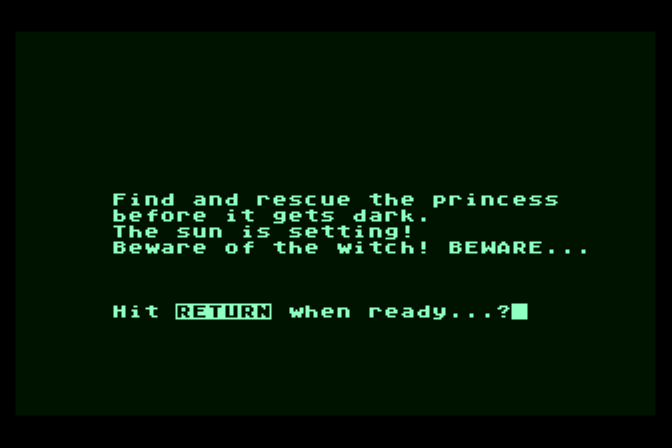
Regarding the plot (“find and rescue the princess”), weirdly enough, we haven’t had a lot of princess-rescue games. Technically the very first adventure (Castle) is one, but there’s also a prince you can rescue, or you can rescue both the prince and princess. Wizard and the Princess played it straight. Dragon Quest Adventure kind of played it straight but also you weren’t supposed to kill the dragon and you get a kiss. Treasure Hunt had a “black book” with the “addresses and phone numbers of every beautiful princess that lives in Vermont”. The Program Power game just titled Adventure had a princess that kept running away.
I’m starting to think people were thinking the idea was old hat even in the 1970s. For our purposes here though, this seems to be playing it straight, but I haven’t gotten far enough to be sure. At the very least, the focus is more on the witch in the title than a princess.
To be clear on it looking like Kirsch, compare to James Brand and notice the upper-case room description to start, the exits listed with one space of indent, the visible items listed with three spaces of indent, and the pattern of when text gets “highlighted”.
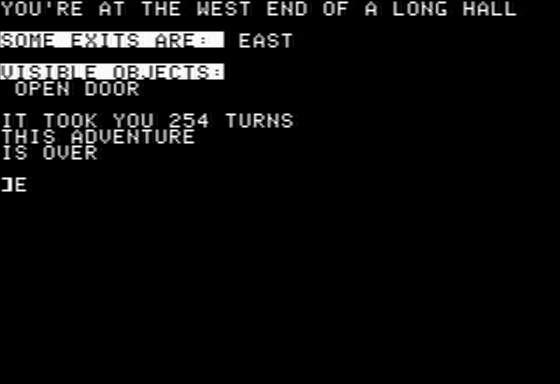
Still, this game has a unique kick-off on gameplay: a very short timer, with you placed adjacent to a Witch Cottage with both a sleeping cat and a sleeping witch. This is the sort of game where you send a lot of “clones” to be killed to get things worked out, even though the starting map is very tiny.
A selection of deaths:
There’s a table inside the cottage containing a book which seems to indicate our overall goal: get ingredients for an invisibility potion.
I mean, the first ingredient location is obvious, but taking a whisker without raising a fuss seems trickier. Can the blood and fingernails come from us? And I haven’t seen any snakes. What I have seen is a cave with a shovel and bat (not the flying kind), a garden with a MAGIC CHARM BRACELET (which you have to dig up), an AXEMAN by a tree (I can refer to the tree but not the axeman), a branch up the tree, and robin’s egg (see previous death screen).
Finally, there’s a mountain where the castle is, but it is too steep to climb.
That doesn’t give me much to work with. But I’m still intrigued to have quite a lot going on in a tight space, so I’ll keep fussing about here. I did seem to have resolved one issue already, though. As promised on the opening screen, we have to worry about it getting dark. However, picking up the MAGIC CHARM BRACELET makes the messages go away, so I assume either it is glowing so we can see or it is stopping time in some manner.
One thing I’ve been puzzling at is how Pimania got viral. Mel Croucher’s April 1985 interview in Sinclair User rather elliptically mentions sales of 100,000 (same as Elite, which is about as big a seller as the UK market could have produced). I’m skeptical of this number but it was still “a lot”.
It hit the right moment to carry another wave of contest mania, yes; rather than just burying the Golden Sundial it went on a rotating exhibition (the way to win, remember, is to find the right place, day, and time to show up). But still, I think there was a lot more marketing push than the underground-comic feel to the art might indicate.
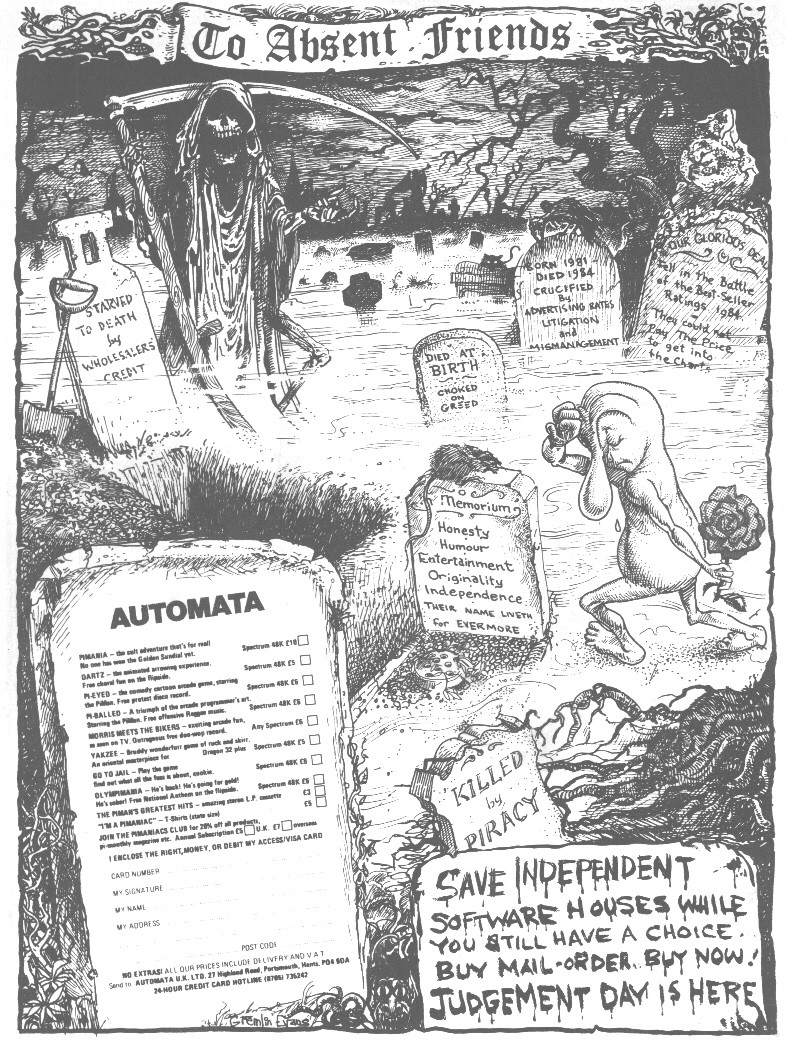
It was advertised fairly regularly in Your Sinclair, but Automata also ended up with an unusual arrangement with Popular Computing Weekly starting somewhere in mid-1983. I’ll let Mel Croucher take over (in the book Pibolar Disorder by Mel Croucher and Robin Evans, published 2018):
After a while, a magazine called Popular Computing Weekly surrendered to our idiocy, and made a deal with us. They would give us the back page of their magazine to do what we liked with, in exchange for us entertaining the masses and increasing their circulation.
Quoting Mel Croucher again, this time from Deus Ex Machina: The Best Game You Never Played in Your Life:
Looking back, I don’t know if I invented transmedia in video games or not, but when I conjured up the computerised quest PiMania in 1981, I saw no reason not to break out of the confines of the computer monitor. It was released in 1982 as a video game, a rock album, a comic strip, a t-shirt, a magazine, a social network, and a real-world treasure hunt for a gold and diamond prize, all of which needed the other elements for maximum participation. The central character (usually Christian Penfold dressed as the PiMan) also made live appearances and TV recordings. The game went to Number One in the UK, Germany, Spain and several other territories we didn’t even know about, thanks to a new phenomenon called “software piracy”. At one point we had thousands of self-styled PiManiacs searching for the prize in the real world, and I trickle-fed them clues via the game content, the weekly comic strips and subsequent music albums. The prize was eventually won in 1985, and in 2010 a commemorative PiMania album was released on fashionably retro vinyl, complete with a PiMan mask, so I guess the little bastard is still selling, and I want to bring him back to life when Deus Ex Machina 2 is done and dusted. But that’s another story.
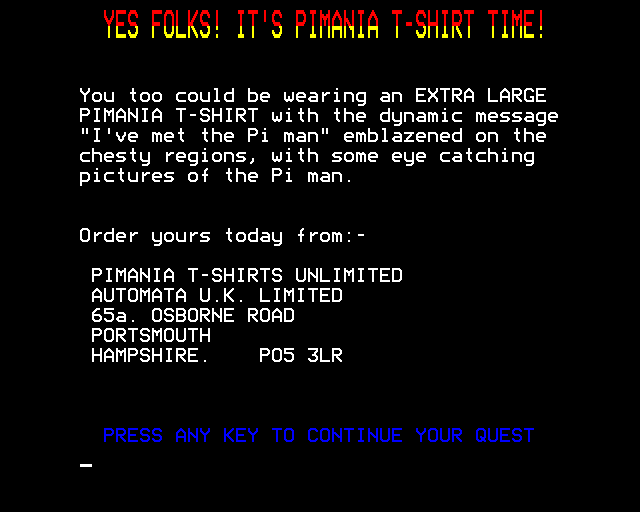
Regarding a T-shirt, there’s also a pitch for merchandise within Pimania itself, but I’ll get to that. I wouldn’t go all the way cynical and say the entire enterprise was unhinged capitalism, but there was at least some level of opportunism.
I say all this because by most metrics the game is pretty dire.
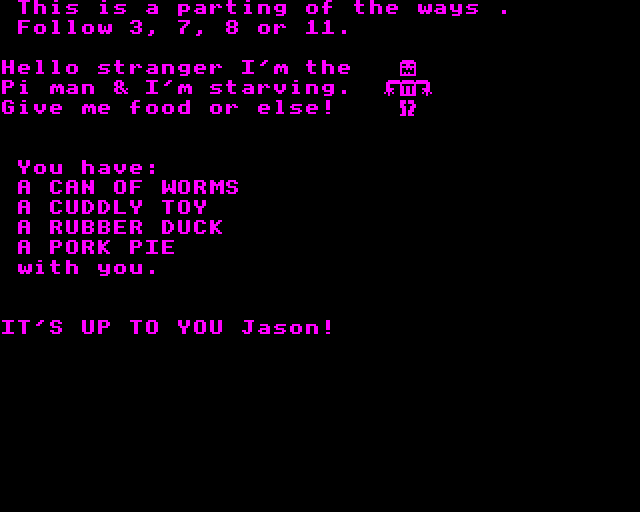
Continuing directly from last time, I had found a Scared Pi-Man and Bored Pi-Man and managed to trade some items. I theorized about at least one other form, and I found it as Hungry Pi-Man.
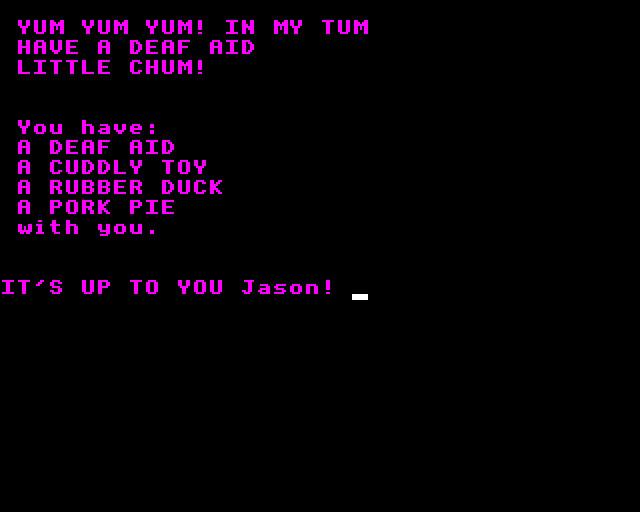
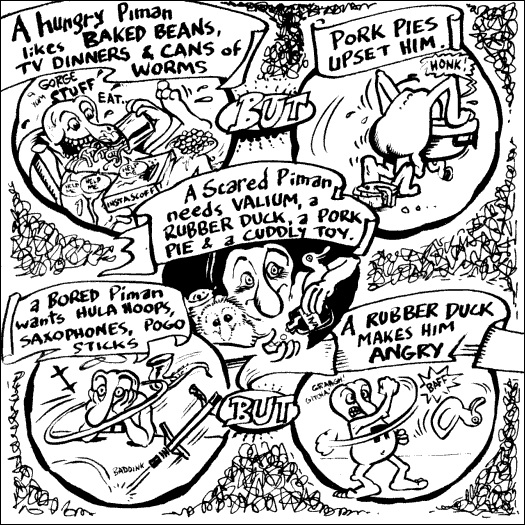
Hungry Pi-Man’s needs are fairly obvious, and he trades just like the other two:
CAN OF WORMS → DEAF AID
BAKED BEANS → HANGLIDER
TV DINNER → TELESCOPE
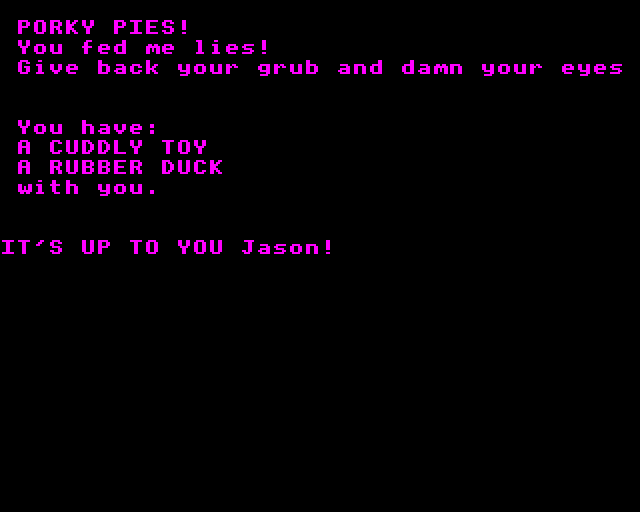
A pork pie is just like the duck with bored Pi-Man; it will cause him to steal something.
While I didn’t work out the pattern until fairly late, to simplify the narrative I’ll explain now: the rubber duck + bored Pi-Man and pork pie + hungry Pi-Man combinations are still important. Holding them in inventory is what summons the respective Pi-Man. The scared one doesn’t seem to be fussy, but the other two simply won’t show unless you have the right item, which is part of why it took me so long to find the Hungry variant (I just didn’t have the luck of wandering around with pork pie in hand, I dropped it in an object stash fairly quickly).
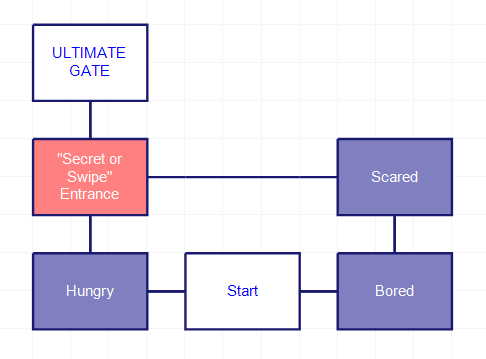
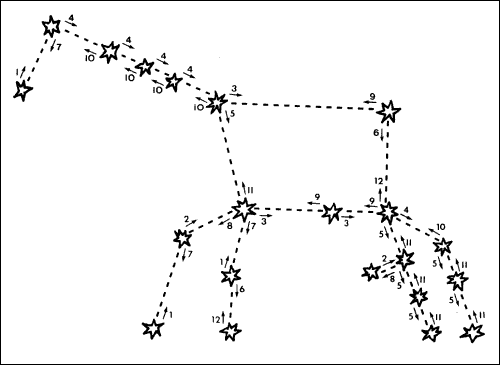
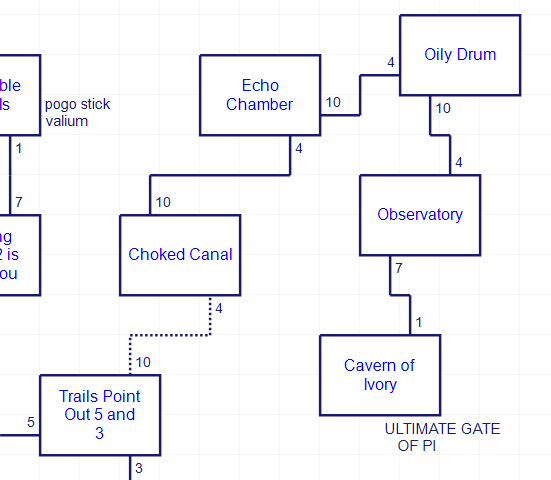
Because it also ends up being important, let me give a simplified map of the three forms of Pi-Man (there ends up being only three) as well as the “secret exit” to the ULTIMATE GATE OF PI.
This excludes all “side passages”.
The “secret or swipe” is what I’m calling the room where sometimes a green door appears, and sometimes the Pi-Man appears to steal one of your items (one that’s been traded for, like, the DEAF AID, but it won’t steal the CAN OF WORMS).
The gimmick turns out to be that if you don’t have a stealable item, nothing happens; if you do, then either it gets stolen or the green door gets open. So you have to risk item theft in order to get in the door.
Furthermore, this isn’t a 50-50 chance. In some cases it is more like 75-25 odds tilted in favor of your item getting stolen (if you have more than one traded-for item it will just steal one, but stealing an item still means no open door). In some cases it is, maybe, 100-0.
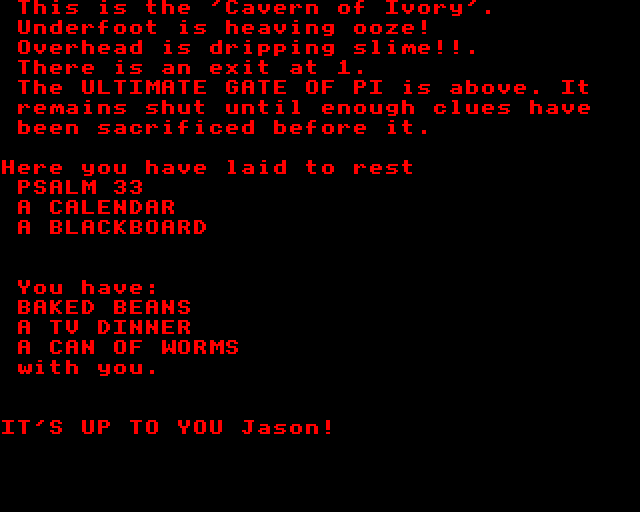
From this next part I am essentially reliant on the pamphlet “The Answer” that was released after the contest was finished. In order to win the game you need to bring seven specific items into the ULTIMATE GATE and drop them. Remember you normally aren’t allowed to drop them, so it is clear when dropping an item as a “sacrifice” works that it means something special.
The seven items are THE COMPASS, THE CALENDAR, PSALM 33, THE TELESCOPE, THE DEAF AID, THE BLACKBOARD, THE HANGLIDER. Any other traded-for items (like OXYGEN) the game won’t let you drop at all.
I never managed to get all seven items in.
This screen was my nemesis. I kept seeing it over and over again rather than having the gate open. The Answer claims that “The more useful the gift, the less likely it was that the Door would be revealed.”; in other words, a fairly nifty object like The Telescope (which gives you a picture of what the target location for the contest looks like) is allegedly much harder to get past the Swiper.
I say “allegedly” because I never got the telescope through, not after many, many, attempts. The randomness is pure hell. In addition, you need to get all seven items through in a fairly specific order.
Remember how the pork pie summons Hungry Pi-Man and the duck summons Bored Pi-Man? (Not something mentioned in The Answer, by the way.) The seven items you need are all from Hungry and Scared. You need to trade away the duck as part of the sequence (you get a CALENDAR from Scared); it means, assuming you stash the Calendar safely, you never see Bored again.
This isn’t terrible in that even though one of Bored’s items technically gives a clue (a MEGAPHONE, I’ll talk about it later) the megaphone doesn’t count for the seven items at the gate. So Bored Pi-Man is technically optional.
On the other hand, you need the pork pie to summon Hungry, so you have to wait on giving the pork pie to Scared until you’ve got all of Hungry dealt with.
That all still is just a matter of sequencing carefully, but the ending upshot is having one (or a few) items that need offloading at the Gate and the Swiper Pi-Man just refuses to let you through. I tried many different permutations. I did get close once — I would have made it to the Gate with six items, but I got stymed by an in-game ad.
You see, typing 10 to go into the green door only sometimes works. Sometimes it gives you an ad. The hard-fought after, sometimes-10-minutes-to-appear green door. I wish I was joking.
After hitting the ad-door the room’s randomness “resets” and you can have something get stolen rather than have the real door appear. I basically got stuck with my cargo and after many different approaches I concluded there was no way to get through.
People talk about the game being obtuse, but really, in a way, once the initial obstacles (opening key and movement) are resolved it is almost trivial; the trades are all very simple puzzles. The appearance conditions of the Pi-Man are arbitrary to work out, and breaking through the Swiper door is especially arbitrary. It is a game near-impossible (impossible?) to beat not because of obscurity but because of randomness.
So I apologize: no official ending.
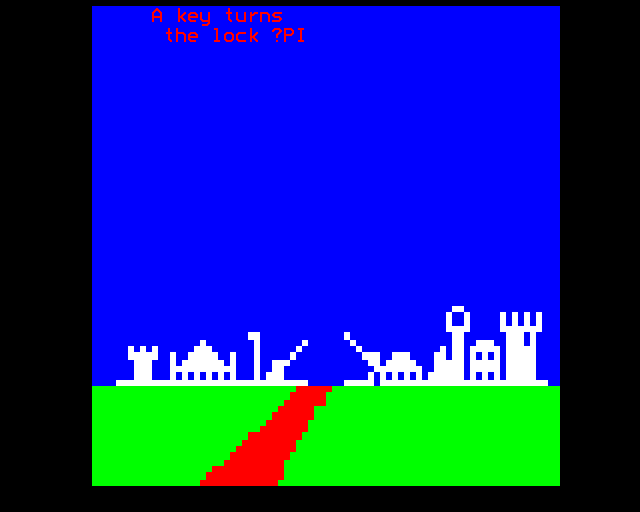
Now the whole thing is in BASIC so we can still read the ending. After depositing the seven artifacts you are asked for one final key, which is 22. (22/7 being an approximation of pi, and 22/7 being the day the contest is asking for.)
AT LAST, BY ACCIDENT OR DESIGN YOU HAVE RETURNED THROUGH THE ULTIMATE GATE OF PI. REMEMBER WHERE YOU HAVE BEEN AND WHAT YOU HAVE SEEN…. REMEMBER TOO THOSE GIFTS THAT UNLOCKED THE GATE. DISTIL THIS KNOWLEDGE AND MEET ME AT NOON ON THE CORRECT DATE AND PLACE REVEALED. I’LL BE WAITING THERE FOR YOU EVERY YEAR, BEARING THE GOLDEN SUNDIAL OF PI
Ugh. The other aspect about all this is that I was able to speed up my emulator. Normally there’s a long wait between commands, but at least I could zip around the map, but it still got irritating trying to get the TELESCOPE through to the gate for the 6th time. I tried save state abuse and that didn’t help either.
Why didn’t any of the reviews point this out? Did nobody really finish the game?
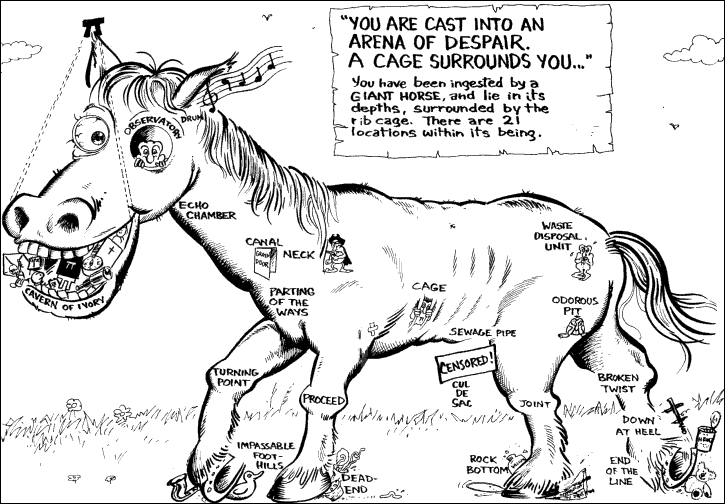
In truth, even the winners, Sue Cooper and Lizi Newman (teachers from Yorkshire), really didn’t. They noticed, if you draw the directions “properly” that they make a horse. The correct place to go was a chalk outline of a horse at Hindover Hill.
Not normally addicted to computer games, they have been playing Pimania since early 1983 on a Spectrum. When I asked Sue for an estimate of the number of keyboard hours they had put in, she replied: “Very little, we knew it had to be a horse fairly early on, so most of our time was spent in researching where!”
They then looked for prominent horses. The star constellation in particular (see the opening animation reference to “shooting into space”) is a Pegasus. They hit two “wrong” horses on the July 22 dates in 1983 and 1984. In 1985:
The clue that pointed them to the correct geographical location was the fact that Pegasus is near the Seven Sisters of the Plough. Their search, after a misleading pointer to Cambridgeshire in the Field Guide, finally put them on to the Seven Sisters cliffs between Seaford Head and Over.
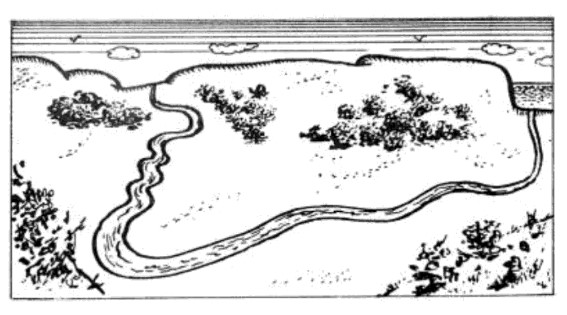
However, they were not convinced that they had the right spot until they made a pre-visit the day before. They saw the large compass mounted on a pillar, close to the car park entrance at this beauty spot. They also noticed the inscription of Psalm 33 on a metal plate set in stone (and adjacent to Psalm 34 in the game) nearby. But it wasn’t until they saw the view down into the Cuckmere Valley, where the river meanders to its outlet at Cuckmere Heaven, that they became convinced that this was indeed the view shown in the Pimania graphic when looking through the telescope.
Here is the river as illustrated in The Answer:
I wish I could give a screenshot, but I was never able to get the Telescope up to the Observatory, where it gets used.
Nor did I get the deaf aid through, which has the Pi-Man listening to the notes CAGG. This is meant to be Ca, or Calcium, referencing the chalk outline of the horse; the GG is supposed to reference “baby talk for a horse”. This latter bit makes no sense to me, is this some kind of British thing?
Also, I never bothered with the megaphone — too exhausted — but if you take it to the Echo Chamber next to the Observatory you can use it to get
I WILL BLESS THE LORD AT ALL TIMES; HIS PRAISE SHALL CONTINUALLY BE IN MY MOUTH!!!
I am honestly sheepishly impressed with the contest part. The GG part is the only thing in the explanation that made me confused; everything seems genuinely workable (not that it stopped legions of Pi-Man fans visiting Stonehenge hoping that was the right place). While we’ve had map spelling things before, the geometrical angle of the clock makes it particularly slick (as well as the rooms corresponding to the parts of a horse). I do have one last piece of history to baffle over, though:
According to various sources, including in Pibolar Disorder, the intent for the final position was for the Finder to be at the horse’s arse. The teachers were instead at the horse’s head but Croucher gave the prize anyway.
…Mel didn’t have the heart to tell them the exact location of the treasure was in the horse’s arse, and he got Robin to change the official answer book accordingly.
But … why? What possible clue is there to the arse rather than the head? The ultimate gate of pi is at the head, the megaphone signals the head. (Even if you consider the megaphone a “negative clue” — as it doesn’t go to the ultimate gate — that doesn’t signal the arse.)
The answer book of course smoothly explains why the head works. There is nothing that contradicts it. Is the whole thing maybe a waggish joke Croucher was playing on future historians? (It makes a terrific conclusion to Jimmy Maher’s chronicle.) I don’t know, but if anyone has a theory as to what was intended there, I’d love to hear it.
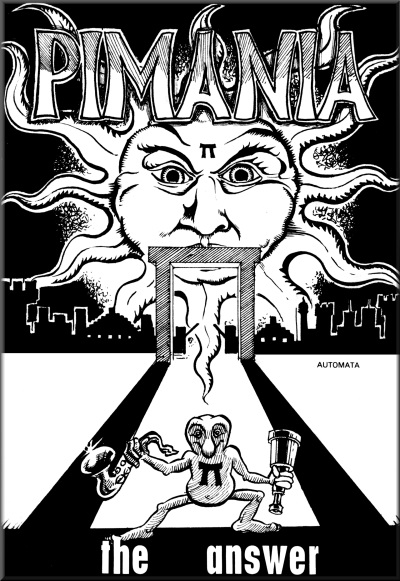
Full Pimania cassette inlay, from World of Dragon.
If you study the image above and turn your head sideways, you’ll notice the game Pimania includes
FREE APPALLING HYPNOTIC DISCO THEME MUSIC !
The game was on cassette like most of the games in the UK market, so audio and code could be stored via the same medium. The entire back side is taken by an erratic piece of music.
I can make no conclusion even after playing the game a significant amount of time. I think it may have more to do with the contest, which I am theoretically not planning on approaching.
The “theoretically” part is because there are aspects of the game related to winning the adventure (or “getting to the end” at least) and aspects related to the contest, but it is not clear which is which. So discarding some information as “external” may reduce the complexity.
For example, last time I had encounter with a scared Pi-man.
Valium is not the only thing that you can trade. For example, you can hand over a CUDDLY TOY and get back PSALM 33. I assume from the Bible, there is no other description.
16 There is no king saved by the multitude of an host: a mighty man is not delivered by much strength.
17 An horse is a vain thing for safety: neither shall he deliver any by his great strength.
18 Behold, the eye of the Lord is upon them that fear him, upon them that hope in his mercy;
19 To deliver their soul from death, and to keep them alive in famine.
I combed over the text a bit to see if it had any game relevant clues, and I don’t think so; if it gets used for something I suspect it goes to the contest.
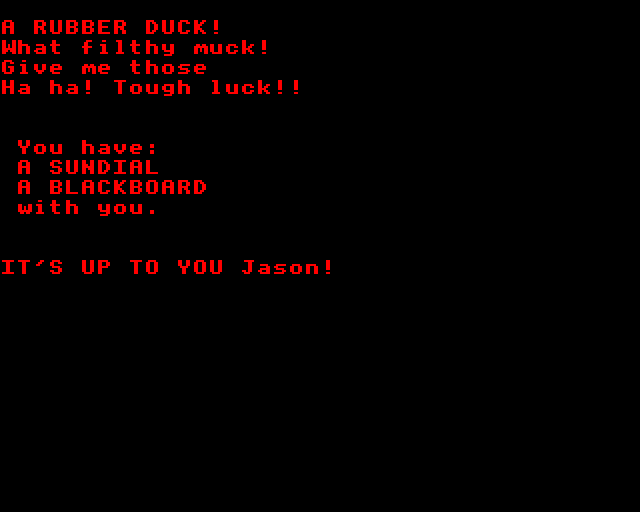
Next to the “scared Pi-Man” room, Pi-man can also appear in a “bored” permutation. He’s willing to trade items just like the “scared” Pi-Man is.
This screenshot was taken after I had already accured some loot. To be specific, whilst wandering the map with no trading involved I found
BAKED BEANS, CUDDLY TOY, RUBBER DUCK, PORK PIE, TV DINNER, SAXOPHONE, CAN OF WORMS, HULA HOOP, POGO STICK, VALIUM
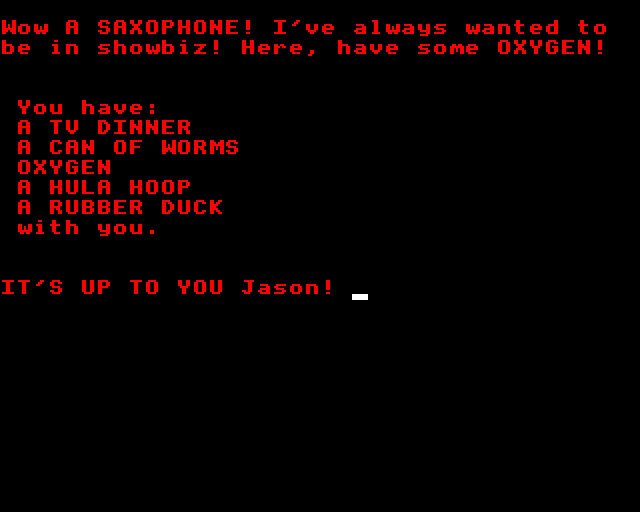
The POGO STICK, HULA HOOP, and SAXOPHONE can all go to the “bored” Pi-Man to obtain a SUNDAIL, MEGAPHONE, and OXYGEN respectively. Most trades have the message “THANKS A LOT (yourname) SEEN ONE OF THESE BEFORE?” followed by the item you are getting, although the saxophone has a special message:
The fact Pi-man is holding a sax in most of his pictures suggests this is one of the more important trades. With “scared” Pi-Man the VALIUM, CUDDLY TOY, PORK PIE, and a DUCK get a BLACKBOARD, PSALM 33, COMPASS, and a CALENDAR respectively.
None of these traded-for items can be dropped. That is, DROP OXYGEN gets the message
You can’t do that around here!
There is an inventory limit of five, which means (since there are seven items to trade for that I’ve found so far) it is technically impossible to get all of them at once.
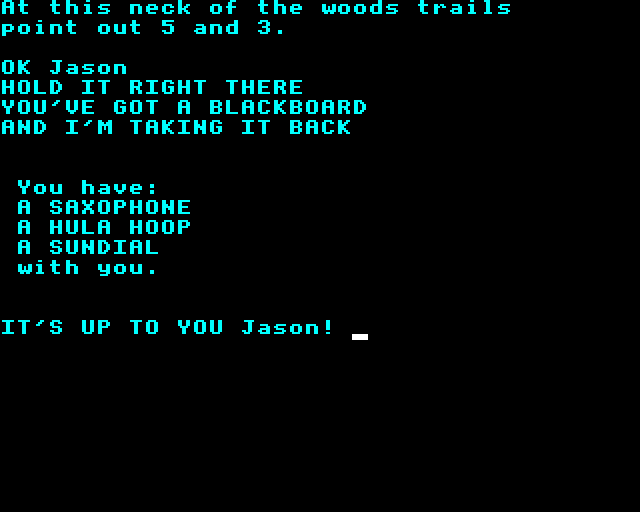
Now, you’re not totally stuck once you get five “traded items”. One room in particular (adjacent to the “scared” pi-man in the other direction from “bored”)…
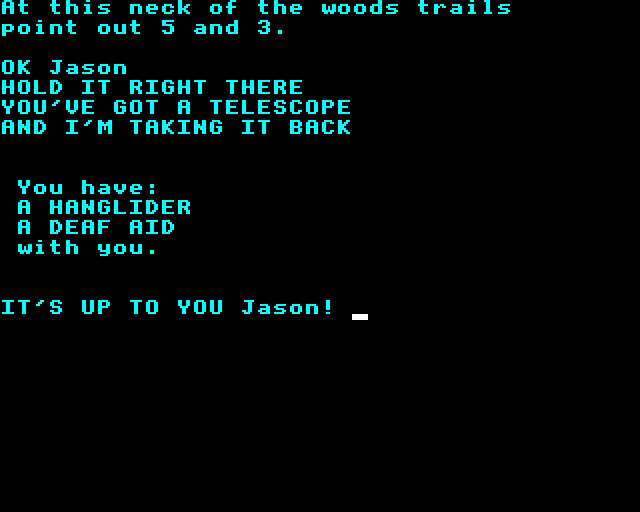
At this neck of the woods trails point out 5 and 3.
…has Pi-man sometimes swipe objects back from you, one at a time. If it triggers seems to be entirely at random, but you can use this to “take back” a trade. I had my blackboard get swiped and the valium re-appeared again in a different room location on the map (so I could trade back for it if needed).
You can also, oddly enough, trade the duck to the bored rather than the scared Pi-man. He will take both your duck and another item from your inventory, which can also trim down your trading list.
This all seems to be more or less just musical chairs leading to no plot in particular. I can try to USE SUNDIAL and get no response (followed by the screen clearing and the room description repeating) but otherwise I consistently get (say for the CALENDAR):
SORRY!
YOU CAN’T USE A CALENDAR
AROUND HERE
Rather at random — maybe literally at random, but I might have hit a silent trigger — I managed to find one secret exit. Back in the room with the “Pi-man swipes stuff” behavior, one of my visits mentioned a new way out:
It is the only time I have seen this exit. I tried repeating going in the room many times before and after without this result.
The path is linear; going 10 moves forward most of the way, with 4 (pointing the opposite way on the clock/sundial) going back.
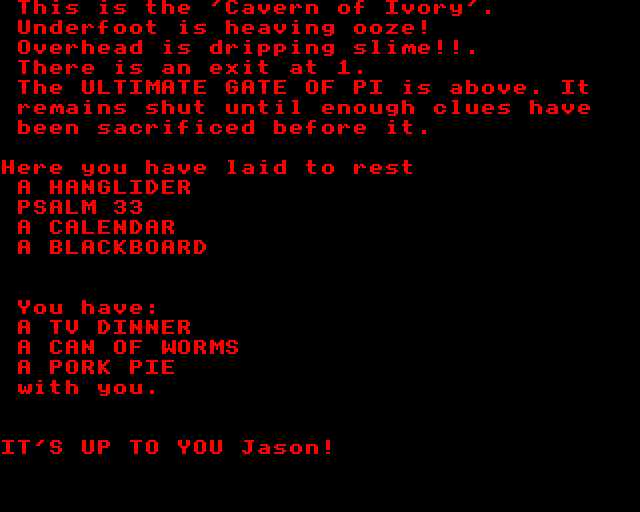
At the end of the line is the Cavern of Ivory, and the ULTIMATE GATE OF PI.
I strong suspect this location is the end of the game. However, I’m not sure how to “sacrifice” any objects. I can drop the anything from the “initial object stash” to no effect; I haven’t been able to USE anything at the gate. However, I still haven’t tested a great many items (see my lack of ability to have the secret exit re-appear).
I’m not sure where to go from here other than to randomly trudge around some more and hope something useful happens. I do have the suspicion there might be more iterations of Pi-man.
Mel Croucher as depicted in Sinclair User, April 1985.
I found the opening somewhat engrossing (albeit surreal) but this has degenerated into a “cope with the weird system” game. Any promise of social satire has pretty much evaporated. Highly cryptic hints are one thing, but this game seems designed to require testing everything everywhere and hoping something falls out. I admit I am close to the “stop trying to solve it myself and look for a walkthrough” threshold here. Especially with random (?) elements it doesn’t seem worth it to trudge in circles for another few hours with nothing to show for it. I’ll give things another good hour before I start cracking a look.
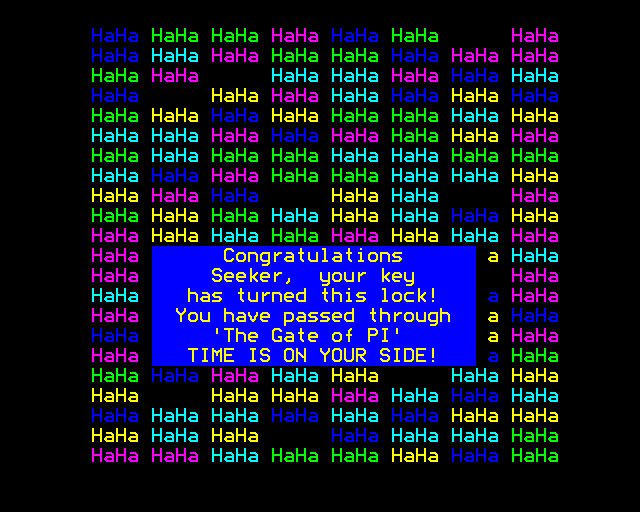
WELCOME SEEKER, YOU STAND BEFORE THE GATE OF PI. YOUR QUEST IS TO LOCATE THE GOLDEN SUNDIAL HIDDEN IN TIME AND SPACE BY THE CORRECT INTERPRETATION OF THE TRUTH THAT LIES WITHIN THIS PROGRAM.
ON THE APPOINTED DAY, ONE AMOUNG YOU WILL BE REWARDED WITH THIS CELEBRATED ORIGINAL TREASURE. IT IS CRAFTED FROM GOLD, DIAMOND AND THE RAREST OF THE EARTH’S RICHES.
Recently, we — and I do mean we, it was most decidedly a team effort between myself and my readers — played through the “contest game” Krakit. There was a rolling prize of “10,000 pounds or more” and it fairly intentionally seemed targeted at the same market that went wild over Masquerade (a contest that ran from late 1979 to early 1982).
Krakit was not that replacement. It was too annoying and too hard, with 12 questions that needed perfect answers, some which required essentially getting lucky, and no buried-treasure component.
Alkemstone from the year before wasn’t that either, being a US-market only game for the Apple II (the US did sell some Masquerade copies but never caught the fever the same way it did in the UK).
Pimania is the closest candidate to a game claiming the title as a Masquerade successor. It originated from and was focused in the UK, and the central mystery involved a Golden Sundial, very much aligned with the Golden Hare.
From World of Dragon.
Mel Croucher and Christian Penfold were the duo behind Automata Cartography, founded in 1977 to make tourist brochures and later audio guides. In 1981 Croucher had bought a ZX81 computer and branched out (using the same Automata Cartography label) into surreal mini-game packs designed for the default 1K model.
Now, before I show some, I think “default 1K model” needs some expansion. We are talking enormously tiny games. The VIC-20 3583 bytes found in Jack and the Beanstalk seem luxurious even in comparison. We’re talking, essentially, little poems as code. Cassettes packed with 1K-sized programs filled stores (alongside tapes for ZX81s with expanded memory) for about a year.
Complete source for a 1K game from Sinclair User, Issue 1, April 1982.
Nearly all the 1K output from other companies was, at best, generic. Despite all that, Automata Cartography produced tapes attempting to be art, in the Dadaist school; or at least tapes that would raise enough of a fuss to get attention.
Ad from May 1982 Sinclar User.
Vasectomy involves a “short sighted drunken surgeon”. In Hitler, you put a whoopee cushion under the Führer’s chair. In Reagan, you have to stop Ronald Reagan’s grey hair from showing so he doesn’t start nuclear Armageddon.
Their next act is what concerns us today, namely their debut on the ZX Spectrum, the adventure game Pimania (with ports to ZX81, BBC Micro, and Dragon 32). Pimania features their company’s bizarro mascot, as shown here in center on a later vinyl release of Mel Croucher:
From Merchbar, Pi-Man with more arms than normal.
I would say the success of the game was inexplicable (especially once I get into the content) but I said, this was oriented as a contest game. Clues to a Golden Sundial valued at £6,000 were put in the game, and it was a real artifact designed by a legit high-end jeweler named Barbara Tipple, whose webpage claims she is “only female jeweler in Britain to ever have received 3 De Beers Diamonds International Awards”; she had already won one of them by the time Pimania came out.
Sinclair User, January 1983.
The clues in the adventure game gave an exact time and place to appear to claim the prize (rather than a location to dig), and unlike Krakit which folded with no winner (and almost certainly no way for there to be a winner), the Pimania prize was honestly and genuinely claimed in 1985. Of course, that’s three years after the game came out, so it still was rather hard to work out, and I’ve heard the adventure game portion is cryptic at the same level as Quondam or one of the other legendary brain-breakers.
I’m … not so certain yet. For one thing, the parser and especially the world modeling system is relatively light; I don’t think the programming (by Penfold) has the sophisticated capability of interlocking complex daemons which require exact timing. (I’m avoiding spoilers, of course, but if nothing else I should point out the source is in BASIC.) I think, rather, this game is cryptic, and might have a couple absurd leaps of typing required. One kicks the game off, and it was a rather fortunate choice (as you’ll see in a moment) that I went with the BBC Micro port.
I went with BBC Micro mainly because BeebEm is a fairly robust emulator.
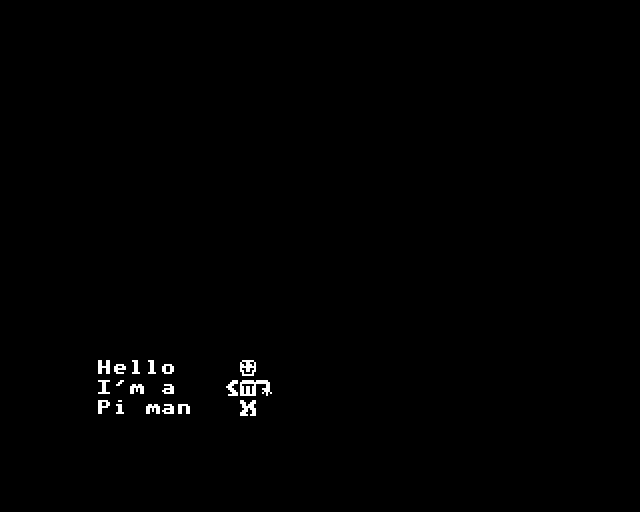
The screen above shows “pi” taking off into space, and then the prompt where you type a word. Just typing PI works.
Before explaining what happens next, I should mention the ZX81 and ZX Spectrum have a very different solution to this puzzle. Take a look at a ZX81 keyboard:
There is a key actually marked PI, or at least, you can shift the function to a mode which types a π symbol. This is the keypress required to start the game in either Spectrum version. Ouch. This is a game that was a genuine hit in the UK marketplace and has a modern Steam release. At least the Steam description spoils how to solve that puzzle.
This is followed by an animated dancing PiMan:
I’m put most in the mind of the Apple II game The Prisoner, maybe of a more absurdist variety. Directly from here you get dropped into the adventure, and I thought for a bit (maybe like The Prisoner again) the command line was a ruse of sorts, and we were supposed to do something different entirely.
The background is a garish pink. I have saved your eyes by switching the monitor to black and white mode. You’re welcome.
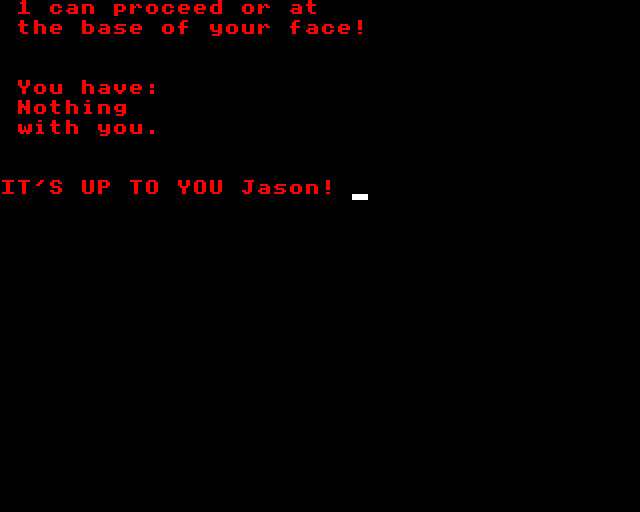
Specifically, it seemed like I could type regular text adventure commands, but almost nothing worked. I spent roughly 30 minutes on this screen. A condensed transcript of some of the more interesting responses:
> GO UP
THAT DIRECTION IS USELESS HERE. TAKE A GOOD LOOK AT YOUR FACE!
> HELP
Sorry my friend, but you have to help yourself around here!
> LOOK UP
You’ll need to use a telescope to see!
> USE TELESCOPE
YOU HAVEN’T GOT A TELESCOPE WITH YOU!
> TAKE A GOOD LOOK AT MY FACE
You’ll need to use a telescope to see!
The last prompt suggested this is a “keyword parser”, looking for words in the line rather than expecting nouns and verbs and so forth lined up in a particular order. Many other commands led to “Please will you rephrase that!”
TURN FACE, CHANGE TIME, GO CLOCKWISE, EXAMINE FACE, JUMP, SET TIME, SHOUT, YELL, SAY HELLO, GET TELESCOPE, GAZE AT SUN, 3:00, MAKE TELESCOPE, GO SUN, WAIT, PI, FIND TELESCOPE, UNLOCK ARENA, BE HAPPY
The 3:00 was fairly close. I had quite quickly decided this was all sundial-themed and I needed a time, but I needed to enter the command in the right way. 3 from 12 could be … 9? Just the digit 9?
Ah-ha! And I soon realized the general gimmick of the game’s movement — to use numbers from 1 through 12, as opposed to any kind of compass direction. If you go 3 to go one direction, you go 9 to turn the opposite way — essentially flipping sides of a standard clock. Here is my map of the game so far.
Room descriptions are minimal and sometimes serve purely to clue what directions are possible. Given the directions are not always given, I ended up testing every number from 1 through 12 in every single room. This could have been tedious, because the game’s response to a command is not instant; there’s a little animation of passing through a “pi gate” after a successful or unsuccessful command. I ended up using save states whenever I was told
NO RIGHT OF WAY AT 1
or whatever number it is, so I could jump straight to testing out 2. Some more room descriptions to give the idea:
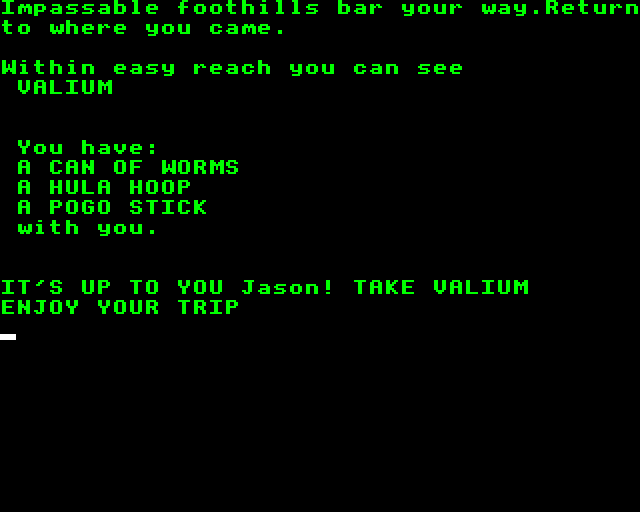
Just laying around there are lots of items: BAKED BEANS, CUDDLY TOY, RUBBER DUCK, PORK PIE, TV DINNER, SAXOPHONE, CAN OF WORMS, HULA HOOP, POGO STICK, VALIUM. Only Valium has the funny description on pick-up, as shown above. You can’t carry them all at once, alas. I’ve only encountered one puzzle while mapping, where Pi-Man himself was feeling scared.
Some Valium works, as this is the 1980s.
And from here I have gotten no farther. I suspect I need to re-check all the rooms post-Valium and the Pi-Man will have moved elsewhere. If not, then there’s some obscure item interaction in one of the rooms. Some of them do have a little description (a PRIVATE cul-de-sac has the game flash at you and warn you to get out, for instance) so the world isn’t entirely barren.
Before I get into the content here — which I promised comes off as rather different than Quest, even though it has similar gimmick — I want to share a little history I’ve found investigating Tim Quinlan (of Mad Hatter). It goes back to February 1977 and the Commonwealth School in Boston, a private high school. This was still early in computing history, as the Commodore PET had only been released the month before, and the other two members of the Trinity (the Apple II and TRS-80) weren’t out yet. If someone owned an Apple, it was an Apple I.
Public Domain via Wikimedia.
There, in the library of the school, the 13-year-old Johnathan Rotenberg held the first meeting of the Boston Computer Society. The meeting only had four people, one who came across it by accident while working late. Subsequent meetings for the next six months hovered near a membership of zero. But every group had to start somewhere, and it managed slow growth up to 70 members by October of 1978, with guest speakers discussing such topics as:
a “homebrew 9900 system,” a talk about DEC minicomputers used in sailing the America’s Cup, the ECD Micromind computer, race betting using a Wang minicomputer, and the Kurzweil Reading Machine.
October 1978 was also when it held the Home/Business Computers ’78 show, intended to address the fundamental concern, what good are these computers anyway? It grew the membership from 70 to 225. Rotenberg (in Infoworld, November 1984) called it a “very big turning point” for the group which eventually ballooned in size and important to have 12,000 members by 1984 and 30,000 at its peak. Apple made its east coast announcement of the Macintosh at a Boston Computer Society Meeting; the late Sir Clive Sinclair (of Spectrum ZX fame) was a member. Mike Markkula (second CEO of Apple) and Don Estridge (“father of the IBM PC”) first met at a BCS meeting.
This turns out to be highly relevant here, because Tim Quinlan is listed third in “323 People Who Made the BCS” as printed in the 10th anniversary issue of the BCS’s magazine, Computer Update. He was the show coordinator for Home/Business Computers ’78 — which, again, was the “turning point” for BCS hitting it big — and later became treasurer and vice president.
I would guess of the 70 earlier members, Greg Hassett was one of them. No idea about Robert Nicholas, but let’s get into his game —
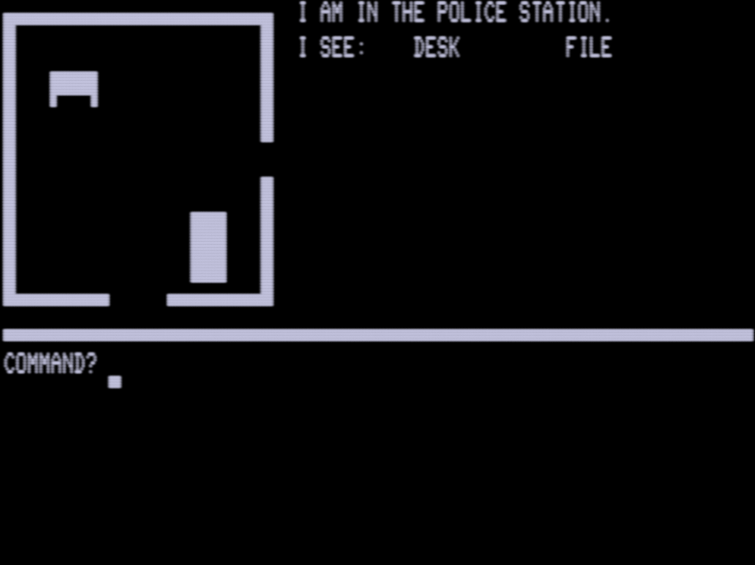
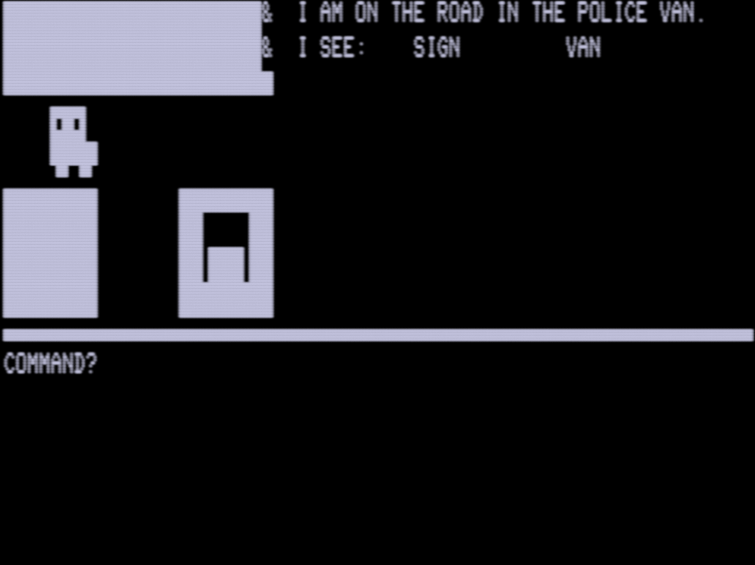
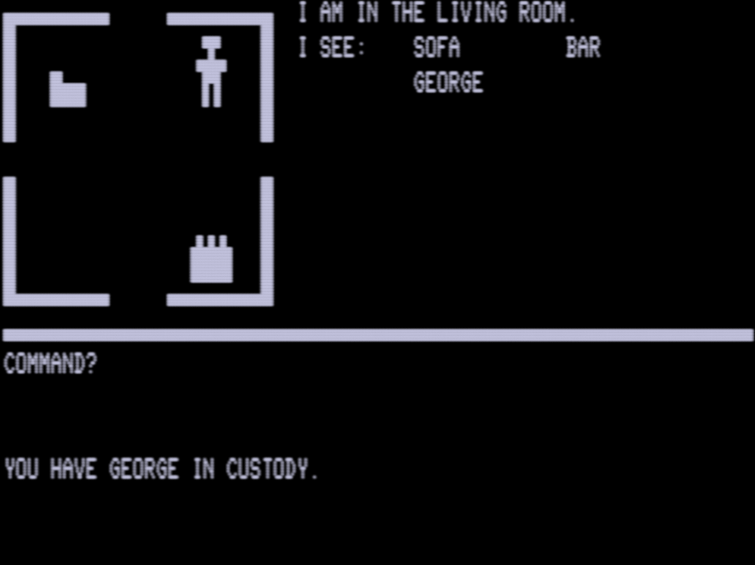
This, is, again, a game with graphics and sound, and more or less the same sound as before. This time you are a detective and there is a murder you must investigate. Your goal is to find the victim, find the murder weapon, and arrest the murderer and bring them back to a courtroom to face justice.
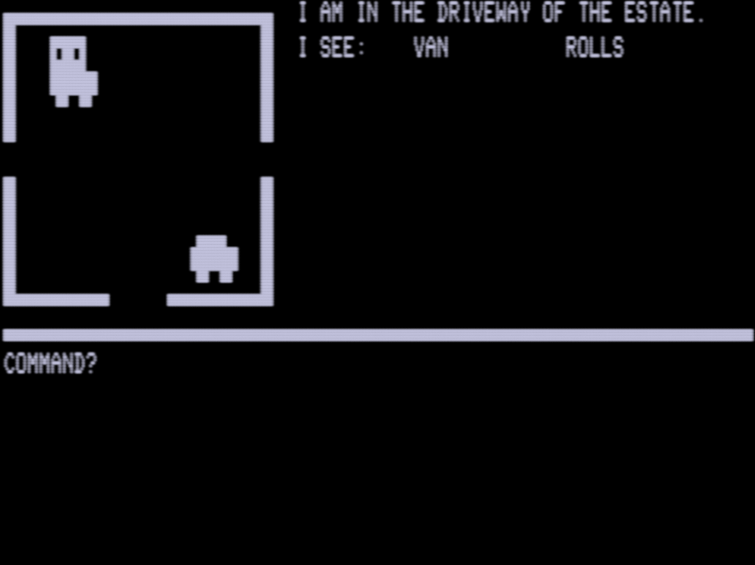
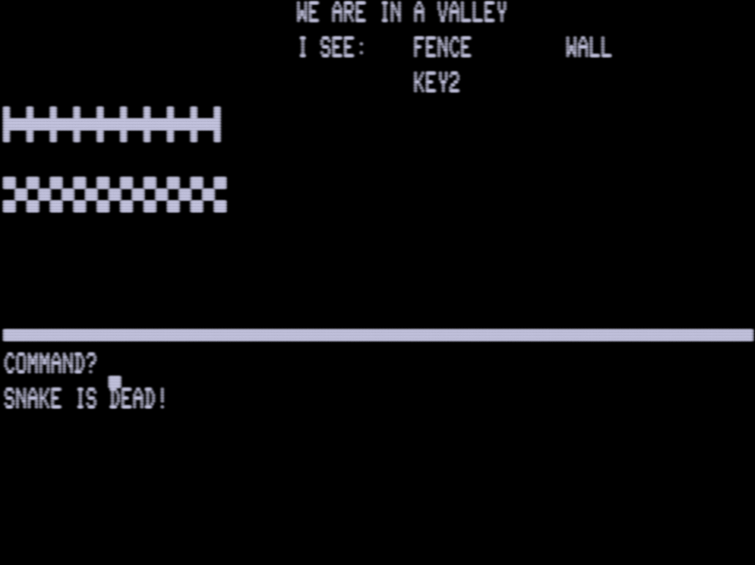
Just like before, items are randomly distributed, and in many cases you need to LOOK in order to find a hidden object. Before arriving on the estate I found HANDCUFFS, KEY1, and KEY2.
LOOK VAN: “I TRUST POLICE ARE ABOVE SUSPICION.”
The verb list is again pretty small; you can walk around, look at stuff, accuse people, handcuff people, and unlock items like cabinets (with either KEY1 through KEY3 found in random spots on the map, or with a PICK when keys won’t work).
Because everything is randomly generated you can also treat this like a speedrun of Clue if you want to and just immediately accuse / arrest the first person you see and hope you get lucky.
(Any% speedrun of Clue done in 0:00.583 as a demonstration.)
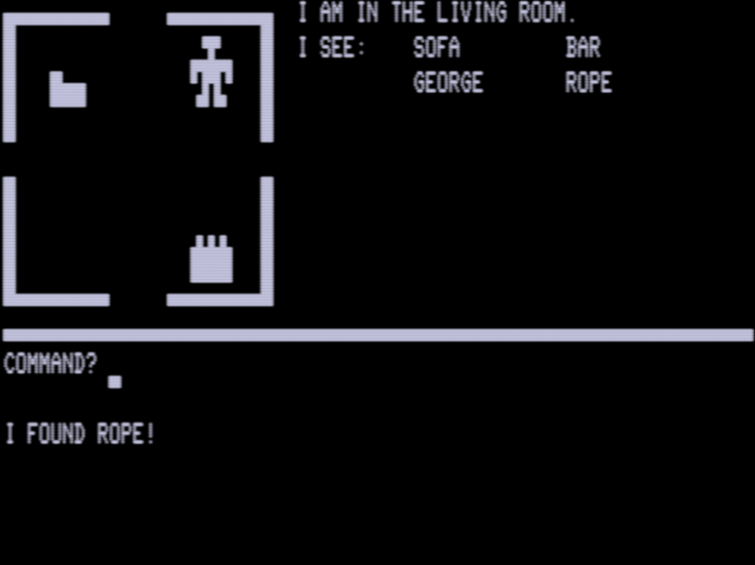
You do at least also need to name who the victim is. From George I found the nurse dead immediately to the west:
There’s a dirge on finding the body. Also, the clock gives you a time limit; there’s no light source or food to worry about.
So here’s me immediately accusing and arresting George and picking the rope there as the murder weapon (technically the second person I found, I skipped the gardener, but whatever):
Okay, that didn’t work. I bumbled around trying to find more potential criminals.
Some objects require unlocking before you can search them (like the cabinet above) although they may or may not hold a potential weapon.
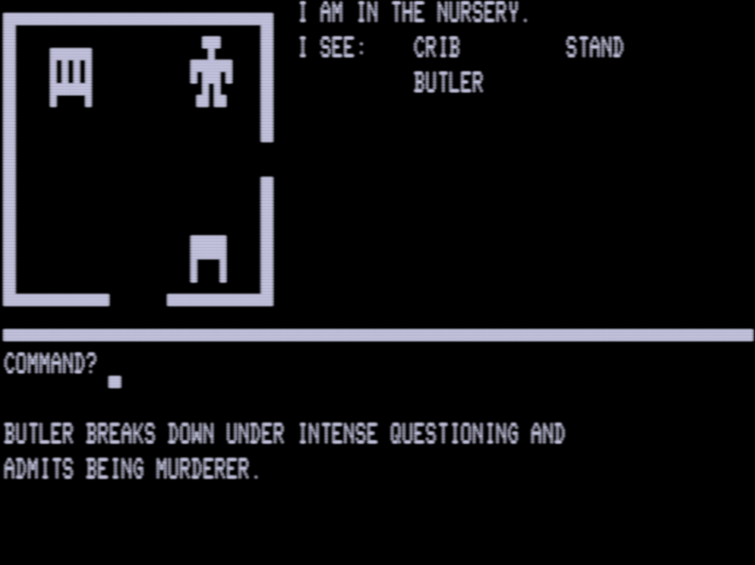
The only way for things to work is to a.) be holding the right weapon and b.) ACCUSE the right person while holding the right weapon. That’s all the evidence you need! But just like Clue there’s a fair amount of potential weapons (PISTOL, POISON, KNIFE, SHEARS, etc.) and if you are holding multiple weapons while accusing the correct person, you won’t know which weapon caused them to spill the beans. But you can save your game, guess while in the courtroom, and restore your saved game, so you can make it work anyway.
By the way, make sure you haven’t dropped your handcuffs amidst all this. Once you find the murderer, you can’t go for your handcuffs and go back, or things go awry:
If you do pick victim / weapon / suspect correctly you aren’t quite done yet.
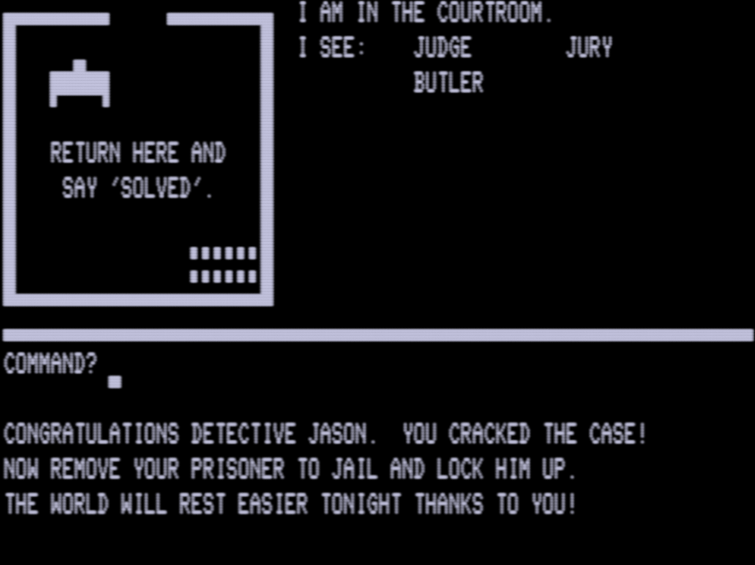
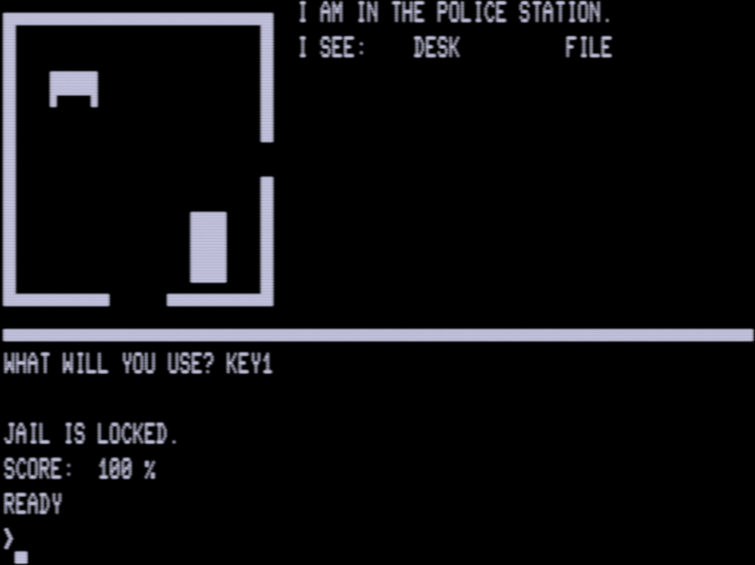
You have to take the criminal back to the jail at the police station, uncuff them (with the right key), step out, and then LOCK JAIL (also with the right key). After you do the uncuffing, if you get either of the other steps wrong (especially the not-so-intuitive LOCK JAIL given it isn’t given as a noun in the initial room description) then the murderer kills you.
Do everything correct, and victory:
I had a lot more fun with this one with Quest even though it really doesn’t have much to it. The randomization makes more sense with a murder mystery, the narrative strand of a detective who has to accuse everyone in the house more than once while holding different weapons is hilarious, and the twist ending (you will die the first time around) was clearly meant as comedy. Quest was fairly self-serious, but that doesn’t work for a structure as flimsy as this one.
It was important I get through this now because Narrrascope 2023 is happening next week (dedicated to all things interactive narrative), and I gave a talk about the All the Adventures project at Narrascope 2022. As part of my presentation I had the audience play Sleuth, live. (If you just want to jump ahead to the video, go to 31:30.)
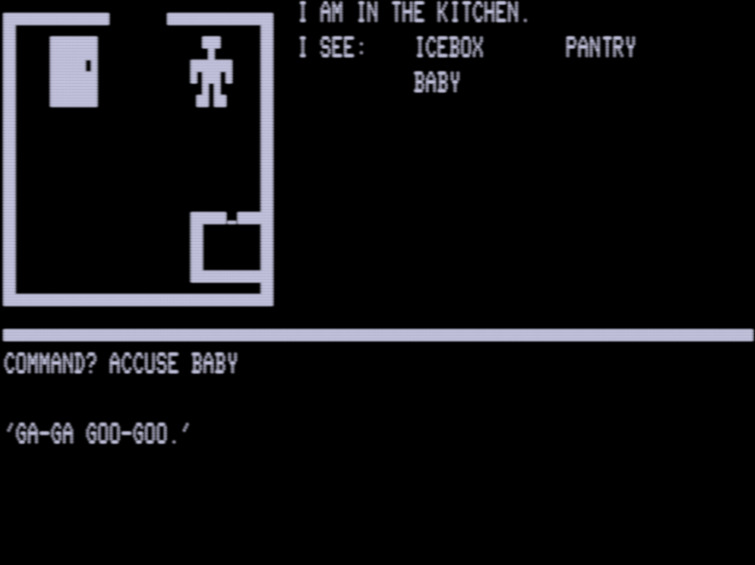
I’m not sure if my point fully came across, but I was trying to show that even a weird game from more than 40 years ago that would normally be thrown away still has value and interest, if nothing else to see what people were trying with graphics in the very early days. Also, I had the secret hope people would try to arrest the baby.
Speaking of graphics in the very early days, as Rob astutely pointed out in my last post, the pair of games being from 1980 and having a fuzzy publishing date brings up the possibility they was written before Mystery House. So Mystery House would not be the first, second, or even third graphic adventure written, but maybe the fourth.
Plotlines are thin and seem to be built around gimmickry rather than solid plots and programming.
which, ok, fair. (Just because a review is from long ago means they were impressed by everything!) “Recent” for me in December 1980 suggests the second half of 1980, that is, after Mystery House. I realize this isn’t hard evidence; despite getting more information on Mad Hatter than I’ve ever had before, we have no catalogues from them in 1980 (and I haven’t unearthed any ads) so it is hard to know when they first started offering the game. Given magazine lag times and the occasional vague use of language an earlier time is still possible; clearly, if nothing else, these games were made from a separate “track” than the ones the Williams innovated in.
We’ll be sticking on the unique-innovator track with the wildly unconventional game Pimania. It certainly has a command-interface with some of the framings of an adventure, but given the intent is to give clues in order to find the (real) Golden Sundial, does it really play like one? Does it play like any other game made, ever, really at all?
This is a game I’ve technically had on my list from the very beginning of the Project but I had it marked as 19xx. It wasn’t until a reader pinged me last year that I found out about when it was made; the manual had very recently been uploaded to the Internet Archive.
The manual means it was worth the wait and makes for one of the few late artifacts from Mad Hatter Software. Mad Hatter is a company I still find mysterious. We have a summer 1979 catalog which indicates Tim Quinlan is the proprietor and it claims to be their sixth edition; the 1979 catalog sells four of the Greg Hassett games (House of Seven Gables, Journey to the Center of the Earth, King Tut’s Tomb, Sorcerer’s Castle) and Quinlan was apparently in the same circle of people as Bob Lidill (of the Captain 80 Book of Basic Adventures) who reports Tim was “a character and always wore a top hat.”
This is the sixth catalog that we have produced since our start in the summer of “78”. Our first one listed six games for the TRS-80. By the time we hit the West Coast Computer Faire last November, we were offering 36 items for the APPLE, PET and the TRS-80. The winter edition listed about 60 Items and this one rings in with over 150.
Of the six initial TRS-80 offers, I’m guessing some or maybe all are by Tim Quinlan himself, like Budget Planning Program and Othello III, both copyright 1978, taking the “variety pack” approach to development.
How his “star adventure writer” ended up being a 12-to-14 year old is unclear, but North Chelmsford, MA (where Greg Hassett hailed from) and Dracut (where Mad Hatter was located) are fairly close, so I assume it was just meeting locally.
But back to our concern today, Bob Nicholas. He wrote two adventure games and I’m playing game #2 immediately after this one. Both tout featuring GRAPHICS & SOUND; for the sound mainly it is a “walking sound” upon move between rooms and a dirge upon dying. I have a clip to demonstrate.
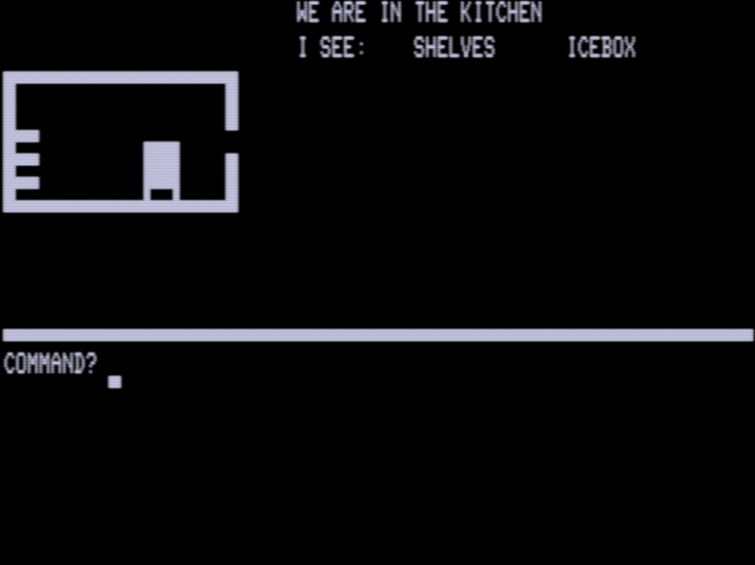
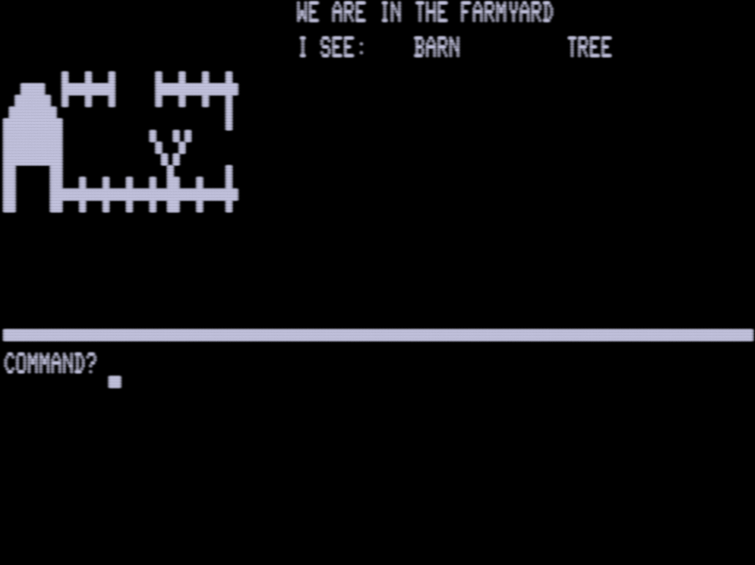
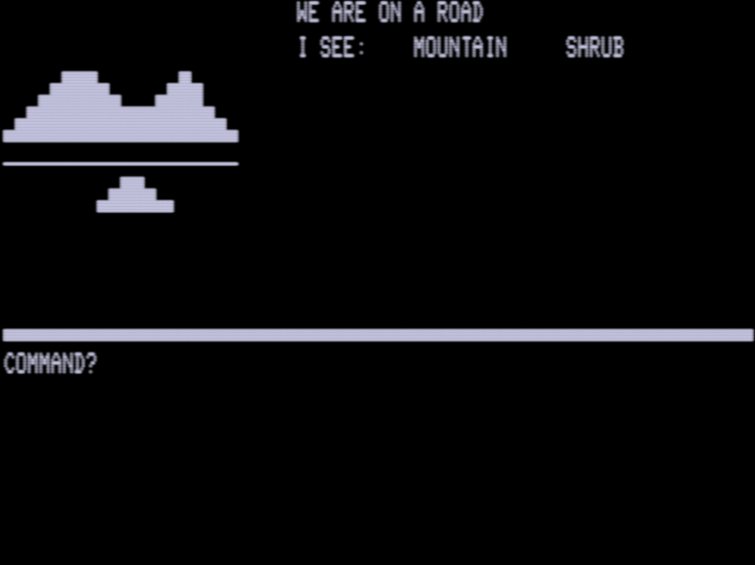
As you can see from the clip, the graphics are fairly unique; a TRS-80 character mode illustration in the upper left, objects and room name to the right, commands on the bottom.
You start at “home” and your object is to gain treasures (not unique) and fame (slightly unique). Fame is simply the game keeping track of how many monsters you’ve killed as a separate stat. You gather/kill as much you like, head home, and SAY HOME to declare you are done with the game.
Other than giant-pixel art, the other big trick the game pulls is to have objects placed randomly. That is, the initial room always has a couch and a fireplace, but in one game the couch may conceal a coat, while in the next it may have matches.
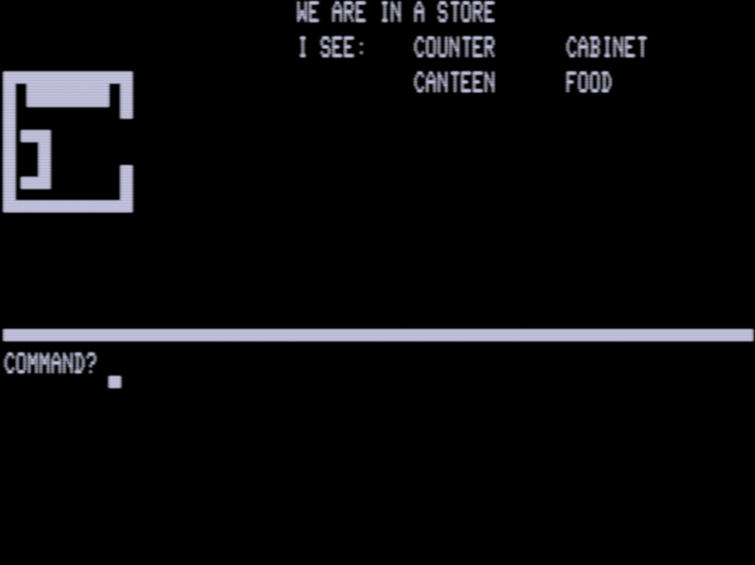
After some initial “your house” rooms where you have to LOOK in everything and scoop up whatever random items might appear, you hit the road, visiting a store on the way:
This just gives you an error if you try to GET things. Since you are in a shop, you need to BUY to pick things up, which works as long as you have your wallet with you. For this iteration the wallet was in my icebox.
There’s a cave that needs a LANTERN and MATCHES to see, and I was stuck for a while because I didn’t realize ON was a verb.
The game understands a very meagre set of verbs; directions, LOOK, KILL, ON, PULL, UNLOCK, BUY, READ. This ends up being confusing, for, say, wearing a coat — which also uses ON, and you need to do before going in the cave, otherwise you’ll freeze — or eating food. I have no idea how to eat food. If you have an OPENER and CANS you can open the cans and then you will automatically eat, but there’s a FOOD object that I never was able to use.
After typing ON COAT.
There’s not really any puzzles past this point other than “make sure you collect all the keys” and “don’t hang around near a monster without killing it, and don’t try until you have the SWORD”.
(Oh! I should talk about the MASTER that appears. The game’s “puppet” takes a “Igor from Frankenstein” like attitude and responds to every command with MASTER. There was a fair amount of hand-wringing over “who are you communicating with” in this era, with the weirdest example from 1980 being CIA Adventure pretending you are speaking with a “partner” who is doing all the actions.)
Assuming you have been doing LOOK on every item, by the time you encounter any locked things you will have found KEY1, KEY2, and KEY3.
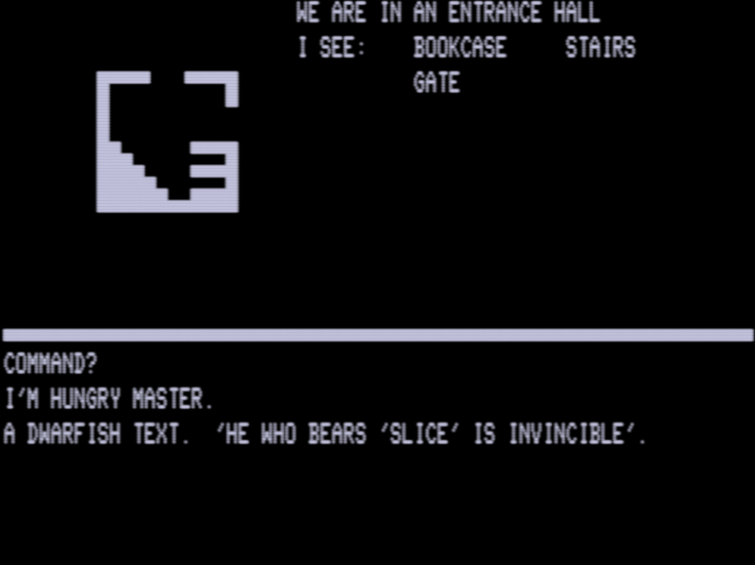
You’ll eventually hit a small dwarven complex.
I was able to unlock the gate but never got through it. GO GATE doesn’t work. No directions work.
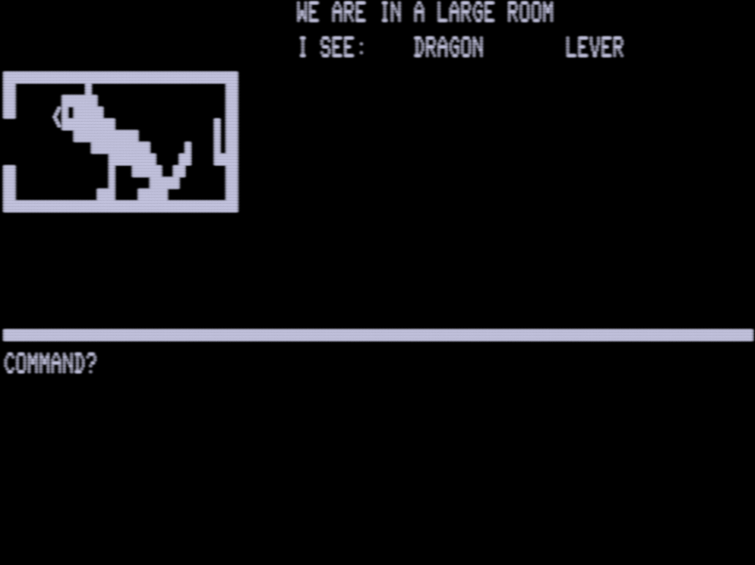
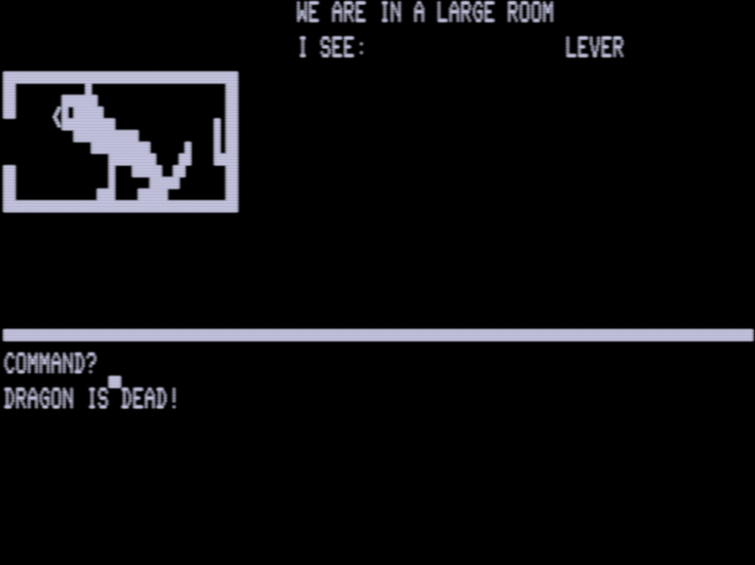
A few steps later you reach a dragon, and then KILL DRAGON / SWORD for glory.
After killing the dragon you can pull a lever to land back on a mountain and on a route that you can use to backtrack to home.
I’m unclear on if sometimes the random spawning makes it literally impossible to get 100% in treasures, but I didn’t find the game enjoyable enough to repeat and find out. There’s also a difficulty level you can set which changes lamp light / number of matches / amount of time it takes before you need food, but since this is such a linear game, the only real optimizing you can do is saving your game, examining everything available to look at, restoring the save you just made, and then only examining items with secret objects.
What’s fascinating about this game is that sound, graphics, randomization are all relatively unique and ambitious for this time frame, but it ended up being more rubbish than the more slavish copies of Adventure (like Cavern of Riches). Such can be the dues of the attempted innovation.
The other Bob Nicholas adventure, incidentally, uses the same system more or less, but because it is oriented as a mystery, it works better than this one. (Not much better, but it ends up being at least kind of hilarious, as you’ll see next time.)









































 Renga in Blue
