There is a real KAXL radio station. It services the Bakersfield, California area with a Christian contemporary format.
This game has nothing to do with the real station, but I just wanted to clear that up; because of how radio station names work we can say the fictional version is somewhere on the western half of the United States (since it starts with “K”, starting with “W” would indicate stations on the eastern half).

This game is otherwise utterly mysterious. There’s an Internet Archive page for it but it isn’t listed (as of this writing) in any of my sources. It is in GW-BASIC format for DOS, copyrighted 1982 by Doug Rogers. Was it written in that format? Probably not. GW-BASIC first appeared in 1983. In 1982 DOS is just rare overall; the only DOS-developed game we’ve seen so far is The Hermit’s Secret. There’s also textual irregularities which suggest to me a port from another platform.
It is not by some company, otherwise I could prod at that angle. There are too many Doug Rogers out there to resolve one as being the author. Could it be the Canadian judo champion from the 1960s? The one who was a developer relations manager for NVIDIA? Maybe the one who co-developed a Macintosh HyperCard stack with Randolph Valentine which generates random poetry and art?

Nevermind. At least the premise is interesting. You get a panicked call from a radio station and need to investigate. No specific goal immediately given. Was it corporate espionage? Murder? Zombies?
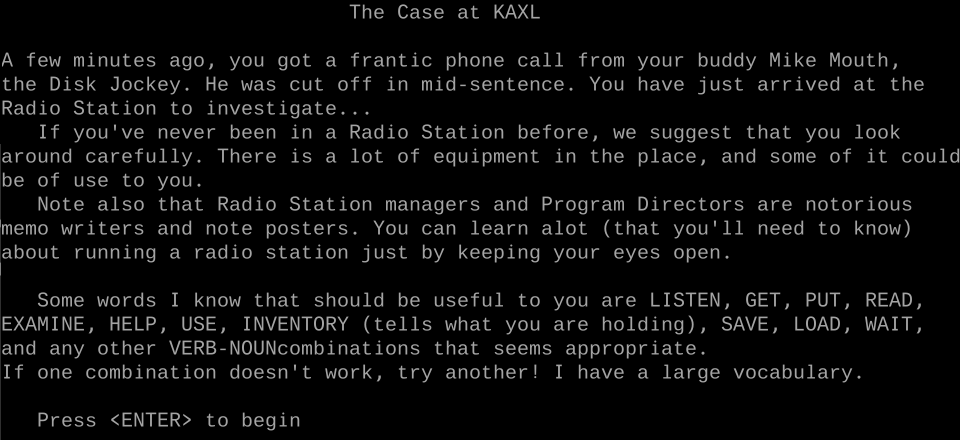
The details about “If you’ve never been in a radio station before” and casually mentioning “Radio Station managers and Program directors are notorious memo writers” strikes me that the author, at least, has/had radio station experience. In fact, this feels like a My Office Game, cousin to the My Home Game, filled with details that aren’t really part of the game proper but are part of a real radio station.

The map structure is fairly simple; there’s a main hallway I have shaded in color above with branches. No rooms are locked off except the one at the very back, and for that room there’s keys just sitting on the desk of the first room, because given the story scenario, there would be keys laying about in the first room. So the design is from the end of verisimilitude, while inserting a story scenario.

You arrive at the station at midnight to find the front door strangely unlocked.

The entire game involves exploring the different rooms of the radio station and looking at things. According to the ratings book in the office, the station is currently number 1 on the charts. The station ID recorder is broken (announcing the name of the station, as is required) so it has to be entered in manually at the hour. There’s a large studio with microphones and an old piano.

The open map means it can take a while to make the main discovery, the dead body of Mike, the one who called us on the phone.

The game isn’t clear from here but the idea is to gather clues as to what happened. You keep in them in inventory akin to getting items in a standard Treasure Hunt.
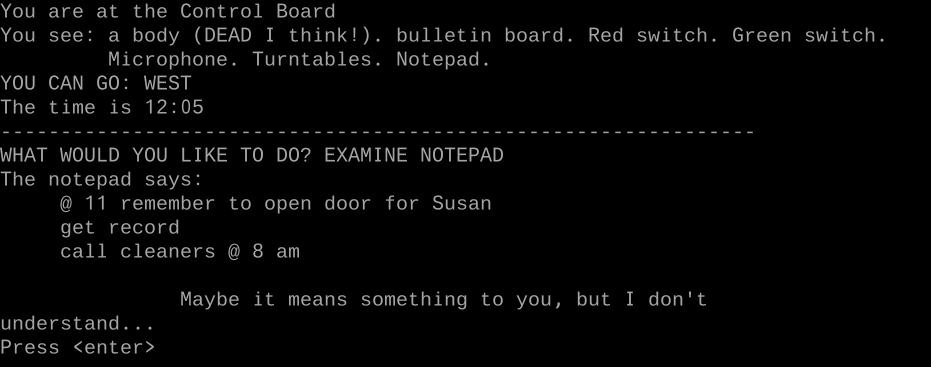
Items include a broken record (“MISTY”), lipstick, a lovenote (between Mike and a “Susan”, the same one that got let in the studio late), a cigarette (there’s also randomly the faint smell of smoke), and a transmitter log.

Once you collect enough information, you can go to the phone at the front desk and USE it. You’ll be prompted who to call; you can call the POLICE.

If you have enough evidence gathered, the police will ask you to help them locate where the murderer might be happening. When I played, I had already gotten stabbed so I knew where to go.

As a game, this was pretty easy and slight. The only challenge I had was realizing the premise in the first place (gathering evidence then calling police).

Just scenery.
As a conceptual premise it was unusual, though; even our “easy” games have generally had arbitrarily map layout meant as service to the game’s puzzles. Here, there’s a radio tower out back for no reason other than that’s what should be there, and the door there is locked only because, logically speaking in the real world, that door would normally be locked. Not because there was a puzzle that demanded a key.


 Renga in Blue
I guess the tape is an allusion to Play Misty For Me, where a DJ (at KRML) is stalked by an obsessed stabby fan.
Huh! I missed this one somehow.
Weird fact: on Wikipedia, one of the scriptwriters for that movie (Dean Weisner) has him as a very young child as the photo. Weirdest reference shot I have ever seen.
Wow, MyHouse.wad is really getting beyond the Doom community, isn’t it?
I’m curious, does the game ever try to lead you down a path other than staby Susan? Seems like in practice this is just Play Misty for Me as a game. An interesting one nonetheless.
I used to make Doom levels and verrrry briefly held some specialized speedrun records.
https://www.doomworld.com/idgames/levels/doom2/p-r/remains2
Haven’t played a bunch of fps lately other than Ziggurat although I really wanted to do the Bioshock trilogy sometime.
There aren’t any “false” clues in KAXL, if that is what you’re asking.
That might not have been a wise thing to mention. ;p
Don’t know if you know, but I’ve got a blog where I play shooters and sometimes their mods. Whenever I get around to playing Doom levels again, that’s definitely going to show up.
I do read your blog. I enjoyed seeing all the 80s titles I probably never were going to make it to.
I don’t always understand your game-picking logic (Journey to the Planets? Captain Comic?), but the oddballs are fun anyway.
Thanks for that MyHouse link, what a wonderful rabbit hole that I didn’t know about!
A “text contents” search at archive.org turned up a published listing in the May/June 1993 issue of TRSTimes, where it’s identified as “a new game.” What’s the source for the 1982 date?
Great find there! It should also be noted that this listing was for the Model 4, which itself wasn’t released until late April of ’83. The Internet Archive listing says 1982, but there seems to be no corroborating evidence, unless it can be found somewhere in the game itself.
I also noticed, as someone with a linguistics background, that some of the usage or “tone” of the text in this game immediately struck me as possibly being incongruous in an early 80s context, although that’s just a casual observation based on a very small sample size.
Taking all the above into account, along with the fact that the TRS 80 was long dead outside of a tiny hobbyist niche by the 90s, I would guess that this may just have been the author porting his own recent game to the then dominant PC platform, which would make perfect sense if he ever actually wanted more than a handful of people to play it. So, maybe the date listed on the Archive was just a typo?
Dig that Cannonball Adderley concert footage in the movie, though!
The title screen says copyright 1982.
Well, please keep in mind that some of us aren’t playing along in real time, and unless I missed something, the introductory screen you posted does not include a date.
I just checked the TRSTimes listing, and, unless I’m missing something again, it only says “Written by Doug Rogers”, with no date listed. As “A” mentioned above, the game is also described as a “new adventure” in the intro to the newsletter.
Now, does it seem very likely that someone wrote one of the very first PC text adventures ever, which apparently remained completely unknown until it was randomly uploaded in 2022, made no effort whatsoever to spread or promote it in the following eleven years, and then suddenly decided to port it to a long dead, vastly Inferior platform, as a BASIC listing in an obscure hobbyist newsletter? The only possible explanation I can think of would be that he originally wrote it in 82 (maybe on a Model I or III?), never released it, then rediscovered his deep love of Radio Shack products and ported it to the Model 4, then shortly after to the PC, only remembering to attach the original date of creation to the latter?
Sounds a bit far fetched to me, but make of it what you will.
Not blaming you or anything! Just giving where the copyright date came from.
TRS-80 hobbyist games lying around and surfacing later (print or otherwise) aren’t that unusual. Roger WIlcox dropped one of his TRS-80 games online somewhere about 1990 that he wrote in 1980. (And he had re-written it in GW-BASIC before he published it!) He didn’t toss the rest of them online until the 2000s. Other people have sent their old stuff to trs-80.com for digitization that isn’t even generally available, just to preserve it. The TRS-80 culture has a lot more preservation along those lines (the Danny Browne set I looked at is similar — a bunch of clearly personal stuff).
Anyway, it’s good to have a thread of info to follow! I’ll probably just make an addendum to this post but if I can go deeper I’ll make a new one.
Ah, very sorry if I came across as being irritated! I didn’t intend it that way. You make many good points about the nature of TRS-80 preservation.
I guess where I think this might stand is: Probably originally written in the early 80s (likely on a Model I or III) but never actually released until it was ported by the author to the model IV and the code was eventually provided to TRSTimes. Then at some point, the author ported it to the PC (remembering to include the original date this time), but it maybe never made it past bring uploaded to some local BBS or something, thus its total disappearance until now, after finally being discovered and uploaded to the IA last year. I do suspect that the game (and particularly some of the text) may have been “updated” from the theoretical lost original, but that’s just speculation on my part.
I think the main point I was trying to get across is that, in light of “A”‘s newsletter discovery and certain other clues, this game should probably be discussed in terms of a likely TRS 80 origin of some kind, rather than as a very early PC original, which may be picked up and spread around on various other online databases and the like, as this site and CASA are by now well established as the “papers of record” for these types of games and their history (and deservedly so!).
Anyway, sorry again for any appearance of tetchiness. I’m just a long-winded bore in general. Too many years spent in obscure academic pursuits, I’m afraid…
oh absolutely
I kind of suspected TRS-80 but I didn’t want to name a platform (PET was _possible_ but more unlikely) without more evidence
Part of the reason TRS-80 feels like a more likely candidate is the weirdness with caps, which tends to happen when something is ported from a no-capitalization system to one with capitalization
Apple II that can happen too but this didn’t feel like a 40-column game
oh also, the GW-BASIC has a timestamp, so we know it was made on:
1986-04-18
Very interesting! It’s all starting to make more sense now.
One question about the gameplay itself: Does the in-game clock actually play a major role? Can the murderer escape or kill you if you take too much time, for instance?
Looking at the listing, it’s possible for Susan to get away, but I’m not sure that it has to do with a timer; it looks like it might have something to do with locking or unlocking a door. The flag that triggers the message that she got away is GF, checked in line 650; that flag gets set in line 540 with a check to O(40). O is the array of object identifiers with O$ being the array of their names; if I’ve counted correctly then the 40th element is “a locked door.”
Ah but wait… it looks like 540 gets called from line 200 with a check on H which looks like the hour variable (there’s an M variable for minutes). So I think it is a timer, if you wait long enough Susan unlocks the door and gets away, but if you’ve gathered enough evidence you can keep the cops from arresting you.
There’s also something about the Program Director calling to see why the station ID didn’t play this hour, so that’s presumably on a timer too (line 900).
Yeah, the station id button lets you stall time longer. If he calls then the police show up right after.
Pingback: The Case at KAXL: Historical Update | Renga in Blue
A murder mystery set in a radio station? Sounds like Color the Truth, by Mathbrush! Interesting coincidence.