WELCOME SEEKER, YOU STAND BEFORE THE GATE OF PI. YOUR QUEST IS TO LOCATE THE GOLDEN SUNDIAL HIDDEN IN TIME AND SPACE BY THE CORRECT INTERPRETATION OF THE TRUTH THAT LIES WITHIN THIS PROGRAM.
ON THE APPOINTED DAY, ONE AMOUNG YOU WILL BE REWARDED WITH THIS CELEBRATED ORIGINAL TREASURE. IT IS CRAFTED FROM GOLD, DIAMOND AND THE RAREST OF THE EARTH’S RICHES.
Recently, we — and I do mean we, it was most decidedly a team effort between myself and my readers — played through the “contest game” Krakit. There was a rolling prize of “10,000 pounds or more” and it fairly intentionally seemed targeted at the same market that went wild over Masquerade (a contest that ran from late 1979 to early 1982).
Krakit was not that replacement. It was too annoying and too hard, with 12 questions that needed perfect answers, some which required essentially getting lucky, and no buried-treasure component.
Alkemstone from the year before wasn’t that either, being a US-market only game for the Apple II (the US did sell some Masquerade copies but never caught the fever the same way it did in the UK).
Pimania is the closest candidate to a game claiming the title as a Masquerade successor. It originated from and was focused in the UK, and the central mystery involved a Golden Sundial, very much aligned with the Golden Hare.

From World of Dragon.
Mel Croucher and Christian Penfold were the duo behind Automata Cartography, founded in 1977 to make tourist brochures and later audio guides. In 1981 Croucher had bought a ZX81 computer and branched out (using the same Automata Cartography label) into surreal mini-game packs designed for the default 1K model.
Now, before I show some, I think “default 1K model” needs some expansion. We are talking enormously tiny games. The VIC-20 3583 bytes found in Jack and the Beanstalk seem luxurious even in comparison. We’re talking, essentially, little poems as code. Cassettes packed with 1K-sized programs filled stores (alongside tapes for ZX81s with expanded memory) for about a year.

Complete source for a 1K game from Sinclair User, Issue 1, April 1982.
1K Chess existed as a standalone tape, almost as a programming stunt, like something from the International Obfuscated C Contest.
Nearly all the 1K output from other companies was, at best, generic. Despite all that, Automata Cartography produced tapes attempting to be art, in the Dadaist school; or at least tapes that would raise enough of a fuss to get attention.

Ad from May 1982 Sinclar User.
Vasectomy involves a “short sighted drunken surgeon”. In Hitler, you put a whoopee cushion under the Führer’s chair. In Reagan, you have to stop Ronald Reagan’s grey hair from showing so he doesn’t start nuclear Armageddon.
Jimmy Maher (who goes into much greater biographical detail than I do) calls Penfold and Croucher “the Merry Pranksters of the early British software industry”.
Their next act is what concerns us today, namely their debut on the ZX Spectrum, the adventure game Pimania (with ports to ZX81, BBC Micro, and Dragon 32). Pimania features their company’s bizarro mascot, as shown here in center on a later vinyl release of Mel Croucher:

From Merchbar, Pi-Man with more arms than normal.
I would say the success of the game was inexplicable (especially once I get into the content) but I said, this was oriented as a contest game. Clues to a Golden Sundial valued at £6,000 were put in the game, and it was a real artifact designed by a legit high-end jeweler named Barbara Tipple, whose webpage claims she is “only female jeweler in Britain to ever have received 3 De Beers Diamonds International Awards”; she had already won one of them by the time Pimania came out.

Sinclair User, January 1983.
The clues in the adventure game gave an exact time and place to appear to claim the prize (rather than a location to dig), and unlike Krakit which folded with no winner (and almost certainly no way for there to be a winner), the Pimania prize was honestly and genuinely claimed in 1985. Of course, that’s three years after the game came out, so it still was rather hard to work out, and I’ve heard the adventure game portion is cryptic at the same level as Quondam or one of the other legendary brain-breakers.
I’m … not so certain yet. For one thing, the parser and especially the world modeling system is relatively light; I don’t think the programming (by Penfold) has the sophisticated capability of interlocking complex daemons which require exact timing. (I’m avoiding spoilers, of course, but if nothing else I should point out the source is in BASIC.) I think, rather, this game is cryptic, and might have a couple absurd leaps of typing required. One kicks the game off, and it was a rather fortunate choice (as you’ll see in a moment) that I went with the BBC Micro port.

I went with BBC Micro mainly because BeebEm is a fairly robust emulator.

The screen above shows “pi” taking off into space, and then the prompt where you type a word. Just typing PI works.
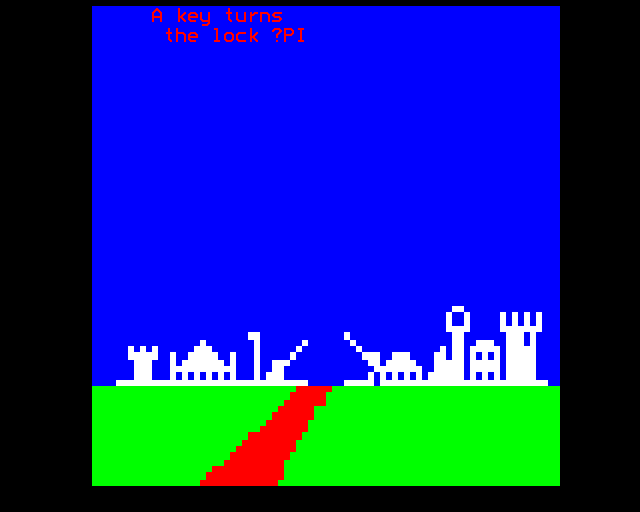
Before explaining what happens next, I should mention the ZX81 and ZX Spectrum have a very different solution to this puzzle. Take a look at a ZX81 keyboard:

Wikipedia, CC Attribution-Share Alike International 4.0, via Binarysequence.
There is a key actually marked PI, or at least, you can shift the function to a mode which types a π symbol. This is the keypress required to start the game in either Spectrum version. Ouch. This is a game that was a genuine hit in the UK marketplace and has a modern Steam release. At least the Steam description spoils how to solve that puzzle.
This is followed by an animated dancing PiMan:


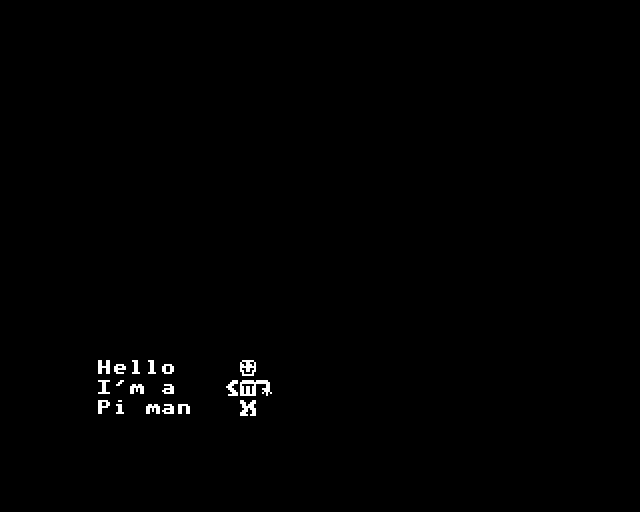
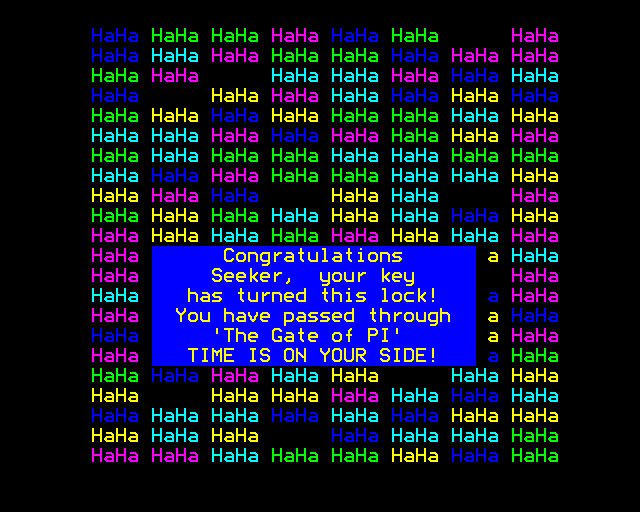
I’m put most in the mind of the Apple II game The Prisoner, maybe of a more absurdist variety. Directly from here you get dropped into the adventure, and I thought for a bit (maybe like The Prisoner again) the command line was a ruse of sorts, and we were supposed to do something different entirely.

The background is a garish pink. I have saved your eyes by switching the monitor to black and white mode. You’re welcome.
Specifically, it seemed like I could type regular text adventure commands, but almost nothing worked. I spent roughly 30 minutes on this screen. A condensed transcript of some of the more interesting responses:
> GO UP
THAT DIRECTION IS USELESS HERE. TAKE A GOOD LOOK AT YOUR FACE!> HELP
Sorry my friend, but you have to help yourself around here!> LOOK UP
You’ll need to use a telescope to see!> USE TELESCOPE
YOU HAVEN’T GOT A TELESCOPE WITH YOU!> TAKE A GOOD LOOK AT MY FACE
You’ll need to use a telescope to see!
The last prompt suggested this is a “keyword parser”, looking for words in the line rather than expecting nouns and verbs and so forth lined up in a particular order. Many other commands led to “Please will you rephrase that!”
TURN FACE, CHANGE TIME, GO CLOCKWISE, EXAMINE FACE, JUMP, SET TIME, SHOUT, YELL, SAY HELLO, GET TELESCOPE, GAZE AT SUN, 3:00, MAKE TELESCOPE, GO SUN, WAIT, PI, FIND TELESCOPE, UNLOCK ARENA, BE HAPPY
The 3:00 was fairly close. I had quite quickly decided this was all sundial-themed and I needed a time, but I needed to enter the command in the right way. 3 from 12 could be … 9? Just the digit 9?

Ah-ha! And I soon realized the general gimmick of the game’s movement — to use numbers from 1 through 12, as opposed to any kind of compass direction. If you go 3 to go one direction, you go 9 to turn the opposite way — essentially flipping sides of a standard clock. Here is my map of the game so far.

Room descriptions are minimal and sometimes serve purely to clue what directions are possible. Given the directions are not always given, I ended up testing every number from 1 through 12 in every single room. This could have been tedious, because the game’s response to a command is not instant; there’s a little animation of passing through a “pi gate” after a successful or unsuccessful command. I ended up using save states whenever I was told
NO RIGHT OF WAY AT 1
or whatever number it is, so I could jump straight to testing out 2. Some more room descriptions to give the idea:
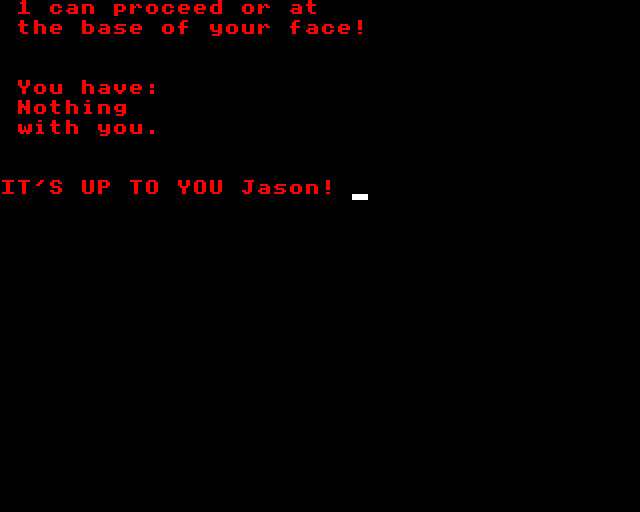
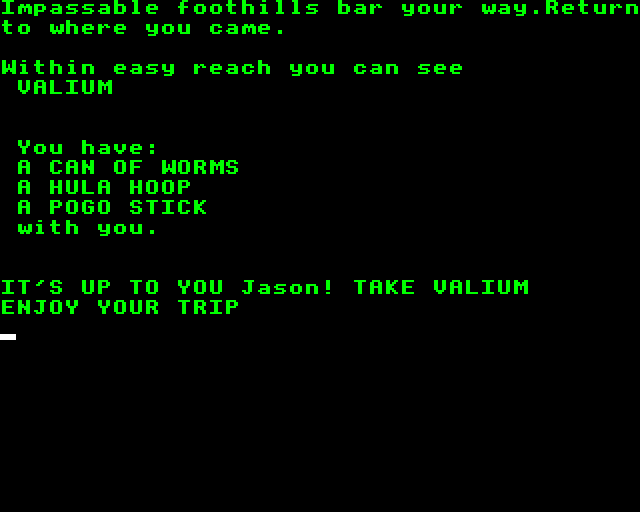
Just laying around there are lots of items: BAKED BEANS, CUDDLY TOY, RUBBER DUCK, PORK PIE, TV DINNER, SAXOPHONE, CAN OF WORMS, HULA HOOP, POGO STICK, VALIUM. Only Valium has the funny description on pick-up, as shown above. You can’t carry them all at once, alas. I’ve only encountered one puzzle while mapping, where Pi-Man himself was feeling scared.

Some Valium works, as this is the 1980s.

And from here I have gotten no farther. I suspect I need to re-check all the rooms post-Valium and the Pi-Man will have moved elsewhere. If not, then there’s some obscure item interaction in one of the rooms. Some of them do have a little description (a PRIVATE cul-de-sac has the game flash at you and warn you to get out, for instance) so the world isn’t entirely barren.


 Renga in Blue

Ah, face = clock face, I was a bit slow in getting that.
Have you listened to the “free hit single” on the other side of the tape yet? I think it has some clues. It is an experience at least as weird as the game though.
It’s interesting that you mentioned The Prisoner, because I sort of feel that Croucher and Mullich were two sides of the same coin, in that they were both representative of a certain undercurrent at the time (late 70s/early 80s), i.e. the lingering influence of the social and cultural upheavals of a decade prior, and the psychedelic/progressive (to use rock music terminology) ways of thinking that broke through to the cultural surface for a brief period. Mainstream/corporate society was quick to want move past this, but it had made its mark, especially on certain creative types, and was particularly noticeable on things like children’s programming of the era. The young coders of the day were typically more prosaic and concerned with overcoming technical limitations, but these guys were presenting an alternative vision of how this new medium could be used, which when seen in retrospect, especially in the context of the relatively primitive technology they had at their disposal, gives their output a strong whiff of the hauntological (although that term has admittedly become a bit muddied).