As top detective in the police department, you have been assigned to investigate a crime at the home of the wealthy industrialist, George Bodewell.
This is a direct continuation of my previous post on Quest.

From the Internet Archive.
Before I get into the content here — which I promised comes off as rather different than Quest, even though it has similar gimmick — I want to share a little history I’ve found investigating Tim Quinlan (of Mad Hatter). It goes back to February 1977 and the Commonwealth School in Boston, a private high school. This was still early in computing history, as the Commodore PET had only been released the month before, and the other two members of the Trinity (the Apple II and TRS-80) weren’t out yet. If someone owned an Apple, it was an Apple I.

Public Domain via Wikimedia.
There, in the library of the school, the 13-year-old Johnathan Rotenberg held the first meeting of the Boston Computer Society. The meeting only had four people, one who came across it by accident while working late. Subsequent meetings for the next six months hovered near a membership of zero. But every group had to start somewhere, and it managed slow growth up to 70 members by October of 1978, with guest speakers discussing such topics as:
a “homebrew 9900 system,” a talk about DEC minicomputers used in sailing the America’s Cup, the ECD Micromind computer, race betting using a Wang minicomputer, and the Kurzweil Reading Machine.
October 1978 was also when it held the Home/Business Computers ’78 show, intended to address the fundamental concern, what good are these computers anyway? It grew the membership from 70 to 225. Rotenberg (in Infoworld, November 1984) called it a “very big turning point” for the group which eventually ballooned in size and important to have 12,000 members by 1984 and 30,000 at its peak. Apple made its east coast announcement of the Macintosh at a Boston Computer Society Meeting; the late Sir Clive Sinclair (of Spectrum ZX fame) was a member. Mike Markkula (second CEO of Apple) and Don Estridge (“father of the IBM PC”) first met at a BCS meeting.
This turns out to be highly relevant here, because Tim Quinlan is listed third in “323 People Who Made the BCS” as printed in the 10th anniversary issue of the BCS’s magazine, Computer Update. He was the show coordinator for Home/Business Computers ’78 — which, again, was the “turning point” for BCS hitting it big — and later became treasurer and vice president.
I would guess of the 70 earlier members, Greg Hassett was one of them. No idea about Robert Nicholas, but let’s get into his game —
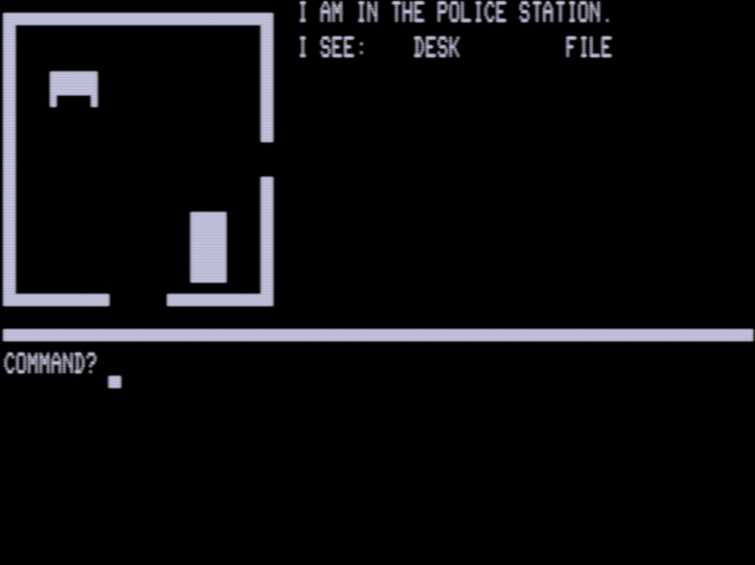
This, is, again, a game with graphics and sound, and more or less the same sound as before. This time you are a detective and there is a murder you must investigate. Your goal is to find the victim, find the murder weapon, and arrest the murderer and bring them back to a courtroom to face justice.
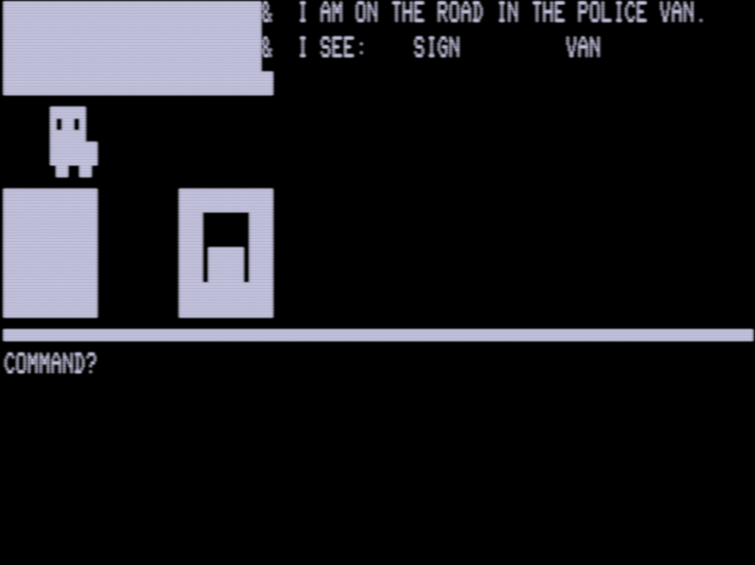
Just like before, items are randomly distributed, and in many cases you need to LOOK in order to find a hidden object. Before arriving on the estate I found HANDCUFFS, KEY1, and KEY2.
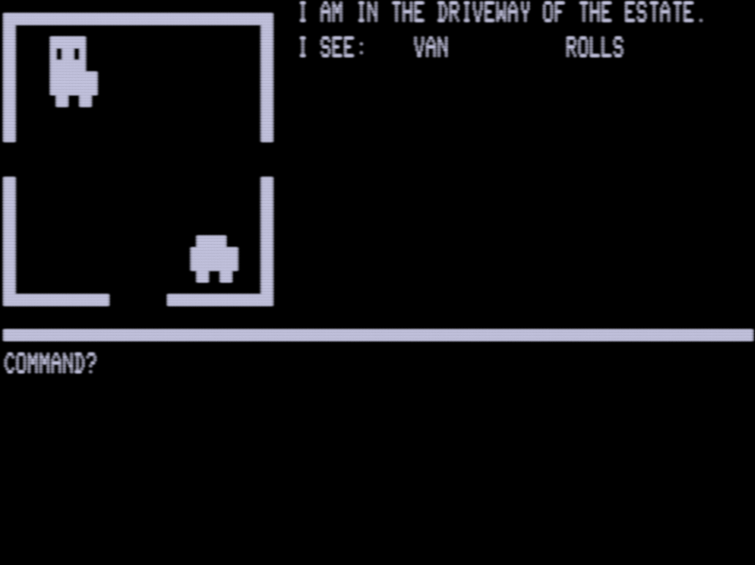
LOOK VAN: “I TRUST POLICE ARE ABOVE SUSPICION.”
The verb list is again pretty small; you can walk around, look at stuff, accuse people, handcuff people, and unlock items like cabinets (with either KEY1 through KEY3 found in random spots on the map, or with a PICK when keys won’t work).
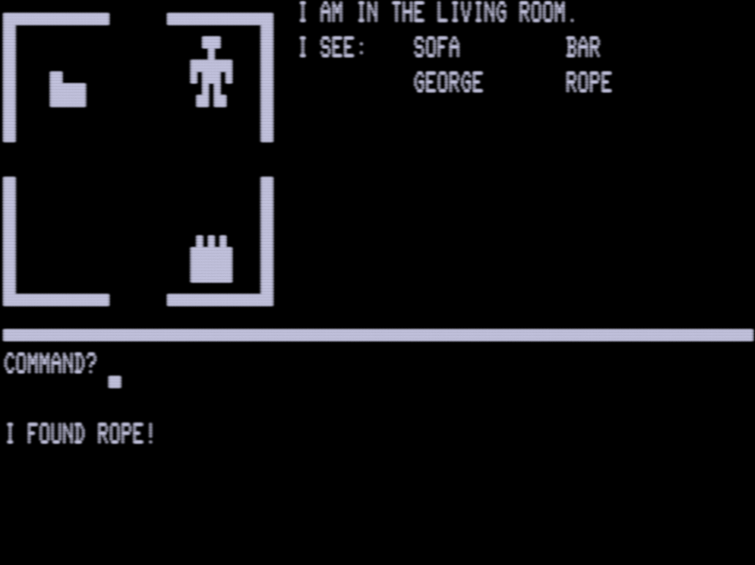
Because everything is randomly generated you can also treat this like a speedrun of Clue if you want to and just immediately accuse / arrest the first person you see and hope you get lucky.
(Any% speedrun of Clue done in 0:00.583 as a demonstration.)
You do at least also need to name who the victim is. From George I found the nurse dead immediately to the west:

There’s a dirge on finding the body. Also, the clock gives you a time limit; there’s no light source or food to worry about.
So here’s me immediately accusing and arresting George and picking the rope there as the murder weapon (technically the second person I found, I skipped the gardener, but whatever):
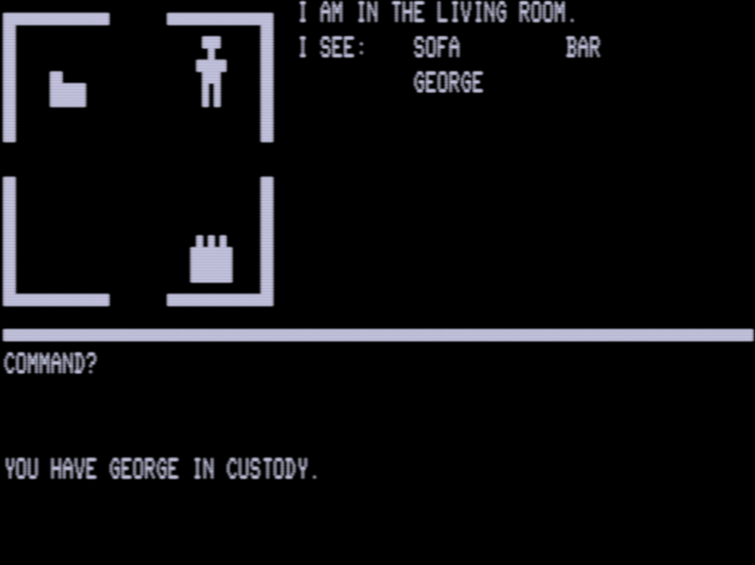

Okay, that didn’t work. I bumbled around trying to find more potential criminals.
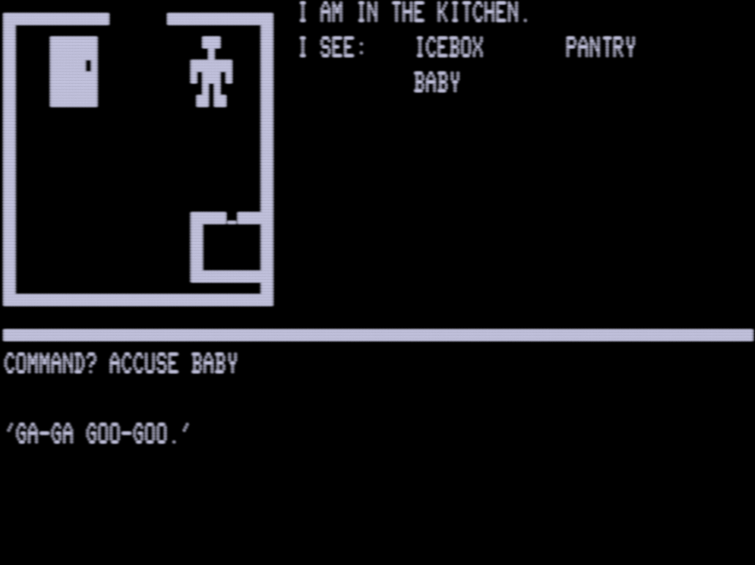
Some objects require unlocking before you can search them (like the cabinet above) although they may or may not hold a potential weapon.
The only way for things to work is to a.) be holding the right weapon and b.) ACCUSE the right person while holding the right weapon. That’s all the evidence you need! But just like Clue there’s a fair amount of potential weapons (PISTOL, POISON, KNIFE, SHEARS, etc.) and if you are holding multiple weapons while accusing the correct person, you won’t know which weapon caused them to spill the beans. But you can save your game, guess while in the courtroom, and restore your saved game, so you can make it work anyway.
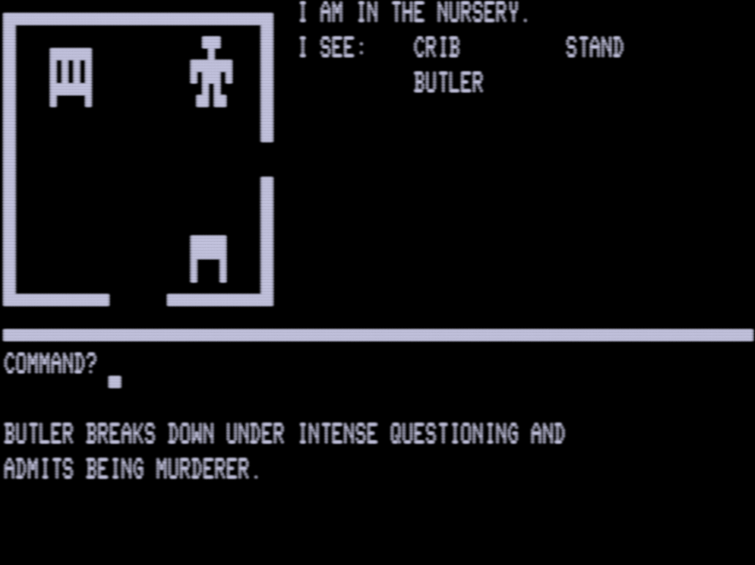
By the way, make sure you haven’t dropped your handcuffs amidst all this. Once you find the murderer, you can’t go for your handcuffs and go back, or things go awry:

If you do pick victim / weapon / suspect correctly you aren’t quite done yet.
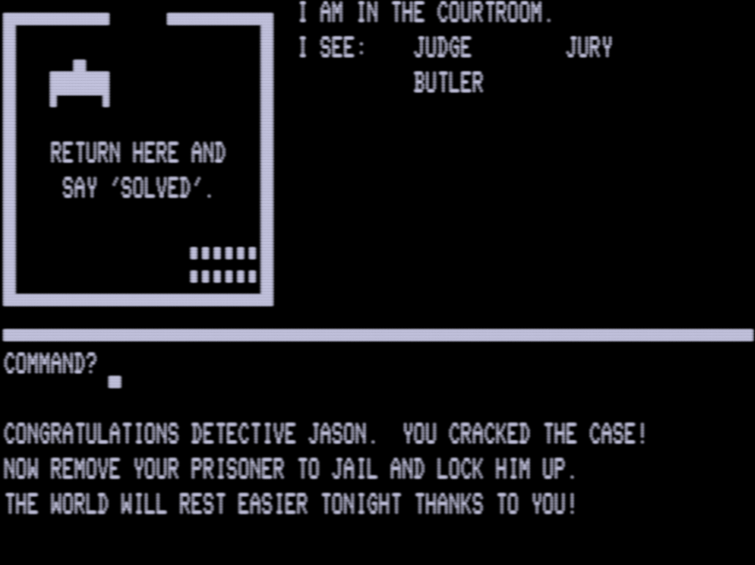
You have to take the criminal back to the jail at the police station, uncuff them (with the right key), step out, and then LOCK JAIL (also with the right key). After you do the uncuffing, if you get either of the other steps wrong (especially the not-so-intuitive LOCK JAIL given it isn’t given as a noun in the initial room description) then the murderer kills you.
Do everything correct, and victory:
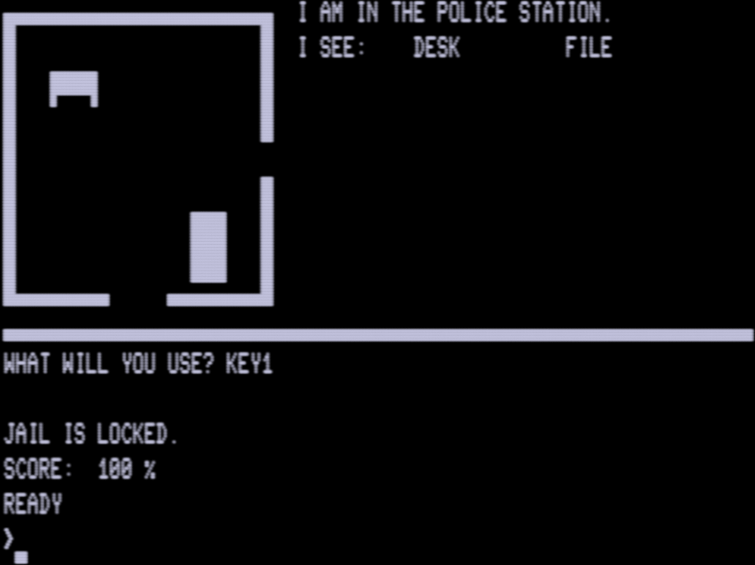
I had a lot more fun with this one with Quest even though it really doesn’t have much to it. The randomization makes more sense with a murder mystery, the narrative strand of a detective who has to accuse everyone in the house more than once while holding different weapons is hilarious, and the twist ending (you will die the first time around) was clearly meant as comedy. Quest was fairly self-serious, but that doesn’t work for a structure as flimsy as this one.
It was important I get through this now because Narrrascope 2023 is happening next week (dedicated to all things interactive narrative), and I gave a talk about the All the Adventures project at Narrascope 2022. As part of my presentation I had the audience play Sleuth, live. (If you just want to jump ahead to the video, go to 31:30.)
I’m not sure if my point fully came across, but I was trying to show that even a weird game from more than 40 years ago that would normally be thrown away still has value and interest, if nothing else to see what people were trying with graphics in the very early days. Also, I had the secret hope people would try to arrest the baby.
Speaking of graphics in the very early days, as Rob astutely pointed out in my last post, the pair of games being from 1980 and having a fuzzy publishing date brings up the possibility they was written before Mystery House. So Mystery House would not be the first, second, or even third graphic adventure written, but maybe the fourth.
I don’t think it is likely simply because there is a December 1980 review of the pair from Byte and that review (by none other than Bob Lidill) claims the game are recent. The review also complains
Plotlines are thin and seem to be built around gimmickry rather than solid plots and programming.
which, ok, fair. (Just because a review is from long ago means they were impressed by everything!) “Recent” for me in December 1980 suggests the second half of 1980, that is, after Mystery House. I realize this isn’t hard evidence; despite getting more information on Mad Hatter than I’ve ever had before, we have no catalogues from them in 1980 (and I haven’t unearthed any ads) so it is hard to know when they first started offering the game. Given magazine lag times and the occasional vague use of language an earlier time is still possible; clearly, if nothing else, these games were made from a separate “track” than the ones the Williams innovated in.
We’ll be sticking on the unique-innovator track with the wildly unconventional game Pimania. It certainly has a command-interface with some of the framings of an adventure, but given the intent is to give clues in order to find the (real) Golden Sundial, does it really play like one? Does it play like any other game made, ever, really at all?

Registration for attending Narrascope 2023 online is incidentally still open until June 8.


 Renga in Blue
There are certainly adverts for both games dating as early as September 1980 (both 80 Microcomputing and Creative Computing), but I haven’t done an extensive search… Sleuth and Quest aren’t the most unique! Those two adverts are of the reseller Program Store, rather than Mad Hatter itself, which I guess would indicate an earlier publication date too… Summer 1980 at least?
Speaking of 80 Microcomputing, I’m guessing that the author of these games may be the same Robert F. Nicholas that was a regular contributor of articles to 80 Microcomputing in the early 1980s; often writing with Philip Martel. That particular Robert is resident in Lennox, MA and is listed as running a data-processing center. Philip Martel was an electrical engineer also living in Massachusetts.
Potentially it may also be the same Robert Nicholas who wrote the civilization management game Project Omega for Adventure International, which seemed to have been well reviewed by at least one wargaming magazine at the time.
Nice catch! I was just trying to find a Mad Hatter ad in particular.
I’ve been running with the assumption Project Omega was our Robert Nicholas. It doesn’t make it in the summer Adventure International catalog so it definitely made it in after.
Hopping publishers was not uncommon but it makes me wonder if Mad Hatter was even around in the second half of 1980.
Bob’s Captain 80 columns in 80-US refer to Mad Hatter in the past in November 1982 & August 1983). There is an earlier reference from Creative Computing, July 1981: “I wish that I could tell you that Mad Hatter is still in business. I can’t. I haven’t seen one of their ads in eons and for all I know Tim Quinlan has dropped off the face of the earth.”
But the earliest reference I’ve found so far is from February 1981’s 80 Microcomputing in the letters section on page 11, where in response to a reader the editors say, “At last report Mad Hatter Software was out of business”. So it looks like, even if they got through the summer, they didn’t survive much beyond the end of 1980.
Also, I had the secret hope people would try to arrest the baby.
You showed what happens if you accuse the baby; what does happen if you arrest the baby?
HANDCUFF A LITTLE BITTY BABY?
If only this were Colossal Cave, I’d expect to be able to then answer YES, but this game probably isn’t that clever.
Pingback: Suspended (1983) | Renga in Blue