I’m going to start with some history background which may seem like overkill for an anonymous public domain TRS-80 game, but I already wrote it a while back, so–

From the episode Smurf Me No Flowers. Papa Smurf on the left (who appears in today’s game), Brainy Smurf on the right (who does not, unless he is supposed to be the player character).
After the Nazis occupied France in May 1940, they wanted to keep the film industry going there with the German-controlled Continental Films, founded only six months after the occupation. The managing director, Alfred Greven, was appointed by his personal friend Goebbels.
At this time, the young Belgian Pierre Culliford, aka “Peyo”, was working as a projectionist in Brussels; while he had a love for Robin Hood and fantasy movies, he had to show mostly propaganda films.
It was in this environment we got Les visiteurs du soir (see picture above), a 1942 film by Marcel Carné, set in 1485, about two envoys sent to the mortal world to cause mischief and recruit for the Devil. The envoys (semi-accidentally) start doing some good works, and the Devil needs to visit in person to fix things. While the production design was heavily influenced by Les très riches heures du Duc de Berry, a rather famous manuscript from the 1400s, the story itself was steeped deeply in fantasy, and Peyo watched it repeatedly. (As critics have later pointed out, the movie also could be viewed as a thinly veiled allegory for the Nazis invading France; while the director insisted it was not intended as such, the important thing is that the film managed to escape the censors.)
When the occupation of both France and Belgium ended, Peyo went from projecting to a short stint at a company called Companie Belge d’Actualités, owned by a journalist (Nagant) who originally aspired to make newsreels. Because of the occupation they had switched to animation instead. Peyo saw the designs for a film called Le Cadeau à la fée (The gift of the fairy) which included elves wearing flowers (this will be important for the story later).
Peyo went on to work in newspaper comics, before eventually landing a job at the magazine Spirou. This is where he made the fantasy comic “Johan et Pirlouit”, keeping in mind his previous inspiration by cinema. It centers around Johan, a servant to a King in a castle, and Peewit, a dwarf hired as a court jester.
For The Smurfs (“Les Schtroumpfs”) they were introduced during a Johan et Pirlouit comic entitled La Flûte à Six Trous about a flute that causes people to dance uncontrollably. The flute is stolen and Johan and Peewit end up seeking the creators of the flute.
Now, the origin of the Smurfs was due to Peyo needing a creator for the flute, perhaps a witch or sorcerer? Keeping in mind the film he saw at the CBA, he settled on “little creatures” that live at night but we rarely see, aka elves or leprechauns. The blue came from his wife (Janine “Nine” Culliford), who was his colorist. They were constantly hiding in leaves so couldn’t be green, red was too visible, and yellow and brown … they were trying to avoid the Smurfs looking like unfortunate stereotypes. Hence, by process of elimination: blue.
As far as the name goes, according to Peyo himself, it came from a slip of the tongue while eating at vacation. He asked for salt (“le sel”)
Passe-moi le sel!
but accidentally asked for “le schtroumpf” instead
Passe-moi le schtroumpf!
(When later translated to Dutch this became “Smurf”, which was re-used in English and elsewhere.)
While Peyo originally thought it was a “momentary craze for secondary characters”, Les Schtroumpfs were quite popular and merited re-appearances and their own spin-off, followed by a series of TV shorts in the 1960s later assembled into a film (Les Aventures des Schtroumpfs). Hanna-Barbara came in fairly late, as the entrepreneur Stuart R. Ross spotted Les Schtroumpfs in 1976 when traveling in Belgium and secured the rights, leading to the launch on American TV in 1981. Peyo (and the former editor-in-chief of Spirou, Yvan Delporte) were involved with overseeing the scripts. (Johan and Peewit do still show up, but now as side characters.)
Contrary to the small, often evil characters in popular legends, such as gnomes and trolls, I wanted mine to be reassuring and kind. The Smurfs aren’t really heroes. They form a community in which it is nice to live. Each one works for his pleasure. They practice the principles of equality, liberty, and fraternity.

Gargamel and Azreal, forever trying to capture the Smurfs, from the episode The Last Smurfberry.
So. Back to the public domain TRS-80 game. It, rather unusually for this time, declares itself public domain in the source code:
1 ‘ 06:15 *** PUBLIC DOMAIN *** 21 DEC 82
4 CLEAR200
7 CLS:PRINTCHR$(23):PRINT@394,”THE SMURF ADVENTURE”:GOSUB346:GOTO10
This indicates this game probably is not reproduced from some magazine I haven’t found (although I did do a search) but rather is someone’s random project that just happened to get saved for posterity.
We’ve had a shortage of this kind of game; it really is interesting to see what differences there are (if any) if someone is writing a game just to write a game, not intended for commercial publication.
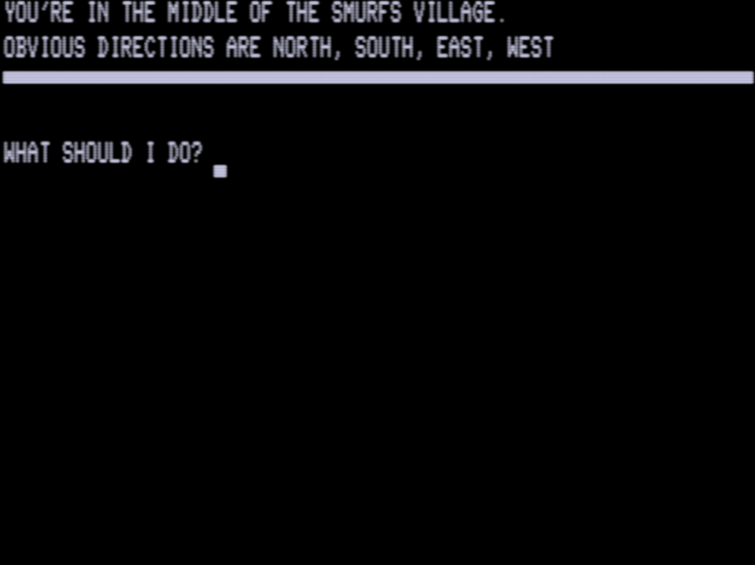
For one thing, it is short by 1982’s standards. Now, given we had Space Gorn and The Room both show on a disk magazine, that doesn’t disqualify it, but also, quite oddly, there are some places and characters that are present just for atmosphere. This is another circumstance where a game with the general plot structure wouldn’t feel out of place in a modern itch.io collection, but does come off as strange in 1982; I get the impression perhaps the author meant to continue (7278 bytes only, so there’d be room on a regular TRS-80) but just decided since the game was a personal whim to stop where they liked.
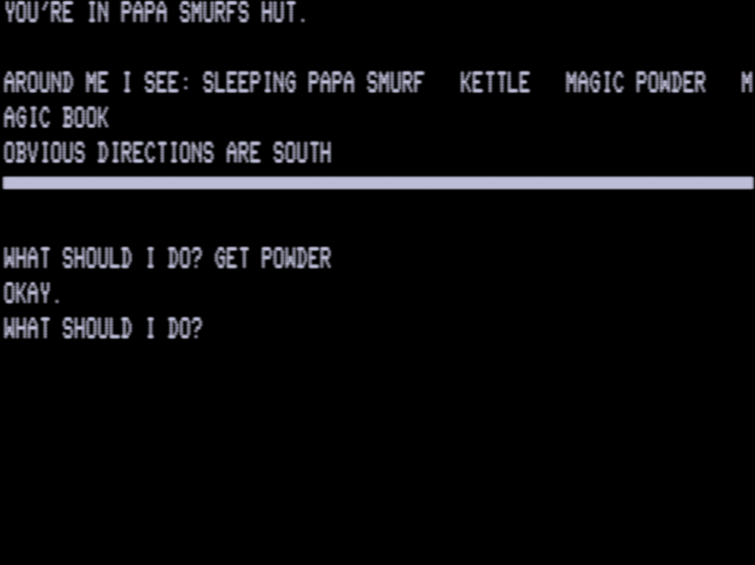
You start with no concept of what you’re meant to do, but heading north into Papa Smurf’s Hut reveals that Papa Smurf has been magically put to sleep.
The book explains that “…YOU’LL NEED 3 THINGS. MAGIC POWDER, SMURFBERRY PLANTS, AND…. THE REST OF THE PAGE IS MISSING!”
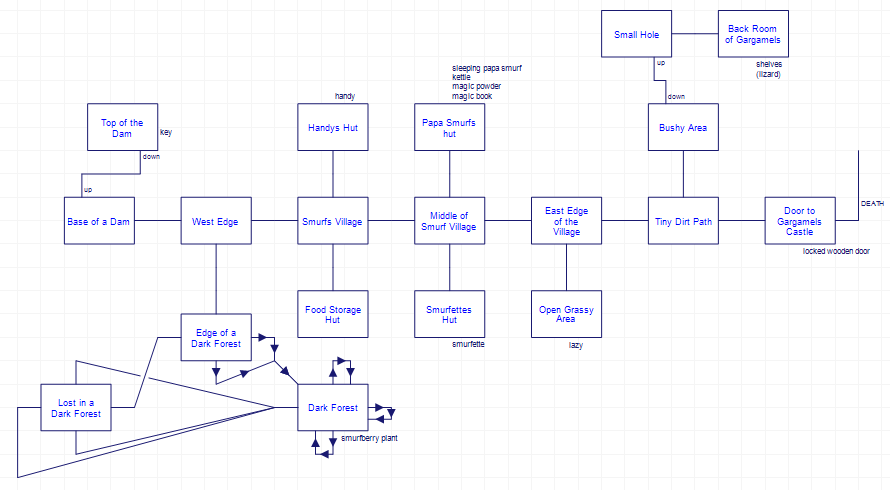
The powder is of course just sitting there in the room, so this is solely a quest for two ingredients. The smurfberry plants are out in the forest in a very tiny maze (see map a little earlier) and the unknown ingredient is a lizard toe that you can find at the back room of Gargamel’s Castle.
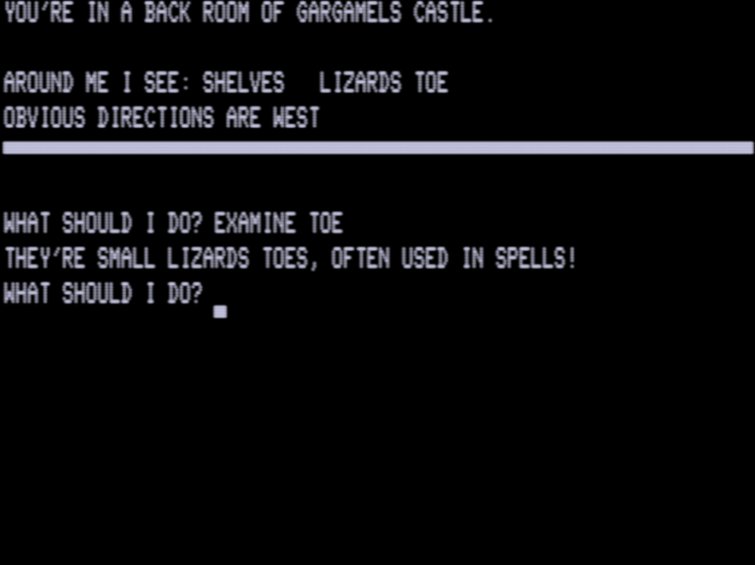
All you need to do is then drop all three ingredients at Papa Smurf (the game will assume you mean in the KETTLE that’s there) and you can win the game.
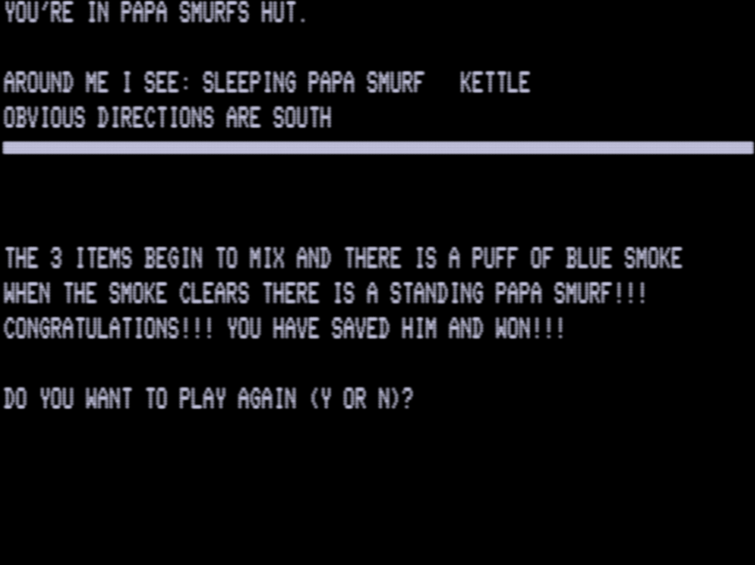
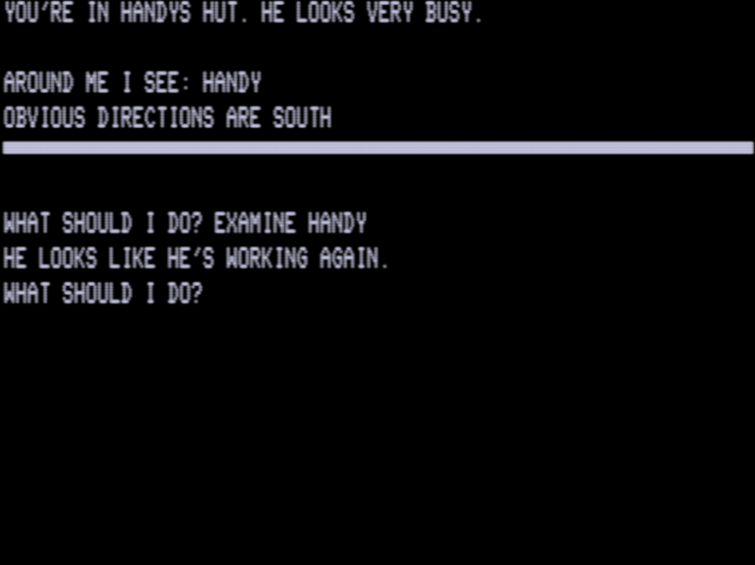
That’s not quite everything in the game; you can visit Handy and Lazy and Smurfette. There’s no particular reason to do so other than to perhaps feel the inherent Smurfiness of the environment.
Also, you can have an actual run-in with Gargamel. You can find a key elsewhere that will unlock the front door of his castle (which is only a few steps from Smurf Village, no wonder he goes berzerk) and find yourself Smurf-food upon entering.

To emphasize, you technically solve a puzzle (however small) in order to reach an instant death room that is purely there because it is there in the cartoon! The sheer oddity of this (and the fact you’re only hunting two ingredients that are almost literally in the open) really does make the gameplay insubstantial, but I’d still like to imagine this game being someone’s winter whim one day to re-create the world they saw on television to be able to enter it, even if only for a little while.

From some of the surviving footage of the 1965 version of the Smurfs.
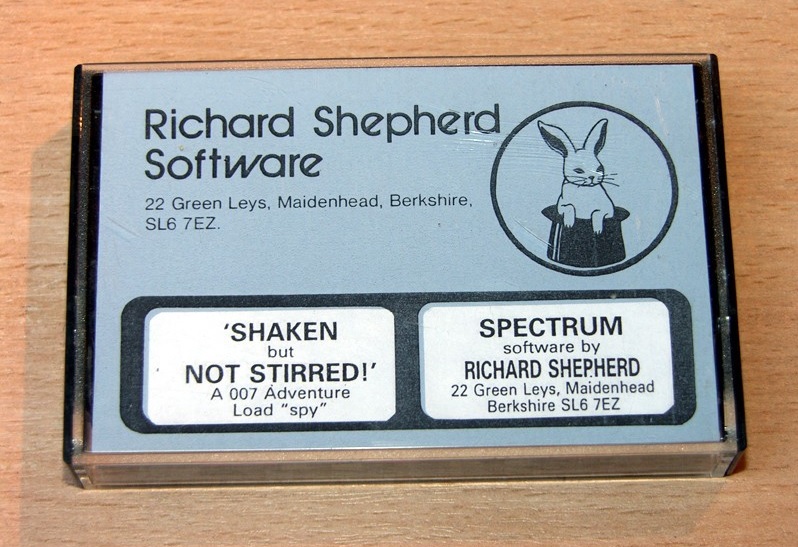
If you’re curious on the double-title, possibly lawyers were involved; Richard Shepherd’s game ‘Shaken but not Stirred!’ (“A 007 Adventure”), first released for the ZX Spectrum, was quickly renamed to Super Spy.
Richard Shepherd software was one of those quick-fire companies the cropped up the same time as the ZX81 in 1981/1982. Richard had been working as an accountant and his wife Elaine was in publicity. Elaine saw “a computerized version of the Dungeons and Dragons adventure game running on a large computer” (I suspect Crowther/Woods Adventure, but it’s hard to know) leading the Shepherds to buy an adventure of their own for ZX81. They were disappointed, but that encouraged Richard to try writing his own game. (There’s not that big a selection in 1981, I’m going to guess maybe Planet of Death.)
Richard ended up making Bargain Bytes, a compilation of 8 pieces of software (not only games).

Your Computer, April 1982.
The problem is that the ZX Spectrum went for sale on the 23rd of April, meaning the game came out right when people were upgrading. They switched to ZX Spectrum along with everyone else to make the simulation Ship of the Line, and here I’d like to share a story direct from the news article I’m referencing:
They took it to the Edinburgh computer fair, where they were one of only three companies selling programs for the new machine. Elaine recalled. “When we went to Edinburgh, we couldn’t afford a hotel, and had to camp. We woke up in the middle of the night to find that Scottish football hooligans were shaking the top of the tent.”
Eventually they had a breakthrough with sales to the company Smiths and were able to quit their day jobs in early 1983, but Super Spy was written before this happened. The first advertisement appeared in the October/November issue of ZX Computing.

“Recover a stolen warhead from the lair of Dr. Death”.
Super Spy is a hybrid game in four parts, so it isn’t entirely a pure adventure. From the instructions:
a) The round the world spy chase in which you aim to discover the location of Dr. Death’s secret hideaway.
b) Exploring Dr. Death’s island to discover the entrance to his underground maze.
c) The 3-D graphic maze which you must navigate yourself through to find the control room where Dr. Death has hidden the kidnapped missile.
d) Breaking the code to disarm the missile and save the world.

I’m honestly surprised we haven’t hit more hybrid games as of yet; I think this this is another case where Crowther/Woods was such a fully formed genre people didn’t feel obliged to experiment but wanted to copy instead. Given our last work was such an, ah, slavish copy, I figured something that went the opposite direction might be worth a try, even if the adventure credentials are marginal.

You start the first part of the game pick three gadgets. There seems to be no functional difference other than the number of shots.


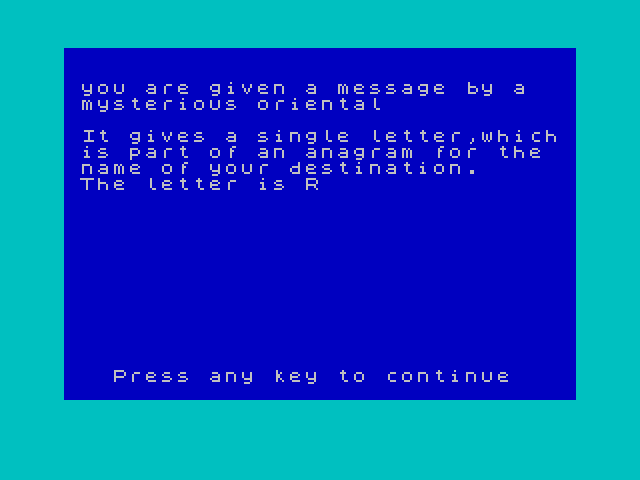
Once you’ve picked some gear, you get to travel to different cities. There isn’t any real “physicality” to them that I can tell (other than London is home base). You get random events at each one which potentially give you clues. The clues are single letters which eventually form an anagram of the location you’re supposed to go to. (The manual indicates the location is not on the list — so it’s an anagram of some random location on Earth.)
Another encounter is a mysterious taxi that can pull up. If you skip the taxi the game says you “missed a clue” but if you trying to enter the taxi the people inside kill you. It’s possible this is a one-shot find-the-right-command puzzle, like The Room was; I wouldn’t put it past the game to say you missed a clue but you really didn’t though.
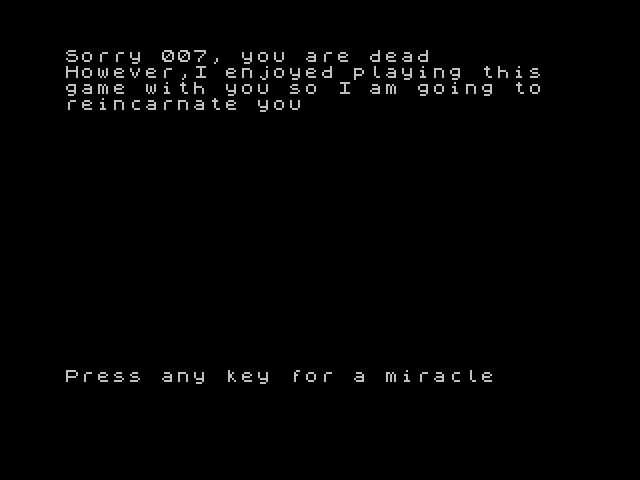
You can sometimes get attacked. This stumped me for a long time and I nearly gave up here.

The instructions indicate to type a sentence appropriately. KILL PRIEST? SHOOT PRIEST WITH GUN? DEFEND MYSELF? All rubbish, apparently. I really did run through quite a few options:
HIT PRIEST
KILL PRIEST
SHOOT PRIEST
FIRE PISTOL
USE PISTOL
SHOOT PRIEST WITH GUN
THROW KNIFE
USE WATCH
IS YOUR PARSER REALLY THIS BAD
I went to find a video of gameplay just to watch what they did. It turns out the magic formula is to type in lowercase. Eek! So yes, “use pistol” and probably a few of the other options work. (You can use uppercase elsewhere, it just doesn’t work here. I did start giving subsequent commands in lowercase, though.) The lowercase rule doesn’t necessarily apply elsewhere, although I didn’t rigorously figure out all the places where you can use uppercase and where it was only lowercase works.
I ran around enough to get the letters R, O, E, I, and S, but I didn’t need to go any farther than that because I got a clue (“from London”) that was the whole location, just enciphered.
AQVOIXWZM
That’s the letters rotated by 8 from SINGAPORE. The amount of rotation is random (I also saw HXCVPEDGT, which is rotated by 15).

The location of Singapore is not randomized so on subsequent playthroughs you can skip part 1 altogether and type SINGAPORE as your very first command.

Dr. Death’s island is I think vaguely modeled off an adventure game but the author forgot to put in, er, gameplay. It randomly generates a map and you meet an enemy every few steps.
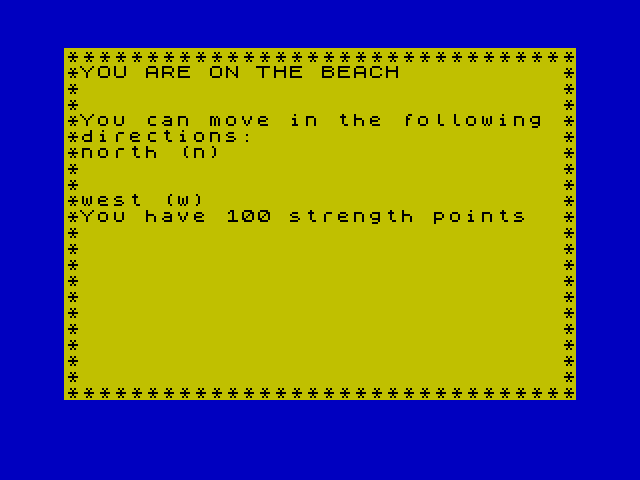
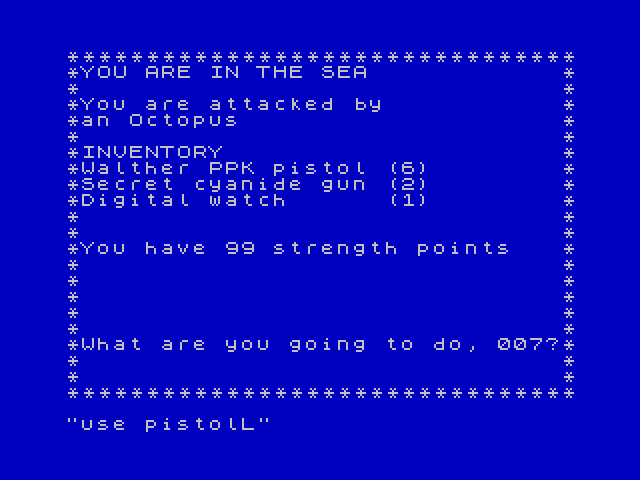
Your weapons always work. There doesn’t seem to be any reason to pick anything other than the highest capacity weapons from M at the start. The frequency of enemies degrades your weapon supply until you have to resort to hitting (hit octopus, etc).
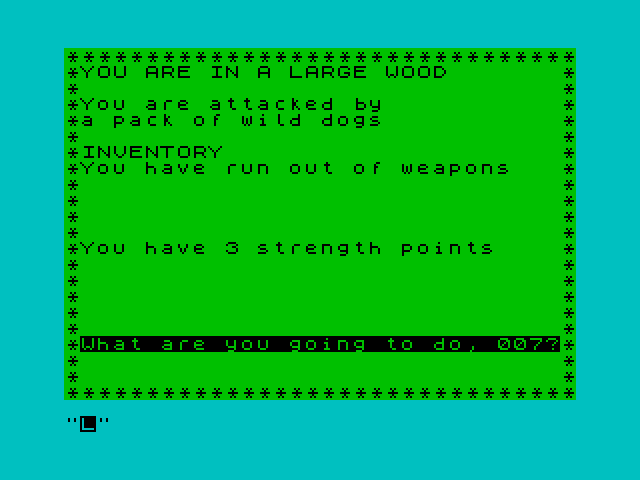
There is almost literally no strategy whatsoever — it’s just getting whittled down and hoping to eventually find Dr. Death’s base before dying. There’s a map up at CASA Solution Archive but as I said, the map is randomly generated, so it doesn’t really help. The only thing that’s a general pattern is that the base seems to be always near the center.
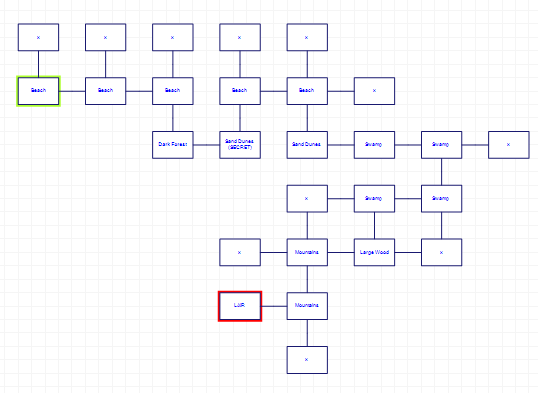
I did eventually get lucky (see above) and made it to part 3, a 3D maze where you are pursued by PAWS.

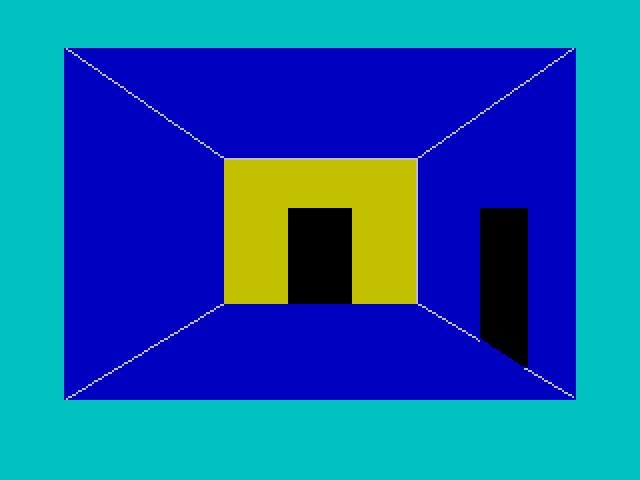
I’m not sure, given the fearlessness of ripping off copyright elsewhere, Richard changed the name of “Jaws” (from the original James Bond movies).

You are dead if you see this.
Unfortunately, while this section is good enough to include an automap — one that you can only look at for a limited time, but it takes so long to draw in authentic ZX Spectrum speed it doesn’t matter — the overall goal of evading PAWS eluded me, and I was never able to make it to an exit. I think there may be some emulator issues — at the least, the game only barely wanted to recognize when I made a keypress — but I decided given the lack of adventure credentials overall it was high time to bail. Sorry, that means I don’t know what part 4 is. Probably Mastermind or something.

There is at least some interest in this game touching upon (but not well-implementing) the idea of an “episodic adventure game”; while Oregon Trail and its brethren worked in episodes, all decisions were reflective of current resources (do you have enough food? do you want to risk losing oxen?) The first part of this game had one-shot episodes with potentially a brief “adventurer choice” with a freeform command.
The second part was just rubbish due to lack of strategy. With every potential enemy being felled in an equal way by every weapon, the gameplay simply consisted of trying to outrun a countdown timer finding a randomly-placed room. I see what the author was trying to do in a narrative sense, but the gameplay was never brought up to match.
There might have been something to the third part which follows in the same tradition as games like 3D Monster Maze but forgets about the part where you’re actually able to dodge the monster coming after you.
I was honestly tempted to pitch the game altogether instead of writing about it but it did take a while to suss everything above out, and it is true that Richard Shepherd Software will appear again, as they published a few traditional adventures, including one that is allegedly rather good.
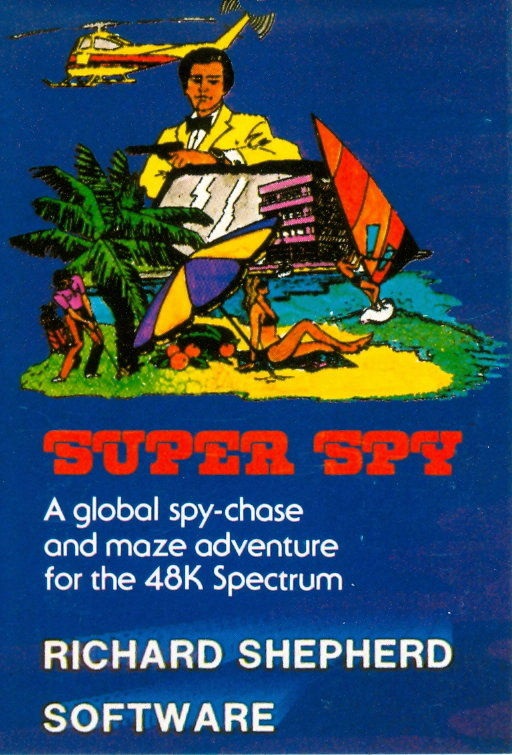
Via Mobygames.



 Renga in Blue