On July 7, 1982, Marshall Robner worked late into the night, last being seen alive at around 11 PM. In morning, he was found dead of an apparent intentional overdose of medication.
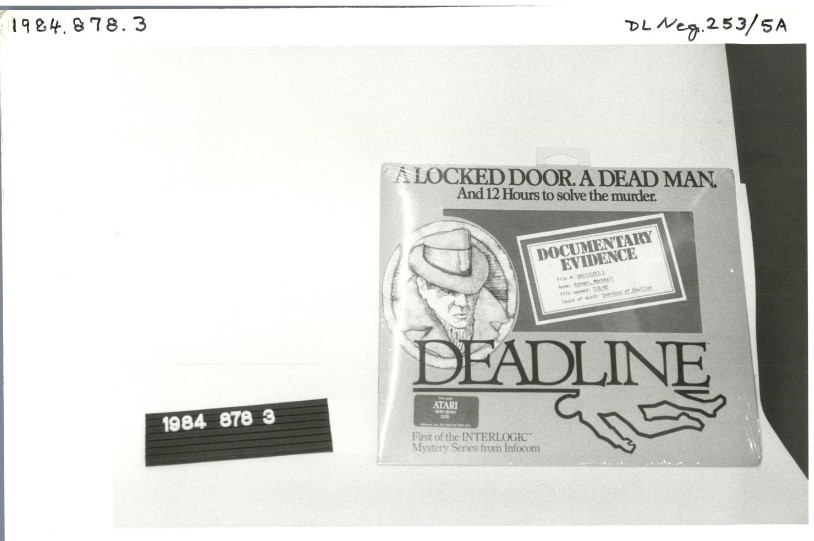
From the Smithsonian’s copy of Deadline, catalog number 1984.0878.03. Usage conditions apply.
The initial investigator on the case, G. K. Anderson, did a number of interviews of the people in the house with the deceased. First came the wife, who testified she woke in the morning to find her husband was not in bed; she assumed that he had fallen asleep working in the library, but he did not wake when she knocked at the library door. Eventually, Mrs. Dunbar (the housekeeper) and George (the Robner’s son) were awakened by Ms. Robner’s attempts to awaken Marshall. Eventually the police was called with axes. The police broke down the door to find the body of Mr. Robner.
ANDERSON: Did your husband ever talk of suicide?
ROBNER: He did, actually, though I never took it seriously. He would talk about how everything would be easier if he were dead, but when he would start again talking about how he was going to have to keep the business going. I’m…I’m stunned, really.
ANDERSON: Mrs. Robner, do you know of anyone who might have wanted to kill your husband?
ROBNER: Why, no. Of course not. He wasn’t a very friendly man; he was very quiet. But he was a great philanthropist, you know, and everyone that knew him respected him. I can’t imagine anyone wanting to hurt Marshall. Do you really suspect he didn’t commit suicide?
ANDERSON: I don’t suspect anything. I just want to understand what’s happened
The coroner’s report noted a bruise on the left temple, “consistent with falling to the floor from a chair”. There was a blood level of 27mg% for Ebullion, with a fatal dose being from 10-20mg%, and no other “common” drugs were found. (This incidentally suggests “uncommon” drugs are still possible.)
There was massive liver damage (which corresponds with an Ebullion overdose) and 10mg of Ebullion in the stomach. Time of death was sometime between midnight and 2 AM.
There’s a photograph of the crime scene, and I see two things of concern:
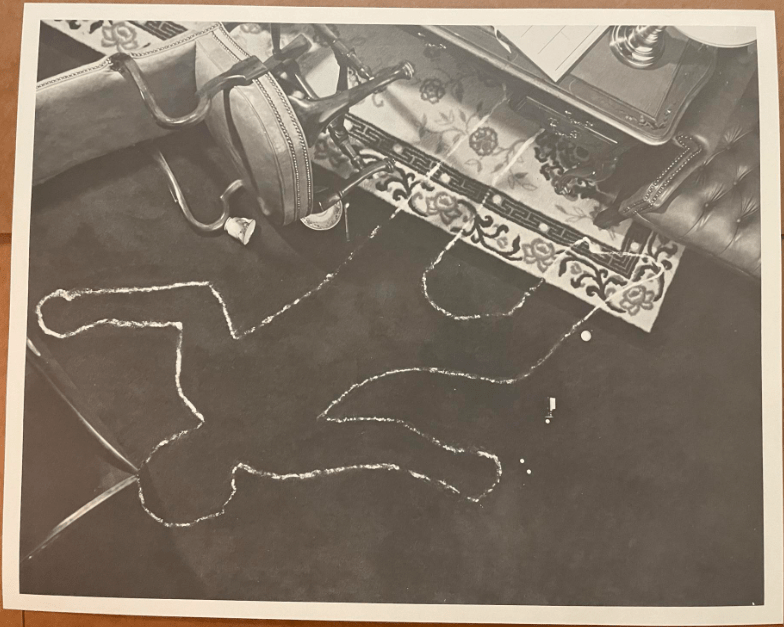
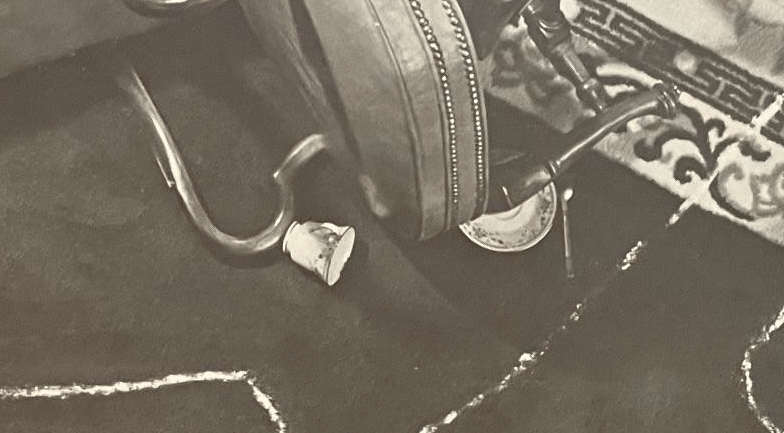
Issue #1: the placement of the china. The idea, theoretically, is that Mr. Robner turned around and fell over, and the china fell down along with himself and the chair. Somehow, the saucer ended up underneath the chair, and doesn’t look like it suffered any damage. Was it placed there?
Issue #2: the coroner report mentioned the front left temple. Assuming he turned around and fell forward, hitting the furniture as shown (the chalk outline actually goes underneath, slightly) it seems reasonable he’d have some manner of temple injury, but unless I’m misunderstanding, wouldn’t the damage be to the right temple?

The actual events of the day before, July 7, seem to be (according to the testimony of the housekeeper) that Mrs. Rourke was settled down in her room at 10:30 PM, with everyone on the second floor of the estate except for the secretary Ms. Dunbar, who had just arrived. At around 11 PM Dunbar brought up tea, and was the last (that we currently know of) to see Mr. Robner alive.
DUNBAR: Why, yes. I brought him some tea at about I 1 PM that night. On nights when he expected to work late, he would always expect tea at that hour. I brought him the tea and he asked me to leave. That’s all.
ANDERSON: Did Mr. Robner seem at all upset?
DUNBAR: He did appear quite nervous, but he had been upset for some time, as you know.
Regarding “being upset for some time”, Mr. Robner’s business he had founded was doing badly, and according to an interview with Mr. Baxter (Mr. Robner’s business partner) there was a “drastic plan” to save the business. Jumping ahead a smidge to my first playthrough, Baxter goes into more detail what this means when asked:
Before Marshall died, we agreed that the only reasonable way to protect our interests was to be bought out by a larger company which could then provide us with capital for expansion. I had been talking to people at Omnidyne and we agreed in principle on the terms for such an agreement last week. I’m hopeful that we can close the deal quickly.
Other than the wife, business partner, and secretary, there was an attempt at interviewing the son (George) who was apparently quite wasteful with money and the week before the death Mr. Robner had said he was going to rewrite his will and take George out of it. This had been threatened before but this time was different? Except no new will has surfaced at the time of the start of the game. (This irregularity with the will is why we, the Chief of Detectives, have been summoned in the first place; this was as a favor to Mr. Coates, the lawyer for Mr. Robner.) The interview didn’t go well.
ROBNER: Look, I don’t get what you’re driving at. You find the poor guy dead in his room. The room was locked. His bottle of medicine is nearly empty. What sort of detective are you, anyway?
ANDERSON: I’m doing the asking, if you don’t mind.
ROBNER: Then ask someone else.
By the Laws of Mystery Plots, the most suspicious person at the start is not the one who did it. Even if we back up and ignore the meta, the locked-room plot does seem to be a little past George working alone.
The big problem is: how did the medicine get in Mr. Robner in the first place? A fatal dose was found in the stomach so he really did ingest a lot of the substance, but given only the one (oddly-placed wound) it seems unlikely he could have been “forced” into taking the pills. The tea was detected as clean from Ebullion. Is the substance dissolvable, somehow? I get the impression from what little I’ve played a great deal of the mystery is in howdunnit, and that once that gets entirely resolved, the suspects will get narrowed down by themselves.
Then there’s the locked-room aspect itself. Assuming the housekeeper was telling the truth (admittedly a big assumption in a mystery) then past the secretary delivering the tea, nobody went up or down the stairs past 10:30 PM as they were very noisy. The only possibility would be out the window of the library to a balcony, possibly down a ladder. There is a shed outside the estate with a ladder but it didn’t have an obvious place for fingerprints; this is something I’m still investigating.

A “meta-map” of the estate.
Even if we assume an entrance via ladder, that doesn’t work consistently with what happened — Mr. Robner would no doubt be quite alarmed by an intruder from the outside. This suggests that perhaps the criminal was hiding in the room somehow (it’s a small library, though) and only left by ladder as opposed to climbing in that way. That of course still requires some coordination to manage correctly.
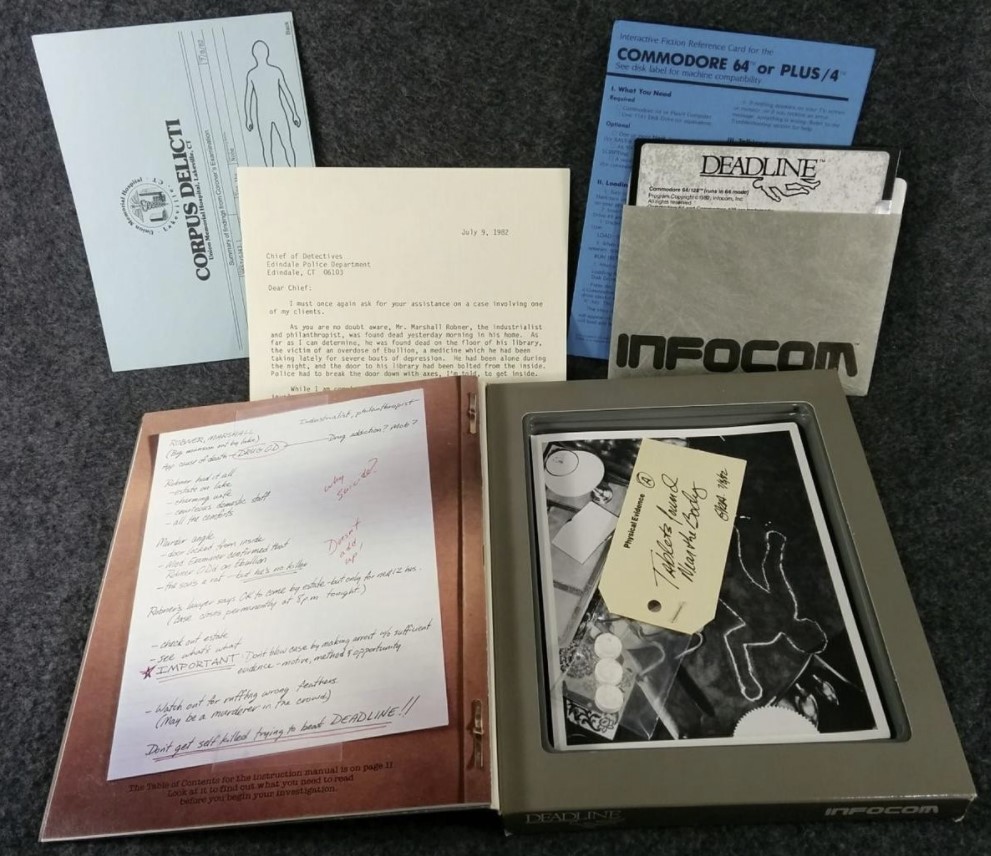
This squeezed everything I could out of the starting documents. I did get through an initial play, but it was a very non-narrative playthrough when where I was creating a map and testing out verbs; there’s a slew of special commands for the game. I’ll save talking about all that for next time, but let me add one thing, a central event. At noon there is a reading of the will from the lawyer who summoned our protagonist.
Mr. Coates begins: “This is an awkward situation. Mr. Robner told me five days ago that he wanted to execute a new will, and promised to call me when it was completed. As I never heard from him, I must assume that he either changed his mind or did not complete the new will. Therefore, the one in my possession must be considered the most recent testament.”
From the corner of your eye, you catch George nodding his head, as if in approval, and smiling broadly.
Continuing, Mr. Coates says: “Naturally, should a more recent will exist and be found within a reasonable period, the present one will be voided. I will proceed with reading the will here in my hands, which was executed three years ago last month.” He reads the will, simply written and direct, leaving equal parts of the estate to his son, George Arthur Robner, and his wife, Mrs. Leslie Phillips Robner.
Again, the game seems to be pointing out George as an obvious suspect, probably too obvious. I’ve made a couple of extra discoveries but I want to fill in some more background and create a narrative for next time. Still, the “more recent will” line sounds ominous, sort of a Chekov’s Gun for information (Chekov’s Clue?) Is there anyone other than George that would have benefited from the new will going missing, assuming there is one?
(Thanks to Drew Cook for providing a scan for the photograph with enough resolution for me to make some zoomed-in shots.)




 Renga in Blue