
No, this game doesn’t have anything to do with Infocom. It does have to do with the virtues of text vs. graphics. I particularly like the quote from Softalk in the ad above about prose “far more graphic than any depiction yet achieved by an adventure with graphics.”
(You should read my posts about the original version of Cranston Manor before reading this post.)
…
The Cranston Manor Adventure by Larry Ledden was published by Artworx; On-Line Systems (the future Sierra) licensed it to keep the Hi-Res Adventures series going, the one started with Mystery House, Wizard and the Princess, and Mission: Asteroid.
On-Line changed the credits to be Harold DeWitz and Ken Williams (according to Mr. Ledden, he was a newbie and didn’t think to get a credits condition on his contract) but I’m leaving Larry’s name on.

Via Mobygames.
The objective is still “find the treasures”, sixteen of them. Text from the packaging, including the typo:
It seems that old man Cranston was not exactly your run-of-the-mill type millionare. Exactly how he made his fortune is unknown (it appears he wasn’t a man known for either scruples or morals). Before his untimely death, he had amassed an uncalculated fortune in jewels, gold and various other rare and expensive items. Cranston was aware of the fact he was dying. He had lived a life of excessive luxury, pleasure and sin, and knew that soon he would end up “paying the piper”! Being a greedy and covetous old man, he figured that if he couldn’t take it with him, no one would take it when he was gone. He hid his treasure throughout the mansion and property encompassing it.
The game shifts the action to “Coarsegold” (where On-Line Systems was located), abandoned due to Cranton’s plotting somehow. I haven’t quite worked out how this happened in either this version or the original. You may remember the hologram of Cranston directing his army of tin soldiers; were those terrorizing the town somehow? In this version, the treasures are explicitly stolen from Coarsegold, and finding and returning the treasures to Coarsegold somehow will return the town to livability. I get the impression there’s still missing backstory, but the even stronger impression nobody thought too seriously about the logic behind it.
The “droid” idea from the original is dropped (it was, admittedly, a little weird). The game simplifies the map; here is, for example, the opening town:

The original “outdoor section” took me about one hour to map; the new one took roughly five minutes. All the mazes have been removed, nearly all paths have been straightened. (There’s an odd bit where going west “jumps” the player over a room; it being just a bug is quite plausible. Remember, the last On-Line game we looked at left the asteroid-hits-the-Earth timer running even after winning the game so the Earth can be simultaneously saved and destroyed.)
Both an inventory limit and the need to rest at intervals have been dropped. There isn’t even, as far as I could find, a limit to the lantern light.
This all sounds great, and I suppose is; but the end result really felt more flavorless than the main game. Example:
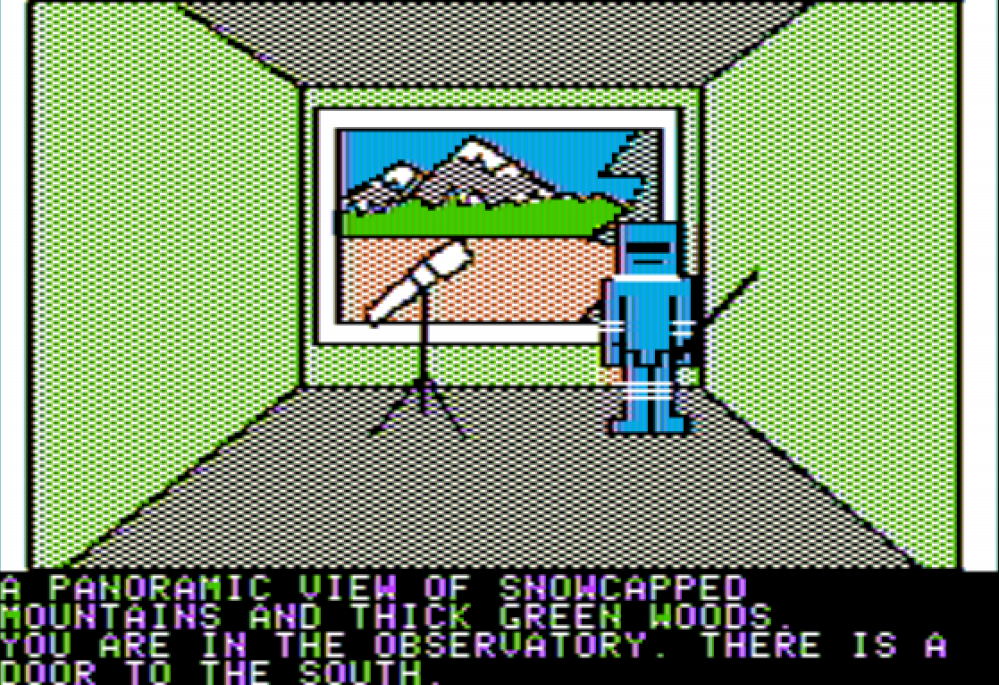
You may remember from my original posts that the revelation of the armor in all the rooms being spooky and atmospheric. Here the armor is more obvious (and it’s much clearer it’s the same armor following you around everywhere) but it comes off as nearly goofy. The armor also stops you from getting items other than treasures, which is I suppose would be fine, except there are two exceptions (cheese and a cage) which it does let you take in order to capture a mouse, and use as the same way as before (dropping the mouse scares away the armor). I could see someone getting stumped here because they assumed they couldn’t get the items.

The library, which has a secret passage that opens with the word EMASES in both versions, now has the word placed in a book in the library, where it is the only book there. Now, the original wasn’t stealthy either, but the word was in the observatory; having it be right on the shelf that gets opened seemed a bit too on-the-nose, turning an easy puzzle into a near-trivial one.
Relatedly, the previous game’s “organ room” had the organ not actually do anything, and you could just enter the fireplace; this version has PLAY ORGAN open the fireplace. (While simpler, I’ll admit this was more satisfying to do than just realizing I could walk in the fireplace.)
The tin soldiers show up underground again, but this time there’s no way at all to kill them. The game includes the dagger, but the dagger doesn’t do anything, so all you can do is run away.

The computer room is still there, and this time the puzzle that requires busting the computer by throwing some water on it works (more on this in a second). However, there’s no scene of the tin soldiers charging themselves up; this room doesn’t connect with anything in the game other than the sphere being another treasure.
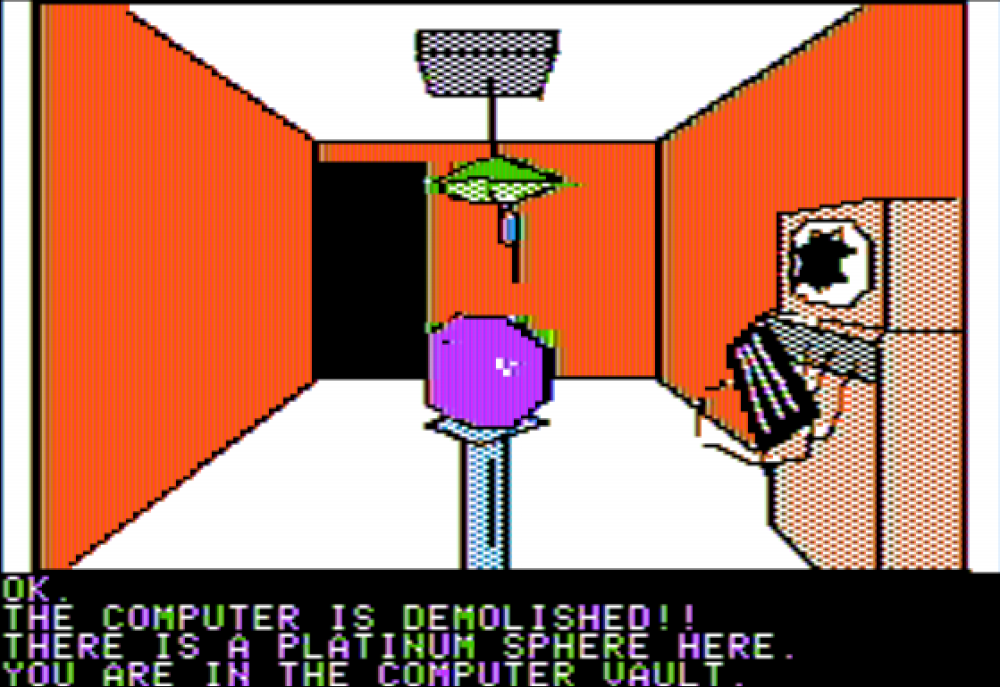
The pink bull is still in, except this time the time stasis field doesn’t hit right away. You have to turn off your lantern, and THEN a time stasis field hits (without even a meta-narrator, just some wizard does it…?) and then you have to walk by in the darkness. I imagine the idea was to enforce having the lantern on/off puzzle be solved, but it turned what was sort-of-fair-but-nonsense (you can just avoid second visits to the bull room in the original game) into complete nonsesnse (it’s not clear how the player character would even know about the stasis field while in total darkness).

The absolute worst change involves an item. In the original, you get a “cauldron” that you fill with water; it is used for both destroying a computer (as already mentioned) and priming a pump. I could not find the cauldron in the On-Line Systems version. I was very stumped and had to check a walkthrough. In the new version, the cauldron is now a “pot” and it is not mentioned in the room description.
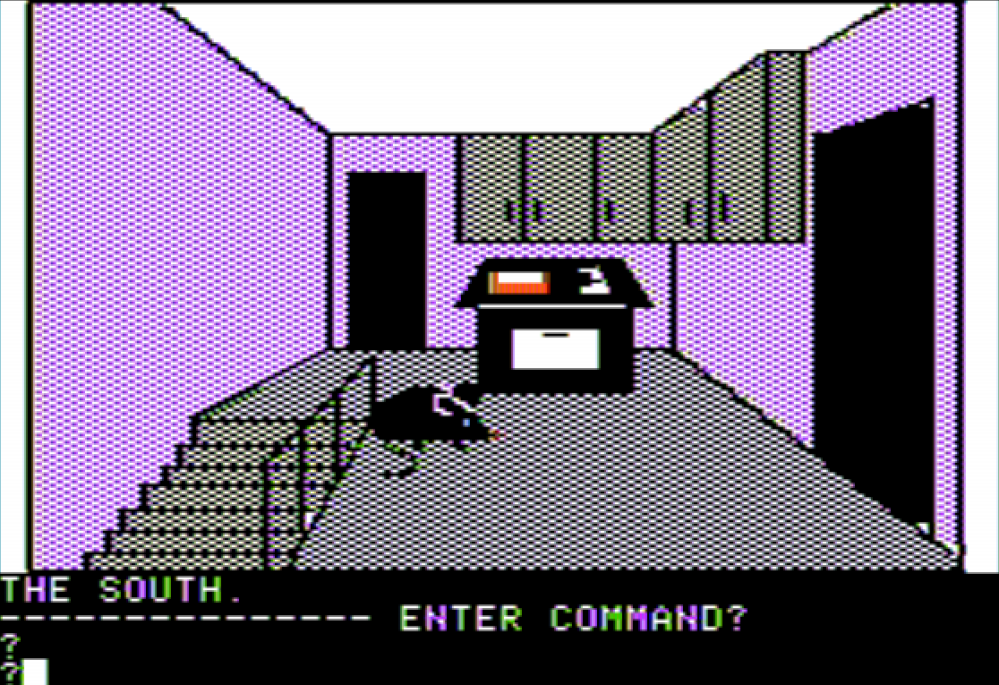
I am somewhat supportive of the items-in-picture-not-in-text system pioneered starting with Mystery House — I didn’t run into guess-the-noun or be-unaware-an-object-even-exists with Wizard and the Princess so it’s possible to be clear, even with a janky art style — but I had no notion at all of a pot in the picture. It’s that partially-visible black thing on the stove, I guess. Also, when the armor is on the screen it entirely covers the pot.

I mentioned being stumped by the raft on the fountain due to a failure in visualization. Unfortunately, I can’t tell for certain how I’d react with this game, but I think I’d make it through; the raft is depicted as very tiny, so at least visually it does fit inside the fountain.

To summarize the changes:
1.) no inventory limit
2.) no lamp timer
3.) simplified map
4.) water container hard to find
5.) suits of armor more obvious
6.) tin soldiers can no longer be killed, removal of visible connection with computer room
7.) computer room puzzle now works as originally planned
8.) pink bull puzzle now enforces turning off the lantern
9.) EMASES is right where it gets used
10.) the organ is used to open a secret passage
There are a few more points, and summed up I think they mostly average out to neutral (except possibly the pink bull puzzle pushing slightly to negative). Yet, as I already implied, I liked the original text-only version better. Why?
While I have nothing against graphics, even bizarre looking ones, the text — despite it being erratic at times, and often just functional — somehow painted the world more vividly. Let me pick a direct example.
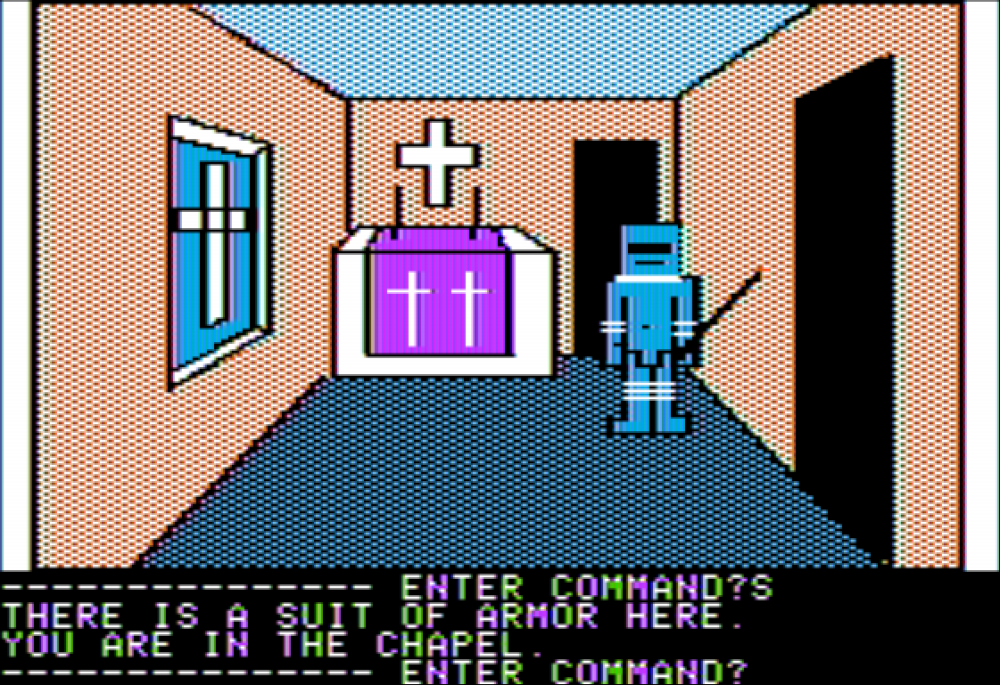
I’m standing in a long room with tall stained glass windows on the west wall. Hard looking wood pews line each side. There are exits to the north and east. Standing in one corner is a large black suit of armor.
Again, the text is almost completely pure function here, but my imagination paints the chapel much more strongly than the Apple II image does.
I wouldn’t welcome a text version of Wizard and the Princess; that game seems designed for its slightly odd characters and locations; I’m perfectly fine with Cranston Manor being reverted to all-text. I don’t know if it’s the sense of loss of setting that makes the difference (the “hard looking wood pews” being gone) or just the loss of part of my imagination, the “brain as graphics engine” as mentioned in the Infocom ad. When Ahab at Data Driven Gamer played both games and had the same reaction: “And as with Sierra’s previous graphical adventures, the graphics are really not very good, and came at the expense of verbosity, and while the writing in The Cranston Manor Adventure wasn’t exactly mind-blowing, it still wasn’t a good trade to lose it.”
One last oddity — and it would take some experiments in hacking the game to be sure — is I’m not sure if all the “positive” improvements even helped. Both the sleeping and lamp time were frustrating to cope with, but they added a rhythm to the game and added tension to explorations underground. Even though I skipped killing the tin soldiers in the original game, the existence of the possibility of doing so added an edge; I was making a strategic choice, one I sometimes questioned.
I also can’t really defend the convoluted map of the original that strongly, but still, I spent time in the opening abandoned town, whereas in the graphical version it was essentially a footnote. Spending time made the sense of abandonment more tangible. There clearly would be a better way to handle the same situation (with a shorter opening and more vivid text, perhaps some character dialogue) but it’s interesting that just dropping the flawed gameplay element ended up hurting the game when it wasn’t replaced by some element that conveyed the same effect.
It’s easy to whale on early adventure games (why is there another maze, why do I have to worry about lamp life, etc.) but sometimes, those flawed and now-outdated elements were still used with purpose.


 Renga in Blue
I played a lot of Apple II Cranston Manor as a kid, with my dad. Teachers at the school he taught at would trade play tips on this one. I was never aware, in life, there was another version of it beforehand that was all text until your blog. I appreciate your detailed comparisons as much as ever, though I figure almost nobody would have played or compared both versions in the day. A slice of a slice of the potential audience who’d have to own two expensive early computer systems and then choose to buy the same game on both. In that sense, I experience the comparisons from a more ‘what-if’ perspective than usual. I mean, when the Data Driven chap says ‘And as with Sierra’s previous graphical adventures, the graphics are really not very good, and came at the expense of verbosity, and while the writing in The Cranston Manor Adventure wasn’t exactly mind-blowing, it still wasn’t a good trade to lose it.”… well, at the time, these were the best graphics ever. I remember thinking they were as good as, or a step up, on Wizard & Princess. I can’t contemplate any kind of trade-of on another version I never played over the boundary of this much time when the trade is as dramatic as graphics / no graphics.
The text version was quite obscure – I suspect the vast majority of people only played the graphical one.
I am pretty tolerant of graphical jank, but one of my favorite games is Atari 2600 Adventure, so I am able to embrace giant pixels and slightly bizarre perspective. As far as what Ahab looks for you’d have to ask him.
I have amassed the sixteen treasures plus the crystal triangle after struggling at the end. I had to look up PRIME PUMP but apart from that I was unaided. Obscurity for the sake of it.
However, this appears to be one of those games that builds to a climax and then leaves you wondering what to do. Is there some Deus Ex Machina denouement or do the treasure have to be left somewhere specific? I note that I still can’t unlock the main gate.
I haven’t played this, but Jason’s posts on the text version include an intro that says that in order to get a perfect score, you need to get all the treasures out of the estate. Have you done that? Maybe specifically taking them through the main gate is important? (Jason’s posts on the text game also include a solution for opening the gate but I’m not sure if you want anything more specific about that.)
You enter via the smaller gate but I think you’re meant to leave via the main gate and that’s game, set and match. I have all the treasures and I can take them all outside of the estate but I cannot unlock the main gate even with the game’s only key and the crowbar. I know that the text only version for the Atari from 1981 (the one I played) is somewhat different to the truncated graphical version that Ken Wiliams violated by adding graphics which did nothing but dilute its appeal to me. I am not that worried as it will clearly be adding little to the gameplay in any case.
You should read my post, I spend a good amount of time discussing why the graphics don’t help at all.
Good job! Prime pump is indeed the nastiest bit to solve.
Yes; of course I should have read your post as it would have helped and now I’m home I have. I see you had similar problems to me.
To draw a somewhat tenuous analogy, when I was at school there was a craze for collecting Panini football stickers in an album. Panini released the empty albums just before each football World Cup or European Championship and you could buy the stickers to go inside them. Each player had his own sticker and place to put it in the album and there was a badge sticker for each country as well. Back in the day (starting back in the sixties) they were about 10 pence for two stickers in England although you never knew which footballers or club badges would be inside the wrapper. Inevitably this led to many duplicates as you would have four of the same player and gaps which of course led to us schoolboys swapping them amongst ourselves. I remember there were two Scottish players (David Narey and Derek Stark if memory serves me correctly) whom no-one in my school ever managed to buy. I suspect Panini shrewdly printed very few of some stickers so we were always striving for the last few to complete the album. Anyway the point I’m trying to make is some adventure authors seemed to throw in a completely obscure, off-the-wall puzzle so hordes of players would be stuck playing hunt the verb or trying surreal actions to complete their game and thereby increasing its notoriety.
I think this was certainly more common in the days of the commercial text adventure.
I always try to be careful about judging if an author intentionally breaks a game because people were bad enough at design it could happen quite naturally. Sort of the “oh they made Sierra games hard to sell hint books” mythology — the design was just a continuation of their older days back before they even sold hint books, I think they genuinely didn’t realize when they were looking at something bad, especially in this era with a lack of playtesters.
The one game I can definitely say a puzzle was made to force discussion was the endgame of Adventure 550 which required magic words which a player won’t even necessarily see on a single run. https://bluerenga.blog/tag/adventure-550/?order=ASC
Regarding the “puzzle that provokes discussion” thing, I suppose that would be natural to some of the old mainframe adventures, as they were often expected to be played communally on whatever system they happened to be on. I seem to recall that the original mainframe Dungeon/Zork was said to have been like that, and one gets the impression that the Cambridge/Phoenix guys were more interested in “out-boffining” each other than trying to create a smooth playing experience for the general public, at least early on.
When it came to home computer adventures, I do think a bit of a competition developed among some authors in the early 80s as to who could create the most difficult puzzles, but often it was just poor game balance where the author didn’t do enough outside playtesting to realize that what he/she thought was perfectly logical was actually anything but…
I think the Aardvark catalog descriptions kind of catch that — they brag about 40 hours of playtime or whatnot
Their games tend to be difficult due to parser minimalism more than full-on illogic though
I certainly don’t think it’s coincidence that the first four games written on the Phoenix mainframe out of a total of fifteen are probably the hardest although Xeno and Fyleet are very tough too.
Most of the puzzles in these games are very tough but fair with the odd exception (the teabag in Brand X and the smoke-filled corridor in Hezarin spring to mind) but the conscious use of exclusively obscure verbs such as PRIME, SMITE and COGITATE are surely there merely to frustrate and lazily make the game much tougher to complete.
Incidentally completed versions of those old football albumks are worth a lot of money if they are in good condition.
https://www.ebay.co.uk/itm/305747731307?chn=ps&_ul=GB&mkevt=1&mkcid=28&google_free_listing_action=view_item
I didn’t want to be too harsh on Larry Ledden. His original 1981 game stands up still as one of the best of the early treasure hunts. Ken Williams was the master of schmooze but I have always suspected he was in it for the money and not the love, even if you discount the recent graphical Colossal Cave abomination. Someone exquisitely described the latter as akin to “painting a clown-like rictus on the Mona Lisa.”