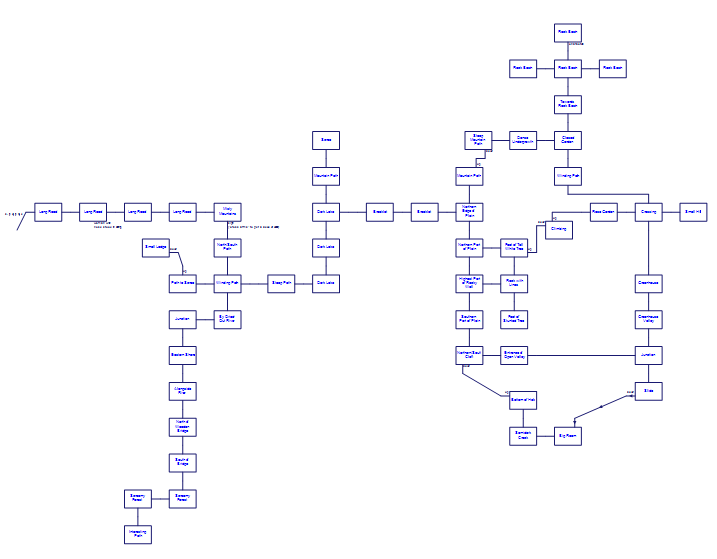
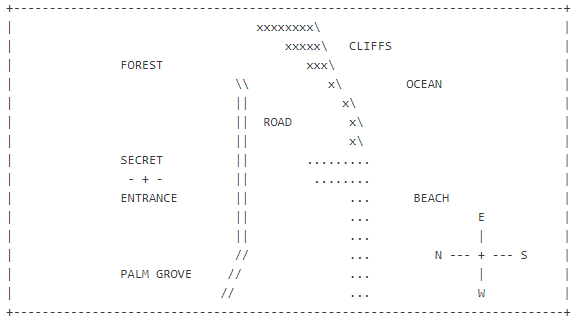
According to the one and only source I’ve found, Ringen was originally written in Norwegian by an author going by “Hansen”, probably at the University of Tromsø. (ADD: This is not quite accurate — I now have updated posts as the original game has been found. You can jump up to the new posts in sequence here, or keep reading until reaching the 2025 posts for the full story.) It’s based on the area around Moria (shown above) in Tolkien’s Lord of the Rings books.
Late in the 1980s it was translated into English and ported to the online MUD Genesis by Pål-Kristian Engstad, and in 1991 Per Arne Engstad took the same area and added it to VikingMUD.
While I’m not generally writing about MUDs — although I did write about MUD1 a little — I made an exception here because the original source is lost. Genesis MUD has since done major modifications to its Tolkien area, but VikingMUD’s is roughly like it was in 1991, so I played that game (as a guest) and went through to the “Ringen” area (from the newbie room, go south, east four times, north four times, then east once).
So far all I’ve been able to do is explore above-ground.
Long Road. A fairly broad and flat road it is, and it seems to continue eastward for quite a while. Surrounding is the mighty Hollin forest, or Eregion, as elves liked to call it. It is not to be confused with the Great East Road further north, which leads to the hobbit Shire, since this one probably will lead to the Redhorn Pass, and not to Rivendell, where Elrond holds his house.
There are two obvious exits: east and west
>EAST
Long road. You are walking along a hard and flat path through the Hollin forest.
There is a big sign here saying something important. An old root of a tree.
There are two obvious exits: east and west
A wicked woman with her nose stuck in (he he) the tree-stump
The woman says: If you aid me, I’ll reward you, I promise!
The woman says: Please help me get free from the stump!
Other than the scenario above, which might be a puzzle (?) all I’ve seen so far is scenery, things to examine, and orcs that want to kill me.
You are on a path that winds along side a dried out river. This once was the mighty Sirannon-river, which came gushing and foaming from the Misty Mountains. The path goes up, steeply to the east, where it meets some steps in the rock. To the north the path gets wider. A small footpath leads west towards a scree. The dried out river continues somewhat south.
There are four obvious exits: east, north, south and west
Urk arrives searching for human flesh.
Urk screams uglily and starts bashing and slicing you!
You notice Urk approaching you with murder in its eyes.
The enemies are the “mobs” from the MUD system I’m playing on. They did kill me twice but otherwise I’ve been able to basically ignore them and get on with looking around the map. I’m considering them “outside the game” so to speak, assuming they aren’t really part of the original Ringen. Of course, the original game may have had some sort of enemies and combat system, but it would have been different than the MUD’s system, and without hearing from the author or translators it’s impossible to know details.
I did run into Bilbo Baggins …
Bilbo Baggins arrives.
Bilbo says: Think about it! The whole party was lost!
Bilbo says: Howdoyado that? Oh, see you later, ok?
Bilbo Baggins leaves east.
… although he seems to be just a “peaceful” wandering character; I wasn’t able to get any interaction out of him.
The literary-adaptation angle otherwise seems to be restricted to geography and map references.
You are wading across a green and slimy brooklet The stones are very slippery, so take care not to fall! The main path continues east and west.
There are two obvious exits: east and west
>EAST
This is the east side of a green brooklet. The path continues east between some gentle slopes.
There are two obvious exits: east and west
>EAST
This is the northern edge of the plain in front of the Misty Mountains. Paths from the west, north and south meet here, and to the east there is a long and narrow wall of rock. To the south however, a plain covered with soil, pebbles tussocks opens, and to the south-west extends the Sirannon Lake.
I’m not discounting the possibility there’s something else hidden though, because the sign near the old woman mentioned earlier has this:
This is the new area made by Sir Rogon. Please use ‘bug’ and ‘typo’if you find my English terrible.
It is rumoured that great treasures and terrible monsters dwell under the Misty Mountains, in dungeons called Mines of Moria. If you only could find the entrance!
The closest I could find to a possible entrance is the famous “friend” door.
You are standing under a polished vertical wall.
As the moon shines upon the grey face of the rock, faint lines appear, like slender veins of silver running in the stone. At first they are no more than pale gossamer-threads, so fine that they only twinkle fitfully where the moon catch them, but steadily they grow broader and clearer, until their design can be guessed!
There are three obvious exits: north, south and west
I haven’t found any command that works here. It’s possible Ringen is just meant to have some open exploration and that’s it, but I suspect there’s at least one thing hidden I haven’t unearthed yet.
So, last time I discovered EXAMINE ROOM was needed to find hidden objects in rooms. (It turns out this was mentioned in the instructions, sort of, as a suggested command.) I also discovered that part of the reason I had trouble referring to objects is they wanted to be referred to by adjective, so to pick up “CHARRED WOOD” I needed to type GET CHARRED rather than GET WOOD.
At this point it seemed like all I needed was to clean up: visit and EXAMINE ROOM at every place on the map, grab the things I needed, and leave. There was one slight wrinkle.
so I found a CEREMONIAL MASK in my first room and put it on.
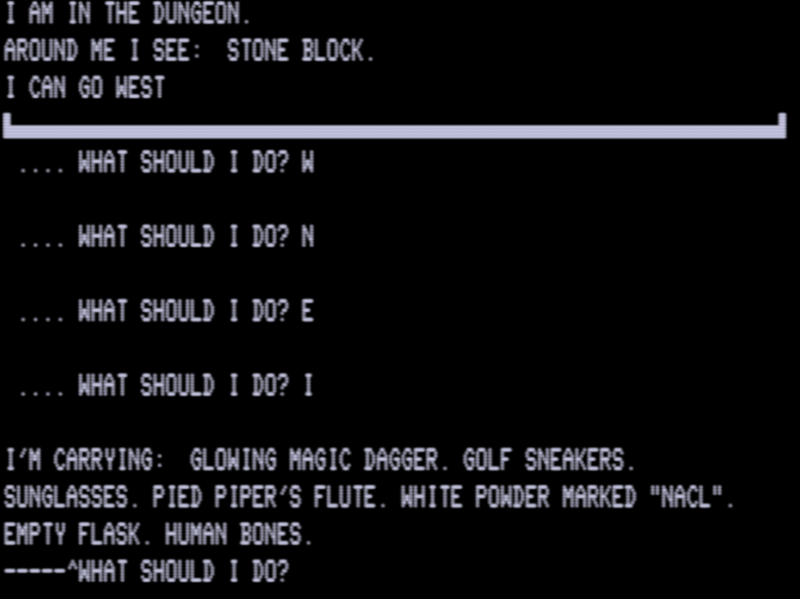
However, shortly thereafter I was surrounded by a blue light and fell asleep; then I had the message on the top of this post. The gods sent me to the shrinking-walls-of-death room.
It took a bit of exploration to realize that there is more than one mask, and many of the masks are fake. To win, you need the “FEATHERED MASK OF GOLD” specifically; there are also fake crowns and robes.
The robe and mask here are both fake.
I was also foiled by the fact an EARTHQUAKE occasionally happens at random and kills the main character. Again, it states the gods are angry, but I have no idea if there’s any logic to this; one time the earthquake happened before I even entered the temple.
Finally, there’s also an odd trick regarding jaguars:
There are two rooms that have “3 jaguars”. One of the rooms (the one above) has an endless supply of jaguars, and if you try to EXAMINE ROOM to find anything secret the jaguars will kill you. In the other room with “3 jaguars”, the jaguars don’t attack at all; hence, EXAMINE ROOM works fine. I have no idea if this is supposed to be a pun and the jaguars are supposed to be statues or something?
CONGRADULATIONS to me, I guess. This game was interesting in theory that this was essentially an open-world game where you’re just supposed to collect things and avoid tricks and traps along the way, but the myriad problems just led to frustration.
To end on a positive note, I’ll have to admit the “fake treasure” conceit was really fascinating. It did give a unique feel to the final stage of the game.
…
I’m not sure what I’m playing next — Lugi is still going to have to wait, so I might try a different mainframe game, or some oddity from the Apple II or … well, if people have been anxiously awaiting anything in particular, feel free to suggest in the comments.
Playing Temple of the Sun by Jack Powers led me to wonder, philosophically, what I really mean when I judge the quality of an adventure game. How much is based on context and what I’m used to, and how much is truly bad in an intrinsic way; that is, some design choice that is a poor call no matter what alternate gaming universe I might be writing from?
Just as an experiment, I’m going to mark game design flaws with
(C) this is probably because I’m used to it from other text adventures but it still annoys me
(U) this is probably reviled even amongst the aliens of Universe #5612 who type by vibrating their squid-tentacles
(?) I have no idea if this is really universally bad or not but it still made me feel unpleasant at the time
As my intro might have hinted, I’m going to tear into this one, but first, let me be positive on the introduction setup. Our previous encounters with ancient ruins (see: King Tut’s Tomb, Pyramid of Doom) had us raiding treasures without a care or even a “it belongs in a museum!” line. To be fair, this is just the games being flatly equivalent to all the other treasure collect-a-thons of the time.
Temple of the Sun has a slightly different conceit:
Our goal is to enter an ancient temple and do the rituals needed to become a shaman. The implications are: the main character is doing something as part of a culture, not as a money grab. The end result is still picking up treasures, but at least the motivation is slightly different. The SCORE command straight-out lists what you already have and what you still need to beat the game:
I initially thought this meant the parser experience would be nice. I was very, very, wrong.
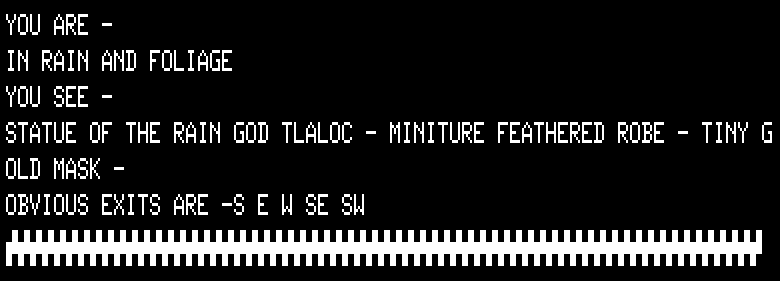
Here’s the opening screen. The “Dark Entrance” can’t be referred to or entered. It’s just “scenery” but is supposed to represent the south exit. (?)
I had a bit of confusion thinking the starting place had two exits.
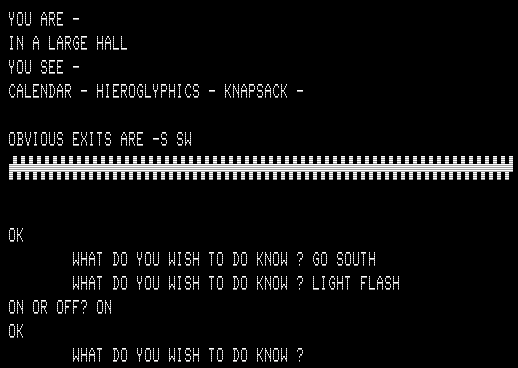
Incidentally, just S or SOUTH doesn’t work, you have to type GO SOUTH. (C)
The next place has a “calendar”, “hieroglyphics” and “knapsack”. Both READ CALENDAR and READ HIEROGLYPHICS have the same response, and I spent a fair amount of time re-confirming there was no way to get a different message by referring to either in a different way. (?) I suppose it could be implying a calendar was in the form of hieroglyphics, but I still get the uncomfortable impression this is just a bug in one of the first rooms of the game. The message you get
IT SHOWS A SHAMAN SKINNING A DEER TO MAKE A POUCH AND APRON.
is kind of nice; there are other hieroglyphs throughout the game that indicate what you’re supposed to be finding. This is only undercut by the fact one of the basic commands of the game already states exactly what items you need to get. (?)
Also, TAKE KNAPSACK doesn’t work. (U)
SORRY BUT YOU CANNOT TAKE KNAPSACK
Oops! Checking the verb list at LIST, the word is GET …
YOU CAN ONLY WEAR IT.
… huh? The object is modeled in a way that wearing the knapsack is the same thing as picking it up, and you can’t be carrying the knapsack. (?) I also could not find a way to open it or look inside. (U)
Moving on to the southwest, I find a room with shrinking walls and die. Oops.
I’ll see this room a lot. There’s a turn (or two?) before you die suggesting there’s a way out, but if you use the command PRAY (which seems to be the games “hint” command) the game just suggests quitting and trying over. (?)
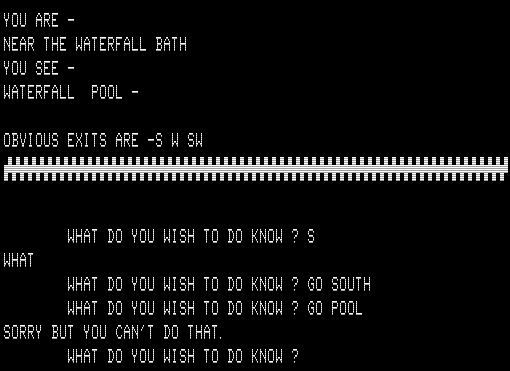
Restart! Back to the knapsack room, then south:
>GO POOL
SORRY BUT YOU CAN’T DO THAT.
Oh, SWIM is a verb off the list, ok. (C)
>SWIM POOL
YOU SEE A LARGE TUNNEL
The room description didn’t change other than OBVIOUS EXITS are now just “UP”. This felt uncomfortable and I was confused for a while if I was still in the same room somehow. (C)
>SWIM TUNNEL
YOU HAVE JUST ENTERED THE MOUTH OF A LARGE TURTLE. YOU NEEDED MORE SALT, BUT YUMMY.
Yay, death traps! Let’s accelerate things a little with a map:
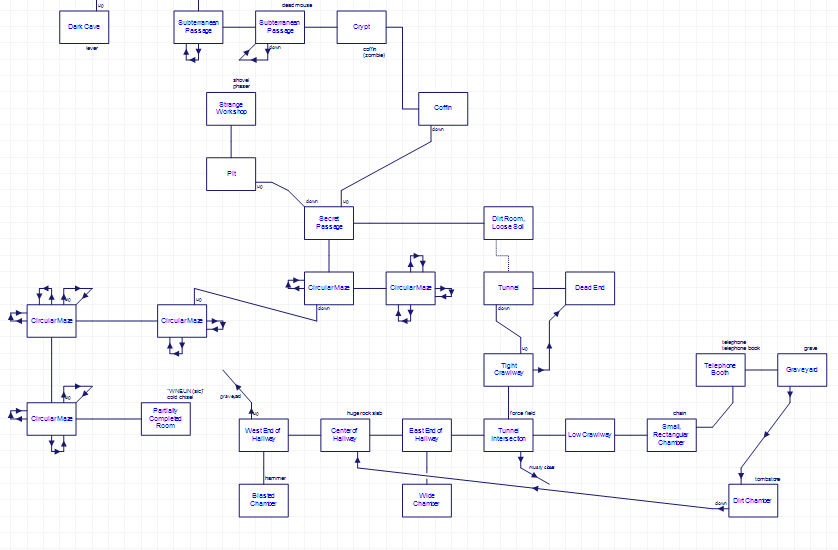
Note how in the upper left corner there’s a bunch of one-way arrows leading to one room. This is the shrinking walls room which always killed my character, and once I realized the layout was a grid (mostly) I was able to predict what was going to happen, but I still had to test to be sure.
The “mostly grid” part led to far more annoyance than the map needed to; there are a fair number of “one-way” places where you have to detour to get back to where you start rather than just going there in a single step. I’ve seen plenty of crazy map connections in my day, but the fact this was almost a perfect grid made the whole setup more grating than usual. (?)
I have no idea how to get the game to recognize any input regarding the steel box either.
There were lots of items that seemed like you should be able to take them or manipulate them, but the game just either flat out refused to recognize the input or responded with SORRY YOU CAN’T DO THAT … YET without any good reason at all the action might be prohibited. (?) In some cases, I suspect this response applied to some actions that were never intended to happen in the future. (U)
Near the end of my play session, I had no idea how to get most of the items (like the mask) mentioned from the SCORE command. Out of curiosity I checked the start of Gaming After 40’s writeup and found (in the non-spoiler section) something which made the game completely different.
Most critical objects are randomly hidden in the game world — the player must EXAMINE ROOM in every location to unearth these items. I had to dig into the code to figure out why so many necessary items didn’t seem to be available.
Erf, argh! This would have been helpful to include in the instructions, perhaps? (EDIT: I read carefully through the start game instructions and it does get included as an example suggested command.) I tried EXAMINE ROOM immediately after this and found two of the important items in the room my character was in. Then I was annoyed enough I decided to call it for a day.
Hopefully I’ll finish this off next time; otherwise, I’ll be making the squid aliens take over on this one.
As predicted I was quite near the end, but I had to do the extreme measure of opening the data file with a text editor to get there. It was worth it for the ending (which, I’ll be honest, is not something I’d ever expect to say for a Greg Hassett game, but here we are).
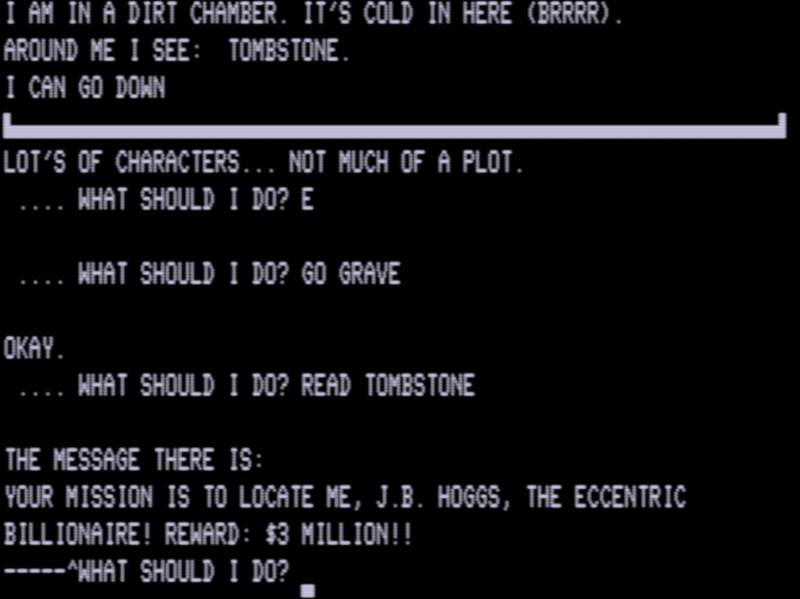
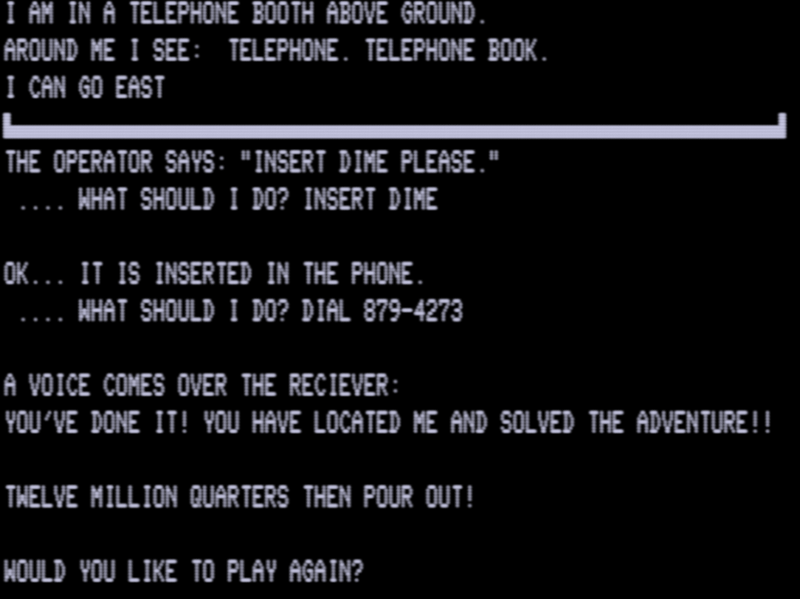
After the shenanigans in my last post, which included bringing down a force field with a phaser and chiseling a dime out of rock, I made it to a graveyard where I found out the objective of the game:
Nearby was a phone booth with a phone book. (Conveniently, the faux-dime made out of rock worked on it.) I suspected that the goal above would be reached via dialing the right number, but no permutation of >READ BOOK yielded a number; it wasn’t possible to look up the name HOGGS or the like.
Fairly soon I was out of obstacles, except for a large rock which didn’t have any writing and didn’t yield to any of the adventurer commands of TWIST / TURN / PULL / etc. After fruitless wandering back and forth I decided to open the file in a text editor and hope for the best.
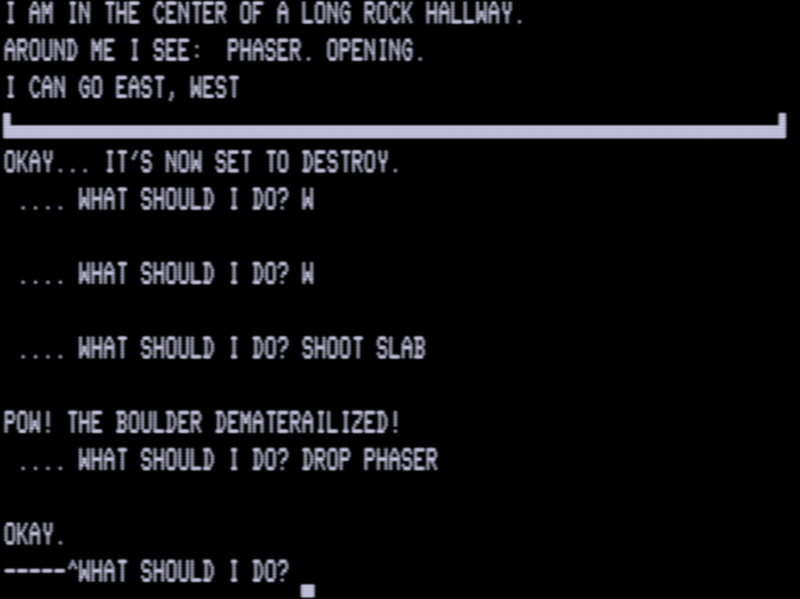
I had overlooked my Star Trek references: if a phaser is in a game, *always* check it for multiple settings. Specifically, >LOOK PHASER revealed it had settings for REVERSE (the default) and DESTROY. I changed the setting to DESTROY and went back to the large rock:
This opened up a new passage into some secret archives.
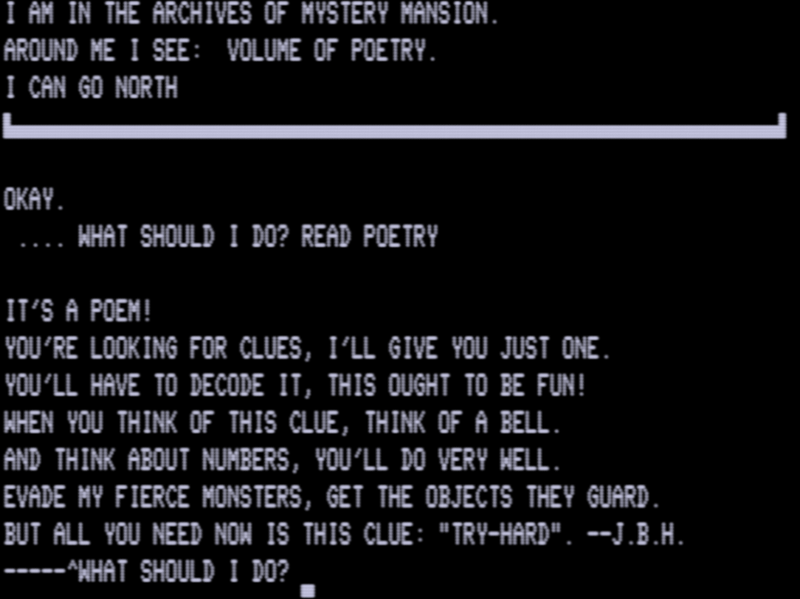
Fortunately, letters on keypads haven’t gone out of date yet, so I was able to convert the clue into a number, and the glorious ending.
Just for reference, a quarter is about 5.67 grams, so 12 million of them would weight 68 metric tons or just a bit lighter than a large dinosaur. It’s going to be fun toting away the haul! (This is assuming the main character even survived the deluge.)
Most games from this era had perfunctory endings. I suppose this one did as well — just three sentences! — but the Monkey’s Paw style twist was enough for me to be happy. (I liked Zork’s ending as well as Local Call for Death’s, but I can’t think of any others from 1980 or before that were memorable.)
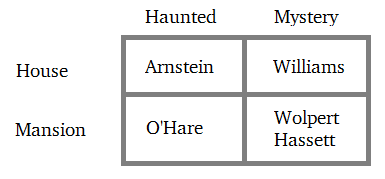
Here’s a handy guide for keeping track of spooky domicile text adventures.
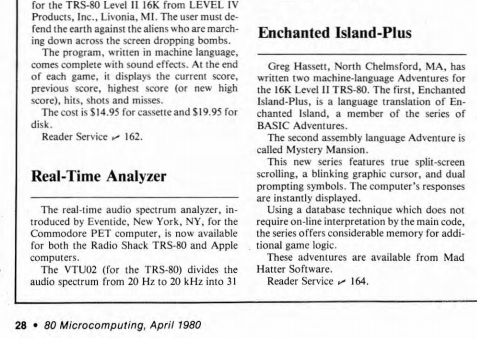
(Before I get started with the game itself, I’d like to thank Brian Decker for letting me know he found Greg Hassett had released his games into the public domain, leading Ira Goldklang to upload the entire set to the internet. Mystery Mansion wasn’t available anywhere until last year when this happened.)
This was Mr. Hassett’s first game done originally in machine language. He ported his prior game Enchanted Island to machine code and called it Enchanted Island Plus, but it was still essentially the same game; Mystery Mansion was designed from scratch in machine language.
Ad from Micro 80 magazine.
The premise is simply that “you have been called by a strange dream to a huge mansion. What you are doing here is part of the mystery.” There’s no treasures to collect, but not a lot of direction, either. I didn’t feel like the game was as aimless as Battlestar, because there’s enough tightness to the geography that it was always clear where the next obstacle was.
It does come across as a better game than his previous ones, by a multiplier. It’s nice in a “scientific” sense because he doesn’t change that much of his style; since Mr. Hassett essentially changed only one variable it’s more obvious what led to the improvement. The puzzles are still quite simple (you have poison, cheese, and an evil rat: what do you do?) His main innovation was to be more careful with the structure.
The game starts in a linear way: passing through a door or secret passage causes it to close, so you’re moving from small area to small area. There’s one point where you can leave something behind. It was genuinely interesting (and not, as I would expect, irritating) to solve this puzzle, in that I had to think of not just the tools I had, but a tool I could have had access to in the past had I approached a certain situation differently. This violates the essential rule in adventure game design that you can’t block progress by a prior action, but this is a special scenario in that a.) it happens near the start and b.) it takes about 60 seconds to get back to the puzzle in question. (This kind of design can still be very, very painful.)
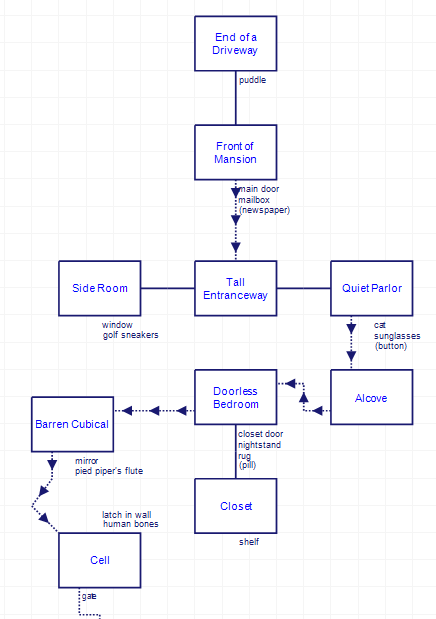
After the linear section, the map opens up to a slightly larger but still blocked section. The left section opens up via a lever, and solving a puzzle there allows passing a zombie, opening up the third and largest section.
The overall effect is a sort of overlapping going on where solving puzzles leads to doubling back over the game’s geography in new ways. Even with very basic room descriptions …
… the structure gave enough of an “adventurer feel” that playing the game felt like exploring an environment, rather than filling in a bunch of map boxes.
I did finally discover why my character was summoned to the Mansion, but I’m stuck on what might be the last puzzle, so I’ll save talking about that for my next (hopefully last) post.
My last update promised I would get to the mainframe game Lugi soon, but in the process of trying to set it up I made a new discovery regarding Warp.
Brief reminder: Warp is a gigantic mainframe game with 1216 points possible on the HP3000. It has an unusual parser that allowed “conditional” statements and macros. The only way I had of playing it was via a telnet server, so I was paranoid it would eventually disappear forever.
In May of last year, a genuine expert at the HP3000 (Big Dan the Blogging Man) made a “packaged” version of the HP3000. If you’ve tried the Digital Antiquarian’s TOPS-10 in a Box, this is similar: you just download and run.
which is the games account, and then you can RUN WARP to play Warp offline! Bill Wolpert’s Mystery Mansion from 1978 is on there too (RUN MANSION) so you can emulate it running on the original hardware rather than using a port.
To quit, press CTRL-A to enter console mode, then type SHUTDOWN.
I never saw a “*** You have won ***” message, but I managed to kill Darth Vader, so I think I can call this one done.
Okay, maybe you need more backstory, but note I’m still as confused as you are.
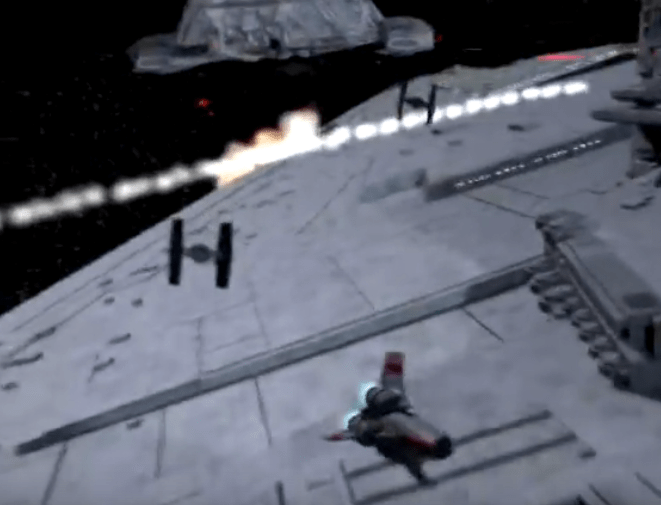
To commemerate the moment, here’s a fan video where TIE Fighters and Vipers do battle. Sadly, I could not find a crossover video that also tossed Fantasy Island into the mix.
My first breakthrough came from a game of guess-the-noun.
You are at the clubhouse.
The clubhouse is built over the most inland part of the lagoon. Tropical bananas and fragrant frangipani grow along the grassy shore. Walking across the short wooden bridge, we enter. Along one wall is a bar with only a few people seated at it. The restaurant and dance floor are closed off with a 2 inch nylon rope.
There are some matches here.
An old-timer with one eye missing and no money for a drink sits at the bar.
I happened to have some coins so I tried >GIVE COINS or >GIVE COINS TO OLD-TIMER or >GIVE COINS TO MAN or a bunch of different permutations. Fortunately, the right action is strongly hinted in the text, but I still had to look at the source code to find the answer.
>give coins to timer
coins:
Given.
He fingers the coins for a moment and then looks up agape. `Kind you are and I mean to repay you as best I can.’ Grabbing a pencil and cocktail napkin…
‘This map shows a secret entrance to the catacombs. You will know when you arrive because I left an old pair of shoes there.’
I managed to find the right place, procure a lantern to explore darkness, and after some crawling and a ladder I came across:
Out from the shadows a figure leaps! His black cape swirls around, and he holds a laser sword at your chest. ‘So, you have come to fulfill the Quest.
Ha! Your weapons are no match for me!’
You look tired! I hope you’re able to fight.
>shoot man
With his bare hand he deflects the laser blast and whips the pistol from you!
He attacks…
I’m afraid you have suffered some minor abrasions.
I admit I was distracted at first by the notion I was supposed to fulfill a “Quest” I hadn’t heard anything about. I only realized after a couple failed combat attempts that I was dealing with this guy:
I got very stuck here — the laser quite easily blasted any other enemy I had come across but didn’t work on Vader — so I kept exploring both the game and the source code. I found out I could >USE AMULET:
The amulet begins to glow.
A light mist falls over your eyes and the sound of purling water trickles in your ears. When the mist lifts you are standing beside a cool stream.
You are on the bank of a stream.
The stream falls over several small boulders here and continues on left.
(Incidentally, you can do this from the very start of the game, while you’re on the Battlestar, and skip flying the Viper entirely!)
Continuing:
You are at the thermal pools.
Several steaming fumaroles and spluttering geysers drenched by icy mountain waters from a nearby waterfall heat half a dozen natural pools to a delicious 42 degrees. Enchantingly beautiful singing seems to flow from the water itself as it tumbles down the falls. There is a mossy entrance to a cave ahead.
A flower-like young goddess is bathing in the hot mineral pools. She is watching you, but continues to steep and sing softly.
Because this is also Fantasy Island, giving a diamond ring and kissing is sufficient to make a plot dump happen:
She cuddles up to you, and her mouth starts to work:
‘That was my sister’s amulet. The lovely goddess, Purl, was she. The Empire captured her just after the Darkness came. My other sister, Vert, was killed by the Dark Lord himself. He took her amulet and warped its power. Your quest was foretold by my father before he died, but to get the Dark Lord’s amulet you must use cunning and skill. I will leave you my amulet. which you may use as you wish. As for me, I am the last goddess of the waters. My father was the Island King, and the rule is rightfully mine.’
She pulls the throne out into a large bed.
You get a medallion after this scene to go with your amulet. The game still never quite says “This is your Quest!” but that might be intentional — I don’t find any “final message” for winning the game whilst diving through source code, so it’s possible things are supposed to be a little freeform and you can ignore all this lore if you want.
A bit after this scene I was hanging out with Mr. Roarke and Tattoo when this happened:
You are at the sea plane dock.
Native girls with skin of gold, clad only in fragrant leis and lavalavas, line the dockside to greet you. A couple of ukulele-plucking islanders and a keyboard player are adding appropriate music. A road crosses the clearing ahead. There are some tables set up right.
An unctuous man in a white suit and a dwarf are standing here.
A swarthy woman with stern features pulls you aside from the crowd,
‘I must talk to you — but not here. Meet me at midnight in the gardens.’
It seems to just be an event that triggers some time after the goddess scene and doesn’t happen anywhere in particular.
Later in the gardens:
The swarthy woman has been awaiting you anxiousy. ‘I must warn you that the Island has anticipated your Quest. You will not be welcomed. The Darkness is strong where you must search. Seek not the shadows save only at night, for then are they the weakest. In the mountains far from here a canyon winds with ferns and streams and forgotten vines. There you must go. Take this rope.’
(I never found a use for the rope, but I didn’t find the canyon either.)
In any case, I set to work trying to kill the Dark Lord/Vader, which after many failures involved the secret Jedi technique of “studying the source code”. I found that most of the weapons in the game (there’s a chain, a knife, a halberd, and a mallet) do very little damage, a rusty broadsword does a reasonable amount of damage, and a two-handed sword does the most damage.
I first tried to bring the two-handed sword to Vader, but it’s so heavy I needed to drop every single item not being worn. Unfortunately, this includes the laser blaster, and any attacks by elves on the way were deadly without the blaster. (It also included the lantern needed to see, but this wasn’t as much a problem since I knew what route to take when underground.)
Rusty broadsword vs. laser sword it was. I also dropped everything else I was carrying right before the battle because it looked like from the source code that the amount being carried factored into the combat result. Voila:
>kill man
His ribs crack under your powerful swing, flooding his lungs with blood.
He attacks…
You emerge unscathed.
>kill man
You swung wide and missed.
He attacks…
I’m afraid you have suffered a minor puncture wound.
>kill man
A bloody gash opens up on his right side.
He attacks…
You emerge unscathed.
>kill man
The steel bites home and scrapes along his ribs.
He attacks…
You emerge unscathed.
>kill man
With a mighty lunge the steel slides in, and gasping, he falls to the ground.
You have killed the Dark Lord.
A watery black smoke consumes his body and then vanishes with a peal of thunder!
It’s too dark to see anything in here!
I returned to the goddess but had no reaction. The source code indicates a “talisman” the Dark Lord had but I didn’t see one. (It also indicates a scene where the Dark Lord runs to another place and you have to give chase, so it’s possible some spots are just broken.) If you wear the amulet, medallion, and talisman all at once the game claims you are now a “wizard” and I suppose something fun might come out of that, but I’m satisfied with the result I have.
Incidentally, the “score” of the game tracks PLEASURE, POWER, and EGO as three separate scores. Shooting stuff raises power; romancing goddesses raises pleasure, and … I’m not sure on ego, but giving the coins to the old-timer boosted that one.
…
I can charitably say this was ambitious. Unfortunately, the same ambitions led to issues. It’s like all of them were half-way to a good thing.
By dropping puzzles, the game had a startlingly modern flavor, but there was a major lack of things to do. There was no examine command or way to manipulate any of the scenery; there was no way to have conversations with any of the characters, and in the few cases a verb was required picking the right one was often a struggle. On top of that, it didn’t really drop all puzzles, so the few that remained — like realizing what weapon would be good in a fight against Vader, or figuring out the right parser command to hand over some coins — were rather bad.
The fairly loose approach to the plot was admirable in a let-the-player-do-what-they-want sense but it led to major out-of-order confusion, and I’m still really not sure what to think of the main character (I guess he stopped caring about the Battlestar being in crisis).
I’m glad to see experiments like this, but I’m also glad to leave them behind for something more traditional. I’ll probably be hitting another TRS-80 game or two before getting back to a mainframe game, specifically the thought-to-be-lost-forever-recently-found game Lugi.
Since last time I’ve walked around an island very confused, not just because of the still-horrendous mapping, but because of being entirely unclear what the game has turned into. There’s a reference to “Huggies” which suggests modern Earth …
You are in a secret nook beside the road.
Hidden from all but the most stalwart snoopers are some old clothes, empty beer cans and a trash baggie full of used Huggies and ordure. Lets get back to the road behind you.
… random battles …
There is a fierce woodsman here brandishing a heavy mallet.
>shoot woodsman
The Woodsman took a direct hit!
You have killed the Woodsman.
The road crosses the lagoon here.
Strange mists rising from the water engulf a rickety old enclosed bridge here. Spider webs catch our hair as we pass through its rotting timbers. I felt something drop on my neck. The road delves into the accursed forest ahead and behind you.
A dead woodsman has fallen here. He was savagely murdered.
A heavy wooden mallet lies nearby.
… a modern house …
This is the front lawn.
There is a small fountain here where the driveway meets the lawn. Across the driveway, right, is an ornate white house with and elegant woodworking. The bargeboards are carved with fylfots, the ancient symbols of luck. Even a bell tower has been built here. There is a road behind you which turns into the driveway.
… and finally, a place that led to an astonished/horrified revelation.
The natives are having a festive luau here. Beautiful dancers gyrate in the torchlight to the rhythm of wooden drums. A suckling pig is sizzling in a bed of coals and ti leaves are spread with poi and tropical fruits. Several natives have come over to you and want you to join in the festivities. There is a light burning in a bungalow left.
A kerosene lantern is burning luridly here.
An unctuous man in a white suit and a dwarf are standing here.
There are some ripe papayas here.
There is a ripe pineapple here.
There are some kiwi fruit here.
There is a ripe mango here.
A native girl is sitting here.
The “unctuous man in a white suit and a dwarf” in particular was the clue.
This is a Battlestar Galactica / Fantasy Island crossover game.
The basic premise of the TV show: guests can travel to the island to live out any fantasy they want (although the ramifications can be along the lines of “be careful what you wish for”). A sampling of the plot lines from the show:
The Boxer: A boxer named Billy Blake (Ben Murphy) wants to win a match despite the fact that it would kill him.
Ghostbreaker: A librarian named Elliot Fielding (Ken Berry) can’t get his ghost-busting guide published. To prove his skill, he lives out his fantasy where he must exorcize a real ghost.
The Over the Hill Caper: A blackmail victim named Spencer Randolph (Ray Bolger) and his aging buddies reunite their gang to defeat their blackmailer.
Aphrodite: Professor Alan Briar (George Maharis) is a picky man who wants the perfect woman. He ends up meeting Aphrodite: Goddess of Love (Britt Ekland).
I have still no idea what the goal might be, or even if this game has an ending. I’m going to call it and say — finished or not — next time will be my last post.
In previous text adventures I’ve played involving a compass, taking the compass “activated the interface” so to speak and let you use north/south/east/west as directions. Battlestar decided otherwise:
You are in the old garage.
This is an old wooden building of the same vintage as the stables. Beneath a sagging roof stand gardening tools and greasy rags. Parked in the center is an underpowered Plymouth Volare’ with a red and white striped golf cart roof.
There is a length of heavy chain here.
There is a compass here.
The keys are in the ignition.
>-: get compass
compass:
Taken.
>-: use compass
Your compass points right.
You still have to go ahead/back/left/right, now you just get to USE COMPASS in every room and try to decipher what the compass directions might be. The room descriptions are unchanged.
The road leads to several large buildings here.
There is a clubhouse left, a large barn and stable ahead, and a garage of similar construct to the barn behind you.
This strikes me as the author sticking with a noble pursuit in versimilitude, without considering the fact that the whole process of navigating with relative directions has been a sort of anti-realism, jarring at every step. (I can’t exactly be upset, though — this was so early in adventure game history it was hard to say what the result of such an experiment would be.)
As a more general point, though: having to communicate with the computer via some sort of interface always adds a level of unrealism. The player isn’t literally “in the story” — in this case they’re reading a constructed set of prose, drawing a map (maybe), and typing a response — which is why an attempt at adding verisimilitude can in practice reduce it, especially if the player “loop” goes haywire.
In the days before the darkness came, when battlestars ruled the heavens…
Three He made and gave them to His daughters,
Beautiful nymphs, the goddesses of the waters.
One to bring good luck and simple feats of wonder,
Two to wash the lands and churn the waves asunder,
Three to rule the world and purge the skies with thunder.
In those times great wizards were known and their powers were beyond belief. They could take any object from thin air, and, uttering the word ‘su’ could disappear.
In those times men were known for their lust for gold and desire to wear fine weapons. Swords and coats of mail were fashioned that could withstand a laser blast.
But when the darkness fell, the rightful reigns were toppled. Swords and helms and heads of state went rolling across the grass. The entire fleet of battlestars was reduced to a single ship.
Well, we’ve seen a Star Wars game, we’re definitely going to see some Star Trek games, but what about fan games for other franchises, like, say, the 1978 TV show Battlestar Galactica?
From the Internet Movie Database. (The pilot for the TV show was given a theatrical release.)
As the long timeframe of creation implies, this is another mainframe game. The manual page claims it was written “in 1979” so I’m guessing the bulk of the writing happened earlier rather than later. I was also somewhat excited to get to this one, because of this comment (also from the manual):
… it’s slightly less of a puzzle and more a game of exploration. There are a few magical words in the game, but on the whole, simple English should suffice to make one’s desires understandable to the parser.
I was thinking maybe this would be a proto-version of a late-era Telltale game, dispensing with the idea of “puzzles” and reducing things to exploration and action. That’s sort of accurate.
I. The Plot
You awaken amidst chaos.
This is a luxurious stateroom.
The floor is carpeted with a soft animal fur and the great wooden furniture is inlaid with strips of platinum and gold. Electronic equipment built into the walls and ceiling is flashing wildly. The floor shudders and the sounds of dull explosions rumble though the room. From a window in\ the wall ahead comes a view of darkest space. There is a small adjoining room behind you, and a doorway right.
The first phase of the game has you wandering the Battlestar and finding a lot of dead people. Example:
This is the maid’s utility room.
What a gruesome sight! The maid has been brutally drowned in a bucket of Pine Sol and repeatedly stabbed in the back with a knife.
The hallway is behind you.
There is a knife here
The maid’s body is lying here. She was murdered!
Or:
This was the seen of a mass suicide. Hundreds of ambassadors and assorted dignitaries sit slumped over their breakfast cereal. I suppose the news of the cylon attack killed them. There is a strange chill in this room. I would not linger here. The kitchen is right. Entrances ahead and behind you.
And yes, it’s a little excessive. The bizarre thing is
a.) it’s unknown why you survived, given nearly everyone else around you is dead
b.) there are lots of explosions and bodies and stabbings and so forth, but no enemies.
I can chalk up (a.) to dumb luck, but (b.) really started to bother me — I’m still unclear about what was going on. The “cylons” mentioned in the second excerpt are the robot antagonists of the TV series but they are mentioned nowhere else in the game (I searched the source code to confirm this). There are enough knifings elsewhere it doesn’t seem like the main catastrophe is a robot attack. Also, would the “hundreds” of people in charge really decide spiking their breakfast cereal is better than, well, taking charge? Everyone still alive is for the most part mutely running around in panic, except for someone guarding a thermonuclear weapon (which you can activate by shooting it and killing everyone, but otherwise seems to serve no purpose).
All this time, we’re still in our pajamas, or possibly pajamas and a robe.
> i
You are holding:
amulet
coins
= 2 kilograms. (3%)
You are wearing:
pajamas
robe
You are in perfect health.
In the end, there’s not much to do on the Battlestar. You can pick up some items, including the aforementioned amulet
The amulet is warm to the touch, and its beauty catches your breath. A mist falls over your eyes, but then it is gone. Sounds seem clearer and sharper but far away as if in a dream. The sound of purling water reaches you from afar. The mist falls again, and your heart leaps in horror. The gold freezes your hands and fathomless darkness engulfs your soul.
but you can’t talk with anyone or learn anything really. I suppose the intent is to soak in the atmosphere. The only thing to do is to get to a Viper ship and fly off.
Then things get really weird, but first I need to mention …
II. Relative movement
… the most painful aspect of the game. None of what happened above came out remotely smoothly, because the game eschews compass directions.
The compass directions N, S, E, and W can be used if you have a compass. If you don’t have a compass, you’ll have to say R, L, A, or B, which stand for Right, Left, Ahead, and Back. Directions printed in room descriptions are always printed in R, L, A, and B relative directions.
We’ve had movement with relative directions back in 1978 with Mystery Mansion, but it took a mercifully short time to find the compass and have everything switch to compass directions. Here, I have yet to find a compass and I’m a good chunk into the game. Not only does the direction of ahead/back/left/right change as you walk around, it changes sometimes when you just do an action, like picking up an item. You have to watch the room description like a hawk as it changes, from, say
A door is behind you.
to
A door is left.
I stopped trying to “map” in the full sense but just filled my page with a set of room interconnections. I can’t tell you exactly how many times I accidentally went back and forth between rooms when I was intended to go somewhere else, but I’m fairly confident (without exaggeration) it’s nearing the triple digits.
If you accidentally go in a direction that doesn’t exist, you still turn in that direction and cause all the other directions to change (I didn’t understand this until after I was done with the ship). So you might type >LEFT and be told you can’t go that way, and type >LEFT again immediately after and enter a door.
III. The Plot, Continued
So you jump in a Viper and take off — I’m not sure if the frame story is supposed to be you are running away, or being brave and getting help, or what.
You are in space.
You get no directions in space, so you have to wander more with the R/L/A/B system and get lucky. And you really do have to get lucky, because one of the things you can find is a “small blue planet”, where trying to land is disastrous.
You are flying through a dense fog.
A cold grey sea of mist is swirling around the windshield and water droplets are spewing from the wingtips. Ominous shadows loom in the darkness and it feels as if a trap is closing around us. I have lost all sense of direction.
All directions from here are just “You are flying through a dense fog.” The only recourse is to quit the game.
Another possible find when flying around space: a mini-game.
It’s the glory of ASCII combat. You can maneuver your targeting with U/D/L/R and it moves sluggishly, kind of like a game of Lunar Lander; the goal is to hit F (fire torpedos) when the enemy ship is in the center of the screen.
After a couple tries I lucked out and found the real destination:
You are orbiting a tropical planet.
It’s just another planet, only this one isn’t a trap; you can go down and land.
Feather palms outlined by mellow moonlight and a silvery black ocean line the perimeter of the island. Mighty mountains of emerald and amethyst rise like jagged teeth from black gums.
Then there’s a lot of forest and jungle to wander through. If you take a long time night can fall, and you can fall asleep from exhaustion.
You drop from exhaustion…
………………………………………………………………….
You are awakened abruptly by the sound of someone nearby.
A fiendish little Elf is stealing your treasures!
-: shoot elf
The Elf took a direct hit!
You have killed the Elf.
A watery black smoke consumes his body and then vanishes with a peal of thunder!
You are flying through a dense fog.
There is a knife here.
Yes, an Elf. Somehow we’ve wandered into Adventure.
I think making progress now is just a matter of making my way inland on the island. The relative directions confuse me so much it’ll likely be by luck and then maybe … something will happen? It’s disconcerting not knowing if I’m playing a hero or a villain.












 Renga in Blue