We last saw Lance Micklus in Treasure Hunt (1978) which was only sort-of what we’d recognize as an adventure game. This one is a clear Adventure-based game including a parser with the distinction that it is the first of its kind printed in a magazine: the May 1979 issue of SoftSide.

To be clear, this was a “type-in”, meaning it was intended that to play the game you’d have to first type in the source code. I used to do this all the time. When I was young (7 or 8 or so) I spent weeks typing in an adventure game from a book (this one, maybe) but somehow the source code was too large and the entire disk crashed as I was putting in the last lines. I was disconsolate and crying. My mother, being sympathetic, bought me a copy of Zork 1. This was my first Infocom game.
When typing an adventure it tends to be obvious in the process of typing what all the puzzle solutions are. Fortunately, Dog Star Adventure later got published under the Adventures International “Other Ventures” line, and there are plenty of copies besides (8 versions, at least). I do predict at some point in the future I will have type in a type-in, but not today.
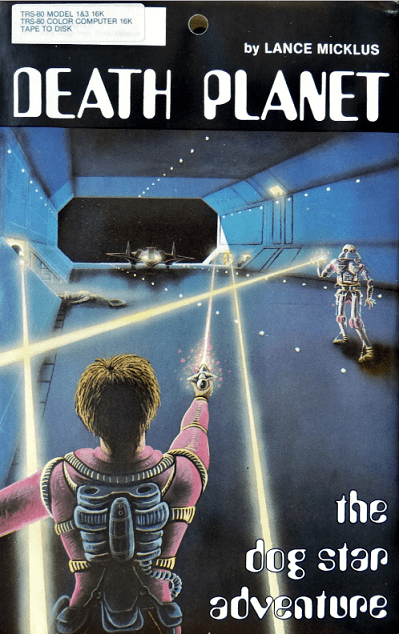
Via the Museum of Adventure Game History.
Let’s quote the plot directly from the ad copy:
The evil General Doom and his Roche Soldiers are preparing to launch an attack against the forces of freedom led by the beautiful Princess Leya. The Princess has been captured by Doom — and it’s up to you to pull of a daring rescue and save her and the royal treasury!
It’s not even trying to disguise its Star Wars origins, although science fiction adventures are still rare for this time period. Also note, even with a plot that really doesn’t demand it, there’s still a treasure hunt tossed in (at least if it’s the royal treasury you’re not trying to steal it for yourself, right?)
I ended up playing the commercial port; if you really want the classic type-in experience (complete with having to fix a typo in the source code) check out Jimmy Maher’s playthrough. Early on, there is a very significant gameplay difference:

The original supply room just states it has “all kinds of things” and you are literally supposed to just guess what the room contains, and then try to take it. I would call this “breathtakingly unfair”, even compared with games that actively strive to be unfair.
You can’t get that far without the supply room either. There’s no dark rooms, so no time limit as far as a limited light source goes; however, every once in a while a security guard will pop up (in some versions you can call them “stormtroopers”) …

… which you can take down with the blaster from the supply room. The blaster has a limited number of shots (and can only be refilled once, with the ammo that’s also in the supply room).
The game is otherwise fairly straightforward as far as puzzles go; you grab stuff mostly in the open and cart it back to the ship. At two points you need to use “key words” found elsewhere in the game (SECURITY to get into a vault and SESAME to open the space station doors). There’s also an infamous puzzle involving a hamburger:

Much to my own surprise, I figured out what to do with it. There’s an attack robot you find later, who is … hungry? Clearly instead of activating the clones in Star Wars Episode 2 to stop the droid army, the Republic needed to cook up some fast food.

Also of note: if you wait too long the hamburger will get cold, and the attack robot won’t take your offering; it’s game over. This happened to me the first time I played.
In any case, the game ends by the player collecting as many treasures as possible (including Princess Leya, who you pick up like any other item), and then launching the ship to escape. Due to the primary tasks of rescue and escape you don’t need all the treasures to get a “win”, which I found to be a nice design finesse. For games that are pure treasure hunts, this often doesn’t come across as an option.
I still can’t recommend this one for modern players. The puzzles are either too hard (hamburger, original supply room) or too easy (most everything else) and the experience of making it to the end felt more grinding than insightful. Still, it is surely important in being the first readily available source code to people who wanted to write their own adventures. I am curious: does anyone know of any works in particular that specifically mention they were based off the Dog Star source?

[Source.]
ADDENDUM:
Just for historical reference, Dog Star’s first started being sold a month earlier than the May issue mentioned above. Here is a page from the April 1979 issue of Softside:

It also is listed on page 41 as a “new arrival”.


 Renga in Blue
Pingback: Spelunker (1979) | Renga in Blue
The casual sexism in that May 1979 issue of SoftSide is really something. The editorial measures the addictiveness of games in how many hours past bed-time an adult male will stay up to play it. The introductory text of the Scott Adams(!) game Awari that follows Dog Star says “The medicine man … has even given you 3 of his daughters to keep you warm at night … they work hard to meet your needs.” And the introduction to Super Sub begins: “You saw the poster … a dashing sailor with his arm around a beautiful girl .. Join The Navy And See The World. You had no girlfriend, and so you fell for it … Still, your home port is Pearl Harbour, and they do have beaches full of gorgeous girls.”
I guess it’s good to see how we’ve moved on.
I think there’s something important lurking here.
At the time the men/women percent in computing wasn’t too bad (70/30?) but you wouldn’t know looking at hobbyist magazines. Arguably home computing taking over was the beginning of the end.
You’re saying that there was a fairish gender balance in professional programming in the late 70s/early 80s, but that home computing was very male-dominated? I didn’t know that (and to be clear, I am not disputing it). I wonder why males dominated home computing so completely for so long?
Found a chart. 70-30 was a good guess, although it wasn’t peak yet.
http://www.npr.org/sections/money/2014/10/21/357629765/when-women-stopped-coding
Pingback: Mighty Mormar (1980) | Renga in Blue
I’ve ported Dog Star Adventure to the BBC Micro. Not sure why. https://bbcmicro.co.uk/game.php?id=4504
cool! and glad to see you back!
I’ll try it out. Seems like the best way to have an online-play version. (willus.com lets you play the TRS-80 version, but the BBC Micro font works better dropped into a web browser, and it looks like you added a no-patrol cheat?)
Thanks! Yes, I added the “cheat” originally as a debug, and the only sane way to test the walkthrough. I’m not actually sure how to handle the random guards in non-cheat mode! Dorothy Millards’s walkthrough at CASA (to a similar but different version of the game) has some helpful tips, but the whole scenario still sounds like a real faff to deal with!
I don’t know if he was inspired by this game or simply the movie, but Donald Brown, the creator of Eamon, made a similar game in 1979 called Star Wars, which he shared on Apple user groups.
I think it had very few puzzles, if any, and was more focused on combat mechanics, weapon use, and followers you could give orders. Considering he shared it before Eamon, it’s quite possible that it was a preliminary work.
The scenario is the same as in Dog Star Adventure, controlled by text commands, and at the end you receive a score based on whether you rescued Leia or not, and the damage you caused to the enemy base, but I seem to recall there are no treasures.
If I’m not mistaken, it can be downloaded from the following page (the file is “STAR_WARS_ADVENTURE.do”):
https://mirrors.apple2.org.za/ftp.apple.asimov.net/images/games/rpg/misc/
huh! If it’s based on Star Wars directly it might explain the 1978/1979 date issue that Jimmy Maher ran into where John Nelson swore he saw Eamon in 1978
https://www.filfre.net/2012/04/my-eamon-problem/
Also, something I ran across purely by accident (wasn’t even looking for adventures at the time) and I’ve been hanging onto until I go back and try a few more Eamons:
https://archive.org/details/084_SMC_International_Volume_96A_Apple_Disk_1-5_SMCV96A1
This is a port of Adventure for Apple. The original is by Donald Brown and unfortunately no date for that (the link is to a PRODOS version from much later). I haven’t dug around yet to see if the original disk is around, but it seems quite likely it came before Eamon.
I found a DOS 3.3 disk with the two games:
https://archive.org/details/riag_005_Volume_100_-_Star_Wars_and_Magic_Cave_Adventure
Maybe the game disk is stored as Magic Cave…
it is indeed Magic Cave
still no date, although the fact it was packaged w Star Wars (date 1979) is suggestive
I don’t think Star Wars was based on Dog Star, the source looks very different
I had meant to mention that Adventure port a while back. It’s a port of Ben Moser’s HP3000 adaptation of Adventure from the 11/79 issue of Creative Computing. The same one that I found for the Tektronix System, if you’ll recall, that’s missing the endgame, etc.
The earliest Eamon stuff is generally dated as having been distributed locally and by a nearby Apple II users group circa late ’79 before gaining wider exposure after his 7/80 Recreational Computing article, with its conceptual roots going back to his 1978 D&D sessions. So neither of these is likely to be definitively before Eamon. It’s probably safer to say that he was experimenting with using the Crowther/Woods framework in various ways at around the same time, IMHO.
I also just went back and read that Digital Antiquarian article you linked. There are some dating errors and broard assumptions made there, so I wouldn’t take it too seriously.
Whenever I get back around to doing a couple Eamons I’ll revisit all the dates and so forth. I imagine there are sources that weren’t around 10+ years ago on top of everything else
I agree that Donald Brown could have been developing Eamon at the same time as Star Wars, but in the Washington Apple Pi newsletter, they list his Star Wars game in an earlier volume of their software library, and when they talk about Eamon, they mention that it’s from the same author known for his Star Wars game, so it seems clear that Star Wars was shared before Eamon. Considering that Star Wars has a 1979 copyright, late 1979 seems like a correct date for Eamon. If it existed before, it would still be in development, and its author wouldn’t have shared it with the groups yet because he didn’t consider it finished. I don’t know if John Nelson could have seen it then, or if his memory simply failed him.
On the other hand, although a character isn’t created, nor does he have attributes or abilities that improve, some Eamon mechanics are glimpsed in Star Wars, especially regarding the allies who, once found, follow the character and fight alongside him.
Yes, but the problem there is that Washington Apple Pi got these from Terry Taylor’s Denver-area Apple Pi library, which in turn had gotten them from somewhere else (either Brown himself or another users group), and they had already been circulating around locally the previous year in Des Moines, so the distribution chain is too muddled to really draw any firm conclusions.
Nelson himself also said that version 1.0 of the Eamon master disk was barely distributed outside of the Des Moines area, for whatever that’s worth. So it’s possible that original version predated Star Wars but never made it to the wider users group/software library circuit, thus the Washington Apple Pi dates. Who really knows, though.
You’re right. I assumed that when they built their software library in late 1979, the Washington Apple Pi would have included the entire library available for the Denver Apple Pi, but it’s possible they only included part of it and not a game like Eamon, had it been available, since its popularity hadn’t yet spread.
On the other hand, Donald Brown ported his Star Wars adventure to Eamon’s system in 1980 as the Death Star adventure, which could indicate that the system didn’t yet exist when he created Star Wars, or perhaps he would have created it directly for Eamon.
In any case, Eamon can’t be dated before the summer of 1978, which is when the first Runequest rulebook was published. However much D&D influence is attributed to it, Eamon is clearly based on the Runequest rules.