Archive for November 2015
By Naomi “Norbez”. Played to completion three times using Firefox.

In The Speaker, you are human (Riviera) helping an alien (a “Satunian” named A. A. Arthur, AA for short) write responses to questions on his blog.
This could have been sort of a riff on My Dinner With Andre with an alien concept (if you’re unfamiliar with the movie, it involves a long philosophical dinner conversation … and that’s it). There are certainly vibes the story could go that way, but it gets undermined by:
a.) Being too short. I normally don’t like leveling this criticism — I have found some one-paragraph short stories to be brilliant — but here the premise never really had a chance to pay off. There are two questions the alien answers and you can choose to type what he wants or not. There’s no chance for the relationship to develop. (There’s another relationship story including, woot, a knitted scarf, but I didn’t find it nearly as interesting as the relationship between Riviera and AA.)
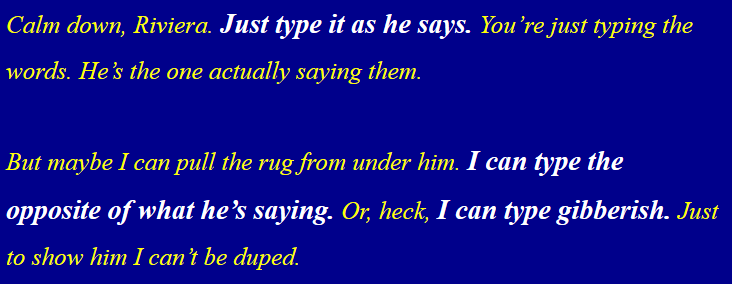
b.) Having facile philosophical content. I especially groaned at the bit where random gibberish (“erbqergfqgoinoiqrpgnqrgia”) somehow represented the profundity of infinity. Philosophical arguments can start with naive notions so I assumed the story would just develop from there, but it instead settles on “yep, that’s profound” and rests its case.
“They hate your gibberish, Riviera.” It seems the laughing will never stop. “They hate our infinity.”
I do worry I’m missing something because the file size seems rather large for the content I saw. If there’s some extensive plot branches I missed, I would appreciate a ping about it. Otherwise The Speaker needs more substance to be a satisfying game.
By Matthew Holland. Played to completion using Firefox on computer.
This bridge is much younger than the solid stone constructions of the rest of the city, and isn’t built to nearly the same standard. It crosses a deep ravine, joining the city to the north with more natural rock passages to the south.
This bridge is just about serviceable, but with the right tool you could weaken it so that heavy or careless pursuers fall into the darkness.
Pit of the Condemned has neither impressive plot nor writing nor setting nor characters. What it does have going for it is a complete variant of traditional text adventure gameplay.
The player is condemned to die and dropped into a ruined city doomed to be chased down by a ravenous beast. Fortunately, there are some supplies left over so the player can fight back.
There are specifically various points on the map that can be made into traps, if the right item can be found. All the time this is happening the player is being chased. Careful attention needs to be paid to the sound of the beast and it’s possible to be chased into a corner. The only other puzzles are locked doors which have matching keys.
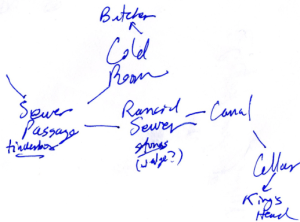
Partial map of the environs.
So far nothing of note, but:
While the locations stay the same from game to game, the location of the beast and the objects are completely randomized.
This drops Pit of the Condemned into the genre of the tiny roguelike, in the same category as works like 868-HACK and Hoplite. It doesn’t represent a fullly fledged roguelike like Kerkerkruip, but rather zooms on a particular interaction — evading a beast and setting a trap — and bases the gameplay around that idea.
Mapping what would normally be a dull layout because much more interesting when one is paranoid about being trapped in dead-ends. Also, the status of keys and locks are much different than a traditional IF game: while they’re simple enough to almost be a non-puzzle, when key locations are randomized they represent branches of game possibility. Perhaps the key to the barracks is hard to find on a particular run, but the barracks have the tripwire needed for the spike trap, so the spike trap is essentially out of service for the game.
Having said that, I don’t think the implementation was strong as it could be. On one run I found the item I needed to set a trap immediately next to the right location; this led to a trivial win. Probably it would be best if the item generation was such that the player was required to use at least one key to win; this would require enough back and forth that there would likely be several near misses with the beast on a winning run.
Also, once the game is mapped it isn’t threatening enough; it’s almost possible to just ignore the beast until ready for a win. I might also suggest something like “alarm traps” that would cause the player to generate noise that can be heard across the map, or alternate obstacles other than just the beast to worry about. As it is this is the stub of an idea for a possible new branch of interactive fiction development.
By Claudia Doppioslash. Finished using iPhone.
The Man Who Killed Time pushes the limits of minimal interactivity. Cat Scratch at least had multimedia elements, but this is almost a literal ebook written in inklewriter with no multimedia and almost no choices (two of them, both minor).
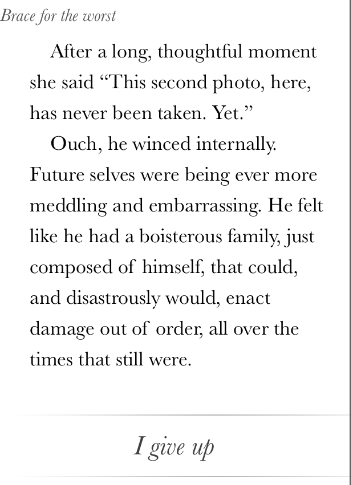
A sample: here you click on “I give up” to continue reading.
Therefore, let me switch reviewer hats and ask: does it hold up as a short story?
Before getting into the plot, I should mention — contrary to the author’s apology in the blurb — the writing is pretty good. I noticed some wonkiness in the grammar:
Outside it was a shabby, and overgrown day, in some metropolis or other, in the years when those fascinating cars, that resembled more horses drawn coaches than anything else, were in fashion.
(Way too heavy on the commas. Plus, “horses drawn coaches” likely should be “horse-drawn coaches”.)
On the other hand, there are parts that could go toe-to-toe with any author, professional or not:
It was the case that he never forgot a good building. They all resided somewhere in his memory, in their own sort of Heaven, surrounded with picturesque valleys and enchanting woods. In life they couldn’t each have their own surrounding park, but he made sure that in his mind they had a grand one.
The story has the form of a traditional detective story; an angst-ridden protagonist is visited by a stranger with a case.
Excerpt here, the angst is due to the protagonist … well, not “killing time”, exactly, but developing a form of energy which uses potential unrealized reality as power. I am unclear why this kills time or has the effect it does (which has the Detective trapped in an unfamiliar universe) but I was willing to let the mysteriousness pass with the notion it would be cleared up later. Unfortunately the clearing up never happens, and I was reminded of one of those dangling plot threads of the TV show Lost with a grand setup leading to no reward.
The mystery is similar: a visitor brings a photo (mentioned in the top excerpt above) which is of herself, in the future. She requests the Detective investigate, although I was not 100% sure what she wanted to know. Again, this might have been cleared up later, but it was not.
The ending involves the Detective departing though “time” I suppose, and has one of those dangling artistic endpoints which can occasionally mark a good short story, but doesn’t work here. In the cases I’ve seen it work, some sort of satisfying action occurred in the plot, and while there might be incidents before and after, they clearly aren’t what the author is interested in nor is it necessarily the business of the readers to know.
I was instead wanting to learn more. Having said all that, if the author plans a sequel I would very much like to read it.
By PaperBlurt. Played to completion using the Chrome browser.
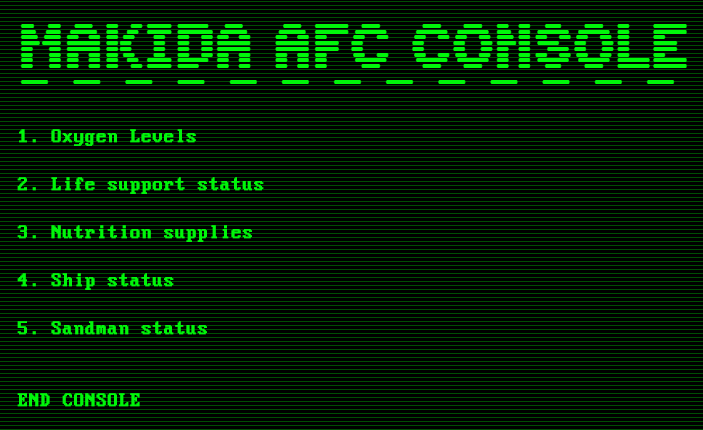
Capsule II involves a long spaceflight where hundreds of millions of people are kept asleep in cryotubes, but a series of “sandmen” are awoken throughout to take care of any problems on the way.

There’s a lot of snazzy changes in graphics and fonts, which is good, because a large chunk of the story isn’t interactive.

(Clicking all the links above simply assert that the ship is okay.)
The protagonist goes along their daily routine and fends off boredom. I oddly found this the most compelling part of the work, because when the accident happens, I started to feel uncomfortable.
.
.
.
.
.
.
.
.
.
.
.
.
S
P
O
I
L
E
R
S
.
.
.
.
.
.
.
.
.
.
.
.
.
.
.
Out of the hundreds of millions of passengers in cyrosleep, a single tube breaks. Heading to the problem, the main character discovers Todd, who awakens and is miraculously alive, but with brain damage.
The main character then treats Todd … badly. I’d rather not recount details, but note this is still in the essentially non-interactive portion of the game.
(“of course I’m not crazy!! I just wanna manipulate people a bit!! nothing wrong with taht, adn Im jstu gald tot haev a freind aigan woh I cna paly wiht adn gte to kown IST GONA BEE SOOO MUTCH FNUUUUUU!!!)
Todd eventually is rechristened is Nilo and disturbing things start to happen. Entire sectors of cyrotubes start to break down for mysterious reasons. Nilo discovers fresh meat and the Sandman cooks it.
There’s a small measure of interactivity near the end, but as far as I can tell, it is token and not where I’d want to have it. I could easily see this being a much better story if
1.) The weird abuse of the mentally damaged Todd was skipped over. He could come out apparently normal but with the same sort of actual strangeness as Nilo.
2.) The interactivity starts far before things get out of control. The player can reject the “meat”. The player can try to do things to confront Nilo early. Perhaps none of those things might work, but as things are designed, the interactivity might as well not be present at all.
On top of that, I found the entire premise far-fetched. Who would design the flight to only have one Sandman awake at a time? Barring the obvious mental problems already highlighted, what if a current Sandman has a run-of-the-mill heart attack? What if there is a problem — not implausible on a giant spaceship — that requires more than one person to fix it?
How is it the main character consumed all the books and movies on the ship so quickly? Was nothing digital? Even just a plow through Project Gutenberg’s current selection would take almost a lifetime to get through.
Would a ship sized large enough to house 500 million people be even remotely practical?
Would 500 million people agree to be watched over by only one person?
By Felicity Banks. Played on iPhone to completion.
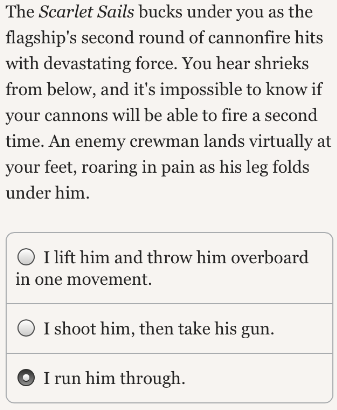
After many IFComp games which subverted their genre premise, Scarlet Sails was something of a relief. It’s a straight pirate romp in a magical universe. It’s in the ChoiceScript engine, and is the power fantasy you’d expect; it’s possible to end by being captain of the largest pirate fleet on the seas.

Scarlet Sails came at the perfect time; struggling to understand (let alone review) the crazy gimmicks I’ve seen so far came close to draining my sense of fun, but this game was a blast. I cranked my gun fu to maxmimum and sailed off to a happy ending.
The downside of being firmly enmeshed in genre is there weren’t any memorable bits of prose. I would like to spend a moment analyzing structure, though.
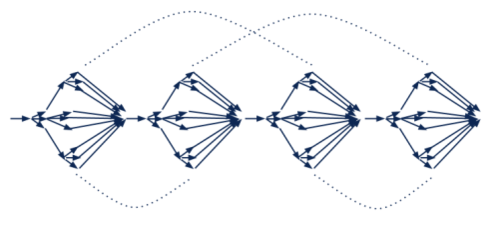
The standard ChoiceScript format is delayed branching (I’m not even extrapolating here; this is an official statement by the CEO of the company).

While the “main nodes” reach the same plot points each chapter, decisions in prior chapters can affect later ones. This is done via the use of statistics, and is subtle enough I think the typical “node chart” is underselling the gameplay short.
Here is a straightforward example: early in Scarlet Sails you have a choice between buying certain items (like fresh fruit or a new sword). This drains your selection of gold coins, meaning that if the gold coin count is reduced too much it shuts off options later (like bribery or gambling). Since the options are numerical, it isn’t easy to draw nodes in a cause-effect sense. Maybe there’s enough later to gamble and not bribe, but winning at gambling will allow bribery again.
The items you buy aren’t straight open-a-branch type purchases either; they provide enhancements to various statistics which can make it easier (but not guaranteed) to reach certain plot points.
That is, buying a new sword isn’t necessary to be good at swords, but this decision will need to be compensated for later via sword practice.
Is this sort of numerical adjustment even possible with a straight node chart? If the game was done as a stateless chooose-your-own-adventure book, it would explode into a blizzard of nodes.
Many choices were along the lines of: out of two different choices in chapter one and two different choices in chapter two, if you pick three of them then you’ll have a particular plot point available in chapter five. This sort of dynamism leads to long-term planning and the feeling that each choice has some story effect (rather than, say, the feeling of reading a footnote).
In other words, the combinatorial explosion of choices led more to the feeling of playing a game rather than just reading a story. I don’t necessarily have a problem with the latter (my favorite of the competition so far is very ungamelike), but I’d also rather not pretend two games are equivalent just based on their maps.
By furkle. Played on iPhone. Not finished.
SPY INTRIGUE is a Twine game about someone who enters a futuristic spy school and goes on missions. This is a terrible way to describe the actual feeling of playing.
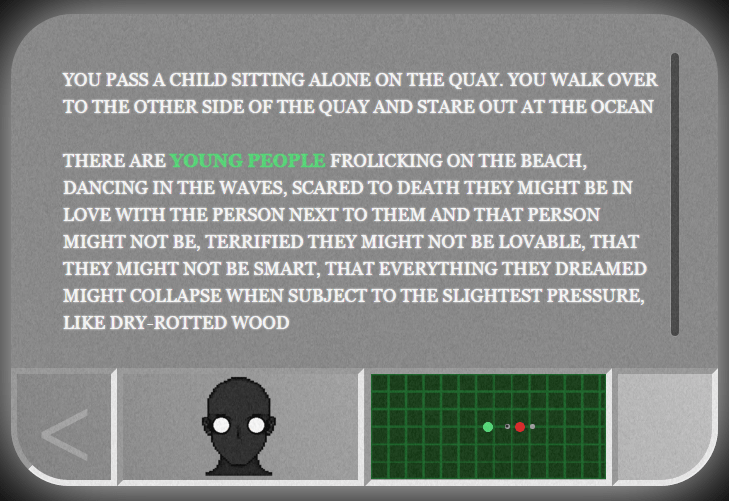
First, to clarify, “Not Finished” is not because I got frustrated or something like that: SPY INTRIGUE is a very long game. After more than two hours I was — I’m guessing a bit here — only halfway. I would have kept going, but the game crashed upon trying to pick the 3rd mission (“SyntaxError: Unexpected EOF”).
I should also get out the way that everything (with an interesting exception) is in ALL CAPS like the clip above. The general effect is not like an angry internet commenter but more like an ancient TRS-80 game or perhaps an essay by FILM CRIT HULK. I’m not sure if the net result was good or bad, but it did allow for some interesting effects where the text read more like poetry than prose.
However, the game also freely mixes high poetry with random humor. The player is the only spy at the school because all of them died of “spy mumps” causing their heads to explode. Instant oatmeal is used as a weapon (OATMEAL TIME OATMEAL TIME OATMEAL TIME OATMEAL TIME). The main character’s attitude is of a stoner out of their depth (who is it one point subjected to actual drugs).
At some points the humor and poetry happen at the same time. The protaganist flies to the second mission on a rocket, and midway thinks they are going to die and goes into a beautiful monologue about the first dog in space … whose name they don’t remember, so they call him “Skywalker”.
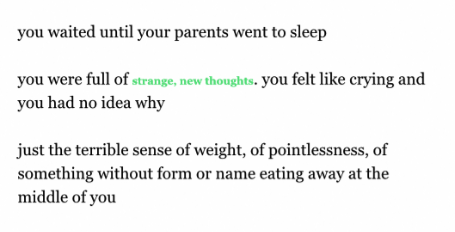
So far with all this, SPY INTRIGUE would be a fun and goofy and mostly puzzleless romp, but then the deaths elevate things to the next level. Whenever the character dies the game switches to “no caps” mode and gives a short story:

I am unclear if the stories are meant to be out of the life of a single person or multiple people. The very first one (in a ridiculous whismy part of the main portion of the game) involves a haunting suicide.
The effect was to have me actively searching for ways to die; in a weird bit of gameplay finesse I would backtrack from successfully passed obstacles in an attempt to fail them so I could read another death story.
All this means there’s a meta-level I haven’t worked out yet. I wouldn’t be surprised if it’s all a dream in the mind of an old man who only exists as part of a virtual reality simulation. Due to the length I would recommend SPY INTRIGUE for after the competition; rushing doesn’t do it justice.




 Renga in Blue